


Short Term Lets Explained: A Practical UK Guide

Updated: Sep 5
You've got a contract in Norwich, but your home is elsewhere. Or perhaps the builders are in, the removal van is booked, and you need somewhere comfortable for a few weeks without committing to a conventional tenancy. A hotel can get you through a night or two, but it quickly becomes restrictive. Short term lets fill that practical gap, giving business travellers, contractors, relocating families and university visitors a furnished base with the space to live normally.
Across the UK, this is no longer a niche part of travel. The Office for National Statistics reports 90.1 million guest nights in short-term lets between January and December 2024. England accounted for 70.3 million guest nights, or 78.0% of the UK total, placing Norwich and Norfolk within a substantial, year-round accommodation market.
Table of Contents
Short Term Lets vs Hotels and Long-Term Rentals - Choose the accommodation around the friction you need to remove
Who Benefits Most from Short Term Lets - Business travellers - Contractors and trade workers - Relocating professionals and families - Students and university visitors
What to Check Before You Book - Start with the working essentials - Read the agreement before confirming - Confirm support and arrival arrangements
UK Rules and Regulations You Should Know - Planning controls affect supply
Booking with Stay Norwich Apartments - A booking process built around real stays
Exploring Norwich and Norfolk During Your Stay - Make the most of a flexible base
Short Term Lets Explained: A Practical UK Guide: What Short Term Lets Mean
A short term let is a fully furnished, self-catering property rented for a flexible period, from a few days to several weeks or months. You book the accommodation, receive check-in details, arrive with your luggage and use the property as a temporary home. Furniture, kitchen equipment and utility accounts should already be in place, unlike with a bare rental.
For a contractor on a Norfolk project, a hotel may cover sleep and washing, but it rarely supports the rest of the working day. A furnished apartment provides space to cook, review paperwork, wash work clothes and keep equipment organised. It also avoids the commitment of a conventional tenancy when the project end date may change.
Relocating families have different pressures. A sale might complete before the next purchase, or renovation work might make the family home unsuitable. A short term let provides a shared base where the family can cook, maintain routines and wait for the longer-term arrangement to become available. The requirement is practical temporary accommodation, not a holiday stay.
The booking experience
Most bookings are completed online. Review the photographs, amenities, location, availability and rates before confirming. The operator should provide check-in instructions, rental terms and a clear contact route for problems during the stay.
Expect a furnished property rather than full hotel service. Cleaning arrangements vary. Some operators include regular cleaning, while others charge separately or schedule it for longer bookings. Ask about cleaning, laundry access, replacement bedding and maintenance support before you pay, particularly when the accommodation is for work.
Practical rule: Choose the property around your daily routine, not only its nightly rate. A usable kitchen, proper desk and reliable internet may matter more than a small price difference.
Short Term Lets Explained: A Practical UK Guide: Short term lets sit between hotels and traditional tenancies. They provide more independence than a hotel while avoiding the longer commitment and setup associated with a conventional rental. In Norwich, check what the booking includes, how support works and whether the arrangement suits your dates. This guide to short-term furnished apartment rental sets out the main points to review before confirming.
Short Term Lets vs Hotels and Long-Term Rentals
The right accommodation depends on the shape of your stay. A hotel works well when you need a convenient room for a brief stop. A long-term rental makes sense when you know where you'll be living and can manage the application, deposit, references and utility arrangements. Short term lets are strongest when the dates are temporary but your need for a functioning home is genuine.
Criteria | Short Term Lets | Hotels | Long-Term Rentals |
|---|---|---|---|
Cost per night | Often better suited to extended stays, depending on dates and property | Convenient for brief stays, but room costs can accumulate | Usually structured around longer commitments rather than nightly use |
Space | Separate living, sleeping and kitchen areas are common | Typically centred on one room and a bathroom | Varies, but properties are normally unfurnished or only partly furnished |
Kitchen access | Self-catering kitchen generally available | May be limited to a kettle, minibar or shared facility | Usually includes a kitchen, but equipment and furnishings depend on the property |
Privacy | More independent, home-like use | Staff, corridors and hotel routines create a different experience | High privacy once the tenancy is established |
Stay length | Flexible for days, weeks or months | Flexible, but less comfortable for extended living | Less suitable when dates are uncertain |
Administration | Booking and rental agreement | Simple reservation process | Application, referencing, deposit and tenancy administration |
For a three-week work assignment, the hotel's simplicity may be outweighed by repeated meals out, limited storage and the absence of a proper work area. A short term let usually gives you a better working rhythm. You can shop locally, cook when you want and leave equipment or documents organised between shifts.
A long-term tenancy creates the opposite problem for temporary housing. It may require paperwork and commitments that don't fit a short project, while an unfurnished property creates another cost and logistical burden. If you're between homes, the priority is a clean, ready-to-use base, not a tenancy that takes longer to arrange than the stay itself.
Choose the accommodation around the friction you need to remove
Hotels remove check-in friction. Long-term rentals provide continuity. Short term lets remove the practical problems of living out of a room while preserving flexibility.
Operators also need to think about the less visible details. Quality bedding, dependable cleaning and mattress protection affect the guest's experience, especially when multiple people use the property over time. Accommodation businesses researching hygiene and durability may find this guide to waterproof hotel mattress protectors helpful when assessing standards behind the room presentation.
For a closer look at the serviced-apartment model, the practical benefits of choosing a serviced apartment set out why space and self-catering facilities can matter more than traditional hotel service during a longer stay.
Who Benefits Most from Short Term Lets
Short term lets suit people whose accommodation needs are temporary but whose routines aren't. The strongest bookings aren't driven by tourism alone. They come from people who need to work, relocate, study or manage a disrupted household without giving up space and independence.
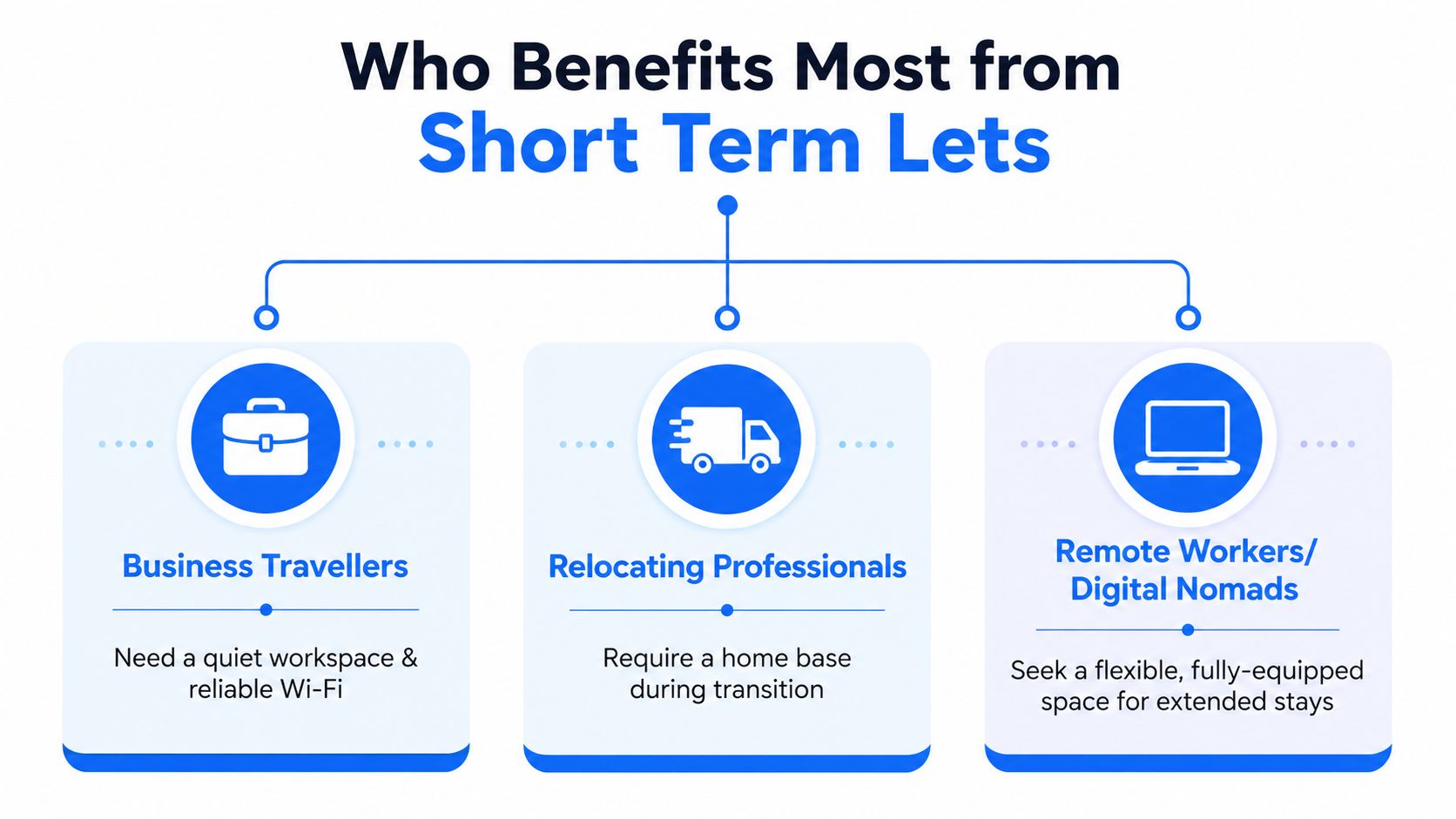
Business travellers
A business traveller needs more than a convenient bed. Check for a dedicated workspace, reliable Wi-Fi, suitable lighting and a quiet setting. If you'll be taking video calls, ask whether the desk is separate from the sleeping area and whether the internet is intended for regular professional use.
Central Norwich can work well for a traveller who needs access to offices, transport, restaurants and evening amenities without a long commute. A kitchen also gives you control over meals when meetings run late or your schedule changes.
Contractors and trade workers
Contractors often need accommodation for a project whose end date can move. A self-catering apartment is practical because it supports early starts, packed lunches, laundry and recovery after a physical working day. Look for on-site or in-unit laundry, straightforward parking information, durable furnishings and clear arrangements for extending the booking.
For tradespeople working across Norfolk, location matters differently from a leisure booking. You may value quick access to main routes and a predictable check-in more than a view or a hotel restaurant. Confirm where equipment can be stored and whether the property suits the number of workers staying.
Relocating professionals and families
A family between houses needs separate sleeping space, cooking facilities and enough room to maintain ordinary routines. A furnished apartment can also help during renovations, insurance-related displacement or a delayed completion date. Ask whether bills are included, how cleaning is handled and whether the operator can accommodate a change in dates.
Children make hotel living particularly difficult. Having a kitchen, living room and laundry access reduces the daily pressure and avoids turning every meal into an outing.
Students and university visitors
Students, visiting academics and university guests may need an all-inclusive arrangement for a defined period. Clear bills, dependable Wi-Fi and proximity to the city centre or campus can simplify the booking. Families visiting students also benefit from an apartment that gives everyone more privacy than adjoining hotel rooms.
Short term lets for professionals in Norwich and Norfolk are worth considering when the booking is tied to a work placement, relocation or temporary assignment rather than a conventional holiday.
What to Check Before You Book
A listing can look perfect and still fail your actual needs. Before paying, check the details that will affect your morning, working day and evening. Photos show presentation. They don't confirm how the property functions.
Start with the working essentials
If you're travelling for work, verify the desk rather than assuming the dining table will do. Ask about the internet connection, mobile signal and where calls can be taken. A contractor should check laundry and parking, while a family should confirm sleeping arrangements, kitchen equipment and storage.
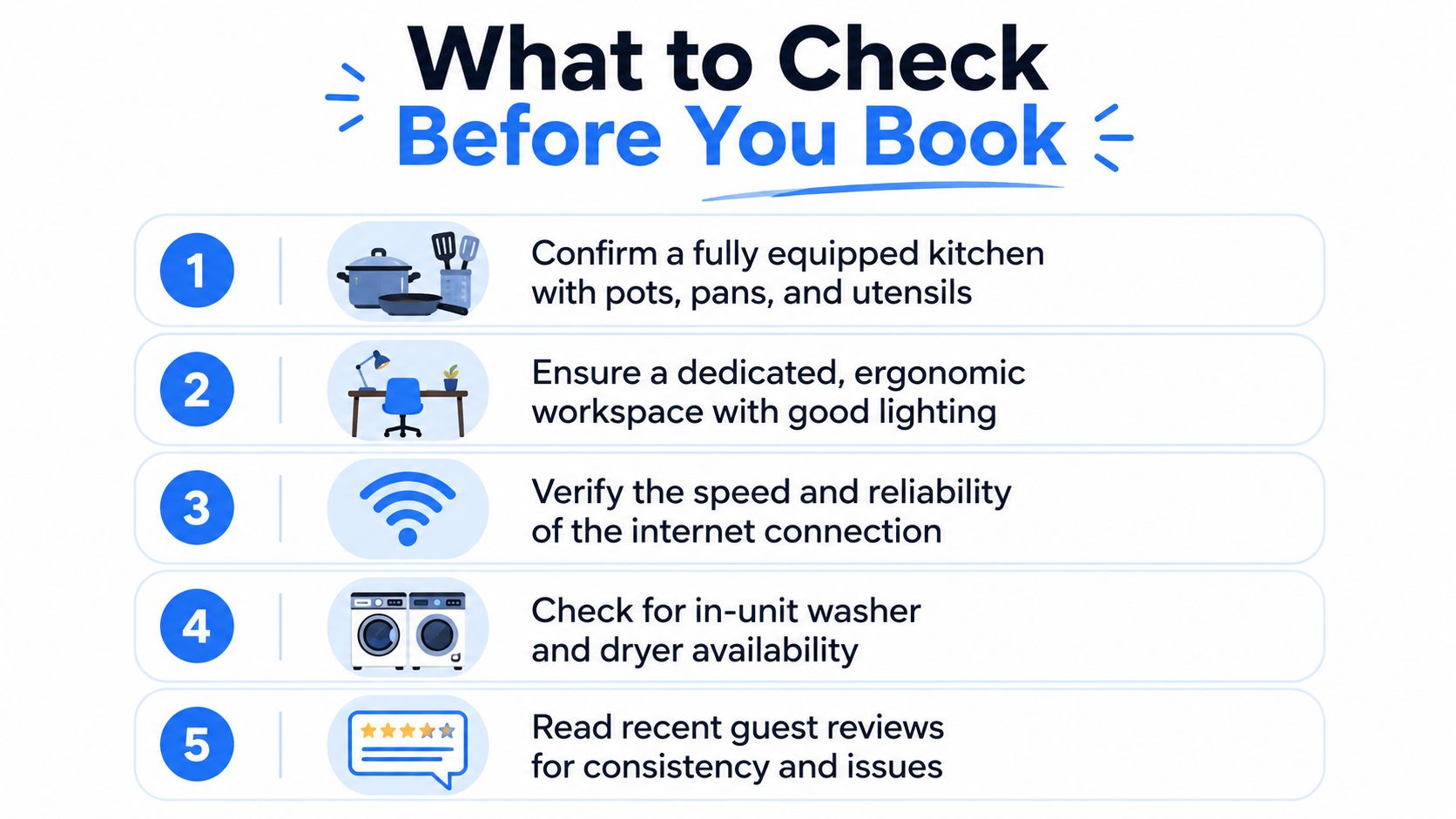
Use this pre-booking check:
Kitchen: Confirm that the property has the pots, pans, utensils and appliances you'll need for self-catering.
Workspace: Check for a dedicated desk or suitable table, a proper chair and good lighting.
Wi-Fi: Ask whether the connection is reliable enough for calls, remote access and ordinary streaming.
Laundry: Confirm whether there's an in-unit washer and dryer, and find out whether detergent is supplied.
Reviews: Read recent guest feedback for repeated comments about cleanliness, noise, heating, check-in or responsiveness.
Read the agreement before confirming
The rental agreement should identify the property, dates, charges, payment schedule, house rules and responsibilities for damage or repairs. Don't rely on a message that says “everything is included”. Confirm whether electricity, water, heating, broadband and cleaning form part of the quoted rate.
Cancellation terms deserve equal attention. A flexible work project or property move can change quickly, so check the deadline for cancelling, the treatment of date changes and what happens if you need to extend. A low headline rate isn't useful if the conditions are too rigid for your situation.
Confirm support and arrival arrangements
Ask how you'll collect keys, what happens if you arrive late and who handles urgent maintenance. Seven-day support is particularly useful when a booking starts outside ordinary office hours or your travel plans change.
Before you pay: Get the total cost, included bills, cancellation terms and check-in process in writing. Clear information now prevents arguments later.
For more practical guidance, use these accommodation tips for finding the right stay alongside your own questions. The operator's answers should be specific. If basic details remain vague, choose a better-documented property.
UK Rules and Regulations You Should Know
Regulation is changing the way short term lets operate in England. The immediate practical message for guests is simple: choose accommodation from an operator that treats registration, planning, safety and tax administration as part of the business, not as optional paperwork.
The government expects England's mandatory national registration scheme to begin in 2026, according to its guidance on letting out a self-catering holiday home in England. Operators will need to organise compliance information, including property identifiers and safety evidence, rather than relying on informal self-reporting.
Tax treatment has also changed. Government guidance says income from short-term holiday accommodation and self-catering properties is taxed under normal residential landlord rules from the 2025 to 2026 tax year onward. That affects owners and managers directly, but guests should understand the wider implication. A professionally run listing should have clearer records, terms and operating processes.
Planning controls affect supply
The government has proposed a new planning use class for properties that aren't used as a sole or main home. Its announcement on short-term-let rules states that planning permission will be required for future short term lets, with existing dedicated short-term accommodation reclassified automatically under the proposed framework.
Local planning controls may become especially important in areas using Article 4 directions. For Norwich and wider Norfolk, that means the supply of professionally managed, compliant furnished accommodation may become more valuable as new conversions face greater scrutiny.
England's policy also distinguishes between a homeowner letting their own main or sole home and a dedicated short-term accommodation business. The government guidance on delivering a registration scheme describes flexibility for homeowners to let their main home for up to 90 nights a year without the planning changes applying in the same way to hotels, hostels or B&Bs.
The clearest existing threshold applies in Greater London. The Mayor of London's guidance says temporary sleeping accommodation can be used for no more than 90 nights in a calendar year without planning permission. Norwich isn't governed by that London-specific rule, so don't assume the threshold transfers to Norfolk.
Scotland shows how detailed licensing can become. The ONS release covering January to December 2024 records 33,952 licence applications received by local authorities by 31 December 2024, with 27,406 licences or exemptions in operation. The point for Norwich operators is clear. Regulation rewards organised accommodation businesses and makes casual, poorly documented supply harder to sustain.
Booking with Stay Norwich Apartments
For a work contract, house move or temporary family arrangement, the booking should be straightforward from the first enquiry. Stay Norwich Apartments provides serviced, self-catering accommodation in central Norwich, with aparthotel-style furnished apartments intended for short stays and longer visits across Norfolk.
The practical specification matters more than polished wording. Apartments include fully equipped kitchens, dedicated workspaces, fast Wi-Fi and TVs, alongside high-quality bedding and soft towels. That setup supports a contractor who needs to prepare meals, a professional working remotely between meetings and a family that wants ordinary evenings rather than hotel routines.

A booking process built around real stays
You can use online viewings, review clear rate information and arrange a booking without the uncertainty that often surrounds temporary accommodation. The rental agreement and cancellation policy are transparent, which is important when a project, relocation or renovation schedule may change.
Customer service is available seven days a week from 9 am to 9 pm. That gives guests a defined route for questions about arrival, the apartment or local arrangements rather than leaving them to search through disconnected messages.
A complimentary guest guidebook includes a Norfolk map and local recommendations. It's a useful addition for someone arriving in the area for work and wanting practical suggestions without spending the first evening researching restaurants, shops or places to visit.
The right property still depends on your dates, number of guests and working requirements. Check the apartment details, ask direct questions about parking or laundry, and confirm what the quoted rate includes. If the fit is right, book a Norwich apartment with the information settled before you travel.
Exploring Norwich and Norfolk During Your Stay
A short term let works best when it gives you a practical base and the city remains easy to enjoy. A contractor may finish early enough to walk through Norwich's historic centre. A relocating family can use a free afternoon to visit the cathedral or explore the shops before returning to cook dinner. A university visitor can combine meetings with a quiet evening near the city's cultural landmarks.
Start in central Norwich. Norwich Cathedral offers a strong sense of the city's history, while The Forum provides a useful civic and cultural focus close to shops, cafés and public spaces. The historic centre rewards unplanned walking, particularly when you have an apartment rather than a hotel room waiting behind you and no reason to rush through every meal.
Make the most of a flexible base
Use workdays efficiently. Keep mornings for meetings or site visits, prepare food at the apartment when your schedule is tight, then reserve one evening for a proper walk or meal in the city. This rhythm suits longer bookings because you can enjoy Norwich without treating every outing as a major event.
Norfolk also gives you options beyond the city. The Norfolk Broads offer a change of pace when you have a free day, while the nearby coast provides beaches, sea air and coastal towns to explore. Check travel times before setting out, particularly if you're working around fixed shifts or returning the same evening.
The best short term let is more than a place to sleep. It gives a business traveller room to reset, a contractor a reliable base, a family somewhere stable during a move and a visitor an easy way to experience Norfolk at their own pace.
Landlords direct with Stay Norwich Apartments, Norfolk, furnished accommodation when you need it, for as long as you need it. No hassle, no drama, pay and stay. Visit Stay Norwich Apartments to check furnished apartments, review clear booking information and arrange a comfortable Norwich base for work, relocation or temporary housing.
Comments