


Accommodation for Contractors in Norwich

Accommodation for Contractors in Norwich: A van comes off the A11 on a grey Monday morning, tools rattling behind the seats and a site manager already asking about sign-in, parking permits and induction paperwork. The accommodation booking looked simple on Friday. By Monday, the wrong postcode can mean a long detour, nowhere safe for the van, poor Wi-Fi for project documents and a kitchen that's useless after a late shift.
That's accommodation for contractors in Norwich. The cheapest room rarely produces the lowest project cost. A workable stay needs reliable access to the site, somewhere to park and store equipment, proper cooking and laundry facilities, clear invoices, and an extension policy that won't create drama when the programme slips.
Norwich gives contractors plenty of choice, from city-centre flats and serviced apartments to houses and rural bases across Norfolk. The challenge is filtering those options before you waste time on unsuitable listings. This guide focuses on the decisions that keep a trade team productive from arrival through final handover, including contract length, team size, worksite geography, amenities, budgeting and booking terms. If you're balancing travel with remote paperwork, SwiftNet Wifi's practical guide on how to travel and work online is also useful preparation.
For local transport planning, keep a Norwich taxi option saved before the first shift, especially if a van is off the road or a late finish makes driving impractical. You can find the relevant local information in this Norwich taxi guide. Start with a clear needs list, not a scrolling session through booking platforms.
Accommodation for Contractors in Norwich: Table of Contents
Landing in Norwich for Your Next Contract - The first week reveals the bad booking
What You Need From Your Stay - Start with the contract length - Match the property to the team - Map the actual worksite - Confirm the working pattern
Essential Amenities That Actually Matter - Must-haves for a working week - Nice features come after the basics
Budgeting Beyond the Headline Price - Three pricing models to compare
Booking and Contract Essentials - Follow the booking sequence - Ask these questions before paying - Get company paperwork right
Logistics on the Ground in Norwich - Four checks prevent most problems
Why Norwich and Norfolk Work So Well - A useful balance for working teams - The regional choice is about resilience
Choosing Stay Norwich Apartments for Your Stay - Check the commercial details early - Use a simple decision path
Landing in Norwich for Your Next Contract
The first booking decision is rarely about décor. It's about whether the accommodation will still work when the project enters its awkward middle stretch.
A four-person team arriving for a city-centre refurbishment needs different support from a solo electrician attending a short snagging job. The first group may need separate beds, van parking, laundry capacity and a kitchen large enough to handle shared meals. The second may prioritise a quiet desk, fast internet, easy check-in and a simple monthly invoice.
Norwich can make both arrangements possible, but only if you match the property to the job. A flat near the city centre may cut the walk to a Lanes refurbishment, while a property near the ring road can make access to Rackheath or the Northern Distributor Road easier. A rural Norfolk base may suit a project outside the city, but a picturesque lane becomes a liability if the van is carrying materials and the team needs to leave before dawn.
The first week reveals the bad booking
A poor stay usually doesn't fail on the first night. The keys work, the bed is made and the listing photographs look acceptable. Problems appear when the team needs to wash workwear, upload documents, park a Transit after dark, or extend the booking because another trade has pushed the schedule back.
That's why the right question isn't “What's the nightly rate?” Ask instead:
Can the team reach the site consistently?
Can the property handle tools, workwear and longer occupancy?
Can the person paying receive an invoice that accounts will accept?
Can the booking extend without forcing a full rebooking?
Practical rule: Treat accommodation as part of the site logistics plan, not as an after-hours purchase.
The rest of the decision follows from those answers. You'll need to pin down the length of the contract, the number of people staying, the exact worksite and the days when the team must be present. Once those basics are written down, amenities and price become much easier to judge.
What You Need From Your Stay
Write the requirements down before opening Rightmove, Airbnb or a serviced-apartment platform. If you start with listings, attractive photographs will pull you towards properties that don't fit the work.
Start with the contract length
A short snagging job may suit a nightly or weekly arrangement, provided the accommodation accepts late arrival and offers straightforward invoicing. A six-month fit-out needs stability, regular cleaning or linen arrangements, and a written extension process. A longer infrastructure project calls for a dependable base where the operator understands changing schedules and can keep the same team housed when the programme moves.
Ask how the rate changes if the project finishes early. Ask what happens if it runs longer. An accommodation provider who answers those questions clearly is safer than one who only talks about the first available night.
Match the property to the team
A solo contractor may need a studio or one-bedroom apartment with a desk and kitchen. Two people can work well in a two-bedroom apartment, particularly when they keep different shifts. A full crew may need a house or several units booked together, rather than forcing everyone into shared sleeping arrangements that create fatigue and arguments.
Count beds, not just bedrooms. Confirm whether the living room sofa is intended for sleeping, whether there's enough fridge space for the team, and whether everyone can park without blocking neighbours or access routes.
Map the actual worksite
Norwich isn't one commute. A job near the castle, market or Lanes has different parking and traffic pressures from work at Norwich Research Park, Rackheath industrial estate or the Norfolk and Norwich University Hospital. A contract outside the city, towards King's Lynn or Great Yarmouth, may justify a different base altogether.
Use the site entrance postcode, not just the town name. Check the morning route at the time the team will travel, then consider whether the journey still works when a shift finishes late.
Confirm the working pattern
Record the arrival day, departure day, weekend movements and any Monday-morning sign-in requirement. A Friday check-in may be convenient for a weekend start, but a property with restricted access can create a problem if the crew arrives after a long drive. A booking that looks available for the calendar dates may not work with the actual shift pattern.
For a more detailed view of the accommodation choices available to professionals, compare these requirements with guidance on short-term lets for professionals in Norwich and Norfolk. Then shortlist only properties that answer the practical questions.
Essential Amenities That Actually Matter
A contractor-ready property is more than a furnished room. It needs infrastructure that supports work, recovery and repeat use.
The first priority is fast, unlimited fibre broadband. UK contractor accommodation guidance identifies a minimum speed of 100Mbps, with no data caps and no per-device throttling, as a core benchmark for stays involving simultaneous video calls, project portals and digital safety briefings (Houst's UK contractor accommodation guidance). That matters when one person is sending drawings, another is completing timesheets and a third is on a video call with the site office.
Parking comes next. Norwich's terraced streets, permit zones and narrow approaches can turn a ten-minute arrival into an evening hunt. Confirm whether the space is off-road, whether it fits a Transit rather than only a hatchback, and whether a second van can be accommodated. Don't accept “street parking available” as a substitute for a named space.
Must-haves for a working week
A full kitchen, proper laundry facilities, a usable workstation and flexible check-in all earn their place on the essential list. Contractors need an oven and hob for batch cooking, a full-sized fridge-freezer for food and drinks, durable furnishings that can handle longer occupancy, and enough sockets for phones, laptops and chargers.
A desk doesn't need to look like a corporate office. It does need a proper chair, decent lighting and enough surface area for paperwork. Laundry facilities are equally practical after a wet week in hi-vis and boots.
Amenity | Must-Have | Nice-to-Have |
|---|---|---|
Fibre broadband | Fast, unlimited service suitable for work calls and portals | Backup connection or especially strong coverage |
Parking | Allocated off-road space suitable for the team's vans | Covered parking or secure gated access |
Kitchen | Oven, hob, full-sized fridge-freezer and usable preparation space | Dishwasher, breakfast bar or larger dining area |
Work area | Desk or table, proper chair, lighting and sockets | Separate office or second workstation |
Laundry | Washing machine and drying provision | Tumble dryer or dedicated laundry room |
Security | Reliable locks and clear access arrangements | Gated compound or monitored parking |
Arrival | Flexible check-in for late site finishes | Keyless entry and fully remote arrival |
Leisure | Comfortable seating and television | Gym access, courtyard or premium entertainment |
Nice features come after the basics
A smart TV, gym access and a courtyard can improve downtime, but they won't rescue a booking with poor parking or unreliable internet. Local convenience matters too. A nearby supermarket, takeaway options and laundry access can reduce the daily friction that pushes crews towards expensive last-minute purchases.
A postcode that keeps the morning run manageable is more valuable than a decorative feature wall. Compare the property against the worksite, the vehicle and the working day, then review what the provider means by “fully serviced” in this guide to fully serviced apartments.
Budgeting Beyond the Headline Price
The lowest nightly rate can be the most expensive choice once the project starts.
A basic Norwich let advertised at £55 per night may look attractive beside an all-inclusive serviced apartment at £95 per night. The supplied comparison, however, assumes the cheaper option accumulates £20 to £40 per day in extras such as utility top-ups, parking, Wi-Fi upgrades, laundry trips, end-of-stay cleaning and additional travel. Those figures come from the commercial pricing scenario in the accommodation brief, so use them as a budgeting illustration rather than a universal market rule.
A contractor should calculate the full daily cost before choosing. Add the accommodation, mileage, parking, subsistence, laundry, tool insurance implications and any likely extension charge. Then compare the total for the entire expected project window, not just the first few nights.
Cost Line | Budget Let (£) | Serviced Apartment (£) |
|---|---|---|
Advertised nightly accommodation | 55 | 95 |
Possible daily extras | 20 to 40 | Included where stated |
Parking and travel friction | Check separately | Check the quoted package |
Wi-Fi and utilities | Check separately | Confirm inclusion |
Cleaning and linen | Check separately | Confirm schedule |
True project comparison | Add every cost | Use the written quote |
Three pricing models to compare
Norfolk contractor stays commonly appear in three formats:
Nightly bookings: Often subject to minimum stays of 3 to 5 nights. This suits uncertain start dates but can become costly when the project is clearly longer.
Weekly rates: Some providers offer a 10 to 15 percent discount against the nightly price. Check whether the discount applies to extensions and whether cleaning or linen remains included.
Monthly corporate arrangements: Indicative one-bedroom rates may sit between £1,800 and £2,400, with utilities, linen changes and VAT included where the quote says so. These figures are market framing from a commercial source and should be verified directly before booking. See the Norfolk contractor accommodation pricing reference.
Use the same assumptions for every property. A clear construction cost management guide can help teams build a disciplined project-cost approach rather than treating accommodation as an isolated expense.
A £10 difference in the nightly rate means very little if the cheaper option causes one extra late-night taxi, repeated laundry trips or a costly rebooking. Ask for the total quote, the inclusions and the extension terms in writing. For further local pricing context, review this guide to the cost of short-term housing in Norfolk.
Booking and Contract Essentials
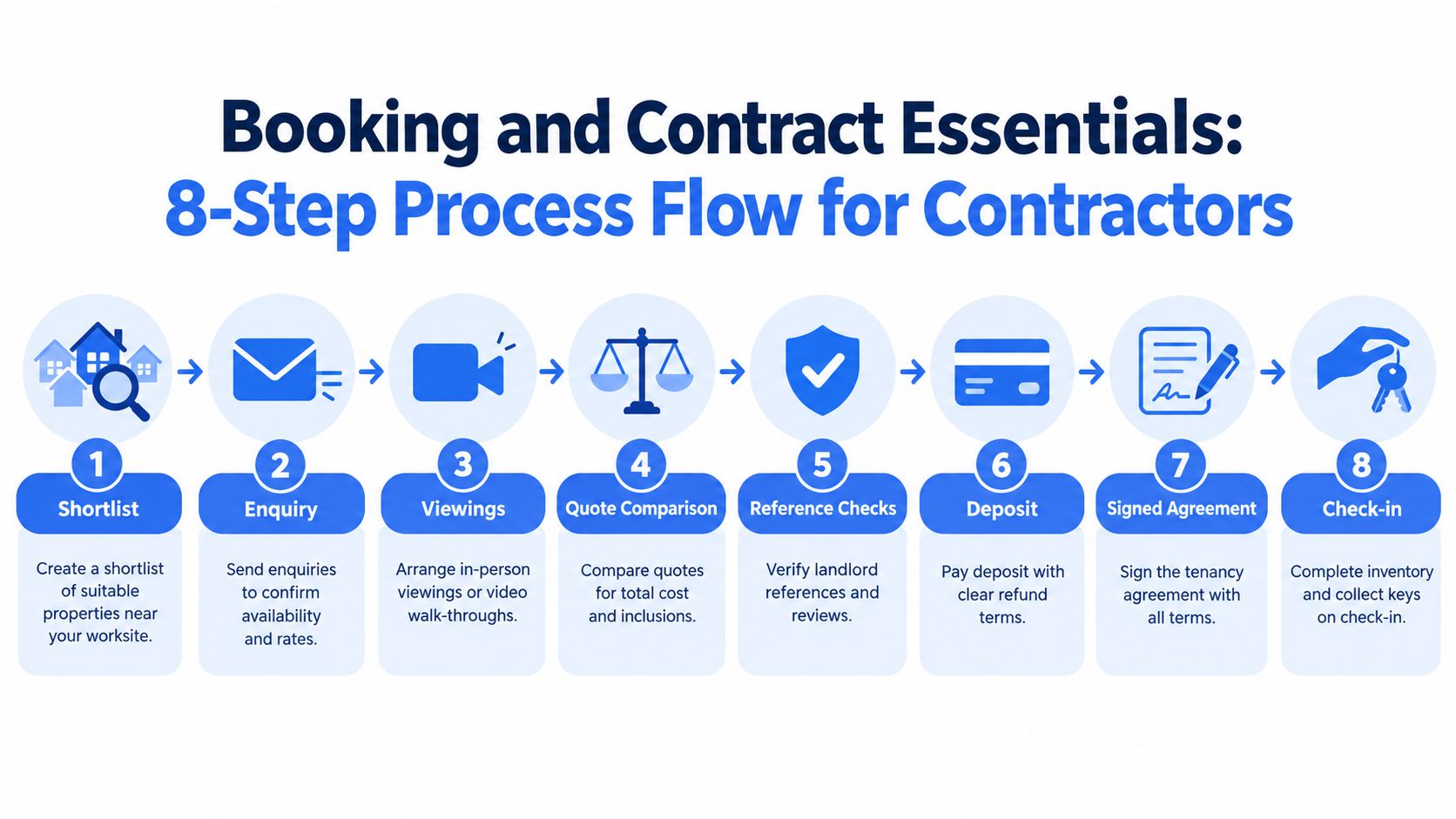
A smooth booking follows an order. Rushing straight from a search result to a deposit is how contractors end up arguing about parking, damaged furniture or unpaid invoices.
Follow the booking sequence
Shortlist suitable properties. Filter by worksite, dates, team size, parking and kitchen facilities.
Send a detailed enquiry. Include the project address, crew numbers, shift pattern, vehicles and likely extension needs.
Arrange a viewing. Use an in-person viewing or video walk-through to inspect access, storage, desks and sleeping arrangements.
Compare written quotes. Look at the total cost and inclusions, not just the first rate shown online.
Check references and reviews. Confirm that previous business stays were handled professionally.
Agree the deposit terms. Get refund conditions, deductions and timescales in writing.
Sign the agreement. Make sure the named occupiers, dates, rate, services and extension process appear in the document.
Complete check-in. Record the inventory, photograph existing damage and collect keys or access instructions.
Ask these questions before paying
Ask whether the landlord is VAT-registered and can issue an invoice addressed to the company. Confirm whether utilities, council tax and TV licensing are included for the complete contract period, not only the first booking block. Check the cancellation policy, the extension policy, the damage deposit ceiling, the inventory process and whether subcontractors or crew replacements can join the stay.
Weekly serviced apartments in Norwich may require a 25 to 30 percent booking deposit, plus a £150 to £250 security deposit, refundable within 10 working days of check-out when the inventory is satisfactory. These figures are indicative terms specified in the supplied contractor-stay guidance, so ask the provider to confirm its own policy before transferring funds.
For ordinary residential arrangements, the permitted tenancy deposit is up to five weeks' rent where annual rent is below £50,000, or up to six weeks' rent where annual rent is £50,000 or more. The deposit must be protected in a government-approved scheme within 30 days, as summarised by Simply Business landlord regulation guidance. The correct arrangement depends on the contract structure, so don't assume a short stay follows the same terms as a standard tenancy.
Get company paperwork right
CIS and limited-company contractors should agree whether invoices are issued monthly in arrears and whether payment terms are net 7 or net 30. Ask whether the operator provides receipts suitable for company records and whether a purchase order can be included on each invoice.
Have these documents ready:
Trade identification: CSCS card or relevant trade card.
Business protection: Company insurance details.
Project evidence: Schedule, site address and expected dates.
Authority to book: A letter of intent from the principal contractor or client.
Read the agreement before check-in, then use the provider's rental agreement information to clarify any terms that affect payment, occupancy or cancellation.
Logistics on the Ground in Norwich
Accommodation is a project risk when it creates daily delays. Norwich's compact centre can be convenient for a city refurbishment, but medieval streets, restricted parking and tight turning points punish vans that need predictable access.
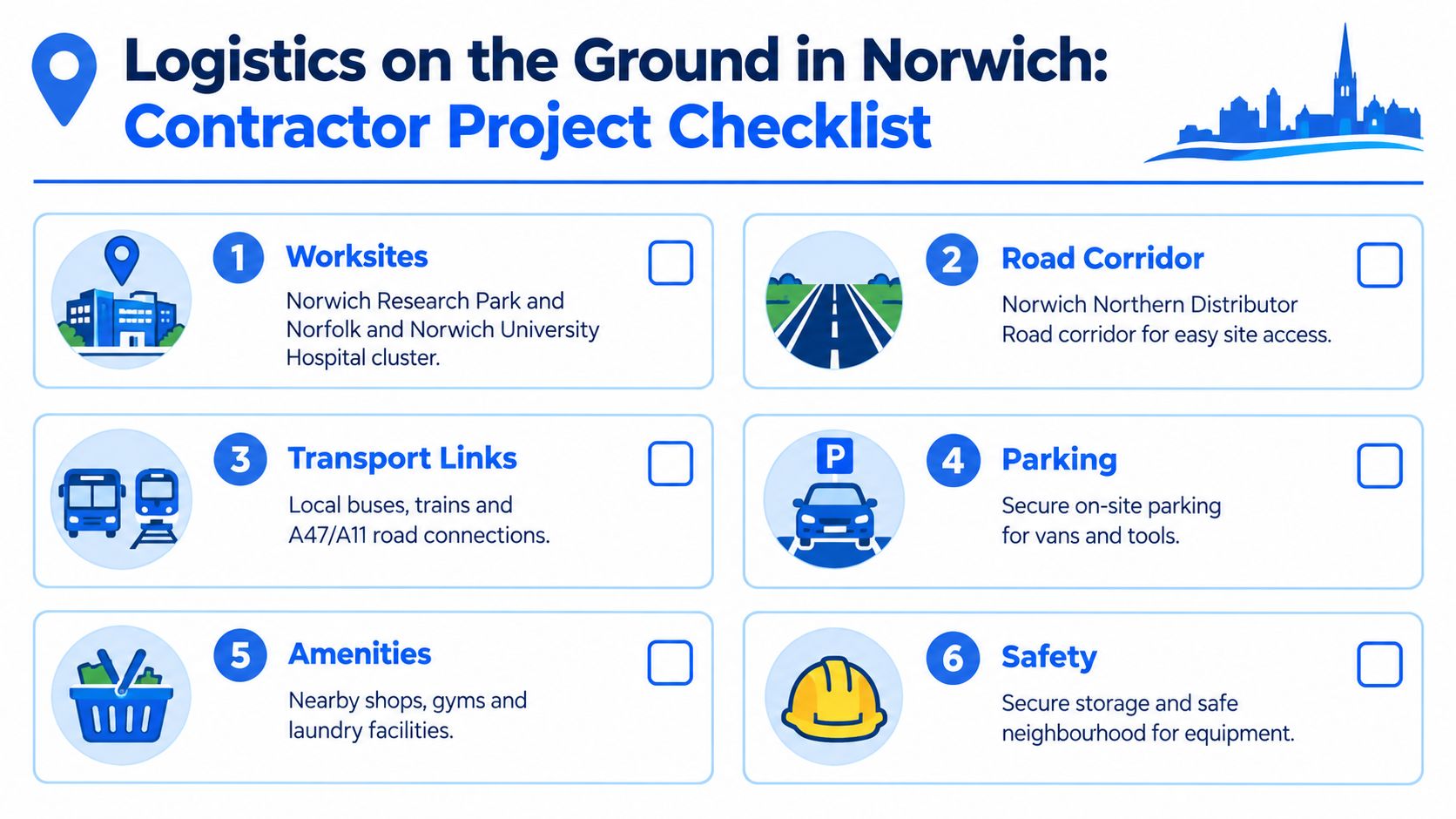
For Norwich Research Park and the Norfolk and Norwich University Hospital, look for a catchment with a simple route and dependable parking. The Norwich Northern Distributor Road corridor suits teams accessing northern and eastern sites, including Rackheath industrial estate. City-centre work around the Lanes, Riverside, Chapelfield and Castle Meadow needs a different plan, usually with secure parking outside the tightest streets and a confirmed final-mile arrangement.
Four checks prevent most problems
Parking: Confirm a dedicated space and its dimensions. A listing that says “parking nearby” may leave a crew carrying tools across several streets.
Transport: Norwich doesn't have a ULEZ, but narrow historic roads still make large vehicles awkward. Check the approach route, loading arrangements and site access.
Storage: Ask for a locked compound, secure outbuilding or ground-floor space for tools and materials between shifts. Don't leave valuable kit in an exposed vehicle because the listing has no storage answer.
Utilities: Check socket locations, desk space and mobile signal. If the team uses different networks, test coverage across providers before relying on the property for calls.
Seasonal conditions need a place in the plan. July and August can make routes around the Norfolk Broads busier, while country lanes may flood overnight from November to February. Roadworks around Chapelfield and Castle Meadow can add 15 minutes to runs in December, according to the supplied local planning brief. Verify current conditions rather than treating any route estimate as fixed.
Before arrival, spend 60 seconds checking the parking instructions, copying the exact worksite address and screenshotting the route. That small routine prevents the familiar first-week problems, including arriving at the wrong entrance, finding no space for the van or discovering that the shortest route is unsuitable for a crew vehicle.
Why Norwich and Norfolk Work So Well
Norwich works as a contractor base because it links different types of work without forcing every team into the same accommodation model. City-centre sites, the airport at Horsham St Faith, the A47 and A11 corridors, and the wider Norfolk road network all sit within a practical regional pattern.
A team working near the hospital or Research Park may value a short city commute and evening access to shops. Another crew travelling towards Great Yarmouth may prioritise fast access east, while a rural project may call for easier parking and a quieter property outside the centre. The right base reduces the amount of time spent crossing the city before and after a shift.
A useful balance for working teams
Norfolk also gives contractors a better recovery option than a standard hotel room. After a long day, a full kitchen lets the team cook rather than rely on takeaway food. A separate workspace gives a supervisor somewhere to finish paperwork, upload records or prepare for the next morning without working from the bed.
At weekends, the Broads, North Norfolk coast and surrounding market towns provide straightforward downtime. That matters because an accommodation decision affects fatigue as well as travel. A base that keeps weekday journeys controlled and gives the crew somewhere comfortable to switch off can support the project without turning every non-working hour into another drive.
The region also offers access to trade suppliers and a broad labour pool across Norfolk and Suffolk, which helps teams respond when a project needs additional skills or materials. Keep those advantages practical. Choose accommodation close to the working route, with vehicle access and enough internal space for the way the crew operates.
The regional choice is about resilience
Demand for flexible furnished housing can compete with other temporary accommodation needs. Households in temporary accommodation in England reached 94,870 at the end of June 2022, according to the House of Commons Library briefing on temporary accommodation. Councils also continue to procure nightly let and temporary accommodation through formal frameworks and preferred-supplier arrangements, which can affect local availability.
That makes supply certainty more important than a polished listing. A well-placed apartment with clear dates, a written extension policy and practical facilities can protect the project from the cost of moving the team halfway through the job.
Choosing Stay Norwich Apartments for Your Stay
Treat the booking as a short procurement exercise. Start by sending the project dates, worksite postcode, team size, vehicle details and likely shift pattern. Ask for live availability rather than relying on an old listing, then check the apartment size against the number of people who'll stay.
The property must fit the team, not merely look presentable online. Confirm the number of proper beds, the kitchen setup, workspace, Wi-Fi, laundry access and parking. If the crew has vans or valuable tools, ask directly about dedicated vehicle space and secure storage rather than assuming those facilities come with a city-centre address.
Check the commercial details early
Company bookings often fail at the payment stage because the accommodation works for the crew but not for accounts. Before approving the quote, confirm the invoice format, VAT treatment where relevant, deposit amount, payment schedule and purchase-order process. Agree whether the operator can invoice monthly in arrears and whether receipts will show the dates and property clearly.
Extensions should be discussed before the original end date approaches. Send the expected programme, explain the likelihood of a longer stay and ask how the rate applies if the project runs over. A clear arrangement is better than waiting until the last available night and trying to find replacement accommodation while the team is still on site.
Stay Norwich Apartments provides furnished, self-catering apartments in Norwich with fully equipped kitchens, dedicated workspaces, fast Wi-Fi and TVs, alongside online viewings and clear rental information. Those features address the basic working requirements identified earlier, while the central location gives teams a practical base for city work and access to wider Norfolk routes.
Use a simple decision path
Before booking, confirm:
Dates: The apartment is available for the full project window, including the arrival and departure days.
Occupancy: The sleeping arrangements suit the actual team, with no assumptions about sofa beds or overcrowding.
Vehicles: Parking is allocated and suitable for the vans being used.
Work: The internet, desk space and sockets support evening administration.
Living: The kitchen, fridge-freezer and laundry arrangements suit a working crew.
Billing: The quote, deposit and invoices fit the company's approval process.
Flexibility: Extensions, weekend changes and crew substitutions have a written answer.
Arrival: Late check-in, keys and inventory procedures are clear before the van sets off.
For teams comparing hotel rooms, B&Bs, basic holiday lets and serviced apartments, this process keeps the decision tied to project delivery. It also leaves fewer loose ends for the site manager, office administrator or contractor who is responsible for the booking.
Landlords direct with Stay Norwich Apartments, Norfolk, furnished accommodation when you need it, for as long as you need it. No hassle, no drama, pay and stay.
Stay Norwich Apartments offers furnished, self-catering accommodation in Norwich for short contractor stays and longer project bookings, with practical kitchens, workspaces and fast Wi-Fi. Share your dates, team size, worksite and parking needs, then visit Stay Norwich Apartments to request a quote and secure a dependable Norfolk base before availability tightens.
Comments