


Norfolk Churches: A Visitor's Guide to Medieval Churches

Norfolk churches are scattered across cities, market towns and small villages, so a visit takes more planning than a route between a few major attractions. Many remain working buildings, not staffed sites with guaranteed opening hours. Choose a small number of churches, study their exteriors first, and check whether each is open before setting out. Like any working building, access can vary from day to day.
Norfolk Churches: A Visitor's Guide to Medieval Churches Table of Contents
Reading Norfolk's Medieval Churches from the Outside - A Five Step Look from the Churchyard
Churches Under Repair and Why Your Visit Matters - How Damage Spreads - Three Rules for Fragile Buildings
Opening, Access and Etiquette Before You Go - Photography, Donations and Services
Sample Day Routes from Norwich - Route One Norwich on Foot - Route Two North Norfolk and Swafield - Route Three a Village Church and the Broads - A Simple Timetable
Broads and Coast Add-Ons - Pairing a Broads Village Church with the Water - Using Cromer as the Coast Alternative - Planning Method
Choose a Norwich Base for Your Church Trip - Why the Base Helps
Norfolk Churches at a Glance
Church | Location | Key feature | Visit note |
|---|---|---|---|
St Giles, Swafield | North Norfolk, near North Walsham | Grade II* parish church, with a fourteenth-century nave and late-fifteenth-century four-stage west tower | Confirm opening and parking before travel |
St Mary, North Tuddenham | Mid Norfolk village | Fourteenth-century west tower, Victorian wall tiling and medieval stained glass | Listed on Heritage at Risk since 2017; check access first |
St Peter, Forncett | South Norfolk village | 10th-century church with a Saxon round tower | Closed in 2022; check whether it has reopened before travelling |
St Andrew and St Peter, Longham | Near Dereham | Flint, ashlar and brick, with a probably fifteenth-century truncated west tower | Confirm opening days and any keyholder arrangement |
Norwich Cathedral | Norwich city centre | A major city-centre church and a natural starting point | Check service and visiting times on the day |
What You'll Actually See
At St Giles, Swafield, compare the nave with the taller, later tower. The contrast shows how a church can take shape over several building phases. Part of the church was rebuilt in the eighteenth century.
St Mary, North Tuddenham combines medieval and Victorian details. If the church is open, look for the stained glass and wall tiling; access may be affected by its Heritage at Risk status.
At St Peter, Forncett, the Saxon round tower is the main feature to examine from the churchyard. The church was closed in 2022, so check its current status before making it a planned indoor visit.
Longham offers a useful lesson in materials. Flint, ashlar and brick are easy to distinguish, while the truncated tower gives the outline a different shape from a complete west tower.
Norwich Cathedral needs a different sort of planning from a village church. Check visiting arrangements and services on the day, rather than assuming the building will be open for sightseeing.
Practical rule: Choose a church for the feature you want to see, then confirm access before setting out. A nearby church may still be closed or accessible only by arrangement.
For a day trip, pair the Cathedral with one rural church whose opening you have confirmed. Add another only if it fits the same route. Swafield suits a North Norfolk loop; Longham is a focused stop near Dereham. If you cannot confirm access at a rural church, treat the exterior and churchyard as the visit and keep an alternative nearby.
Reading Norfolk's Medieval Churches from the Outside
Norfolk County Council's Historic Environment Service recorded approximately 659 medieval churches, including about 120 characteristic round-towered examples. The Diocese of Norwich describes over 650 church buildings across Norfolk and Waveney, with more than 90% listed. These counts use different categories, so treat them as broad measures of the county's historic church stock rather than competing totals.
From a Norwich base, this density gives you plenty of choice. A simple method for reading a church exterior is often more useful than chasing famous names.
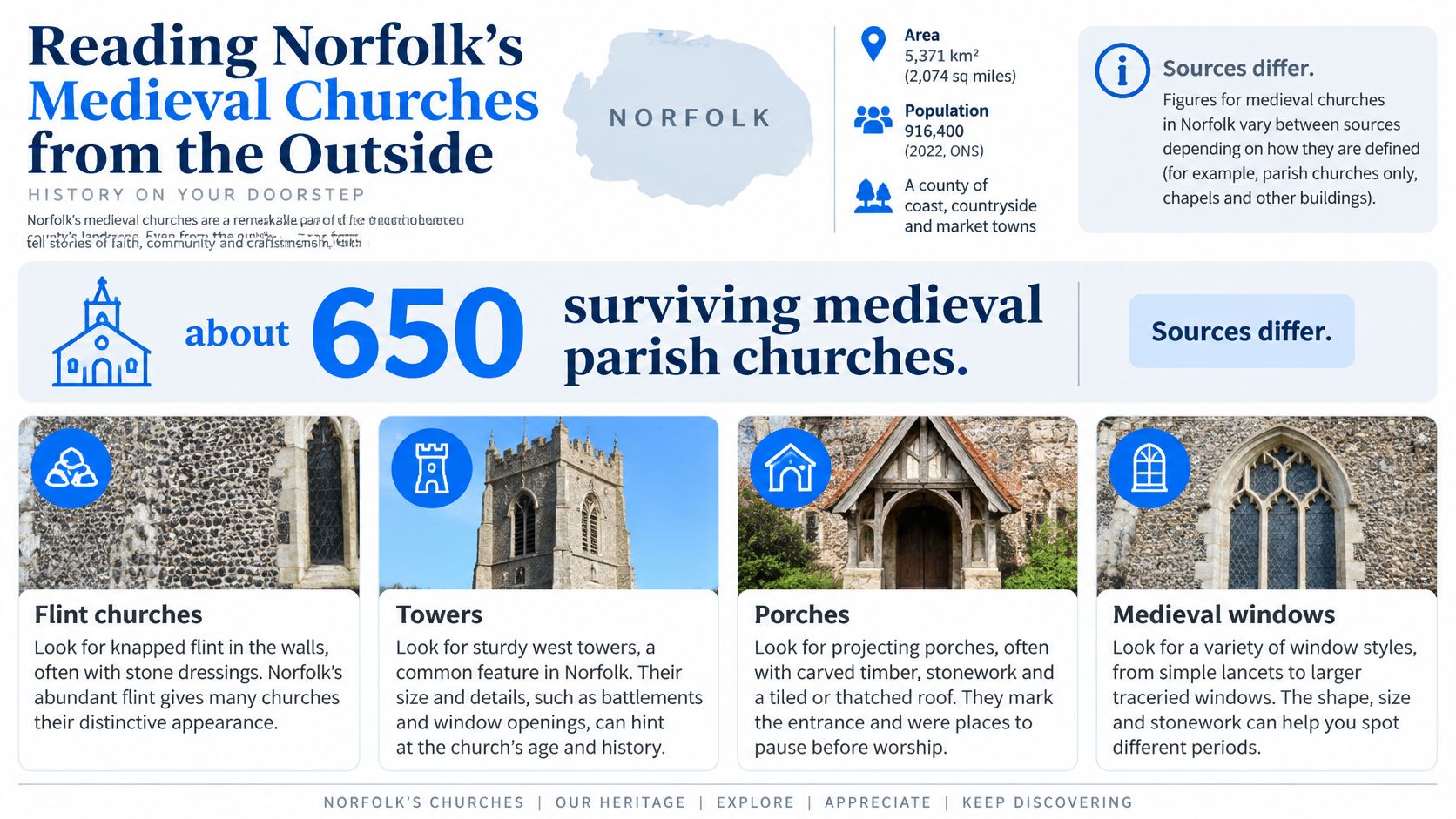
A Five Step Look from the Churchyard
Stand back and judge the tower shape. Is it round, square or truncated? Its form offers an initial clue to local building practice and the church's history.
Read the stone mix. Flint, conglomerate, reused Roman tile, quartzite and millstone grit were used where high-quality limestone was less accessible. Varied materials can point to different building phases.
Compare tower and nave. Look for a change in masonry, roof line or window style. A visible break can indicate rebuilding rather than one continuous campaign.
Count the stages. String courses and window openings divide many towers into levels. At Swafield, four stages help distinguish the late-fifteenth-century tower from the fourteenth-century nave.
Check wall and dressing contrasts. Flint walls with stone or brick dressings, as at Longham, show how builders used different materials for corners, arches and windows.
A round tower is more than a distinctive outline. Its circular form avoids corners, while its masonry shows how builders worked with local materials. Even from the churchyard, these details can help you identify early work and later rebuilding.
For a wider architectural context, read this visitor's guide to Norwich architecture before setting out to the villages. Check each church's current visiting arrangements separately: an informative exterior does not mean the building is open.
Churches Under Repair and Why Your Visit Matters
A locked or closed church can look neglected. Often it's the opposite. At Forncett, closure followed serious problems with roof and masonry, and the building needed urgent work before regular access could be safe or sensible.
The National Churches Trust's analysis of Historic England's Heritage at Risk data identifies Norfolk among the English areas containing the greatest number of at-risk places of worship. St Peter's, Forncett, entered the Heritage at Risk Register in 2019 and urgent works followed its closure in 2022. That sequence is worth understanding because it explains many disappointing arrivals.
How Damage Spreads
Most historic value sits in vulnerable fabric: roofs, masonry, timber, monuments, stained glass and painted or carved interiors. Water is usually the accelerant. A defective roof or blocked drainage lets rain into wall tops, then timber and internal finishes begin to decay.
Masonry failure adds a second problem. Cracks and loose stone create safety risks, so barriers or closure may follow even when the church still looks sound from the road. Listed status recognises importance, but it doesn't guarantee public access.
North Tuddenham shows the scale of response a small church can need. Historic England placed St Mary's tower on the Heritage at Risk Register in 2017 because major structural cracks raised the possibility of at least partial collapse, then awarded £280,000 for urgent conservation work. The planned repairs included underpinning, extensive buttress work, tower wall and parapet repairs, and a new drainage system.
That's not routine maintenance. It's structural engineering alongside specialist care for interiors such as medieval stained glass and Victorian tiling. When you see scaffolding or restricted areas, you're usually seeing that balance between keeping people safe and keeping fragile fabric intact.
Three Rules for Fragile Buildings
Stay behind barriers: They mark falling masonry, weak floors or active work, not just display boundaries.
Don't touch fragile surfaces: Paint, stone carving, tiling and old timber can be damaged by repeated contact.
Support repair funds where you can: Small donations help local volunteers meet costs that listed status alone doesn't cover.
A closed door is often a sign of care rather than neglect.
Check before you go, and don't press for access during repairs. You can still learn from the churchyard, noticeboard and exterior, then return when the building is ready for visitors again.
Opening, Access and Etiquette Before You Go
Norfolk's parish churches do not follow one county-wide opening schedule. Some welcome visitors on set days, others open for services or by arrangement, and some may be locked even when the building looks inviting from the lane. Check the church's noticeboard or contact the parish or keyholder before setting out. A quick message can save a wasted journey.
Access varies too. Heritage status does not guarantee step-free entry, and a route into the church may differ from the route through it. Ask about the entrance, internal ramps, seating, lighting, heating and toilets if those details affect your visit.
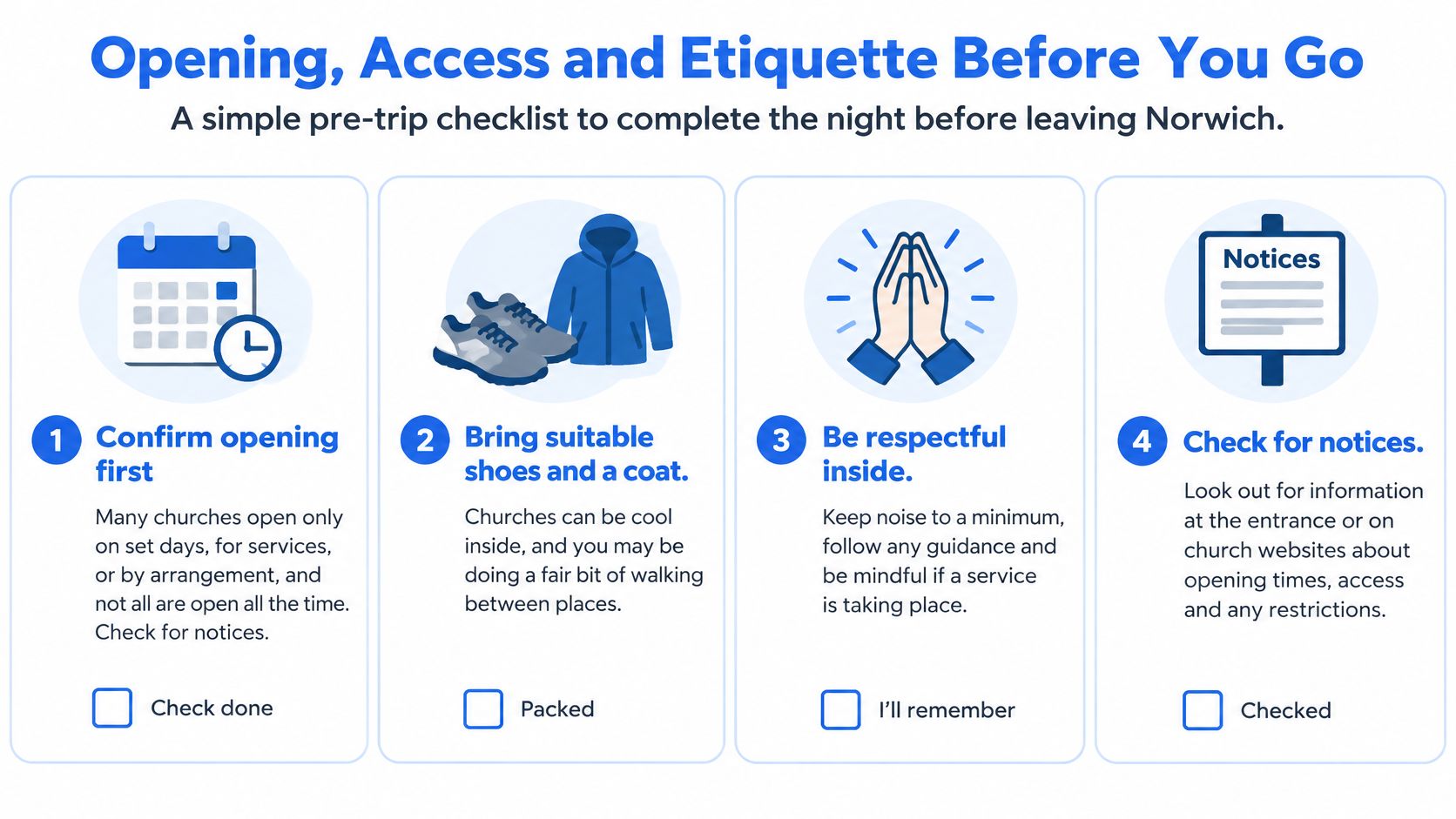
Check | Why it matters |
|---|---|
Opening days and service times | Churches may be open only on set days or during services |
Step-free entrance | Confirm access for wheelchair and pushchair users |
Ramp or internal access route | The entrance and interior may have different access arrangements |
Seating and rest points | Useful for longer visits and visitors who need a place to rest |
Lighting and heating | Interiors can be dim or cold, depending on the building and season |
Accessible toilets | Check facilities before planning a longer visit |
Hearing support | Ask whether support is available for your needs |
Card or digital giving | Check which donation methods the church accepts |
Photography, Donations and Services
Photography rules vary by church. Ask before taking pictures, avoid flash near painted or delicate surfaces, and put your camera away during services unless you have permission.
Check how to make a donation before you leave, as not every church offers the same options. Norfolk parish churches vary widely, so a quick message to the parish or keyholder saves guesswork. For a sample of clearly presented service information, see Lehigh Valley Baptist Church service details.
If the church is closed, stay outside: walk the churchyard, read the noticeboard and look at the tower and flint walls. Do not try side doors or assume a keyholder is nearby. For city-centre timing, consult this guide to Norwich Cathedral and apply the same opening checks to rural churches.
Sample Day Routes from Norwich
Three churches in one day is a comfortable target. More than that usually means rushing churchyards, skipping interiors and arriving after volunteers have locked up. Build each route around one confirmed opening, then add stops that still work from outside.
Route One Norwich on Foot
Start at the station and walk into the city for Norwich Cathedral in the morning. Give the Cathedral and Close proper time, then use the market area for lunch and a break from church interiors. This is the easiest route if you don't have a car, and it's also the best first day if you're learning how to read towers, stonework and churchyards.
Keep the afternoon flexible. A second city church, a museum stop or time in the historic streets will teach you more than another rushed drive. If you want wider context before you set out, read our guide to medieval Norwich the night before and note which streets connect the places you want to see.
Route Two North Norfolk and Swafield
Take the Bittern Line towards North Walsham or drive north from Norwich. Visit St Giles at Swafield late in the morning if you've confirmed access, then stop for food in a market town before continuing to Cromer for the afternoon. The contrast works well: a village church where you read phases of building slowly, then a coastal town where nobody in your group needs to concentrate quite so hard.
Check train and bus times the day before, especially at weekends when rural services can be less frequent. Allow extra time for the return leg rather than planning the last possible connection.
Route Three a Village Church and the Broads
Choose one church close to a Broads village, confirm whether it's open, then pair it with a boat trip or waterside walk after lunch. This route suits families because the church visit stays short and focused. Pick one feature to find, such as a tower, font or stained glass window, instead of trying to explain the whole building.
A Simple Timetable
Arrive and recheck opening times: Do this before you leave your base, not at the church gate.
Visit the first church before lunch: Morning is when you're freshest and many staffed places are open.
Break for food in a market town: You'll find toilets, parking and alternatives if plans change.
Visit one rural church: Keep it to one, and accept the exterior if the door is locked.
Return by early evening: Rural lanes, low light and infrequent buses punish late starts home.
Parking note: Rural churches often have only verge or roadside parking. Use a designated car park in a town where possible, and never block gates, driveways or farm access.
A Norwich base shortens every version of this day. You're starting near the station and main roads, and you can change the order of stops if a churchwarden replies with different opening information.
Broads and Coast Add-Ons
The Broads and the coast extend a church day without turning it into a long expedition. The trick is to let the church set the morning, then give the afternoon to water, walking and food. Don't try to make every stop educational.
Pairing a Broads Village Church with the Water
Choose a church near a Broads village you already want to visit for a boat trip or riverside walk. Check the church first, because boat times are usually easier to move than a keyholder arrangement. If the church is open only for a service, attend respectfully or view the exterior and keep the waterside plan.
Our guide to Norfolk Broads villages to visit from Norwich helps you choose a village base first. Then pick the church from current parish information, rather than assuming the nearest medieval building will be open when you arrive.
Using Cromer as the Coast Alternative
Cromer works well after Swafield because North Walsham points you naturally towards the coast. Do the church while you're alert, travel on for lunch, then spend the afternoon by the sea. On a two-day trip, keep Cromer as the second day if weather makes a Broads boat trip less appealing.
That backup matters with children and older visitors. A windy pier walk and hot drink can rescue a day when a waterside walk would feel like hard work. You're not abandoning the church theme. You're giving people enough variety to enjoy the one church you do visit.
Planning Method
Pick the village or town first: Choose somewhere within easy reach of Norwich with food, toilets and parking.
Check the church second: Confirm whether it's open, open on set days, or exterior only for your visit.
Book the waterside activity for after lunch: Morning light and energy are better spent on architecture and interiors.
Keep a coast backup: If the Broads plan depends on calm weather, know how you'll switch to Cromer without a long cross-country drive.
Be honest about energy. One Broads pairing is enough for a day, and the coast alternative belongs on day two unless your group loves travelling. Norfolk rewards repeat visits because villages are close together but churches differ sharply in access, atmosphere and state of repair.
Choose the specific Broads church from current visitor information before you travel. A famous name with a locked door is less satisfying than a modest church that's open and cared for.
Choose a Norwich Base for Your Church Trip
This post is sponsored by Stay Norwich Apartments, your furnished rental accommodation provider in Norwich, Norfolk, offering temporary or short-term furnished accommodation. You never know when you might need it. Rest assured that Stay Norwich Apartments will have you covered. staynorwichapartments.com
A Norwich base simplifies the routes in this guide. You can walk to the Cathedral on the first morning, use the station for the North Norfolk loop, and return each evening to check the next day's opening arrangements with Wi-Fi and a table for your notes.
Why the Base Helps
Our properties are close to the train station, Norwich Cathedral, the market and the main employment sites in and around the city. They're in the city centre, in postcode areas NR1, NR2, NR3 and NR5, so you're not adding a long commute before a rural church trip even begins.
Property types include houses sleeping 6, studios with river views, and apartments five minutes from the Cathedral. For a church trip, the practical advantages are plain: an early start without packing up each day, a kitchen for packed lunches where the property has one, and a quiet evening to confirm keyholders, services, parking and train times.
Plan your stay against route dates because availability varies. If your trip combines Norwich with at least one rural church, a Norwich base is the simplest choice. It keeps the city day walkable and makes a change of plan easy when a church is closed for repairs or open only at a different time.
Norfolk Churches: A Visitor's Guide to Medieval Churches If location is your main question, our overview of Norwich city centre accommodation explains how the central areas work for visitors. Your next step is to check current availability through the Stay Norwich Apartments property search for your dates.
Stay Norwich Apartments offers furnished short-term accommodation close to Norwich Cathedral, the station and the market, giving you a practical base for confirmed church visits across the city, Broads and North Norfolk. Choose the property that fits your group, check your first church opening before you travel, and book through Stay Norwich Apartments for rates and direct booking.
Comments