


Norwich Walking Tours

Updated: Sep 16
You've stepped off the train with a rucksack, four hours before your next commitment, and an itinerary that already feels too ambitious. Norwich is exactly the sort of city where the right walk can rescue that gap. The medieval centre, riverfront and principal heritage sights are close enough to explore without taxis, parking stress or a timetable full of compromises.
The trick is choosing the right format and route for your circumstances. A guided walk suits visitors who want local storytelling, a self-guided trail works better when you need to pause, and an independent riverside loop is ideal when daylight or energy is limited. This is my practical guide to Norwich walking tours, with recommendations for business travellers, families, rainy evenings, mixed-ability groups and anyone staying for only a short while.
Norwich Walking Tours: Table of Contents
Three Ready-to-Walk Itineraries From the City Centre - Route A for a free hour - Route B for the main historic sights - Route C for a proper heritage day
Heritage Themes Running Through Norwich's Trails - Viking Norwich - Medieval walls and religious heritage - Industry and wartime Norwich
Booking Tips and How to Avoid Sold-Out Walks - What to confirm before paying
What to Wear and Carry on a Norwich Walk - A sensible day-walk checklist
Arriving in Norwich and Wanting to Walk It
You arrive at Norwich train station with a few free hours, a bag in hand and no appetite for organising taxis. Start walking. The centre, River Wensum and historic quarters sit close together, so a well-chosen route gives you more time among the sights and less time between them.
The city is generally manageable on foot, though Castle Meadow, Cow Hill, Elm Hill and parts of the cathedral close bring steeper gradients or uneven surfaces. If mobility is a concern, favour the flatter riverside sections and check the practical details in this guide to Norwich train station before leaving your accommodation.
Driving adds friction. Central car parks become harder to use later in the morning, and medieval streets limit vehicle access. Park once, then walk from your base rather than shuttling between individual attractions.
Local rule: With less than half a day, choose one coherent trail and follow it properly.
For a short stay, match the route to your time and energy. The river towards Fye Bridge and the cathedral makes a satisfying heritage walk with clear landmarks. The market, Elm Hill and Norwich Castle suit visitors who want the busiest central sights, with an easy lunch stop afterwards. Both options work because Norwich rewards compact, themed walking instead of frantic box-ticking.
Your accommodation should shape the start point. Guests at Stay Norwich Apartments can set off from a practical city-centre base, walk until the route feels complete, then return without planning another journey. In bad weather, keep the loop short and stay near cafés, museums and indoor stops. For families, choose a route with obvious pauses. For a business traveller, use the station and central streets as anchors so a delayed meeting does not ruin the plan.
The principle also applies beyond Norwich. Guides to outdoor activities Boston locals love show how city breaks can include outdoor time without turning the day into a major expedition. In Norwich, use the same approach: set off near your base, check daylight, and leave room for a café or pub stop.
Your first decision is practical. Choose a guided walk for narration, a marked trail for control, or your own route when timing and mobility matter most.
Guided Tours, Themed Trails or Your Own Route
There's no universally correct choice among guided tours, self-guided trails and independent walks. The best format depends on how much preparation you can tolerate, whether you need flexibility, and whether the history matters as much as the movement through the city.
Format | Typical Cost | Group Size | Flexibility | Best For |
|---|---|---|---|---|
Guided group walk | Paid booking, varies by operator | Published limits vary | Fixed start and finish | First-time visitors who want narration |
Themed self-guided trail | Free or low cost | Your own party | High, pause or skip sections | Independent travellers and families |
Fully independent route | No tour charge | Your own party | Highest | Late arrivals, meetings and short gaps |
Guided walks are the easiest option when you want context without doing preparation. Operators may use fixed departure points around the Forum, marketplace or other central meeting places, with walks commonly designed around a manageable city-centre duration. You get a live narrator, opportunities to ask questions and a route that someone else has already tested. The trade-off is commitment. If your child is tired, your meeting overruns or the rain arrives, the group won't wait indefinitely.
Self-guided trails give you control without requiring a blank sheet of paper. Norwich's heritage material includes marked city-centre routes, brochures and online guidance, while the Norwich Society's heritage trails describe three city-centre trails, each taking around two hours, with a green dotted line marking the route where needed. One themed circuit visits 17 locations, including clocks, sundials and weathervanes. That's useful granularity for visitors who want a clear plan but still want to stop for lunch or photographs.
A fully independent walk costs nothing beyond whatever you buy along the way, but you'll need to check the route, opening times and surfaces yourself. It's the right choice for a contractor finishing late, a business traveller with an unpredictable diary or parents working around a toddler's nap.
For perspective, a premium private experience in another historic destination, such as this VIP tour of New Orleans, shows how much a guided format can add through personal attention. Norwich doesn't require that level of ceremony for every visit. Most guests should book a guide for interpretation, choose self-guided material for flexibility, and walk independently when time is the only constraint.
Here's useful background before choosing a route with a Viking focus: East Anglia and the Vikings gives the regional context that guided commentary often brings to life.
Three Ready-to-Walk Itineraries From the City Centre
Arrive after a train journey with only an hour before dinner, and the Riverside Loop is the route to choose. Staying near the centre gives you three practical options, each with a clear finish point and different demands on time, attention, and mobility.

Route A for a free hour
Allow about 45 minutes for the Riverside Loop. Start from your apartment, walk towards Pulls Ferry, follow the River Wensum past Cow Tower, then return through Fye Bridge. Finish around the cathedral quarter, or stop beside the river when you are ready to sit down.
This is my recommendation for a first evening and for business travellers with a spare hour before dinner. The water gives you an immediate feel for Norwich without requiring close attention to every building. It also works well for a short-stay guest who wants fresh air without committing to a full sightseeing circuit.
The route is mostly straightforward, but the riverbank can be uneven and exposed. Wear shoes with grip. Avoid it once darkness is settling or after rain has made the path slippery.
Route B for the main historic sights
The 90-minute Medieval Mile starts near Norwich Market. Walk towards Elm Hill, continue through the Cathedral Close, then head to Norwich Castle and Strangers' Hall before finishing near the market or a central café.
Choose this route for the strongest first-time overview. It brings together the market's bustle, timber-framed streets, the cathedral precinct, castle views and one of the city's most atmospheric historic buildings, without taking up a full day. The cobbles around Elm Hill and the close require care, particularly for prams, mobility aids and smooth-soled shoes.
For a shorter cathedral-focused variation, follow this Norwich Cathedral Quarter walking guide. Cut the route if rain arrives, rather than trying to cover every stop.
Route C for a proper heritage day
Set aside around three hours for the longer Heritage Trail. Begin in the central streets, pick up sections of the old city walls, continue through Bridewell Alley and Surrey Street, explore the Lanes, then return towards the riverside. Add the Museum of Norwich at the Bridewell if it is open and you want the industrial story alongside exterior views.
Pick this route when your group has the daylight, energy and interest for a longer outing. It makes Norwich feel like a working city rather than a collection of postcard stops, with more changes in surface, places to pause, steps and gradients. Families should plan a meal break, while anyone with limited mobility should check each section before setting out.
The full circuit is optional. If energy falls or the weather changes, return to the city centre and finish near your base at Stay Norwich Apartments rather than forcing the final stretch.
Heritage Themes Running Through Norwich's Trails
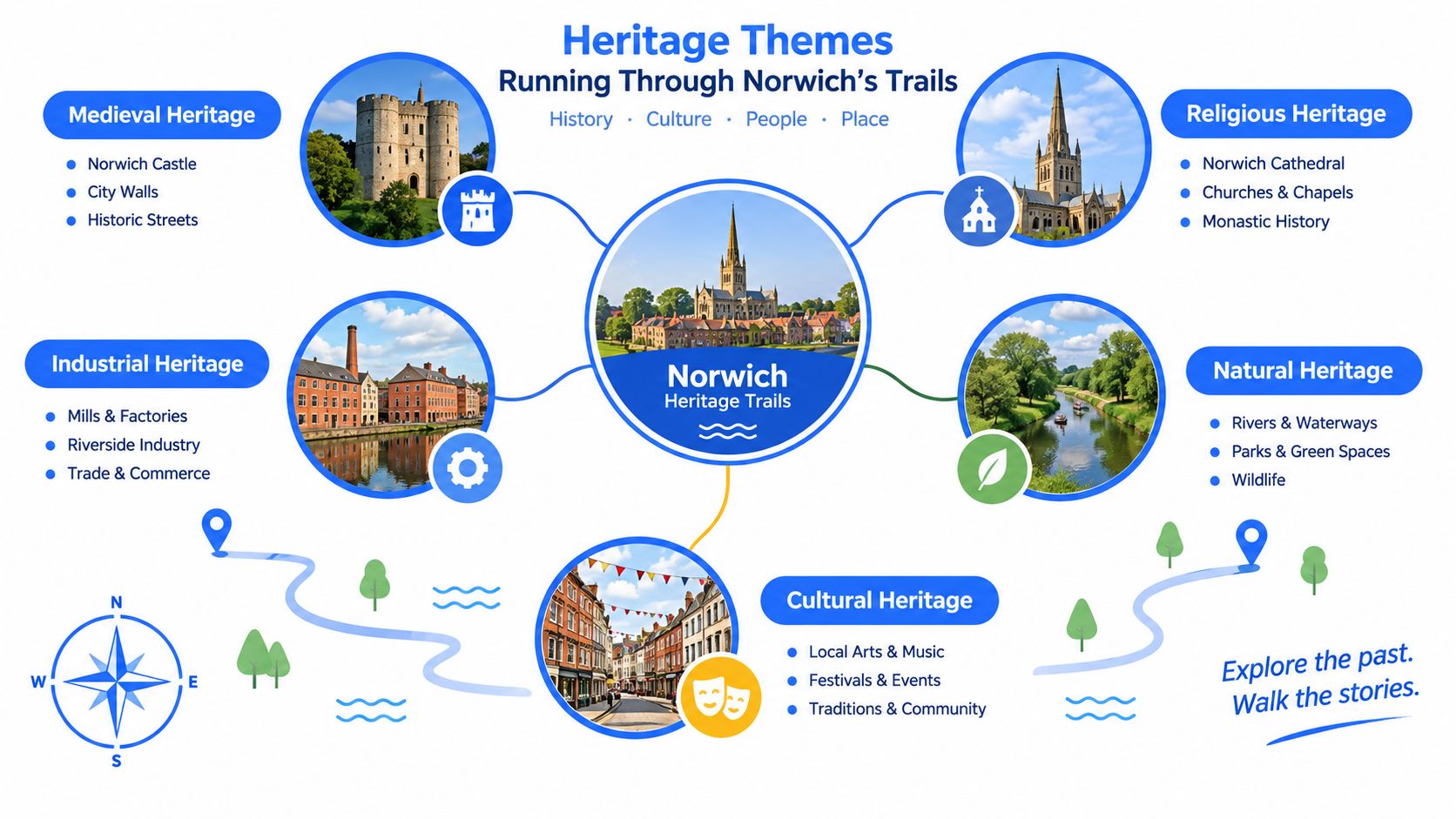
Norwich becomes easier to choose once you select a historical theme before selecting a street. The city's routes aren't merely geographic loops. They connect layers of settlement, religion, trade, conflict and everyday life.
Viking Norwich
The official Viking Norwich Trail is a circular route that begins and ends at Fye Bridge. Norfolk's heritage record says Danish settlement in Norwich likely dates to the late 880s, giving the city an unusually early origin story for a modern walking tour. Choose this theme if you enjoy place-name clues, river connections and the way settlement patterns survive beneath today's streets.
The route's circular design also suits visitors who don't want to finish far from where they began. It's a better choice for a curious history enthusiast than for someone who only wants the most photographed buildings.
Medieval walls and religious heritage
The medieval core is the safe recommendation for a first visit. Norwich's city walls began in 1294 and were completed in the mid-14th century. When finished, they formed the longest circuit of urban defences in Britain, exceeding London's circuit at the time, as recorded by Norfolk's Viking Norwich Trail heritage information.
This theme brings together the cathedral, Elm Hill, Tombland, Castle Meadow and surviving defensive fragments. Families often prefer it because the streets provide visual variety, while architecture enthusiasts can slow down around doorways, roofs and close entrances.
Industry and wartime Norwich
Industrial routes work best when you want the story of work rather than royalty. Look for links between the river, mills, trading streets, textile activity and the former Bridewell site. The Museum of Norwich adds useful depth when you want objects and interiors rather than another exterior plaque.
Wartime walks suit visitors interested in the city's resilience, air raids, memorial spaces and twentieth-century change. They can feel more reflective than entertaining, so I wouldn't choose one as a casual family stroll unless everyone wants that subject.
For a deeper regional connection to early East Anglian history, read about Edmund, King of East Anglia before booking a historically focused walk. It'll help you decide whether you want a broad introduction or a route built around one period.
Matching a Tour to Weather, Daylight and Mobility
A good route on a dry summer afternoon can be a poor choice after work in winter. Check four things before booking: weather exposure, remaining daylight, surface quality and group needs.
Norwich's official listings include rain-or-shine guided walks, while shorter self-guided options can be easier to adapt. The Riverside and Cathedral Quarter walk is particularly important to check because part of that route closes at dusk. Don't treat every riverside path as an evening option because it's attractive in daylight.
Condition | Best Route Choice | Avoid |
|---|---|---|
Heavy rain | Cathedral Close and market loop, or a rain-or-shine guided walk | Long exposed riverside sections |
Limited winter daylight | A central route completed within a short session | Outer river loops after dusk |
Mixed mobility | Central cathedral, market and Elm Hill circuit, checked in advance | Uneven banks, steep cobbles and narrow sections |
Family with tired children | Short self-guided route with planned café stops | A long thematic circuit with no easy exit |
Accessibility needs serious attention, not a vague “easy walk” label. Visit Norwich lists an operator with a maximum group size of 20, bespoke private tours from 2 to 30+ people, and a pub-tour product that can be customised for accessibility requirements, as shown on its walking tours listings. Independent listings also include a 90-minute Norwich Knowledge Tour marked wheelchair and pram accessible, alongside a wheelchair-accessible Norwich Story Walks route.
Ask about gradients, cobbles, toilets and stopping points before you pay. A route can be technically accessible while still being tiring if it has frequent pauses, narrow passages or difficult approaches. For weather planning, this guide to weather in Norwich and Norfolk is a useful starting point, but check the forecast again on the day.
Booking Tips and How to Avoid Sold-Out Walks
Turn-up-and-hope is a poor strategy for a popular Norwich walking tour. Group capacity is limited by narrow medieval streets, the pace of interpretation and the need for everyone to hear the guide. The result is simple. A walk can have plenty of demand and still have no space for you.
Book through the operator's own page whenever possible. You'll see the actual cancellation terms, meeting instructions and weather policy rather than a simplified reseller listing. This matters particularly for ghost walks, pub tours and themed evening routes where the meeting point may be a pub entrance rather than a prominent landmark.
What to confirm before paying
Meeting point: Check the map pin, not only the postcode. Some central meeting points are easy to miss.
Weather policy: Find out whether the walk runs in rain, changes route or offers a refund.
Late arrivals: Ask whether the guide can wait. Most fixed departures can't hold the group for long.
Minimum numbers: A small booking may be moved or cancelled if the operator requires a minimum.
Accessibility: Confirm the actual surface, steps and toilet arrangements rather than relying on a general label.
Cancellation terms: A clearly published refund window signals a properly organised booking process.
Weekend slots deserve advance planning, especially during school holidays, festival periods and warm weather. I'd reserve a themed walk before travelling if it's the main reason you're visiting. For a private booking, give the operator enough notice to match the route to your group's pace and mobility.
Arrive early enough to find the meeting point without starting flustered. That's particularly important if you've come from a train, are carrying luggage or have children who need a toilet stop before departure.
Norwich's walking market is becoming more varied, with Visit Norwich listing options including Paul Dickson Tours, Norwich Free Walking Tours and experience-led products. That variety is useful, but it makes comparison more important. Check length, group size, route conditions and cancellation terms instead of choosing solely on the title.
What to Wear and Carry on a Norwich Walk
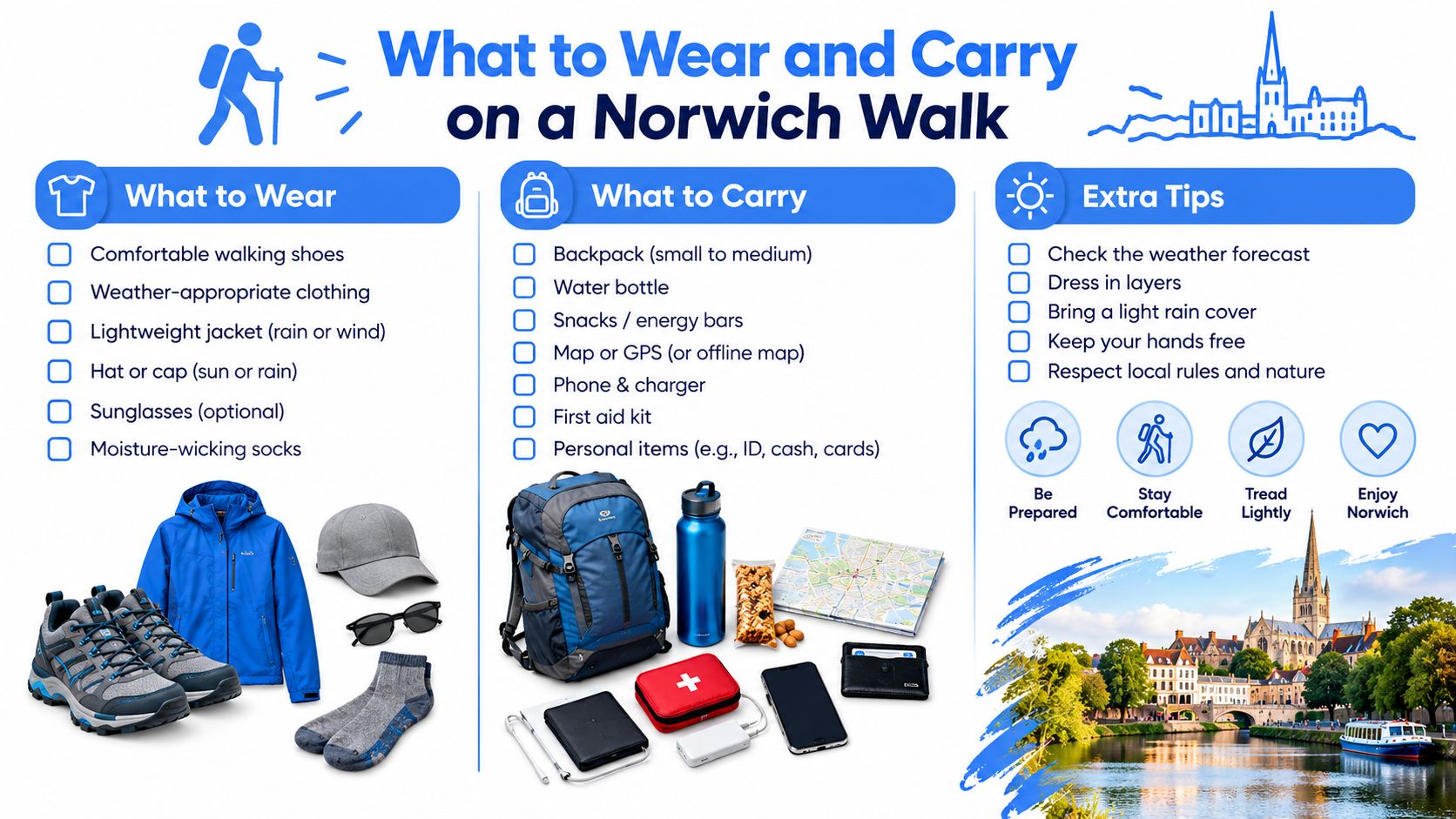
Norwich's medieval surfaces punish careless footwear. Wear closed shoes with cushioning and grippy soles for Elm Hill, Tombland and the Cathedral Close. Flip-flops and brand-new trainers are poor choices, especially if you'll combine a heritage trail with riverside paths.
Dress in layers rather than relying on one thick coat. A light fleece under a waterproof shell gives you more control when the temperature changes, while a compact umbrella handles sudden showers. Between November and March, add a thin hat and gloves, particularly if your route follows the river where wind can make a mild day feel unpleasant.
A sensible day-walk checklist
Footwear: Choose soles that grip wet cobbles and support your feet.
Waterproof layer: Keep a shell jacket in your bag even when the morning looks bright.
Phone and battery: Charge your phone before leaving, especially for self-guided maps and tickets.
Small bag: A crossbody bag works better than a bulky backpack in crowded market lanes.
Water: Carry a refillable bottle, particularly on a longer heritage route.
Payment: Bring a contactless card, with a little cash for stalls that still prefer it.
Paper backup: Keep a printed booking confirmation beside the digital version if your signal fails.
Keep passports and unnecessary valuables secured at your accommodation. Heavy jewellery adds no value to a walking day, and it becomes irritating when you're taking photographs or navigating crowded streets. Tissues are also worth carrying because public toilet availability varies by route.
For wider day-hike packing principles, Adventure Medical Kits trail advice is a useful reference, although Norwich is an urban walk rather than a remote hike. You don't need expedition equipment. You do need footwear that won't betray you halfway up a cobbled lane.
Ending the Day Back at Your Norwich Base
The best walking plan ends at a base that cuts down on effort. If you can return to the same front door between routes, you can drop a wet coat, charge your phone, rest your legs and head out again without carrying the entire day with you.
That's why location matters more than a glossy list of amenities. Stay Norwich Apartments provides furnished, self-catering accommodation near the city centre, with kitchens, workspaces and Wi-Fi that suit leisure guests as well as business travellers and contractors. A short walk to the market, Cathedral Close and central trail starts means you can use one base for a dawn riverside loop, a midday heritage circuit and a quieter evening wander.
Norwich's temporary-accommodation scene also shows why practical furnished space matters. The council's homelessness review says suitable temporary accommodation remains difficult to secure and that the average number of people in temporary accommodation rose from 312 in 2022/23 to 375 in 2023/24 and 403 in 2024/25 (Norwich City Council review). That isn't a walking-tour statistic, but it underlines the importance of distinguishing planned serviced accommodation from emergency placement arrangements.
A kitchen is useful after a wet walk because you can make breakfast before an early meeting or prepare something simple instead of searching for food late. A drying rail, proper bedding and space to separate work from rest matter just as much when you're staying for several nights.
If you're comparing a holiday let with longer-term accommodation, remember that HM Government abolished the Furnished Holiday Let regime on 6 April 2025, with short-term holiday accommodation taxed under normal residential landlord rules from the 2025/26 tax year (official guidance on self-catering holiday homes). Don't assume older tax or occupancy advice still applies.
For a visitor, the practical conclusion is simple. Pick the route according to your time, weather and mobility, then choose a base that makes changing plans easy. Norwich is most enjoyable when you can walk without turning every coat change, meal or phone recharge into another journey.
Stay Norwich Apartments offers furnished, self-catering accommodation with equipped kitchens, dedicated workspaces and fast Wi-Fi for short stays, contractor visits and longer temporary housing needs. Use the city-centre location as your starting point for Norwich walking tours, then visit Stay Norwich Apartments to check availability and plan your stay.
Comments