


Parking Near Norwich Train Station: Prices and Options

You're on the 07:45 out of Norwich, or you're due on site at eight, and the car is sitting on the drive with a full tank. Between you and the train there's one small logistics problem: where the car goes, and what it costs to leave it there.
Norwich is a working rail terminus, not a park-and-ride with a platform bolted on. The station has a car park, but it's small, and the alternatives scattered around the city each come with a different price, a different walk and a different risk. Choose badly and you lose money. Choose badly on a busy Tuesday and you lose the train.
The figures below come from the station operators and from Norfolk's own rail planning documents. What matters is how you read them for a day trip, a week, a three-week contract or a month away from home, because the right answer changes with the length of the stay.
Parking Near Norwich Train Station: Prices and Options: Table of Contents
Why Station Spaces Run Out and How to Plan Around It - A Three-Step Plan for the Morning You Travel
Station Car Park Prices and Cost by Stay Length - What Each Ticket Works Out at per Day - Where the Break-Even Points Fall - A Worked Example for a Three-Week Contract - What the Tariff Doesn't Tell You
Nearby Car Parks, Street Parking and Park and Ride - City Centre Car Parks and What They Cost You in Time - Street Parking and Where It Stops Being an Option - Park and Ride for Day Visitors
Parking Options at Norwich Station at a Glance
If your trip is a single day and the train leaves early, the car park at the station itself is the obvious first call. It's the only option that removes the walk entirely, and for a short trip that convenience is worth paying for. The catch is supply: Norwich station's car park holds 70 spaces, 5 of them accessible, according to the station record compiled by trainmap.co.uk, which is a thin margin for a principal rail terminus. If you want the full picture of how the station is laid out, our guide to Norwich train station covers the entrances, platforms and onward connections.
The main fallback for anything longer is a city centre NCP or multi-storey car park. They hold far more cars and they don't depend on you arriving before the morning peak, but you'll walk further and you should price the daily rate on the operator's own site before committing. Compare the total for your stay, not the headline day rate.
On-street parking near the station is for short visits only. The bays that exist are signed, plenty of side streets are permit zones, and yellow lines apply as marked. Treat an unsigned gap as a loading bay or a mistake, never as a space.
Park and Ride sites on the city edges suit day visitors who'd rather not drive into the centre at all, provided you check the last return service before you leave. For anyone with heavy cases, a buggy or limited mobility, the drop-off point and taxi rank beat every car park on this list.
Option | Best for | Watch for |
|---|---|---|
Station car park (operated by National Car Parks) | Short trips and early arrivals | Fills at weekday peaks, so check availability |
Nearby NCP and multi-storey car parks | Multi-day stays and flexible arrival | Daily rates and walking distance vary by site |
On-street and permit bays | Short visits only | Signed bays and yellow lines are enforced |
Park and Ride sites on the city edges | Day visitors avoiding central traffic | Confirm last service times before travel |
Drop-off and taxi rank | Heavy luggage or limited mobility | Plan the set-down point before arrival |
The table gives the short answer and the sections that follow explain each row. The simple rule: for a short trip with a confirmed train, use the station car park if a space is free. For anything longer, decide your second option before you travel, not while you're sitting at the barrier.
Why Station Spaces Run Out and How to Plan Around It
The obvious assumption is that a busy station means a busy car park, and that arriving ten minutes early is enough to beat it. The first half is right. The second half is where people end up watching their train leave.
Norwich station is busy, and the traffic through it has returned to where it was before the pandemic. The Norfolk Rail Prospectus 2024 records 4,041,818 entries and exits at the station in 2019/20, a fall to 967,650 in 2020/21, and a recovery to 3,963,948 in 2022/23, which is about 98.1% of the 2019/20 figure. Rail demand from Norwich is, in practical terms, back where it started.
Against that volume, the car park's capacity works out at roughly one space for every 57,740 annual entries and exits, on the same prospectus figures. That ratio doesn't mean every passenger drives, because plenty walk, cycle, take a bus or get dropped off by someone. It does explain why the car park can't absorb everyone who might want it, and why "I'll find a space when I get there" is a gamble rather than a plan.
The supply side of the equation is simple enough to draw.
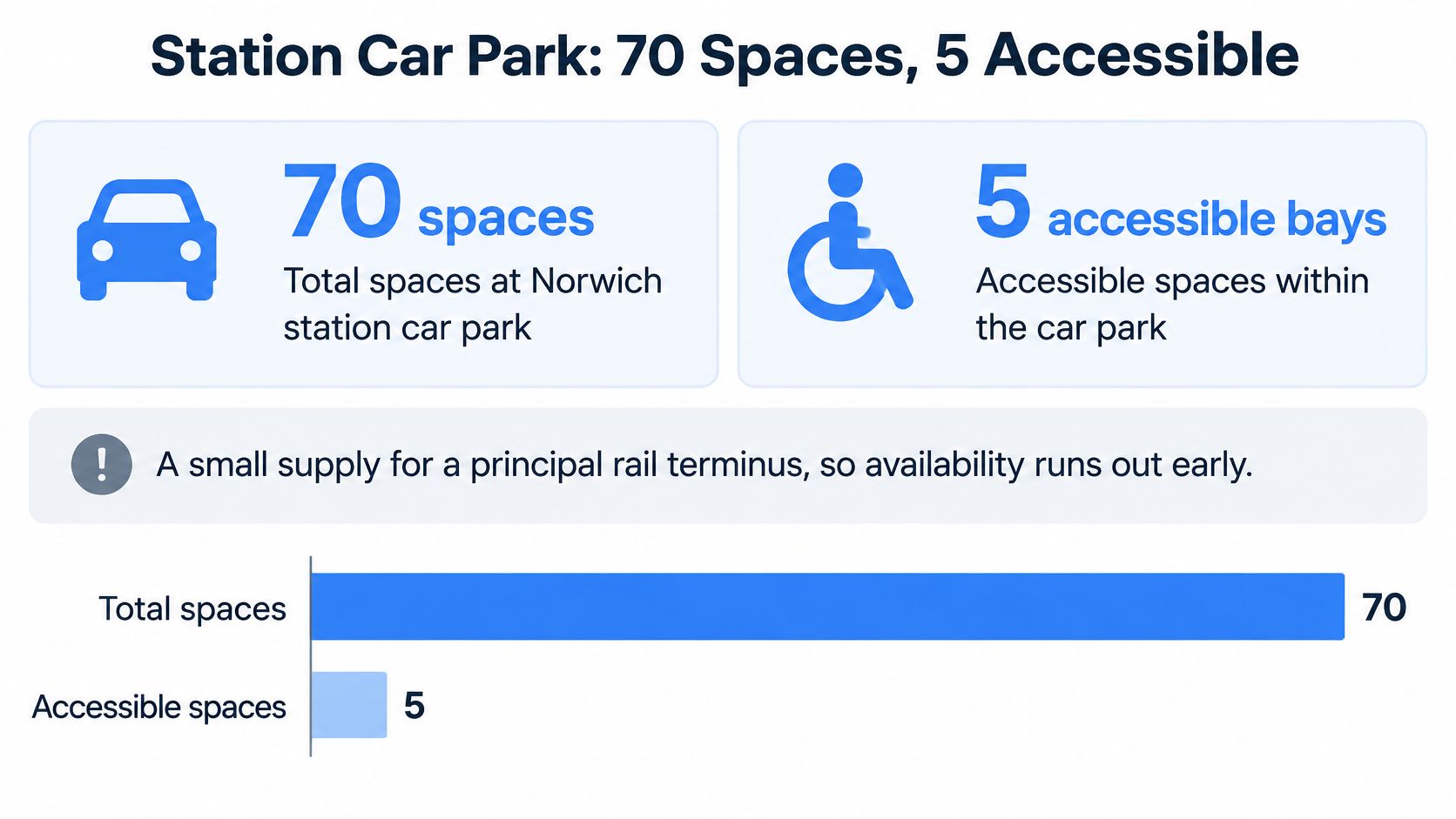
National Rail's station information for Norwich describes the provision as a relatively small supply for a principal rail terminus, which makes availability a practical constraint rather than a certainty, particularly at weekday commuter peaks, during major events and around holiday departures.
A Three-Step Plan for the Morning You Travel
Check the station page on the day. Provision, access arrangements and station information can change, and a two-minute check on the morning beats a twenty-minute detour.
Have the nearest city centre car park in your head before you leave. Not the name of one, the route to one. If the station approach looks congested, you want to be turning away rather than queuing to find out.
Allow 15 to 20 minutes to park elsewhere and walk back. That buffer is what turns a full car park from a missed train into a slightly longer stroll.
One detail is worth flagging because it catches people out: whether the station car park accepts advance bookings isn't settled by the published station information. Treat a reservation as possible only once the operator's own terms confirm it, and plan as though you're arriving without one.
The realistic assumption: the station car park is a convenience you use when a space happens to be free, not a capacity you can count on.
If you end up coming in by bus rather than driving, the Surrey Street bus station guide explains how that interchange connects to the rail station.
Station Car Park Prices and Cost by Stay Length
The price list is the easy part. What you need is the cost per day for the stay you're making, because the gap between a daily ticket and a monthly one isn't a rounding error. It's the difference between a sensible week and an expensive one.
The station car park is operated by National Car Parks and open Monday to Sunday, 04:30 to 01:30. The charges published in Norwich station's parking information from Grand Central are £14.50 for an off-peak ticket, £15.50 for a daily ticket, £62 weekly, £223 monthly, £603 quarterly and £2,170 annually, with Saturday and Sunday parking listed at £10 per day. If you want to widen the comparison beyond the station itself, our guide to parking in Norwich covers the city's other sites.
Ticket | Price | Covers |
|---|---|---|
Off-peak daily | £14.50 | One day, off-peak time window |
Daily | £15.50 | One day |
Weekend daily (Saturday and Sunday) | £10 | One day |
Weekly | £62 | Seven days |
Monthly | £223 | One month |
Quarterly | £603 | Three months |
Annual | £2,170 | One year |
What Each Ticket Works Out at per Day
Hold one rate steady and the pattern becomes obvious. Using the off-peak daily ticket as the benchmark throughout:
Two days: two off-peak dailies, £29.
One week: a weekly ticket at £62, or £8.86 a day, against £101.50 for seven off-peak dailies.
A fortnight: two weekly tickets, £124, still £8.86 a day.
A month: a monthly ticket at £223, or £7.43 a day.
A quarter: £603, or £6.70 a day.
A year: £2,170, or £5.95 a day.
For a Saturday day trip the weekend rate at £10 undercuts both daily tickets, so it's worth buying the weekend ticket rather than assuming a standard day rate applies.
Where the Break-Even Points Fall
A weekly ticket costs the same as about 4.3 off-peak days. A monthly ticket costs the same as about 15.4. Those are the only two numbers you need to remember, because everything shorter is pay-as-you-go and everything longer rewards committing to a longer ticket.
The overnight test: staying more than four nights? The weekly ticket wins. Staying more than about fifteen days? Switch to the monthly.
The arithmetic assumes the car stays parked on the days you've paid for. If you drive home every evening and return each morning, a weekly ticket buys you nothing on the days you're not there, and daily tickets are the honest comparison.
A Worked Example for a Three-Week Contract
Say you're on a job in Norwich for three weeks and the van stays put near the site. Paying by the day, 21 off-peak tickets comes to £304.50. Three weekly tickets come to £186. That's £118.50 back in your pocket for the same parking, purely from buying the right ticket.
If you're commuting in from outside the city each day instead, the calculation reverses: you need a daily ticket on each day you travel, and the weekly rate only makes sense if the vehicle stays overnight.
What the Tariff Doesn't Tell You
Off-peak pricing depends on a time window, so check the ticket terms and your arrival time before you buy, particularly if you're arriving before dawn for an early departure. Payment and booking methods aren't confirmed in the published information either, so verify them on the operator's site rather than assuming a card machine at the barrier. The car park has CCTV and accessible equipment, which matters more for overnight and multi-day stays than for a morning drop-off.
Nearby Car Parks, Street Parking and Park and Ride
A ten-minute walk in the rain with a suitcase feels nothing like a ten-minute walk on a dry Tuesday, and that gap is the main trade-off once you leave the station car park. Multi-storey sites in the city, including the NCP car parks, are the usual first alternative for longer stays.
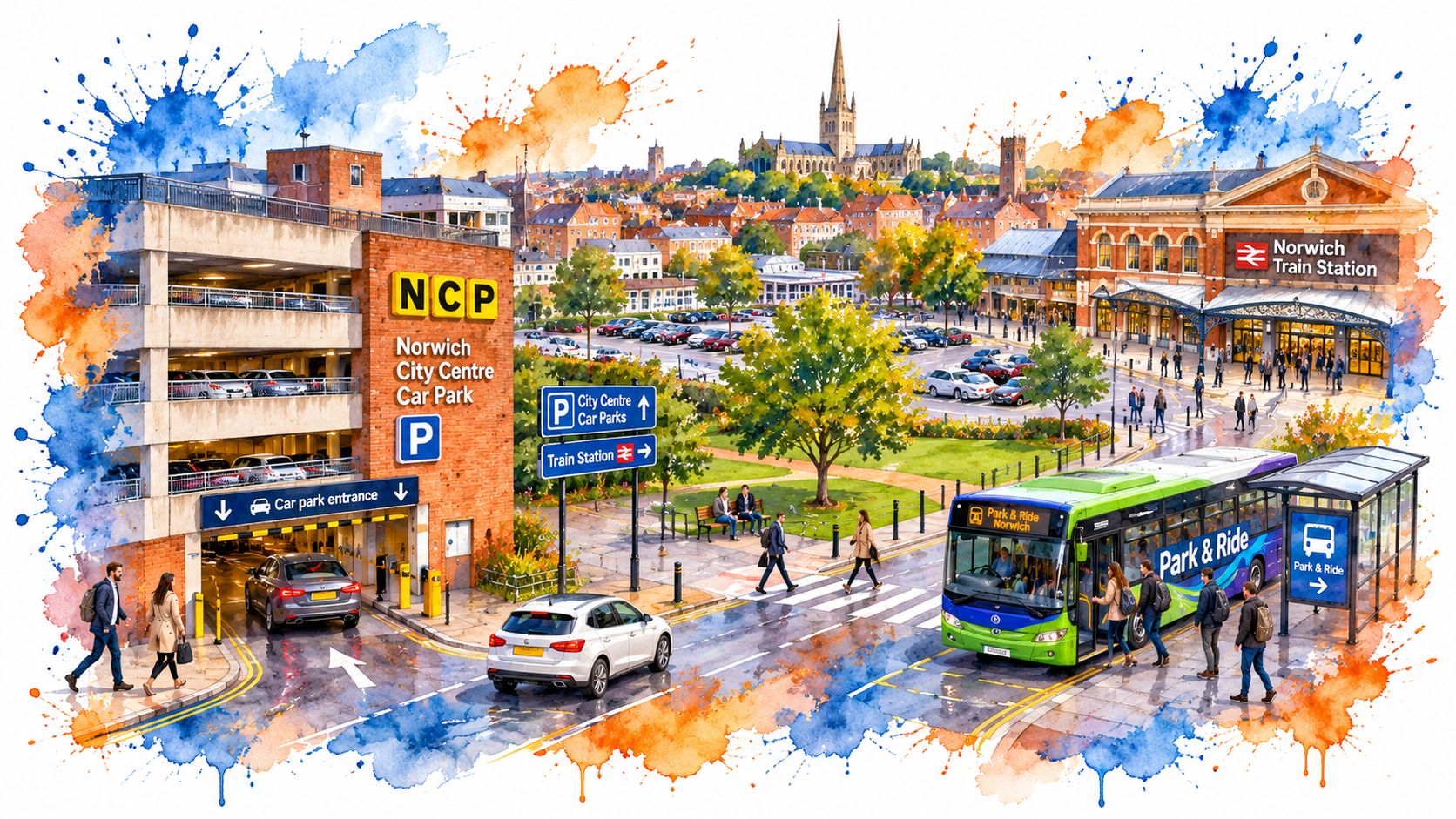
City Centre Car Parks and What They Cost You in Time
These sites hold more cars, take arrivals later in the morning and rarely turn you away, which is exactly what you want on a multi-day stay. The trade is a longer walk and a rate you need to check per site rather than assume. Publish the comparison to yourself properly: measure the walking route from the car park entrance to the station door on a map before you book, and add time for luggage or a laptop bag. Our round-up of the best car parks in Norwich town centre shortlists the ones worth comparing. If you're driving into Norfolk from outside the county, these self-drive tips for UK roads cover the signage and roundabout conventions that catch visitors out.
Street Parking and Where It Stops Being an Option
Every bay around the station is governed by a sign, a permit zone or a line, and enforcement sits with the highway authority rather than the car park operator. Short errands are fine where a bay allows. Overnight is where it goes wrong: a space that looks legal at 9pm can be a permit bay or a loading restriction by morning, and an informal spot on a corner is never worth the ticket. Pay for a proper car park if the car is staying put.
Park and Ride for Day Visitors
Park and Ride works when you don't need to be near the station at all and the service runs on the day you're travelling. Check the last return time before you leave home, not when you come back to the stop, and confirm weekend and bank holiday timetables separately because they change.
The trade-offs stack up. Multi-storey car parks give you space but a longer walk. The station gives you the shortest walk but the tightest supply. Park and Ride keeps you out of central traffic but ties you to a timetable.
Accessible Bays, Height Limits and Assistance Checks
You arrive with ten minutes spare and every marked bay is already taken. Step-free access only covers the platforms, not the stretch from the car to the concourse. Norwich is a station with step-free access to all platforms, according to National Rail's station record. That still leaves the earlier problem for a Blue Badge driver, someone travelling with mobility limits, or anyone moving equipment between the car and the train.
Accessible bays work like a short queue with no second line behind it. The station's allocation is tiny and there's no overflow, so a full set of bays means the backup plan starts at once.
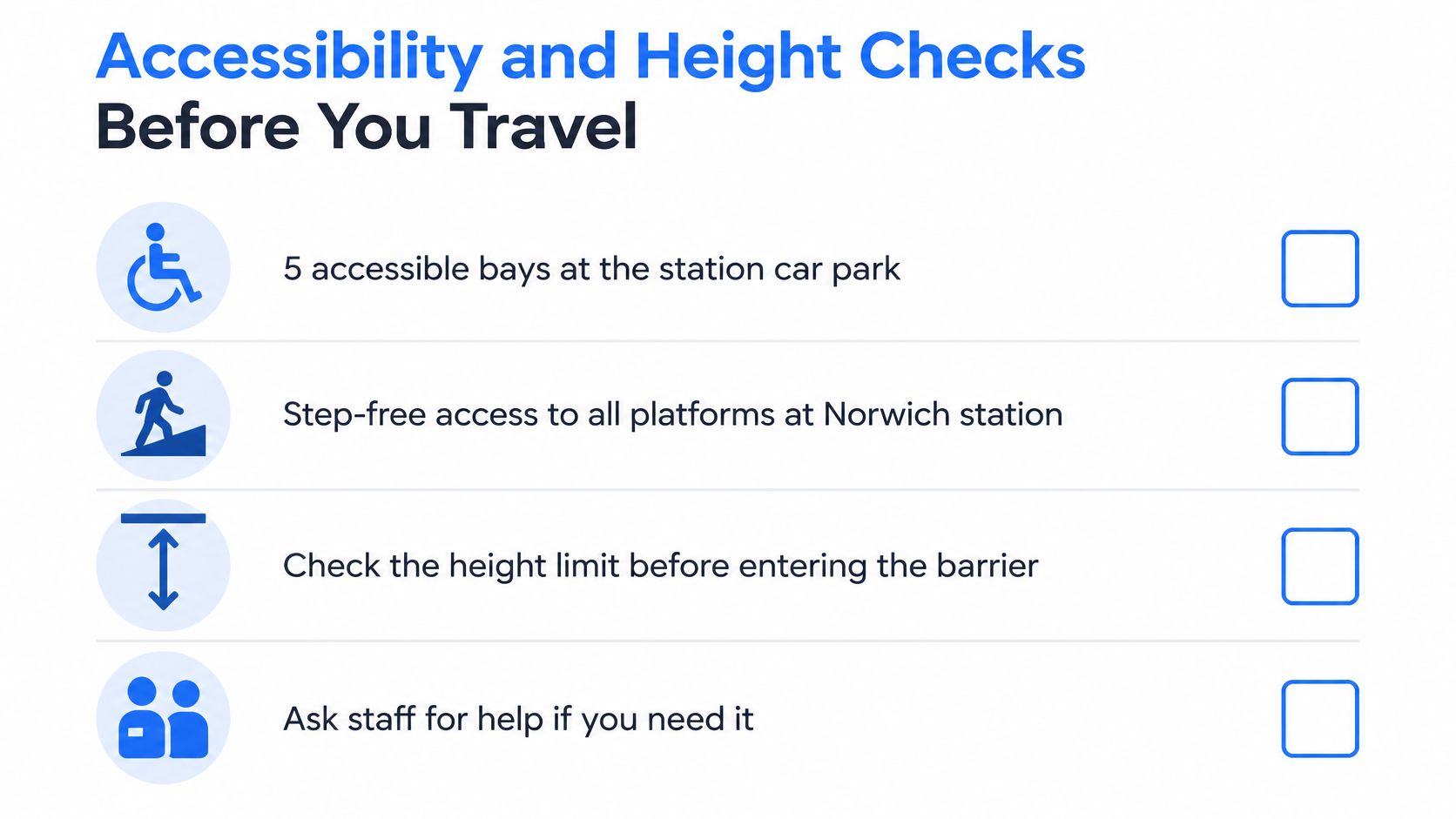
Work through these before you set off, in this order.
Confirm an accessible bay is free. The station's accessible allocation is tiny and there's no overflow, so a full set of bays means going straight to the backup plan.
Check the route from bay to entrance. Walking distance from the marked bays to the station door isn't published consistently, so look at a map and, if you can, ask staff what the surface and kerbs are like.
Identify the set-down point first. Knowing where a taxi or a friend can stop means a passenger with limited mobility doesn't circle the car park while you look for somewhere to pull in.
Read the height clearance before you enter. Barriers are a common place for a van with a roof rack or a high-top vehicle to get stuck, and clearance differs by site, so read the sign at the entrance and the operator's page before committing.
Keep a second site in mind. A city centre car park with confirmed accessible bays and a route you've checked is a better backup than an improvised one at the barrier.
Ask the railway for assistance before the journey. Whether booking is required isn't confirmed in the published station information, so speak to staff in advance and find out what they need from you.
A van that clears one entrance can still fail the next, because each site sets its own limit. Check that number on the sign and on the operator's page before you join the queue.
Priority order: the station's accessible bays first, a city centre car park with confirmed bays and a known route second, and a set-down at the drop-off point if neither is available.
Choose Your Parking Option Before You Travel
Three steps, in order, and you're done. Do them while you're still at your desk rather than at the barrier, and the morning becomes a drive, a park and a walk.
Match your stay length to a ticket. Find your stay in the price breakdown and use the cost per day, not the headline sticker. A fortnight is two weekly tickets. Three weeks is three weekly tickets. A month is a monthly.
Check the station car park on the day. Look at National Rail's station page before you leave, and go in with the assumption that a space may not be there.
Switch to your fallback if the station is full or the stay is long. City centre car park or Park and Ride, with the route and the return times confirmed first. If you'd rather not drive at all, our guide to taxis in Norwich covers the alternative, and for shorter city trips electric bike versus car for commuting sets out when two wheels beat four.
Parking Near Norwich Train Station: Prices and Options: Longer stays change the question. If you're in Norwich for a month rather than a weekend, parking every day becomes a line item worth managing, and accommodation with parking included at the address removes it. Our properties are close to the train station, Norwich Cathedral, the market and the main employment sites in and around the city, and free parking is included at all of our addresses. Booking direct gets you our best available rate and a direct line to us if anything comes up.
This post is sponsored by Stay Norwich Apartments, your furnished rental accommodation provider in Norwich, Norfolk, offering temporary or short-term furnished accommodation. You never know when you might need it. Rest assured that Stay Norwich Apartments will have you covered. You can search Stay Norwich Apartments properties by date and length of stay. If you need a specific bay, a space for a van or a particular arrival time, tell us when you book so we can confirm the details for that address.
If you're weighing a monthly station ticket against somewhere to stay while a contract runs, a furnished apartment with free parking at the address takes the daily parking decision off the table entirely. Stay Norwich Apartments offers serviced, self-catering apartments in the city centre, close to Norwich train station, the Cathedral, the market and the main employment sites, with kitchens, workspaces and free parking at every address. Visit Stay Norwich Apartments to see current availability, and book direct for the best rate.
Comments