


Walk in Dentist Norwich: Where to Go for Urgent Care

You're back at your accommodation after work, a filling has broken, and the tooth that was manageable at lunchtime now hurts when you bite. Or you're visiting Norwich for the weekend and don't have a local dentist to call. Searching for a walk in dentist in Norwich feels like the obvious next step, but travelling to the nearest surgery without speaking to anyone can leave you at the wrong door.
Your first phone call decides your route. Match your situation to the right service, describe the symptoms and confirm where you should go before travelling. For urgent dental care, the call itself is often the practical equivalent of walking in.
Walk in Dentist Norwich: Where to Go for Urgent Care: Table of Contents
Which Dental Service to Contact First - An urgent appointment isn't an open-door service - Match expectations to the appointment
Finding a Walk-In Dentist and Timing Your Visit in Norwich - Check the journey before accepting the slot - Keep a usable appointment record
How to Make the Urgent Dental Call - Give useful information, then confirm the arrangement
What Urgent Dental Care Costs in Norwich - NHS dental charge bands and private fees - Ask about the whole likely bill
When Urgent Dental Care Is Not Enough - Different problems need different responses - Have a fallback that includes safety advice
Set Up Your Norwich Dental Plan Before You Need It - Keep accommodation and healthcare contacts separate
Which Dental Service to Contact First
Which service to contact for each dental situation
Your situation | Call first | What to expect |
|---|---|---|
Registered with an NHS dentist, pain or broken tooth | Your own practice, by phone first | Urgent slot or triage advice from the practice you already know |
Not registered, visiting or temporary in Norwich | Any NHS dentist offering urgent care, or NHS 111 | Urgent NHS treatment is possible even if the practice is not taking new patients |
Dental problem outside office hours | NHS 111, online or by phone | Triage and advice on whether an urgent appointment is needed |
Severe swelling of the mouth, throat, neck or eye, heavy bleeding or facial trauma | A&E, or call 999 for a life-threatening emergency | Emergency assessment, not a routine dental appointment |
Private dentist without NHS triage | The practice directly, asking for a written quote | Private appointment with fees agreed before treatment |
Minor injury or illness with no dental need | Norwich GP-led walk-in centre | Treats minor injuries and illnesses but does not replace urgent dental assessment |
An urgent appointment isn't an open-door service
Don't assume a Norwich practice operates an unbooked queue because its website mentions emergency dentistry. A same-day appointment, an NHS urgent appointment and an out-of-hours referral are different arrangements. The receptionist or triage clinician needs to establish what's wrong before directing you to an appropriate slot.
For sudden pain, bleeding or a cracked tooth, NHS appointment guidance says to contact a dentist for urgent care, with NHS 111 available if further help is needed. Any NHS dentist can provide urgent NHS treatment, including when you haven't attended before or the practice isn't accepting new routine patients. That's permission to ask, not a promise that a slot is available.
If you already have a dentist, start there. The practice can check your records and decide how to handle the problem without you having to explain your whole dental history to an unfamiliar team.
The access difference is substantial: among adults with an urgent dental need who tried to obtain an appointment during the previous 28 days, 95.6% of those with an NHS dentist obtained one, compared with 29.9% without one, according to the NHS dental statistics guidance.
Practical rule: Ask for urgent assessment of your symptoms, rather than asking only whether a practice is taking new patients.
Match expectations to the appointment
NHS urgent care prioritises stabilising a problem, not completing every piece of dentistry you might need. The dentist may address pain or infection and arrange further treatment rather than complete a crown, a root-canal procedure or a wider restoration plan during that visit.
Clinical urgency also determines timing. The NHS emergency dental guidance says patients should be offered urgent treatment within 24 hours or seven days, depending on their symptoms. Those are clinical pathways, not a guarantee of immediate treatment whenever you arrive.
If you're unsure how to describe a suspected crack, Mouthology's explanation of when tooth pain needs a dentist can help you recognise relevant symptoms. It can't diagnose your tooth or replace the call.
For private care, contact the practice directly and clarify the fee before committing. Whichever route you choose, the phone call is the walk-in: it gets your symptoms assessed and establishes your next destination.
Finding a Walk-In Dentist and Timing Your Visit in Norwich
Start with the NHS website's dentist search and look for Norwich practices whose service information mentions urgent appointments. Treat the results as a shortlist, not a live booking board. A practice listing can't tell you whether its remaining urgent capacity suits your symptoms today.
Phone a manageable selection rather than opening an endless series of search results. Ask specifically whether the practice can assess an urgent dental problem, not just whether it accepts new patients. If no suitable practice can help, move to NHS 111 rather than repeating the same search.
Check the journey before accepting the slot
For someone staying in central Norwich, a practice reachable on foot or by bus may be more practical than an apparently convenient appointment across the wider county. However, don't reject clinically appropriate care solely because another practice looks closer on a map. Confirm the actual appointment location before making that decision.
Use this short search-and-timing routine:
Check today's hours. Ask whether the urgent appointment line is operating and when staff stop taking requests. Published reception hours don't necessarily describe urgent booking arrangements.
Call early when possible. Don't deliberately leave a worsening problem until late afternoon, when the practice may have allocated its available appointments.
Explain your departure date. If you're leaving Norwich soon, say so before accepting a proposed appointment or follow-up arrangement.
Confirm access details. Save the practice name, full address and instructions about arrival, rather than relying on a search-result pin.
Use the out-of-hours route. For evening, weekend or bank holiday problems, seek NHS 111 triage instead of travelling to a closed routine practice.
Keep a usable appointment record
Write the confirmed time into your phone calendar while you're still on the call. Add the address and any instructions about returning a call or waiting for further contact.
If you need to rearrange, contact the service rather than missing the appointment. For short-term workers and visitors, explaining your work location and travel constraints early gives the booking team useful information without confusing availability with clinical priority.
How to Make the Urgent Dental Call
Prepare a short note before dialling, but don't delay emergency help to make it perfect. The purpose is to give the person assessing you a clear account, especially when pain makes it difficult to concentrate.
The preparation sequence is summarised below.
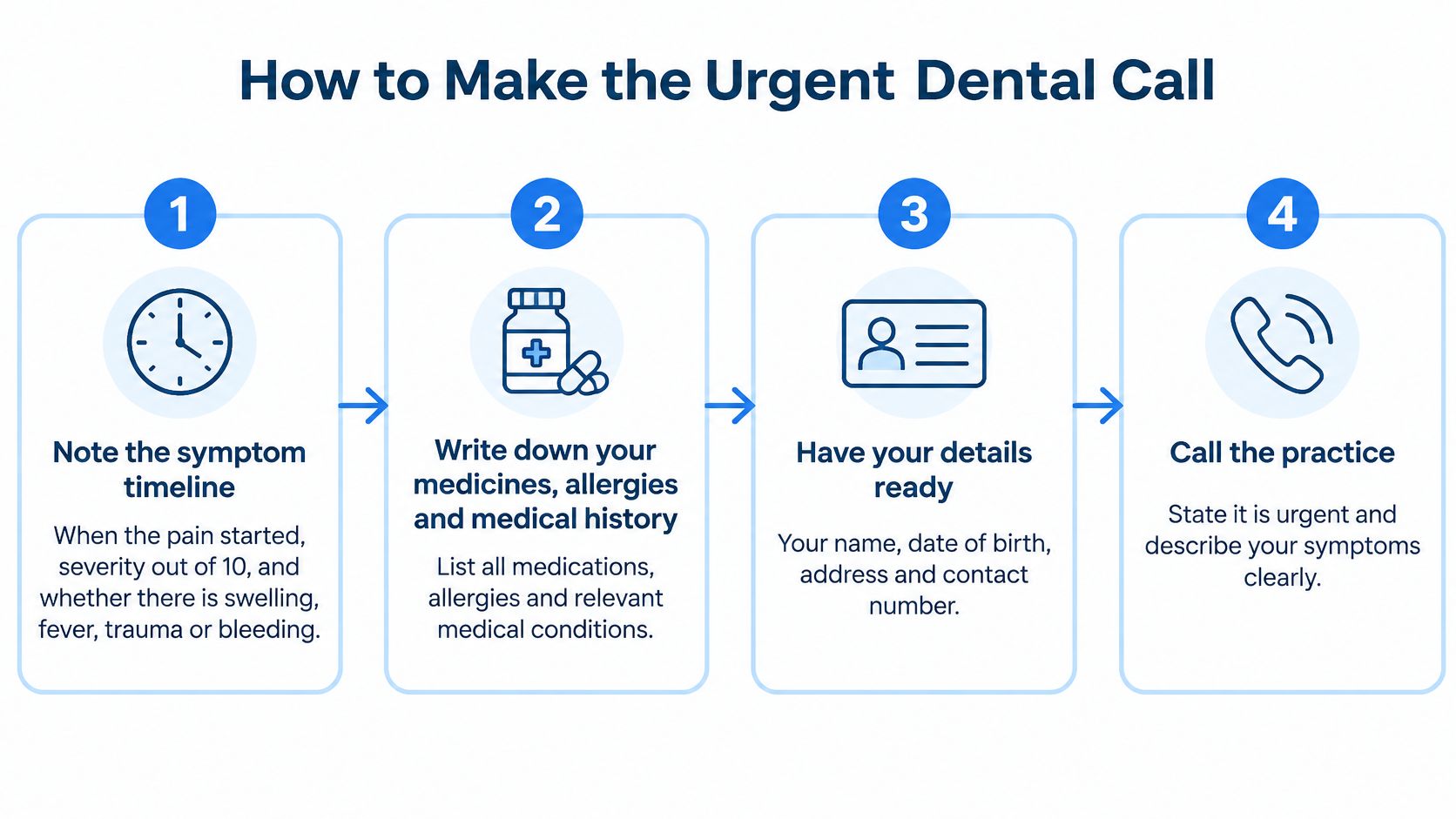
Give useful information, then confirm the arrangement
Record the symptom timeline. Note when the pain began, how severe it feels, and whether there's swelling, fever, an injury or bleeding, because changes help the clinician assess urgency. Don't report only that it hurts now if symptoms have been worsening or interrupting sleep.
Write down your medicines, allergies and relevant conditions, including blood-thinning treatment, so the dental team can plan safely. A common slip is remembering prescribed tablets but forgetting non-prescription medicines already taken for the pain.
Choose the dental route. Contact your existing practice if you have one, or an urgent-care practice or NHS 111 if you don't, so you reach someone who can arrange dental assessment. Calling a GP because its reception answers quickly can send you through an unsuitable service.
Give your name, date of birth, address and contact number in the order requested. This helps staff complete their assessment accurately; don't assume a temporary Norwich address or a mobile number is already on their system.
Clarify the appointment before accepting it. Ask whether it's NHS or private, what charge applies and what urgency category the clinician has assigned, because those answers affect both your plans and your bill. Don't mistake an appointment at an NHS practice for confirmation that the particular appointment is NHS-funded.
If there's no slot, ask what to do while waiting and which changes require immediate help. The mistake is ending the call with only a refusal, rather than a safety plan and a clear instruction about further contact.
Save the outcome. Record the practice, appointment time, callback arrangements and advice so you can act on them accurately. Don't rely on remembering everything after a painful or stressful conversation.
At the appointment, expect an examination and diagnosis before the dentist explains suitable pain control or immediate treatment. Ask what remains unfinished, who should provide follow-up and what information your usual dentist will need.
Leave with a treatment plan, not just relief. A tooth that feels better may still need further work.
What Urgent Dental Care Costs in Norwich
In England, urgent NHS dental treatment cost £27.40 from 1 April 2025, according to the NHS Business Services Authority charge announcement. That is a dated charge, not a promise of today's price, so confirm the current amount when booking.
The important distinction is between an urgent course of treatment and a subsequent course of definitive care. An urgent visit isn't automatically a restoration appointment, and a later treatment plan may attract a different charge.
NHS dental charge bands and private fees
Charge band | What it covers | Cost from 1 April 2025 |
|---|---|---|
Band 1 | Examination, diagnosis and preventive care; urgent care has a separate urgent-course charging arrangement at the equivalent rate | £27.40 |
Band 2 | Fillings, extractions, root-canal treatment and other treatment within this band | Confirm the applicable published NHS tariff with the practice |
Band 3 | Crowns, dentures, bridges and laboratory work within this band | Confirm the applicable published NHS tariff with the practice |
Private walk-in | Assessment and treatment specified in the practice's estimate | Practice-set fee, obtain a written estimate |
Don't assume that an extraction or filling automatically converts an urgent course into a higher-band course. What matters is the treatment arrangement the dentist proposes, including whether further care forms a separate course. Ask for that distinction to be explained before agreeing.
Ask about the whole likely bill
A useful cost question is: “What will I pay for this visit, what treatment does that include, and what might I need to pay for afterwards?” For private care, establish whether examination, imaging, temporary treatment and follow-up are included or charged separately.
Some patients qualify for free NHS dental treatment or help with costs, including children, eligible pregnant or recently pregnant patients, and people meeting certain benefit or low-income criteria. Student status or receiving a benefit doesn't, by itself, establish entitlement. Ask the practice what evidence it needs and check your eligibility rather than guessing on a declaration.
NHS and private appointments can be offered by the same practice. Confirm which service you're accepting, and get private estimates in writing, particularly if you're away from home and may need another dentist to finish the work.
Ask about cost before treatment, not after it. A clear estimate lets you distinguish necessary urgent care from treatment that can be planned separately.
When Urgent Dental Care Is Not Enough
Seek emergency assessment for:
Severe or increasing swelling involving the mouth, throat, neck or eye.
Heavy bleeding that won't stop.
Facial or oral trauma, particularly where injuries extend beyond a damaged tooth.
These are the escalation signs identified in Norfolk and Suffolk guidance on choosing the right service. Call 999 if there's a life-threatening emergency, including difficulty breathing or swallowing.
Norwich's GP-led walk-in centre treats minor injuries and illnesses, but it isn't a substitute for urgent dental assessment. Going there for an isolated tooth problem can add another journey without getting the tooth treated.
Different problems need different responses
A visitor's pain eases, but the tooth is cracked. Don't interpret reduced pain as proof the problem has healed. Arrange a dental appointment promptly, avoid chewing on that side and report any new swelling or worsening symptoms rather than waiting until the end of the trip.
A contractor breaks a filling during a short job. Tell the dentist when you're leaving and ask whether temporary stabilisation is suitable. Before you go, establish what permanent treatment is needed and request information you can take to your usual dentist.
A student knocks out a permanent tooth. Seek urgent dental help immediately, handle the tooth by its crown rather than its root and keep it moist in milk if it isn't back in its socket. Don't scrub it, leave it wrapped in tissue or delay while searching for a routine appointment.
Have a fallback that includes safety advice
If NHS 111 can't arrange a slot, ask what further contact is appropriate and what symptoms should trigger escalation. A pharmacist can advise on suitable non-prescription pain relief while you continue seeking dental care, taking account of medicines and health conditions.
DentalHealth.com's guide to OTC options for nerve toothaches provides useful background for that conversation, but medication won't repair a damaged tooth. Follow the product instructions and avoid duplicating ingredients across different medicines.
A plan B is part of the plan, but it must include what to do if you get worse, not simply another search tomorrow.
Contact services again as advised. Don't wait for morning if symptoms develop into an emergency.
Set Up Your Norwich Dental Plan Before You Need It
A small amount of preparation is easier than arranging everything while you're in pain. Before a work assignment, university visit or temporary move, make your dental contact details as accessible as your accommodation booking.
Save the right contacts. Keep NHS 111 and a local practice offering urgent NHS care in your phone.
Create a health note. Include medicines, allergies, relevant conditions and details of unfinished dental treatment.
Ask about ongoing access. For a longer stay, ask a local NHS practice whether it can accept you for routine care during your time in Norwich. Don't assume a temporary accommodation booking creates temporary dental registration.
Check practical travel. Identify a workable route from your accommodation to dental services before you need it.
Walk in Dentist Norwich: Where to Go for Urgent Care: For broader planning, our guide to finding an NHS dentist in Norfolk can help you prepare for a stay beyond the city.
Keep accommodation and healthcare contacts separate
This post is sponsored by Stay Norwich Apartments, your furnished rental accommodation provider in Norwich, Norfolk, offering temporary or short-term furnished accommodation. You never know when you might need it. Rest assured that Stay Norwich Apartments will have you covered.
Our properties are close to the train station, Norwich Cathedral, the market and the main employment sites in and around the city. For accommodation enquiries, call 01603 477522, not for dental triage. Browse the property search when planning your stay.
Save the call steps and cost-band questions now, so you can act quickly when a problem starts.
Stay Norwich Apartments offers furnished, self-catering accommodation for temporary stays, work assignments and longer visits to Norwich. Keep your dental contacts ready alongside your travel plans, and visit Stay Norwich Apartments to arrange a practical base for your stay.
Comments