


Rent in Norwich: A Practical 2026 Renter's Guide

Updated: Sep 5
You're probably here because the move is already real. Maybe you've got a contractor start date in Norwich, a family school move that can't slip, or you're trying to work out whether a private tenancy or a serviced apartment makes more sense while you settle in. The wrong choice in Norwich isn't just about rent, it's about cash flow, flexibility, and how much hassle you're willing to carry while you get on with work or family life.
Landlords direct with Stay Norwich Apartments, Norfolk, furnished accommodation when you need it, for as long as you need it. No hassle, no drama, pay and stay.
Table of Contents
Why Renting in Norwich Looks Different in 2026 - What that means in practice
Norwich Rent Prices and What They Really Mean - Norwich monthly rent ranges by size band 2026 - Where the money goes
Norwich Neighbourhoods Worth Knowing - Norwich neighbourhoods at a glance
Serviced Apartments Versus Standard Lettings - Serviced Apartment vs Standard AST vs Short-Let in Norwich
Tenancy Requirements and Documents in Norwich - Deposits and checks you should expect
Where and How to Search Safely - Match the channel to the property type - Verification routine
Budgeting and Moving Tips That Save Real Money - The costs people forget - A sensible 30-day plan
Matching the Right Rental to Your Situation - Best Rental Type by Renter Profile
Rent in Norwich: A Practical 2026 Renter's Guide: Why Renting in Norwich Looks Different in 2026
Norwich looks compact on a map, but the rental market behaves like a city with its own rules. If you're arriving for a project at Norfolk NHS, Anglian Water, UEA, or Norwich Research Park, the first question isn't just “Can I find a place?” It's “What kind of place fits the time I've got, and what will it really cost me to live there?”
The cleanest baseline is the local rent figure from the Office for National Statistics, which puts average monthly private rent in Norwich at £1,146 in July 2026, up from £1,136 in July 2025, a 0.9% annual increase. That's not a headline you can ignore, because it tells you Norwich is already a four-figure rent city with continued pressure in the market, but not wild volatility. The ONS housing prices dataset is also useful because it tracks the local authority area, not just advertised listings, so it gives a steadier picture of what tenants are paying. ONS Norwich housing prices dataset
What that means in practice
If you're a contractor, a relocator, or a family between houses, the decision usually comes down to four things. How much rent can you carry each month? Which area matches your daily routine? What paperwork will you face? And does a serviced apartment beat a standard tenancy for the length of stay you've got?
Norwich doesn't reward vague planning. People who arrive with a rough budget and a postcode wish list usually waste time. People who arrive knowing whether they need a short, all-inclusive base or a longer tenancy tend to move faster and with less stress. For a broader sense of how the city is changing, this local read is useful: Norwich evolving into a vibrant cosmopolitan hub.
Practical rule: In Norwich, the right home is usually the one that matches your stay length first, and your dream postcode second.
Norwich Rent Prices and What They Really Mean
A family flat in Norwich, a compact one-bed near the centre, and a contractor base on the edge of town all sit in the same market, but they do not behave the same way. You need the size band and the use case, not a neat city average.
The local figure that matters most for planning is the Norwich average monthly private rent of £1,146 in July 2026, with one-bedroom homes around £783 and homes with four or more bedrooms around £1,589. That spread of roughly £806 across property sizes shows why citywide averages can mislead. Smaller units sit much closer to affordability thresholds, while larger homes move into a different monthly commitment entirely. Norwich local housing allowance levels
Norwich monthly rent ranges by size band 2026
Property size | Norwich typical range (£ pcm) | East of England median (£ pcm) | Best suited to |
|---|---|---|---|
Studio | £700 to £850 | Higher than Norwich | Solo workers, short stays, tight budgets |
One-bed | £850 to £1,000 | Higher than Norwich | Contractors, relocators, couples |
Two-bed | £1,050 to £1,300 | Higher than Norwich | Small families, sharers, project teams |
Three-bed | £1,300 to £1,700 | Higher than Norwich | Families needing more space |
Norwich also sits below the wider regional and national curve. One independent summary using ONS data reported Norwich at £1,149, compared with £1,281 for the East of England and £1,446 for England overall. The same summary reported growth from £1,033 in July 2024 to £1,149 by June 2026, a gain of £116 over roughly two years. A separate snapshot estimated renters in Norwich spend about 45% of the local median gross salary on rent, which explains why all-inclusive accommodation has real appeal for workers and households between moves. Rent in Norwich summary
Where the money goes
The city centre, Riverside, and the better-presented stock in Eaton and the Golden Triangle command a premium because tenants pay for convenience, access, and condition. Out on the edges, you'll find more room for the money, but that does not automatically make a place better value if it adds commuting, parking friction, or higher utility bills.
That is the point where a longer private tenancy and a flexible serviced apartment stop being similar options. A serviced apartment usually makes sense for short assignments, relocations, and people who want one monthly bill while they settle in. A standard tenancy works better for anyone staying put, building a routine, and willing to handle deposits, utilities, and setup in exchange for more control over the home.
For a wider perspective on how Norfolk rental costs compare with other UK markets, see this analysis of houses in Norfolk vs London prices.
A realistic all-in monthly cost for a private tenancy in Norwich usually means rent plus council tax, utilities, and broadband. That total matters more than the rent alone, because the cheapest headline listing can end up being the most expensive life choice once the bills land.
My view: If you're staying less than a year, compare total monthly outgoings, not just rent. If you're staying longer, compare condition, location, and energy efficiency with the same seriousness.
Norwich Neighbourhoods Worth Knowing
Norwich is small enough that neighbourhood choice really matters. A bad postcode choice won't just annoy you, it can make school runs, station access, parking, or night shifts unnecessarily hard. The trick is to match the area to the life you're living, not the one you think sounds nicest on paper.
Norwich neighbourhoods at a glance
Neighbourhood | Character | Typical 2-bed rent (£ pcm) | Best for |
|---|---|---|---|
City centre | Walkable, practical, close to work and amenities | Higher end of the market | Contractors, professionals, short stays |
Riverside | Modern, convenient, good for central access | Higher end of the market | Walk-up professionals, commuters |
Golden Triangle | Period homes, established, popular with families | Mid to upper market | Families wanting character and schools |
Eaton | Leafy, residential, family-focused | Mid to upper market | Families, long-term renters |
Earlham | Practical, varied stock, strong local links | Mid market | Families, UEA-linked renters |
Cringleford | Family-heavy, newer feel, commuter friendly | Mid to upper market | Families, relocators |
Chapelfield and Golden Ball Street area | Central, café-led, easy station access | Upper-mid market | Young professionals |
Thorpe St Andrew | Newer builds, suburban feel, space | Mid market | Families, couples |
Hellesdon | Good road access, practical family stock | Mid market | Families, commuters |
NR2 around Dereham Road and Magdalen Road | Student-friendly, busy, mixed housing | Lower to mid market | Students, UEA-adjacent renters |
Rent in Norwich: A Practical 2026 Renter's Guide: The Golden Triangle stays popular for a reason. It gives you character, decent access, and the kind of street life people want when they're living in Norwich for more than a few months. Eaton and Cringleford suit families who want space and a less frantic feel, while Thorpe St Andrew and Hellesdon tend to work better when practical family stock matters more than being right in the middle of everything.
Parking and bus routes matter more than most outsiders expect. So do school catchments, and so does flood risk near the Wensum in some central pockets. If you're not sure how a postcode fits your weekly routine, don't guess. Check it against your commute, your school run, and your evening habits, because that's what you'll be living with.
For a quick sense of how Norwich shopping and daily errands cluster around these areas, this local guide helps: Shopping in Norwich.
Serviced Apartments Versus Standard Lettings
Most renters in Norwich make the wrong call. They look at the monthly headline and forget the question, which is how long they need the place and how much friction they can tolerate before moving in.
A standard AST suits someone who wants a conventional tenancy, expects to stay, and can handle referencing, deposits, and bills. A serviced apartment suits someone who needs to arrive, work, sleep, and move on without the admin load. A short-let sits between the two, but in Norwich it usually makes sense only when the stay is temporary and you still need a simple, flexible base.
Serviced Apartment vs Standard AST vs Short-Let in Norwich
Factor | Serviced Apartment | Standard AST (6-12 months) | Short-Let / Holiday Let |
|---|---|---|---|
Contract length | Flexible, often short and adaptable | Fixed term, usually less flexible | Very flexible, often nightly or weekly |
Included in rate | Usually utilities, Wi-Fi, linen, and cleaning | Usually rent only, bills are extra | Varies, often priced for convenience |
Total monthly cost | Easier to predict | Can look cheaper until bills are added | Often highest for longer stays |
Paperwork burden | Light, usually ID and registration | Heavier, with referencing and checks | Light to moderate |
Best use case | Contractors, relocators, families in transition | Settled tenants, longer plans | Very short stays and bridge periods |
The paperwork difference is a key divider. Serviced apartments usually ask for a guest registration form and photo ID. A standard AST brings the usual private letting process, including referencing, credit checks, and a deposit protected in a government scheme. If you're moving fast, that gap matters more than people admit.
One local option that sits firmly in the serviced-apartment camp is Stay Norwich Apartments, which offers furnished, self-catering accommodation in Norwich with a straightforward booking process and a transparent rental agreement. For a deeper look at that model, see your guide to serviced apartments Norwich.
Practical rule: If your stay has an exit date, choose flexibility first. If your stay has roots, choose a tenancy that gives you the lowest long-run cost.
Tenancy Requirements and Documents in Norwich
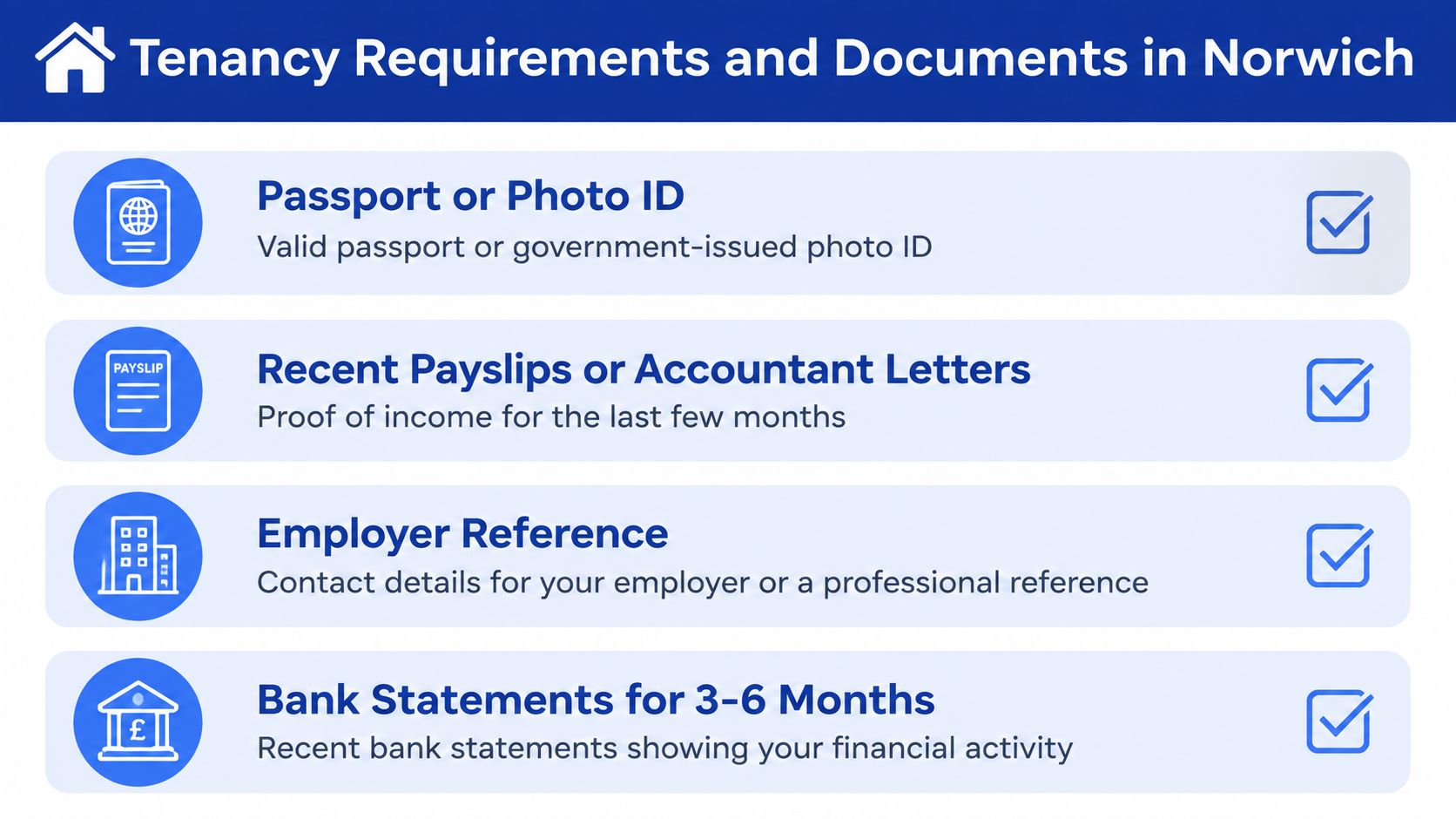
Private renting in Norwich still runs on paperwork, and that's not going away. If you're applying for a standard tenancy in 2026, expect the landlord or agent to ask for passport or photo ID, recent payslips or accountant letters, an employer reference, a previous landlord reference, bank statements, and proof of address dated within 90 days. Students and some contractors will also be asked for a guarantor if their income profile is patchy or their contract is short.
Deposits and checks you should expect
The deposit rules are simple in principle. For tenancies in England and Wales with annual rent below £50,000, the deposit cap is five weeks' rent, and landlords must protect the deposit in one of the three government-authorised schemes within 30 calendar days of receiving it. Those schemes are the Deposit Protection Service (DPS), MyDeposits, and the Tenancy Deposit Scheme (TDS). Government deposit protection guidance Tenancy deposit cap guide
Right to Rent checks still apply, and they're not optional. Agents sometimes try to charge illegal referencing fees, and you should refuse them. Holding deposits can be used to take a property off the market, but they come with strict refund rules, so you need the terms in writing before you pay anything.
If you want a clear reference point for how a professional rental agreement should be presented, this local page is useful: Stay Norwich Apartments rental agreement. For broader tenant-protection reading, Unitism® tenant protection policies is a useful extra reference point when you're comparing how different operators handle deposits and checks.
Where and How to Search Safely
The safest search method is boring, and boring is good. Start with the platform that matches your tenancy type, then verify the property before you send money. In Norwich, that means Rightmove and Zoopla for standard ASTs, OpenRent for direct landlord lets, and Booking.com, Airbnb, or operator websites for serviced and short-stay accommodation.
Match the channel to the property type
If you want an agency-managed tenancy, go through established local names like Abbotts, Bidwells, and William H Brown, plus independent Norwich offices with a visible local track record. If you want a flexible furnished base, look at operator websites first, because that's where you'll usually get the clearest rate structure and the least confusion about inclusions.

Watch for the obvious red flags. Cash deposit requests are a hard no. So are viewings blocked until you hand over paperwork, cloned listings using stock photos, and landlords who won't share the EPC or gas safety certificate. If the story changes every time you ask for documentation, walk away.
Caution beats confidence: A decent landlord or operator can show ownership, compliance, and deposit registration without getting defensive.
Verification routine
Before you pay, check the landlord's ownership via the Land Registry, confirm the deposit scheme registration, and run a reverse image search on the photos. Those three checks won't slow you down much, and they'll save you from avoidable mistakes. In a market like Norwich, where demand is real and good stock moves quickly, speed matters, but verification matters more.
Budgeting and Moving Tips That Save Real Money
The rent number is only the start. The tenancy works or fails on the monthly stack, and Norwich renters who ignore the extras usually feel it within the first billing cycle. Council tax, utilities, transport, and moving costs all need to be thought through before you sign.
The costs people forget
Most Norwich homes sit in council tax bands A to D, and the annual bill is often around £1,400 to £2,100 depending on the band. Older terraced houses can cost more to heat than newer builds, so a cheap-looking rent in a tired property may end up costing more once energy use is added. Water comes through Anglian Water, contents insurance is worth having, and if you're moving a two-bed household, removal costs can run anywhere from £250 to £600 depending on access.

Transport is another easy place to overspend. Norwich is compact enough that walking and cycling cover most daily trips, so a second car is often a poor use of money. If you commute further out, a Norfolk County Council bus pass or a discounted rail season ticket usually makes more sense than adding another vehicle to the household.
For a practical moving checklist that helps you keep the final week under control, this guide is worth using alongside your move plan: Admiral's Yard Self Storage moving guide.
A sensible 30-day plan
Confirm references early: Get your employer, accountant, and previous landlord lined up before you start viewing seriously.
Set up direct debits: Put rent, council tax, and utilities on autopay so nothing slips.
Redirect your post: Do it early enough that bank and NHS letters don't vanish into your old address.
Book checks and reviews: Make sure the EPC and gas safety paperwork are in order before you commit.
The people who move well in Norwich aren't the ones who spend the most. They're the ones who arrive organised, keep their bills visible, and avoid a bad fit on day one.
Matching the Right Rental to Your Situation
The decision really comes down to life stage and stay length. Once you stop thinking in abstract terms and look at the actual profile in front of you, the answer usually becomes obvious.
Best Rental Type by Renter Profile
Renter Profile | Typical Stay | Recommended Option | Why It Fits |
|---|---|---|---|
Contractor on a 3 to 6 month assignment | Short, fixed project | Serviced apartment | Flexible exit, bundled bills, less admin |
Family relocating for schools | Transitional move | Six-month AST first | Time to test the area before locking in |
UEA or City College student | Academic year or term-based | Bills-inclusive purpose-built accommodation | Simpler budgeting, easier move-in |
Relocator without a UK footprint | Early arrival phase | Short-let first, then managed AST | Lets you view properly once you're on the ground |
For a contractor in NR1 or NR2, a serviced apartment usually wins. You get utilities, Wi-Fi, and weekly cleaning bundled in, and you avoid deposit friction at the exact moment you need to be working, not chasing paperwork. For a family moving into Cringleford or Hethersett, a six-month AST is the smarter test period, because it gives you real time to judge schools, traffic, and the feel of the area before you commit longer term.
Students should not overcomplicate it. If you're at UEA or City College, bills-inclusive accommodation near Unthank Road or Dereham Road is the practical answer, not the prettiest listing on a portal. Relocators arriving without a UK footprint should usually take a short-let first, then move into a managed AST once they can attend viewings in person and compare places properly.
The blunt verdict is this. Serviced apartments win on flexibility and certainty. Private lets win on price per square foot if you're staying past six months. Everything else is noise.
If you want a furnished Norwich base that keeps the move simple, Stay Norwich Apartments gives contractors, relocators, and families a practical short-term option with clear rates and a straightforward booking journey. Visit Stay Norwich Apartments to check availability and see whether a serviced apartment fits your stay better than a standard tenancy.
Comments