


Corporate Relocation Housing

Updated: 14 hours ago
A project manager from Manchester arrives in Norwich with two suitcases, a Monday start date and a message from the estate agent: the rental she viewed last week has already gone. Her employer has arranged the job, the travel and the first week of meetings, but nobody has solved the basic problem of where she'll live while the permanent move catches up.
That gap creates the relocation stress. A temporary Airbnb may be available, but the furniture delivery won't match the check-in date, broadband activation needs an appointment, and the employee is expected to make a long-term housing decision before she knows the commute, the neighbourhood or the school catchment. Then come the details most relocation guides skip, including pet arrangements, parking, the radius of a partner's job search and the isolation that can set in during the first month.
Corporate relocation housing exists to keep that difficult week from becoming an expensive chain of emergency decisions. The step-by-step UK relocation guide is useful preparation, but employers still need a practical policy for the period between accepting a role and signing a settled tenancy.
Table of Contents
The Relocation Moment Most People Underestimate - The practical problems that arrive together
What Corporate Relocation Housing Actually Means - Who uses it
Comparing the Main Housing Options - Serviced apartments - Corporate rentals - Hotels and short lets
What Really Drives the Cost - Cost drivers employers should price separately
Employer Policy and Allocation Decisions - Allowance or booked accommodation - Duration and extensions - Family and single-occupant rules
Choosing and Booking a Provider That Delivers - Service standards that matter after arrival - Five negotiation lines that work
Why Norwich and Norfolk Work for Relocation - The regional case in practical terms
Your Relocation Action Plan and Quick Answers - Quick answers
The Relocation Moment Most People Underestimate
The job has started, but the move hasn't finished. That's the awkward middle period where an employee is technically in post yet still living out of bags, making decisions under pressure and paying for temporary fixes.
A short hotel booking might solve the first few nights. It rarely solves the wider problem. The employee needs somewhere to cook, work, store clothes, receive deliveries and establish a routine while viewings, references and tenancy negotiations continue. If a partner or children are moving too, the accommodation also needs enough privacy and space to function as a home rather than a room occupied between meetings.
The practical problems that arrive together
Furniture deliveries often depend on an address that doesn't exist yet. Broadband providers offer installation windows that don't fit a new starter's working day. A pet may need written approval, a parking space or a local vet before the permanent property is ready. A partner may be looking for work across a much wider radius than the employee's commute, which can make a seemingly convenient address a poor household decision.
School catchments create another source of pressure. Families may be pushed towards a rushed tenancy because they believe they need to establish an address immediately. That decision can lock them into a location before they understand transport, wraparound care or the daily journey to work.
Practical rule: Give the employee a proper base first. Ask them to choose a permanent home after they've experienced the city, not while they're exhausted and unpacking beside a suitcase.
The UK housing system makes this pressure harder to ignore. In England, 127,890 households were in temporary accommodation in the fourth quarter of 2024, a 16% year-on-year increase, and those households included 164,040 children, according to the government analysis of temporary accommodation and social housing. Although corporate relocations are a different use case, they face the same basic constraint: suitable, ready-to-live housing isn't always available when a move begins.
An employer that provides a calm, furnished base protects more than productivity. It gives the employee time to assess the commute, test the area and keep the household functioning while the permanent plan develops.
What Corporate Relocation Housing Actually Means
In plain English, corporate relocation housing is furnished, ready-to-move-in accommodation that bridges the gap between a work relocation and a permanent home. The employer may pay directly, subsidise the stay or reimburse the employee under a relocation policy. The purpose isn't a holiday. It's to give someone a reliable place to live while their employment, household and housing arrangements settle.
A useful internal definition is:
Corporate relocation housing is employer-funded or employer-supported furnished accommodation for an employee, contractor or secondee who needs a liveable base during a work-related move or assignment.
Think of it as a long-stay test drive. The employee can learn the city, measure the commute, visit neighbourhoods and assess school options before committing to a conventional tenancy. That's a much better sequence than signing a long lease from a video viewing, then discovering that the journey, parking arrangements or household layout doesn't work.
Who uses it
The first audience is the relocating employee moving permanently or semi-permanently to a new city. Their stay may cover the period between a job offer and a signed tenancy, a delayed completion, a home sale or a renovation.
The second is the contractor or consultant working on a defined project. This person often needs a practical base for an uncertain period, with a kitchen, workspace, laundry facilities and straightforward invoicing.
The third is the employee on a temporary assignment, secondment or internal transfer. They may not need to move their household at all, but they still need accommodation that feels more functional than a hotel room.
Corporate relocation housing isn't the same as business travel. Business travel usually prioritises proximity to meetings and short booking cycles. It isn't the same as a leisure short let, where presentation and visitor appeal may matter more than a stable work routine. It also isn't a conventional private rental, which typically expects a longer commitment, tenant-led furnishing and separate utility arrangements.
The UK category isn't regulated as one single housing product. That matters. Providers can differ sharply in their contracts, safety processes, service standards and approach to extensions, so employers must assess the accommodation rather than rely on the label.
Comparing the Main Housing Options
The right option depends on the employee's actual stay, not the name used in a brochure. A serviced apartment normally suits a two-to-twelve-week arrival period when the employee needs a home base quickly. A corporate rental fits a three-to-twelve-month assignment where a residential feel matters. A hotel or short-term let works for a one-to-three-week intensive stay, an emergency arrival or a family visit.
Criterion | Serviced Apartments | Corporate Rentals | Temporary Housing (Hotel/Short Let) |
|---|---|---|---|
Best fit | Relocation arrivals and project stays | Longer assignments and delayed permanent moves | Short intensives and immediate overflow |
Move-in speed | Usually quick, subject to availability | Can require more checks and preparation | Often fastest for immediate bookings |
Space | Separate living, sleeping and kitchen areas | Residential space, often with more layout choice | Varies from a single room to a whole property |
Kitchen quality | Usually equipped for self-catering | Usually residential and suitable for regular cooking | Hotels may offer limited facilities, short lets vary |
Parking | Must be checked by property | Must be confirmed in the agreement | Depends on the building or host |
Pet policy | Provider-specific and should be agreed before booking | Landlord approval may be required | Varies widely |
Minimum stay | Often flexible for mid-term bookings | Commonly suited to a longer fixed period | Usually flexible, but rates can rise quickly |
Cost structure | Rate may include bills, Wi-Fi and housekeeping | May include bills or require separate arrangements | Hotels bundle service, short lets may add cleaning charges |
Extension flexibility | Usually practical if agreed early | Depends on landlord and contract | Often easy to extend, but availability can change |
Serviced apartments
A serviced apartment is the strongest default for a relocating worker who needs a functioning home without buying furniture or setting up utilities. The employee gets a kitchen, a workspace and separate areas for living and sleeping, while the employer can usually arrange one booking and one invoice. The UK service apartment explainer helps distinguish this model from ordinary hotel accommodation.
Corporate rentals
Corporate rentals make sense when the employee knows the assignment will run for several months and wants a neighbourhood routine. They can offer more residential space, but the employer must inspect the terms carefully. Confirm the bills, maintenance responsibility, deposit, notice provisions, furnishing standard and extension process before treating the property as a simple monthly booking.
Hotels and short lets
Hotels win when speed matters more than space. They're suitable for a late arrival, a short intensive project or the first nights before a managed booking begins. Short lets can provide more privacy, but quality, billing and maintenance vary, so they need stronger due diligence.
The quick rule is simple: choose a hotel for urgency, a serviced apartment for transition and a corporate rental for a settled medium-term assignment.
What Really Drives the Cost
An employee arrives in Norwich with a family, a late project start and no confirmed tenancy. The quoted nightly rate may look manageable, but the final bill will also reflect the booking length, household requirements, included services and travel created by the location. UK housing pressure makes that calculation especially important outside London, where a lower property rate can still produce higher costs if the commute, parking or extension terms are poor.
Stay length usually has the greatest effect. UK contractor accommodation is commonly quoted at £250 to £500 per week in regional cities such as Manchester, Birmingham, Edinburgh and Bristol, while smaller towns and rural areas are commonly quoted at £150 to £300 per week, according to regional contractor accommodation pricing guidance. Monthly bookings can be 10% to 20% cheaper than weekly rates, and stays of several months may receive 20% to 30% discounts, according to the same guidance. For a useful local view, see the breakdown of short-term housing costs in Norfolk before setting an allowance or approving a booking.
Check what the rate includes. Utilities, Wi-Fi, linen, cleaning, VAT and parking may be bundled, or several may appear as extra charges. Compare the complete invoice rather than the headline figure. A cheaper apartment without parking can add daily travel costs, while unreliable Wi-Fi can push an employee towards coworking or hotel day-use arrangements.
Cost drivers employers should price separately
Stay length: Request weekly, monthly and extension rates before approval.
Bedrooms and bathrooms: A family needs privacy and capacity, not merely more floor area.
Location: A city-centre apartment may cost more than an outlying Norfolk property, yet a long commute can add transport costs and fatigue.
Included services: Confirm utilities, Wi-Fi, linen, housekeeping, parking and VAT in writing.
Flexibility: Check the cost of changing dates, adding nights or leaving early.
Household requirements: Pets, accessibility, children and home-working equipment can reduce availability and raise the rate.
Managed contractor housing shows why bundled services matter. In the Midlands, all-inclusive accommodation is often quoted at £22 to £32 per person per night, while typical hotel equivalents are quoted at £75 to £110 per night. In the South West, managed housing is quoted at £25 to £35 per person per night, compared with £80 to £120 per night for hotels, as outlined by contractor accommodation cost guidance. The saving comes from combining utilities, Wi-Fi, linen and weekly cleaning, not just from lowering the room rate.
Region | Studio / 1-bed, 28+ nights | 2-bed family, 28+ nights | Short stay premium, under 7 nights |
|---|---|---|---|
Regional city | Request a monthly furnished quote | Request a family-layout quote | Expect a higher nightly rate |
Smaller town or rural area | Compare monthly and weekly pricing | Check transport and parking costs | Confirm availability before relying on it |
Norwich and Norfolk | Ask for bills-included terms | Confirm beds, workspace and parking | Ask for the full first-week invoice |
Use this formula when forecasting:
Total relocation housing spend = accommodation rate + VAT or charges + parking + housekeeping + deposit exposure + expected extension cost + travel created by the location.
The right employer question is simple: “What will this placement cost until the employee moves into settled housing?”
Employer Policy and Allocation Decisions
Most relocation housing overspends begin before the booking. They start with a vague policy that tells employees to “find somewhere suitable” without defining the allowance, approval route, extension process or household rules.
HR and mobility leads should make three decisions before the next regional relocation.
Allowance or booked accommodation
A lump-sum allowance is fast and gives the employee control. It can also be overgenerous in one city and inadequate in another, leaving the employee to absorb the difference or choose a poor-quality property.
Centrally booked accommodation gives the employer better control over rates, invoices, safety checks and duty of care. It also creates a consistent standard for employees moving between London, Norwich and other regional locations. My default recommendation is managed booking for the initial stay, with a clear allowance process for any permanent tenancy that follows.
Duration and extensions
Set an initial booking period, but don't pretend every move follows the original timetable. A sale can fall through, a tenancy can fail referencing or a building project can run late. The policy should state who approves an extension, how much notice the provider needs and whether the employer will fund a short buffer after the expected move-in date.
England's homelessness framework recognises that some temporary housing periods have no fixed legal maximum before a permanent solution is secured, according to guidance on emergency and temporary accommodation. Corporate policies should borrow the useful principle, flexibility with active review, without leaving an open booking unattended.
Family and single-occupant rules
Define what the policy covers for partners, children and pets. A single employee may need a studio and workspace. A family may need separate bedrooms, cooking facilities, parking and a plan for school travel. A pet clause should be agreed before the booking, not treated as an exception at check-in.
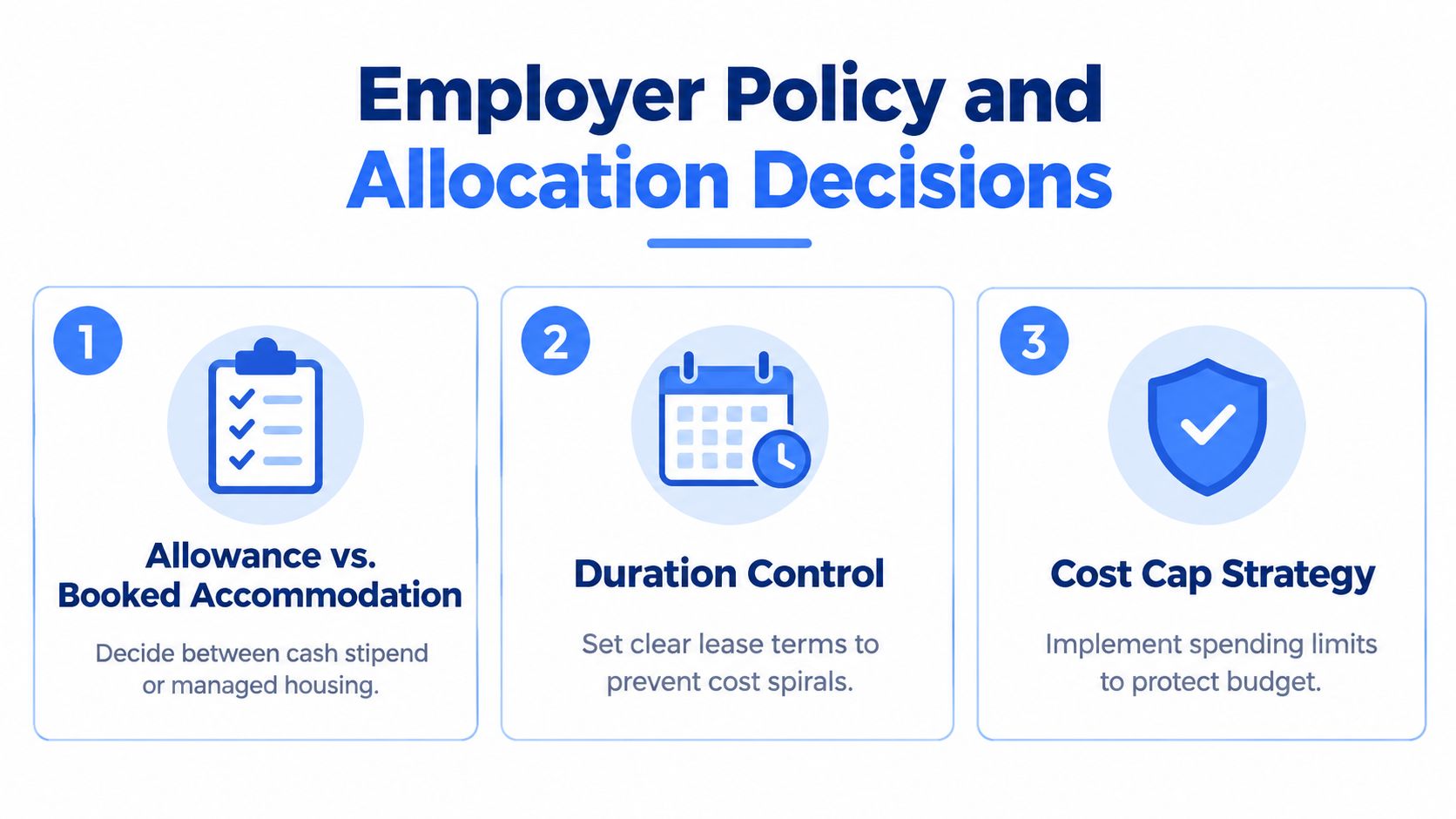
A practical policy can fit on a few pages. Include a maximum nightly or monthly allowance, preferred property standards, approval for exceptions, extension ownership, family eligibility, pet rules and the documents required for invoicing. Review the policy after each move that required an emergency change. That's where the weaknesses show up.
Choosing and Booking a Provider That Delivers
A polished listing proves almost nothing about operational quality. Before booking, ask for documents, service details and commercial terms in writing.
Start with compliance. Confirm the provider's VAT registration status where relevant, ask how fire safety is managed, request evidence of gas safety checks where gas appliances are present and verify public liability insurance. Check guest feedback across more than one platform, looking for repeated comments about cleanliness, heating, Wi-Fi, maintenance and communication rather than isolated praise.
Service standards that matter after arrival
Check-in: Ask whether arrival outside office hours is supported and how access problems are handled.
Connectivity: Request the published Wi-Fi speed or service description if the employee will work from the apartment.
Housekeeping: Confirm the frequency of linen changes, cleaning and rubbish collection.
Maintenance: Find out who responds to a heating, appliance or plumbing fault.
Communication: Get one named contact who can make decisions rather than a generic inbox.
A provider should also state the deposit, cleaning fees, cancellation terms, parking arrangements, pet policy and late-checkout rules. Corporate bookings need invoices that match the employer's finance process. Confirm whether the invoice shows the address, dates, occupants, included services and applicable tax treatment.
The Norfolk accommodation provider guide can help a manager build a local shortlist, but don't stop at a directory entry. Call the provider and test the response before committing. A slow answer during the sales process is a warning about what may happen when the washing machine fails on a Sunday.

Five negotiation lines that work
“Please quote your 28-night rate and every included service in the first proposal.”
“Can you bundle housekeeping into the monthly price rather than adding it separately?”
“If we extend, can you include a complimentary deep clean at the third month?”
“Can the pet fee be waived for a repeat corporate booking?”
“Please lock a maximum extension rate before we confirm the initial stay.”
Those questions expose the true cost and give the provider a clear reason to offer a better commercial arrangement.
Why Norwich and Norfolk Work for Relocation
A London-based housing policy can send an employee to an expensive central location even when the role, project and employer are elsewhere. That decision wastes budget and can make the first weeks of a relocation harder than they need to be.
Norwich gives regional employers a more practical choice. Employees can base themselves in the city centre, reach Norfolk business locations and assess a permanent move without paying for unnecessary London costs. Employers should set the location allowance around the assignment, not copy a capital-city template. The right question is whether the employee can live comfortably, work effectively and test suitable neighbourhoods before committing to a long-term home.
Housing pressure makes that flexibility more important. At the end of the fourth quarter of 2025, 43,040 households owed a temporary accommodation duty were living in a different local authority, up 4.8% year on year, according to the latest statutory homelessness figures for England. This measures the wider housing system rather than corporate relocation, yet it shows why employers should plan for cross-boundary stays. A suitable property may not be available beside the workplace.
The regional case in practical terms
Norwich suits employees working in the city centre, at the University of East Anglia, around Norwich Research Park and in business locations such as Broadland and Hethel. It also gives relocating households a useful base for comparing neighbourhoods, commuting routes and school options across Norfolk. That makes the first booking part of the employer's allocation decision, rather than a temporary fix chosen without local context.
Serviced, self-catering apartments work well when an assignment needs a furnished home, included bills, a proper kitchen, workspace, parking and flexible check-in. Employers can explore Norwich and Norfolk relocation housing solutions to assess local options. A local provider can answer practical questions that a national booking platform may miss, including winter heating, broadband reliability, local transport and the difference between a city-centre address and an out-of-town business park.
Cost Line | Norwich / Norfolk | Central London |
|---|---|---|
Furnished mid-term housing | Compare local monthly quotes and included bills | Compare higher-pressure central availability |
Space for a family | Assess bedrooms, parking and school travel together | Prioritise layout before postcode |
Commute | Match the address to the city or business park | Check travel time and transport cost |
Extension risk | Agree rates before the first booking | Expect availability to change quickly |
Permanent decision | Use the stay to test neighbourhoods | Avoid committing before the household settles |
Location still determines value. A cheap apartment can create an expensive problem through a long commute, poor heating or unreliable internet. Choose accommodation that removes those daily frictions and gives the employee enough time to make a sound permanent decision. Build that judgement into the employer's policy before the booking request reaches a provider.
Your Relocation Action Plan and Quick Answers
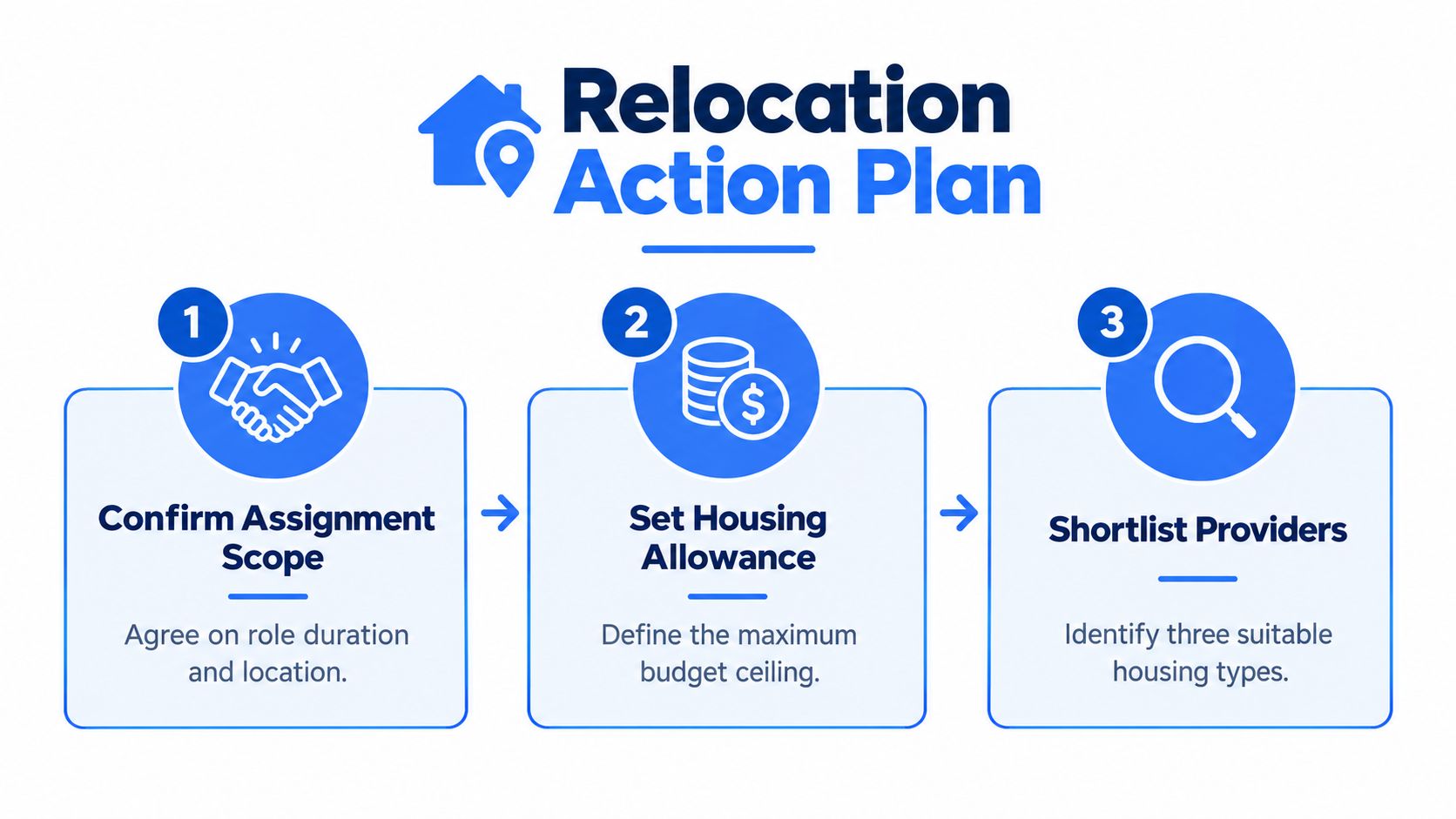
Use this sequence before anyone books:
Confirm the assignment location, household size and likely duration.
Set the maximum housing allowance, including bills, parking and possible extensions.
Shortlist a serviced apartment, a corporate rental and a hotel or short let.
Request like-for-like quotes with every inclusion written down.
Check the contract, deposit, cancellation, notice and checkout clauses.
If the permanent move is uncertain, book a buffer period rather than forcing a rushed tenancy.
Quick answers
Is employer-paid housing taxable? It can create P11D or benefit-in-kind considerations for UK employees. HR or payroll should assess the specific arrangement rather than assuming temporary accommodation is automatically exempt.
Who pays the deposit? Corporate bookings may be paid directly by the employer, held by the provider or recovered through an agreed reimbursement process. Put responsibility for damage, deductions and return dates in writing.
Can partners and pets come? Often, but only when the property, policy and provider agreement allow it. Confirm occupants and animals before payment.
What notice applies to a three-month serviced stay? There isn't one universal standard. Ask for the exact cancellation and extension terms before booking, especially if the move-in date can change.
Does relocation housing affect Right to Work or Right to Rent checks? Employers still need to handle employment eligibility correctly, and providers may require the relevant occupancy or identity checks. Confirm which party collects which documents.
For the softer side of settling in, a practical resource such as the SouthShore Fine Linens moving guide can help a household make a temporary bedroom feel organised rather than improvised.
The lowest-friction option is usually a serviced apartment when the regional city, assignment length and provider terms all match.
Landlords direct with Stay Norwich Apartments, Norfolk, furnished accommodation when you need it, for as long as you need it. No hassle, no drama, pay and stay. Visit Stay Norwich Apartments to discuss a furnished Norwich base for relocating employees, contractors or households between homes.
Comments