


Erpingham Gate Norwich: History and How to Visit

Erpingham Gate is a free-to-view medieval gateway of about 1420 on Tombland, opposite the west front of Norwich Cathedral. Walking through it into the Cathedral Close is a separate visit and depends on current cathedral arrangements.
You might have a gap between meetings, a train to catch later, or a suitcase that makes a longer sightseeing walk unappealing. This is a landmark you can appreciate without committing to a cathedral visit, provided you stop on the street side and know where to look.
The useful distinction is seeing the gate versus entering the precinct. Make the first your reliable plan, and treat anything beyond the arch as an optional extension.
Table of Contents
A Ten Minute Stop at Erpingham Gate - Choose the visit that fits your day - Keep the stop easy to manage
Who Built the Gate and Why It Still Matters - From military service to a Norwich gift - Why the kneeling figure matters
Flint Stone and the Figures Above the Arch - Read the gateway from the ground upwards - Photograph the details without handling them
How to Reach the Gate from the City - Compare your arrival options - Choose a clear meeting point
Quieter Hours Around the Cathedral Close - Put city-centre footfall in perspective
Two Walks After the Gate - A short add-on around the entrance - A longer loop through the historic centre
Stay Near the Gate with Stay Norwich Apartments - A base for work and time off - Book directly and keep contact simple
A Ten Minute Stop at Erpingham Gate
Stand on Tombland, facing the gateway and the cathedral's west front beyond it. The exterior is an outdoor monument visible from the public street without a ticket, while passage through the arch is subject to the Close's current access arrangements.
The exterior has no ticket and no opening hours: you can see it whenever you pass, including early morning. The Cathedral and the Close don't share a single published gate time here, so confirm both before entering. The cathedral interior follows cathedral opening times and whatever admission arrangements are then in force.
Choose the visit that fits your day
Ways to visit Erpingham Gate
Visit | Time to allow | Access | Best for |
|---|---|---|---|
Exterior from Tombland | About 10 minutes | Public street, no ticket | A predictable short stop |
Through the arch into the Close | Check the day's cathedral arrangements | Precinct access can change; historic surfaces | Seeing the gate as an entrance |
Norwich Cathedral after the gate | Allow longer than the gate alone | Cathedral opening times apply | Interior and services |
Wheelchair, limited mobility or pushchair | Add time to assess the route | Uneven historic surfaces likely; verify step-free access | A calm look from Tombland |
Photography | Early weekday morning | Exterior viewable from the street | Quiet light without peak footfall |
Treat the short exterior stop as a suggested itinerary, not a timed attraction. Take in the whole gateway first, look above the arch, then decide whether you have the time and energy to continue.
For wheelchair users, people with limited mobility, families with pushchairs and anyone pulling luggage, pause before entering the precinct. Historic ground beyond the arch can be uneven, and a visible opening doesn't establish that the whole onward route is step-free. Confirm the suitable entrance and route rather than assuming you can negotiate every surface.
The Historic England designation identifies the gate at National Grid Reference TG 23356 08874 as a scheduled monument and Grade I listed structure, built around 1420 and restored during the 19th and 20th centuries. You're looking at medieval fabric alongside later conservation, not an untouched original.
Practical rule: Look closely without touching carved surfaces. Don't fix anything to the masonry or let children use the archway as a climbing frame.
Keep the stop easy to manage
Carry only what you need if you're fitting sightseeing around work. For visitors packing for a wider trip, HYDAWAY's guide to collapsible travel essentials from HYDAWAY offers useful ideas for reducing bulky items in a day bag.
Use our Norwich Cathedral guide to decide whether the interior deserves a separate outing. Before leaving work or your accommodation, check the cathedral's arrangements for that day rather than building your schedule around assumed access.
Who Built the Gate and Why It Still Matters
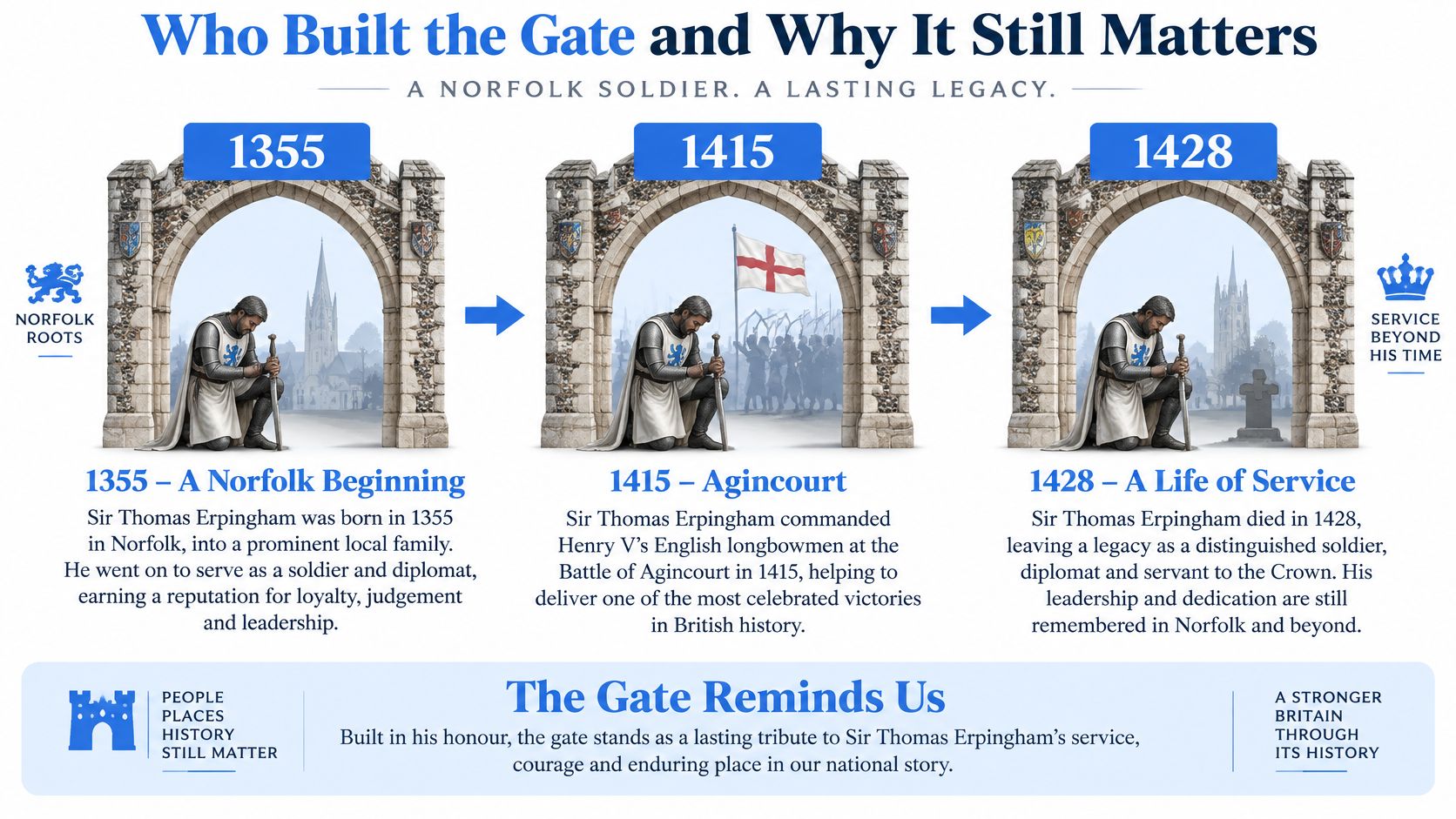
The person above the arch makes more sense once you know the sequence of his life. Sir Thomas Erpingham was a Norfolk soldier and diplomat, not just a name attached to an attractive entrance.
Norwich City Council's heritage guide gives his lifespan as 1355 to 1428, associates him with command of Henry V's English longbow archers at Agincourt in 1415, and dates the gateway to 1420–1435, saying he probably paid for it. That places the gift's origins in the closing phase of his life, following his best-known military service, although the broader building range extends beyond his death.
From military service to a Norwich gift
Agincourt was one of the best-known English victories of the Hundred Years' War. For a visitor standing on Tombland, the important connection isn't a detailed account of the fighting: it's that a Norfolk figure associated with national military history also left a conspicuous mark on his own city.
Think of two different ways a powerful person might be remembered. One is a monument devoted entirely to victory, designed to make the viewer think about a battlefield. Another is a useful building bearing the identity of the person who helped provide it.
Erpingham Gate is easier to understand through the second idea. It's less a triumphal arch than a signed doorway, a thank-you expressed in flint and stone at the entrance to the Cathedral Close.
Why the kneeling figure matters
Look up and the benefactor becomes visible. His kneeling figure occupies a niche above the arch, connecting the person who supported the gateway with the precinct it serves.
The posture matters to how you read the building. You aren't looking at a soldier charging across a battlefield or standing over defeated opponents. The figure is kneeling, and the setting is an entrance associated with the cathedral.
That doesn't require you to guess at every private motive behind the gift. It gives you something firmer: a named benefactor, an entrance people could use, and a deliberate representation linking the two.
Read the figure as a signature on the building, rather than assuming every decorated arch is a victory monument.
Tombland also places the gift within Norwich's civic and commercial life. This wasn't an isolated memorial encountered only by people seeking it out. It stood where city life met the cathedral precinct, making the benefactor's identity part of an everyday approach.
If you're exploring medieval Norwich, that relationship is worth noticing elsewhere too: who provided a building, what purpose it served, and how its decoration identified its supporters. Here, knowing who is kneeling lets you read the surrounding carvings as parts of a coherent building rather than a collection of unfamiliar faces.
Flint Stone and the Figures Above the Arch
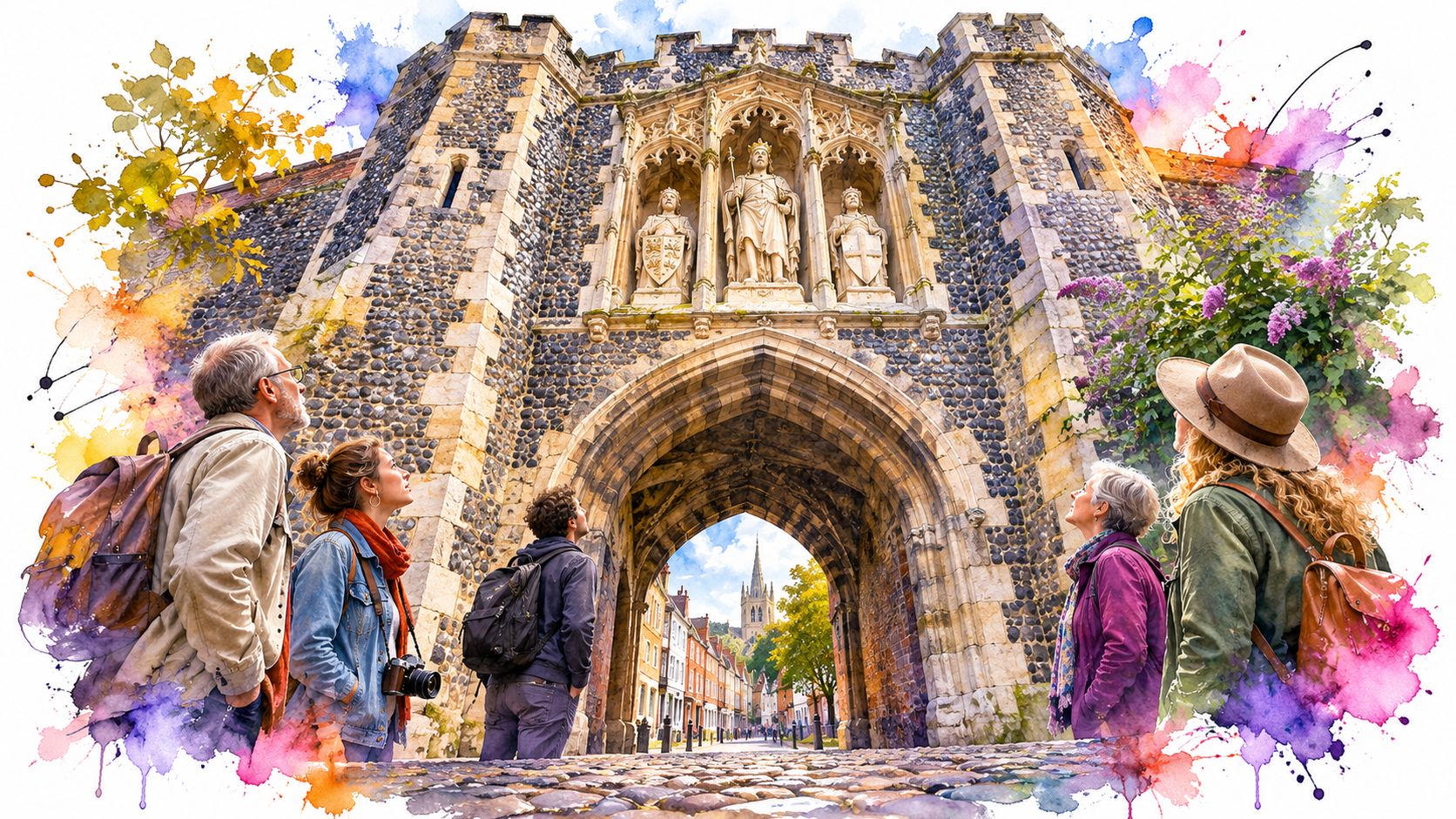
Start with the materials before trying to identify individual figures. The contrast between the darker walling and the shaped stone helps you separate the gateway's structure from its decoration.
The Norfolk Heritage Explorer record dates the gateway to approximately 1420, identifies Erpingham as its donor, and describes its flint-and-stone construction, polygonal buttresses, heraldic features, saints and kneeling benefactor; it also records the national listing reference 1372788. The principal sculptural and heraldic scheme remains substantially intact despite conservation work.
Read the gateway from the ground upwards
Flint and stone are a characteristic East Anglian pairing. Flint provides much of the walling, while worked stone allows builders and carvers to form precise edges, architectural details and figures.
Look first at the projecting supports beside the opening. The polygonal buttresses have several faces rather than presenting as plain rectangular blocks, so shifting daylight makes their shape easier to read.
Then let your eye travel upwards:
Heraldic panels use shields and related devices to express identity and association. You don't need to identify every emblem to recognise their role.
Saints' figures place religious imagery within the gateway's decoration.
The kneeling niche brings Erpingham himself into the same arrangement, above the route into the precinct.
Photograph the details without handling them
The survival of the overall scheme matters more than whether every visible surface is untouched medieval work. Think of a repaired medieval book: an old text can survive with a later binding, and careful repair doesn't erase the value of what remains.
For photographs from Tombland, try the arch profile with the cathedral's west front beyond, then a closer view of the kneeling niche, and finally a heraldic or saint panel. Change your position rather than moving close enough to brace yourself against the monument.
Keep the pavement usable while you compose the shot. If someone is passing, lower the camera and let them through rather than backing into their route.
National recognition has ordinary, practical consequences here. Don't attach signs, attempt to clean marks, lean bicycles or equipment against the masonry, or put your hands on carved faces. These details need only a small part of your short stop, not a lengthy art-history session.
How to Reach the Gate from the City
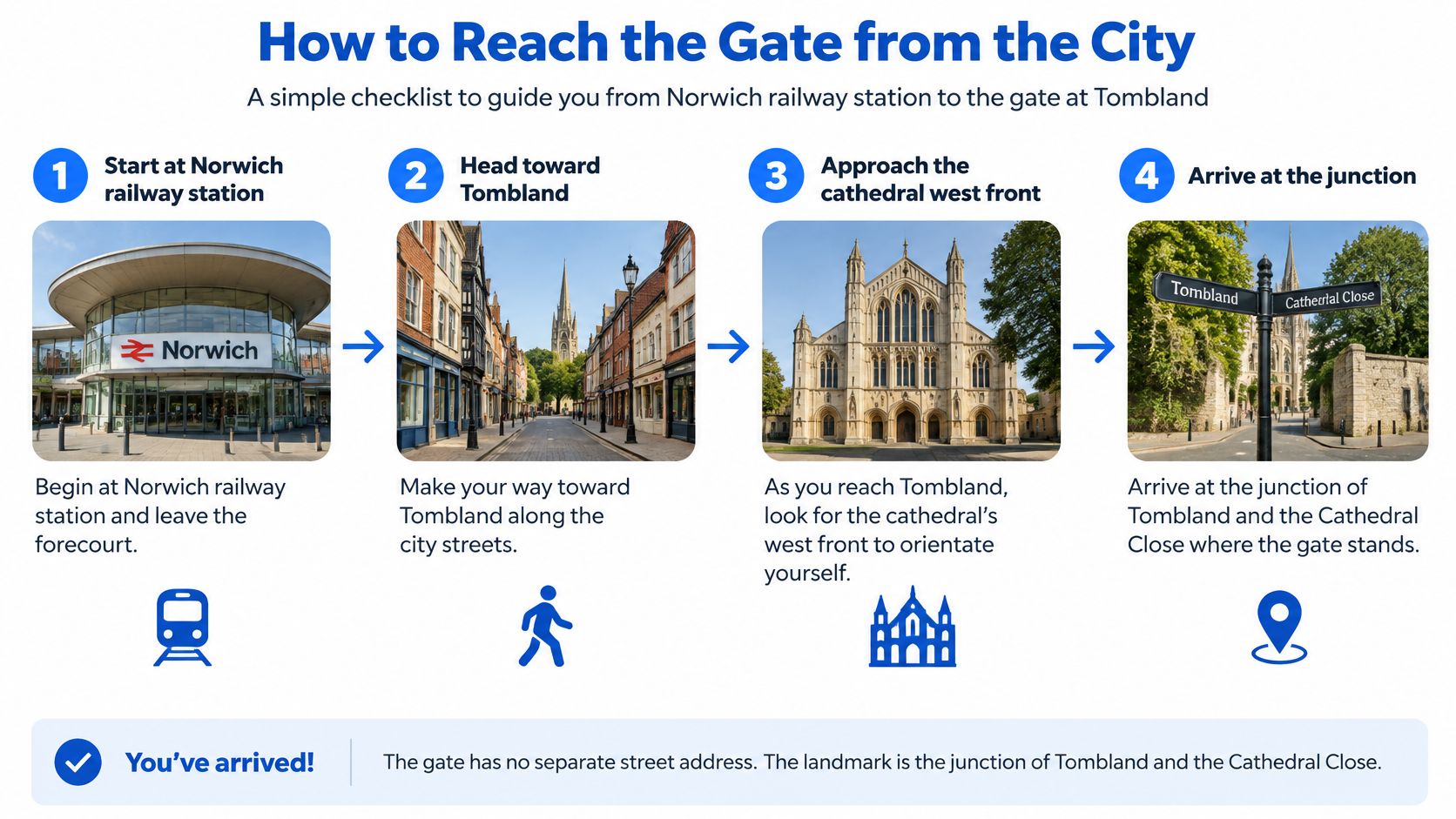
For Erpingham Gate, Norwich visitors should aim for Tombland and the cathedral's west front, rather than search for a separate numbered street address. The useful landmark is the junction of Tombland and the Cathedral Close.
From Norwich railway station, head towards the city centre and then Tombland. Use the cathedral spire as a broad bearing when it's visible, but use the west front to identify the final approach: that's the end of the cathedral opposite the gate.
Compare your arrival options
Ways to arrive at Erpingham Gate
Mode | Start | What to expect | Tip |
|---|---|---|---|
Walk | Norwich railway station | A short walk through the city centre to Tombland | Use the cathedral spire and west front as the final bearing |
Bus | City-centre stops | Tombland sits in the historic core | Check live times on the day |
Car | City-centre car parks | No parking against the monument | Walk the last part |
Cycle | City cycle routes | Dismount near the gateway | Don't lock a bike to the stonework |
Taxi or drop-off | Tombland | A brief stop on the public side where stopping is permitted | Meet outside the arch, not inside the Close |
City-centre bus stops and car parks serve the historic core, with the final approach made on foot. Don't assume the closest point on a map will be the easiest arrival: a straightforward pavement route can be preferable to a more awkward approach with bags.
For drivers, our Norwich Cathedral parking guide helps you plan the parking part separately. For a taxi, ask for a permitted stopping place on the Tombland side rather than expecting access into the precinct.
Choose a clear meeting point
Arrange to meet outside the arch on Tombland, standing clear of the passage. That makes your meeting independent of precinct access and avoids anyone waiting on the wrong side.
A suitcase doesn't prevent an exterior look, but heavy cases make a cathedral visit less comfortable. Leave luggage at your accommodation first if you intend to spend time inside, and confirm any bag arrangements rather than assuming storage will be available.
City-centre bases in NR1, NR2 and NR3 can make the gate an easy outing rather than a separate excursion. Check the actual walking route from your door, especially if you're arriving after work or carrying equipment.
Quieter Hours Around the Cathedral Close
A major busy period isn't the best choice for this small outdoor monument. An early weekday morning is a sensible photography window, although it's a recommendation rather than a promise of an empty arch.
Norwich City Council's economic barometer recorded 9,225,825 city-centre visitors year-to-date by July 2025, 2.5% lower than the previous year; July alone recorded 1,255,442, with a busiest day of 60,157 and a peak hour of 8,690. The later October barometer reported 12,049,039 year-to-date visitors, 2.8% below the comparable period.
Put city-centre footfall in perspective
Norwich city-centre footfall in 2025
Period | Visitors | Change | What it means at the gate |
|---|---|---|---|
Year to July 2025 | 9,225,825 | 2.5% lower than the year before | The centre is busy, but not busier every year |
July 2025 | 1,255,442 | Busiest day 60,157; peak hour 8,690 | Avoid that kind of peak hour for photos |
Year to October 2025 | 12,049,039 | 2.8% below the comparable period | A weekday morning is still the calmer bet |
These are city-centre figures, not counts beneath Erpingham Gate. They show a heavily visited centre with slightly softer footfall, not evidence that every attraction is becoming busier.
Saturday shopping periods and cathedral services can concentrate people around the entrance even when surrounding streets feel manageable. A weekday lunchtime still suits someone between meetings, provided the plan remains an exterior look rather than an uncertain longer visit.
Come early on a workday for photographs. Don't make a Saturday peak period your only opportunity to see the gate.
Rain changes the practical experience more than the history. Wet flint becomes darker and striking to photograph, but wet stone and cobbles can be slippery, so keep to the Tombland viewpoint if footing is a concern.
Two Walks After the Gate
Once you've finished looking from Tombland, choose whether to stay near the entrance or make the gate the start of a longer outing. The best choice is the one that leaves enough energy and time to get back comfortably.
A short add-on around the entrance
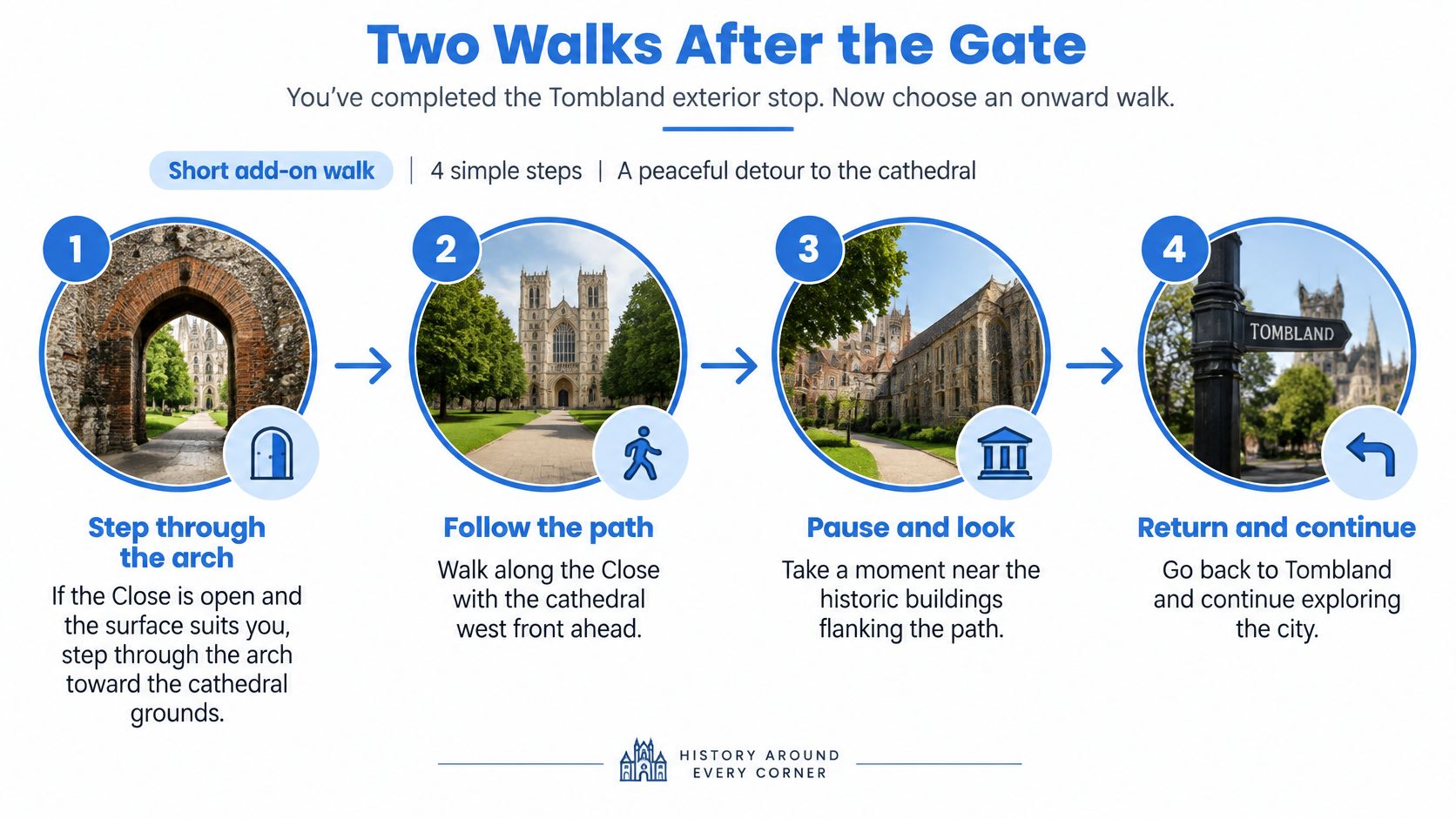
Check before passing through. If the Close is open and the surface suits you, step through the arch towards Norwich Cathedral. Keep clear of anyone coming the other way.
Make the route optional. If cobbles or level changes look difficult for a wheelchair, pushchair or luggage, remain on Tombland instead. There's no need to turn a pleasant stop into a difficult crossing.
Pause rather than press on. Choose a café on Tombland if you're tired or waiting for someone. A seat is more useful than adding another destination because it's nearby.
Regroup outside. Meet companions on the public side of the arch so everyone has a clear return point.
The illustration shows a possible continuation through the precinct when access and conditions suit you, not a route you must complete.
A longer loop through the historic centre
For example, reserve 45–90 minutes for an unhurried outing, adjusting that personal allowance if you want to spend longer inside the cathedral.
Start at the gate and decide whether you're walking continuously or stopping indoors.
Enter Norwich Cathedral if it's open and a visit fits your available time.
Continue towards Bishopgate, choosing a route that suits your mobility and the day's access.
Return towards the market, where you can finish the walk or stop for food.
Add a city museum only if energy remains. With a substantial museum visit, this becomes a half-day plan rather than a quick circuit.
Contractors and short-stay visitors can save this longer option for a free afternoon. The gate can remain a brief before-work visit without creating pressure to fit the whole historic centre into the same outing.
If you'd rather walk with a guide, compare our Norwich walking tour options and check the meeting point before booking. Organisers arranging their own guided outings can use Samba to manage tip-based walking tours, keeping tour administration separate from the route itself.
Stay Near the Gate with Stay Norwich Apartments
This post is sponsored by Stay Norwich Apartments, your furnished rental accommodation provider in Norwich, Norfolk, offering temporary or short-term furnished accommodation. You never know when you might need it. Rest assured that Stay Norwich Apartments will have you covered.
Our business address is 17 Colegate, Norwich NR3 1BN. Our properties are close to the train station, Norwich Cathedral, the market and the main employment sites in and around the city, making the historic centre practical to explore around work.
A base for work and time off
A furnished apartment with a kitchen suits a visit that mixes ordinary routines with sightseeing. You can prepare breakfast, take a short walk to the gate, and leave the longer cathedral outing for a less crowded part of your schedule.
That flexibility is useful whether you're here for leisure, a contract, relocation or a gap between homes. Our guide to serviced accommodation in Norwich explains the accommodation format if you're deciding what suits your stay.
Book directly and keep contact simple
Booking directly at staynorwichapartments.com gets you the best available rate and a direct line to us if anything comes up. Direct bookings have no platform fees, while Airbnb and Booking.com add fees.
Use our property search to explore accommodation, or call 01603 477522 to discuss your plans. Keep the sightseeing decision simple: see the gate free from Tombland, confirm Close access on the day, and allow about ten minutes for your first look.
Stay Norwich Apartments offers furnished, self-catering accommodation for short visits and longer temporary stays, with a city-centre base for exploring Erpingham Gate around your own schedule. Visit Stay Norwich Apartments to choose your accommodation, then plan your walk to Tombland and the cathedral's west front.
Comments