


Norwich Castle Dungeons History and Visit Guide

Norwich Castle's dungeons are the basement of the stone keep, later used inside Norfolk's county gaol until the prison closed on 2 August 1887, not a room built as a medieval torture chamber. From about 1300 that documented prison role runs for roughly 587 years, and the basement you walk through was only one part of a complex recorded with 276 cells.
Plenty of visit write-ups still tell you to brace for a purpose-built torture maze, and to treat the restored castle as step-free from the door all the way down. That advice flattens two different buildings into one scare story. The cold stone under the royal rooms started as a service floor. The locks, the wet cells and the strict sorting of prisoners came centuries later, inside a county gaol that spilled far beyond the keep. The castle's lifts get you into the palace rooms. They do not flatten the steps into the basement.
Table of Contents
What the Norwich Castle Dungeons Actually Are - A basement is not the whole gaol
How a Royal Keep Became a County Gaol - From a royal residence to a waiting gaol - The 1820s rebuild and the museum
Cells Water and Who Was Locked Below - Why the floor was wet - Separate rooms, separate jobs
Stories That Do Not Match the Evidence - Three claims, tested - What you can keep
Access Families and the Feel of the Descent - Who the descent suits - Hearing the same history without the steps
Tickets Routes and the Best Time to Go - If the basement is shut
What the Norwich Castle Dungeons Actually Are
Say you book a dungeon slot because a poster promised a medieval torture chamber under the mound. You come down into a low stone room and wait for the rack. What you are standing in is the basement of a Norman keep, and the drama has been fitted on afterwards.
Historic England's listing places Norwich Castle's current dungeons in the basement of a stone keep built approximately between 1094 and 1121, on the site of an earlier timber fortification on the motte. The fabric is deliberate. Rubble stone was used at basement level. Finer ashlar blocks formed the hall-level walls, with only limited flint. Heavier, less refined masonry at the bottom is what you use when a floor has to carry the rooms above it. It is not the signature of a prison designed from scratch.
Think of a house cellar later fitted with a lock. The cellar explains the house: cool, load-bearing, out of the way of the best rooms. The lock explains a later decision about who was allowed down there. Norwich Castle's dungeons work the same way. The 12th-century structure is a service floor under the principal royal rooms. Custodial use is a later chapter, written into that fabric over centuries of alteration. Uneven walls, tight circulation and patched openings are not a failed visitor attraction. They are what a continuously modified medieval building feels like when you are staying in the centre and walking up to it.
A basement is not the whole gaol
The space on the tour is one surviving piece of a much larger county-gaol complex, not the prison in full, and not a medieval oubliette dug for punishment. Most of the later cells stood in wings built around the keep. Folding all of that into “the dungeon” is how the torture-chamber myth gets its legs.
What the basement does show, clearly, is the split you need before you buy a ticket.
The building: a Norman service level, rubble below and dressed stone above, made to hold up a royal palace.
The records: centuries of county prisoners, sorted, rebuilt around, and eventually moved out.
The visit: a short, constrained descent inside a keep that has been changed again and again.
The rest of this guide follows that split. A dated line runs from the stone keep to the museum. Then the cells themselves: who was locked below, and in what conditions. After that, the dramatic claims that fail once you ask for a date and a specific room. Then who can manage the steps, how to time the day in the centre, and where to sleep if the mound, the market and the Cathedral are the point of the trip.
How a Royal Keep Became a County Gaol
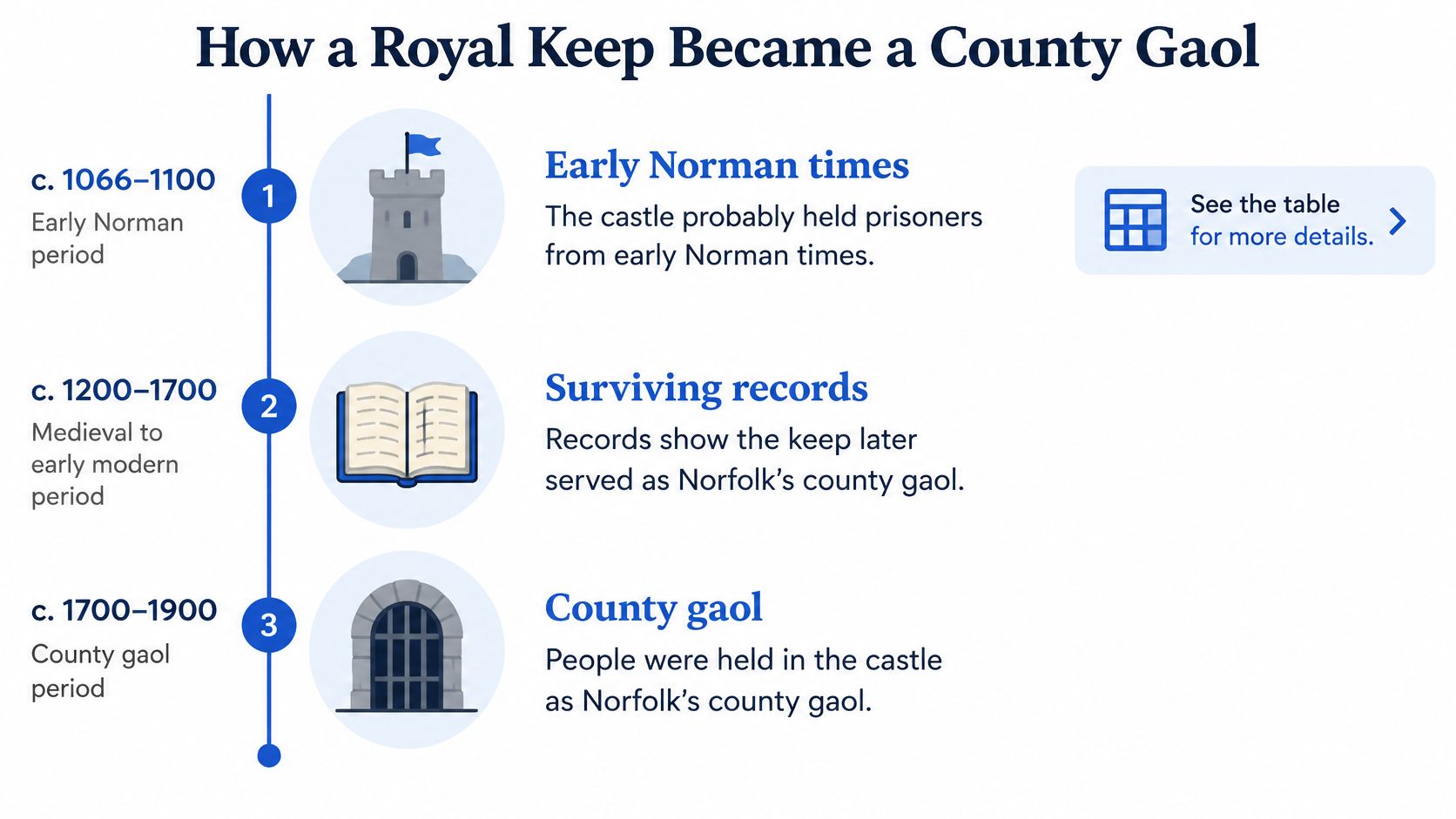
The castle's prison story changes shape once you line up the dates. In the Norfolk Record Office's account of prisons and prisoners, the county gaol finally closed on 2 August 1887, after a documented run of roughly 587 years from about 1300. The same account records 276 cells after the 1820s rebuild.
Date | What changed | What visitors should take from it |
|---|---|---|
c.1094–1121 | Stone keep replaces a timber fort; rubble basement under ashlar halls | Basement built as a service floor, not a prison |
By about 1300 | Keep mainly in use as a prison | Custodial use is medieval, but later than the original build |
1345 | Edward III transfers the former royal residence to Norfolk as the county gaol | Start of the long county-prison role |
1824–1828 | Gaol rebuilt at a reported £50,000; 240 cells in new wings and 36 in the keep, 276 in all | The visible dungeon is only part of the complex |
2 August 1887 | Prison closes; inmates move to Mousehold Heath | End of roughly 587 years of documented prison use from c.1300 |
1888 onwards | Former prison site converted into a museum | Basement kept as evidence of judicial history |
From a royal residence to a waiting gaol
A royal keep works like a building with two lives layered inside the same walls. Norwich Castle began with a Norman service basement beneath its high-status rooms. Custody came later, then grew into a county system with courts, officers, cells and rebuilding programmes.
The castle probably contained prison accommodation from its earliest Norman period. Official records, though, pin its later role as Norfolk's county gaol, holding people who were awaiting trial at the Norfolk Quarter Sessions and Assizes. That makes it a waiting prison tied to the courts. It gives no support to the idea of a royal dungeon built for spectacle.
Historic England records that the keep was mainly being used as a prison by about 1300. Custodial use is medieval. It is also later than the stone build. Wider Norwich helps here: the castle's change of job belongs with the city's medieval routes, market and street pattern, covered in this guide to medieval Norwich.
In 1345 the former royal residence passed to the county, and the long county-prison role began in earnest. Repairing a palace the Crown no longer wanted was the expensive option. The county took the building and used it to hold people for the courts. From that transfer until the late Victorian closure, the keep and its surroundings were repeatedly rebuilt as ideas of security, classification, sanitation and prison reform changed. You are not looking at one frozen medieval interior.
The 1820s rebuild and the museum
A major gaol project begun in 1824 was completed in 1828 at a reported cost of £50,000. Associated wings contained 240 cells. The old keep contained a further 36. Together that is 276 cells across the principal prison buildings. Stand in today's basement and you are in one component of that total, not a scale model of the whole gaol.
The wording matters. The basement tour explains a surviving part of the prison story. The larger complex included wings, yards and rooms arranged for a working county gaol. When those parts are folded into one “dungeon”, the date, purpose and building type all blur together.
On 2 August 1887 the prison closed. Inmates transferred to a purpose-built facility on Mousehold Heath. That date ends the documented span from about 1300. The museum conversion followed in 1888, which is why the keep's basement spaces survived as evidence of Norwich's judicial and penal history rather than being cleared for a new civic block.
Practical rule: If a caption gives you a torture scene but no date, ask which row of this table it belongs to. A service basement, a medieval prison keep, an 1820s cell wing and a museum are four different answers.
Cells Water and Who Was Locked Below
The male-felon cell is where the castle basement becomes easy to misread. A surviving description, set out in Catherine Meyrick's account of the palace and prison, records men descending by an eight-step ladder into a dungeon often covered by one or two inches of water. Women felons had a small separate room. Sick prisoners had two airier rooms, kept apart so infection had less chance of spreading through the whole prison. The same male-felon space was also recorded as flooded.
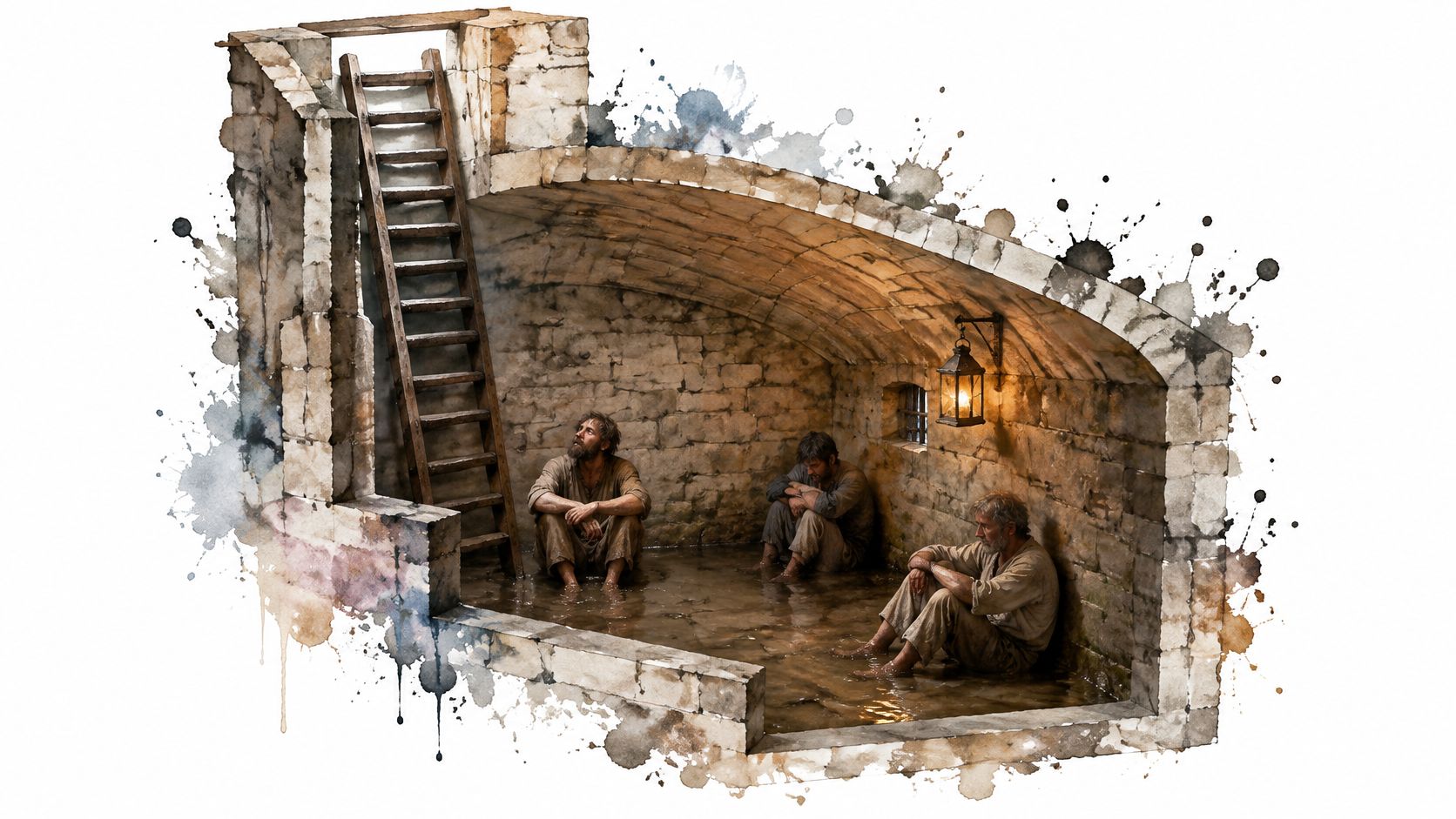
Male felons went down a ladder of eight steps into a space often covered by one or two inches of water. Women were kept apart. Sick prisoners had two airier rooms of their own.
Why the floor was wet
The archaeological note from the castle redevelopment matches that wet floor and gives a comparable measure of roughly 1–2 inches, up to about 5 cm. The cause was practical rather than theatrical. Drainage was inadequate, and below-ground rooms held damp air and water. In a crowded custodial space, that meant more discomfort and a higher risk of disease.
A useful analogy is a cellar with a failed drain. The water itself is not the punishment device. The punishment was confinement, and the damp made that confinement worse. This distinction matters because it separates the county gaol's cells from the older Norman service basement below the royal rooms. The basement had a working role first. Prison use came later.
Recent interpretation, including the local guide to the castle's prison years, describes underground spaces holding men, women and children who were awaiting trial, execution or deportation. That changes how the rooms should be read. Many people locked below were held while a court process moved onward, rather than serving one long sentence in a single cell.
Who | Where | Recorded conditions | Why it mattered |
|---|---|---|---|
Male felons | Dungeon reached by an eight-step ladder | Often 1–2 inches of water, up to about 5 cm | Damp, cramped confinement and higher disease risk |
Women felons | Small separate room | Not placed with the men | Segregation inside the county gaol |
Sick prisoners | Two airier rooms set apart | Positioned to limit the spread of infection | Isolation as a practical health rule |
People awaiting trial, execution or deportation, including children | Underground spaces in the prison keep | Severe crowding rather than a single long sentence | Holding space, not only a punishment cell |
Separate rooms, separate jobs
The rooms worked like different parts of a prison routine. Women were kept out of the men's wet cell. Sick prisoners had airier rooms away from the main holding spaces. Officials may not have understood infection in modern terms, but separation still reduced the chance of illness moving through everyone.
The small separate room for women is best read as county-gaol segregation. It was part of how the prison sorted people by sex and status. The two sick rooms served another purpose: isolation. That makes the floor plan more like a working institution than a set of identical underground pits.
The mound also limits what can be learned. Drainage works, lift shafts and stair foundations required careful archaeological work because the Norman mound is archaeologically significant. Proposed pile investigations were limited to small pits. Visitors therefore see a conserved basement, with gaps in the evidence that cannot be opened up for a clearer story.
Read the table as a working county gaol pressed into a palace basement. Access, water, sex and sickness each had a place. The people locked below were often waiting for a court outcome, which gives these rooms their bleakest meaning. They held people in uncertainty, in damp and in cramped conditions, under a system that kept changing the building around them.
Stories That Do Not Match the Evidence
The claim you will hear first is the blunt one. These Norwich Castle dungeons were built as a torture chamber. The masonry says otherwise, and so does the length of time the county kept altering the building.
BBC coverage of the castle's prison story records that Norwich Castle became Norfolk's county gaol in 1345, after Edward III decided that repairing the former royal residence was too expensive and transferred it to the county. It then operated as a prison for more than five centuries, until 1887. Across that span the keep and basement were repeatedly altered as prison needs changed. A space changed that often was not created for one medieval purpose.
Three claims, tested
The basement was not built as a dungeon. Its heavy rubble is the Norman service level under the royal rooms. Prison fittings belong to later centuries of county use. If a tour starts the prison story in the 1090s, it has skipped the gap between a palace basement and a gaol.
Not every grim feature is the same room. A coal chute, the dungeon access steps and the flooded male-felon cell had separate jobs. Archaeological evidence indicates that one staircase descended into the basement of a prison treadmill room, where inmates were sent to work as punishment. That stair is a labour punishment, not the wet felons' cell, and not a torture pit. The museum's heritage summary records the flooded male-felon dungeon as its own space. Later reforms demanded increasingly strict separation between categories of prisoners. Folding chute, steps, treadmill and wet cell into one chamber blurs the building.
The castle prison was not only the keep. The nineteenth-century wings held the bulk of the cells. The basement cannot stand in for the whole gaol, any more than one interview room can stand for a courthouse. Norwich's other court setting, the Guildhall, is a useful reminder that justice in this city was never a single underground room.
What you can keep
What the records do support is cramped holding of men, women and children, disease that spread quickly, and a male-felon floor that stood in water. Drop the unsourced colour: racks, secret trapdoors, a chamber built only to frighten. On-site panels may now be fuller than an older blog, because interpretation was being refreshed after the basement was cleared and reopened. A sensational caption should be checked against those panels before you repeat it.
Use a simple test on any story you hear in the stair.
A date: which century, or which rebuild, does the claim belong to?
A category: men awaiting trial, women felons, sick prisoners, or someone on the treadmill?
A space: the wet cell, the separate room, the chute, or a wing that no longer stands?
If a story cannot name a date, a prisoner category and a specific space, treat it as atmosphere. These were practical prison rooms inside a later county gaol, not a single medieval torture set.
Access Families and the Feel of the Descent
The restored keep is often described as if every room, dungeons included, were level. That is the claim that catches wheelchair users, parents with a pushchair, and anyone who needs to know how a space will feel before they book.
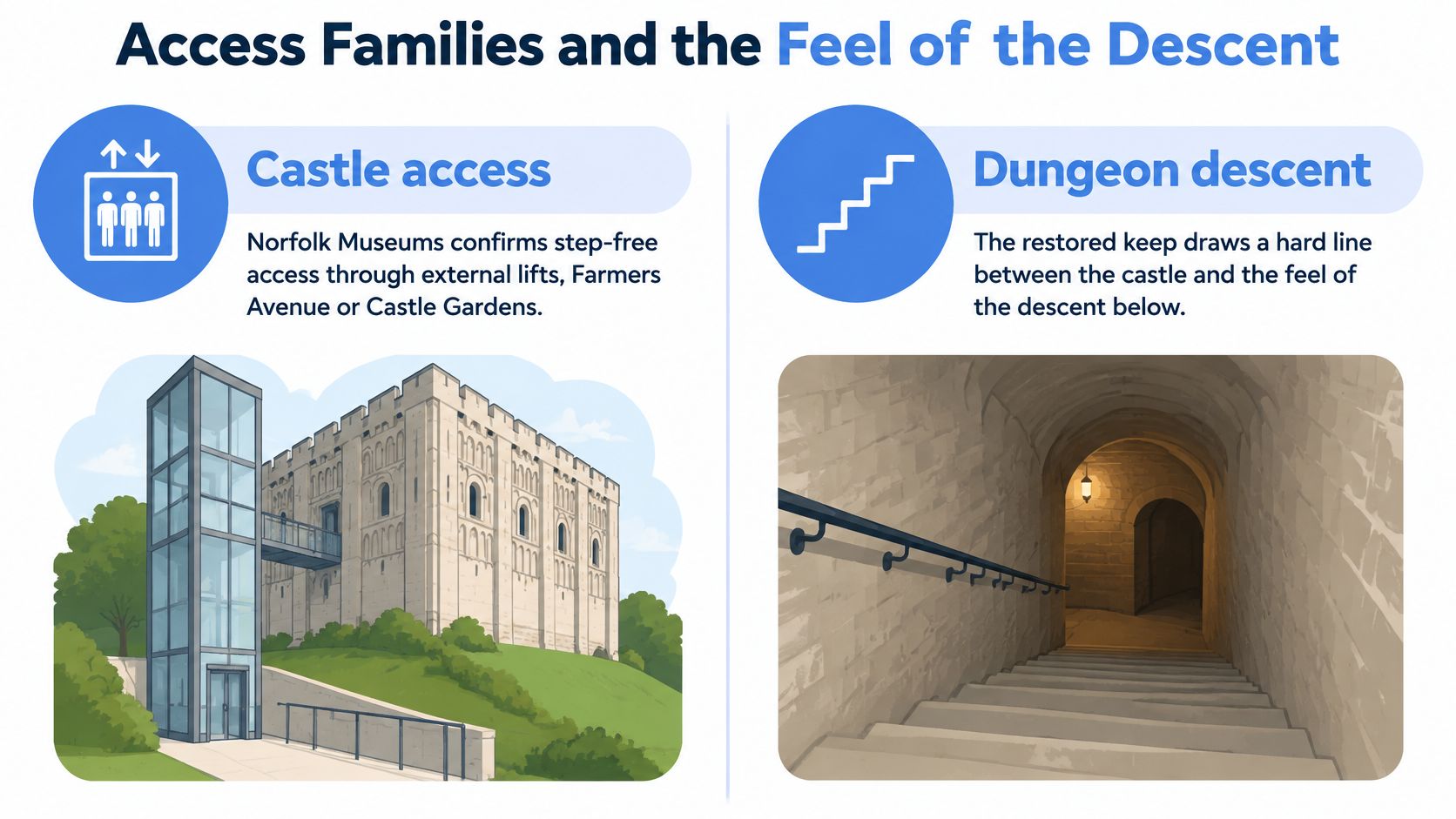
East Anglia Bylines' report on the reborn palace draws the line cleanly. Official Norfolk Museums Service guidance confirms step-free access to the castle through external lifts, Farmers Avenue, or Castle Gardens. The same guidance does not clearly explain the dungeon itself: route conditions, lighting, noise, ventilation, seating, or whether an alternative interpretation is available. Independent visitor information describes the dungeon as reached by steps with uneven flooring, and therefore unsuitable for wheelchair users. Coverage of the 2025 restoration's step-free keep can leave the impression that every area is equally accessible. It is not.
Who the descent suits
Norwich Castle can be exceptionally accessible overall and still contain one historically authentic space that stays difficult. That is a fairer line than calling the whole site, basement included, the most accessible castle in the country.
Visitor | Rest of the castle | Dungeon descent | Better plan |
|---|---|---|---|
Wheelchair user | Step-free routes via external lifts, Farmers Avenue or Castle Gardens | Steps and uneven floor; unsuitable | Use the keep galleries and interpretation |
Pushchair | Step-free arrival possible | Route not suitable | Park the pushchair and use upper rooms for the prison story |
Limited mobility or stamina | Lifts and level routes available | Short but stepped and uneven | Ask the museum about route length before booking |
Anxiety or sensory sensitivity | Galleries are the predictable option | Confined historic space; lighting, noise and seats not clearly published | Skip the descent if the conditions are uncertain |
Family with younger children | Palace rooms and museum displays | Grim themes of disease, trial and punishment | Judge age and temperament; it is history, not a horror ride |
A pushchair will not manage that stepped, uneven route. Park it and take the prison story in the upper rooms. Families can still bring children into the wider castle. The basement narrative covers standing water, disease, trial, execution and deportation. It suits older children who can cope with grim history. It is not a scare maze with a soft ending.
Anyone with anxiety about confined spaces, or who needs predictable light, noise and ventilation, should assume a short, enclosed, historic descent. Seating and an alternative interpretation are not clearly published. Ask the museum before you book, and read the route as a stepped basement rather than as a gallery with a lift at the end.
Hearing the same history without the steps
The keep's upper rooms and the museum interpretation carry the prison history without that descent. Palace halls above, cells below: you can understand the contrast from the galleries if the steps are the wrong choice for your group. If you are driving in, sort the car before you commit to a timed entry. Our notes on parking in Norwich cover the practical side of arriving in the centre, so the access question is not decided in a hurry at the mound.
Use the table as the checklist before you buy tickets. The castle and the dungeon are not one access rating.
Tickets Routes and the Best Time to Go
Norwich Castle sits on the castle mound in the city centre. Once you are in the middle of the city it is a straightforward walk from Norwich Market and Norwich Cathedral. From the railway station, take a taxi, a bus, or the walk up from the platforms if you would rather not ride.
Check the day's page first. Seasonal hours and conservation closures move. Open Norfolk Museums' castle page that morning, before you leave the apartment.
Pick the current entrance. Use the museum map and choose Castle Gardens or Farmers Avenue. An old photo of a doorway is a bad guide after a long restoration.
Buy keep admission for the palace rooms and the basement together. That ticket is what covers the royal rooms and, when the route is open, the basement. The contrast is the point of the visit.
Aim for a weekday morning outside school holidays if you want time on the steps without a queue at your back. Then leave a pause afterwards. The dungeon is not a five-minute add-on on the way to the shop.
Detail | What is known | Confirm before you go |
|---|---|---|
Location | Castle mound, Norwich city centre, near the market and Cathedral | Current entrance, Castle Gardens or Farmers Avenue |
From the station | City-centre site; taxi, bus or a walk up from the platforms | Live bus route and walking route |
Ticket | Keep admission covers palace rooms and the basement when the route is open | Current adult, child and concession prices |
Opening hours | Set by Norfolk Museums and affected by seasons and conservation | That day's hours and last entry |
Dungeon route | Reopened after mould clearance and the wider restoration; a new tour was being prepared | Whether the basement is open on your date |
Quieter timing | Weekday mornings outside school holidays | Local events that fill the keep |
Do not treat a price or a set of hours printed on an old blog as fixed. Both move with the season and with conservation. The table marks them as confirm-on-the-day items for that reason.
If the basement is shut
Plan the palace rooms and the basement as one visit so the royal halls and the later cells read against each other. If the dungeon route is closed for conservation, the keep galleries still carry the prison story. That is a better outcome than a wasted ticket and a cross trip to a locked stair.
The same day pairs naturally with the Cathedral and the market. If you want the centre on foot rather than as a series of taxi hops, a Norwich walking route keeps the mound, the market stalls and the Cathedral close together without adding another attraction for its own sake.
Stay in the Centre After the Castle
If the castle is the point of the trip, sleep in the centre. The mound, the market and the Cathedral stay on foot, and you are not rebuilding the day around a late bus after a dark basement.
This post is sponsored by Stay Norwich Apartments, your furnished rental accommodation provider in Norwich, Norfolk, offering temporary or short-term furnished accommodation. You never know when you might need it. Rest assured that Stay Norwich Apartments will have you covered. staynorwichapartments.com
We are a furnished rental for temporary or short-term stays, including leisure breaks, contractor weeks and the gap between homes, in partnership with Hospitality Norfolk. You never know when you might need a furnished base, and the apartments are meant to cover that without a hotel timetable. Properties sit close to the train station, Norwich Cathedral, the market and the main employment sites, in the city centre. Types include houses sleeping 6, studios with river views, and apartments five minutes from the Cathedral, with kitchens and space to unwind after the keep. A larger group travelling together might look at a whole house such as the Hen Hideaways Norwich house listing, which is a different kind of stay from a short furnished let.
Booking direct with Stay Norwich Apartments gets the best available rate and a direct line if plans change. It also means no platform fees of the kind Airbnb and Booking.com add. Start at our site or the property search. The streets around the Cathedral, covered in our Cathedral Quarter guide, are the walk home if you have stayed central.
Check with Norfolk Museums that the dungeon route is open and suitable for your group, then book the apartment for the nights around the visit and use the evening for the market.
Stay Norwich Apartments offers furnished short-term accommodation in central Norwich, a practical base when Norwich Castle's dungeons and the city centre are the reason for the trip. You get a kitchen, a direct booking and properties close to the station, the market and the Cathedral, without a hotel timetable. Visit Stay Norwich Apartments to check availability for the nights around your castle visit.
Comments