


Handyman Norwich: Trusted Local Repairs & Home Fixes

You've arrived in Norwich after a long drive, put the kettle on, and noticed water collecting beneath the kitchen sink. You're due on site in the morning, you don't own the apartment, and you're not sure whether to call the host, find a handyman, or leave it until daylight. The useful starting point isn't a search result. It's knowing who should arrange the repair and whether the problem is safe to leave.
This post is sponsored by Stay Norwich Apartments, your furnished rental accommodation provider in Norwich, Norfolk, offering temporary or short-term furnished accommodation. You never know when you might need it. Rest assured that Stay Norwich Apartments will have you covered. staynorwichapartments.com
Table of Contents
Why You Might Need a Handyman in Norwich - A sizeable local rental setting
Common Handyman Services in Norwich - Jobs worth asking about - Where the handyman's role stops
Understanding Repair Priorities and Costs - Use risk to decide what happens next - Compare the whole job
How to Vet a Tradesperson in Norwich - Check evidence before availability - Make the written agreement useful
Real-Life Repair Scenarios in Serviced Apartments - A kitchen tap keeps dripping - A wardrobe door hangs unevenly
Why Norwich Needs Reliable Maintenance Support - Maintenance supports different kinds of stay - Small repairs need clear ownership
Emergency Contacts and Booking Tips for Guests - Use the right contact route - Make a non-emergency booking easier
Frequently Asked Questions About Handyman Services - Who is responsible for repairs in a serviced apartment? - Can a handyman decide whether a specialist is needed? - What evidence should I retain after completion? - What is a reasonable snagging period? - Can I leave a minor-looking issue until checkout?
Why You Might Need a Handyman in Norwich
A maintenance problem doesn't have to be dramatic to disrupt a stay. A wardrobe door that won't shut can obstruct a bedroom, while a loose desk fitting becomes particularly annoying when you're trying to work. If you're visiting for a contract, a university placement, or a house move, you probably haven't brought tools or built up a list of local tradespeople.
A handyman can be useful for practical, clearly defined repairs, but being a guest changes how you should arrange help. Your first job is usually to report the defect, not commission alterations to somebody else's property. That distinction protects you from misunderstandings about permission, payment, and responsibility.
A sizeable local rental setting
Norwich's private rented sector grew by 27% between 2011 and 2021, represented approximately 29.3% of housing stock, and was estimated to contain around 20,330 privately rented dwellings by 2025, according to Norwich City Council's census-based housing assessment.
Those figures describe private renting, not serviced apartments alone. They nevertheless establish a substantial local setting for property maintenance, from tenancy changeovers to repairs during occupation.
For a visitor, the useful question is whether the person attending understands the setting:
Occupied accommodation: Can they work without leaving tools, dust, or disconnected fittings around your belongings?
Limited availability: Can access be arranged while you're working elsewhere?
Clear ownership: Has the host approved both the task and the person carrying it out?
A usable outcome: Will the repaired item be checked before the job is marked complete?
Think of the arrangement like taking a hired vehicle for repair. You can explain the symptom, but the owner should normally authorise the work. You don't need to diagnose a hinge or a leaking joint yourself. You need a clear report and an agreed route to help.
Common Handyman Services in Norwich
A sensible handyman job has a defined scope, manageable risks, and a clear stopping point. Replacing a damaged cupboard handle fits that description. Investigating why a wall is moving doesn't.
Norwich City Council's housing asset data records 17,479 homes, including 12,115 properties, approximately 69.3%, built between 1930 and 1975, with only 282 built from 2012 onward, in its Housing Asset Management Strategy. This is council and leasehold stock rather than a profile of every Norwich home, but it illustrates the city's substantial older-property maintenance context.
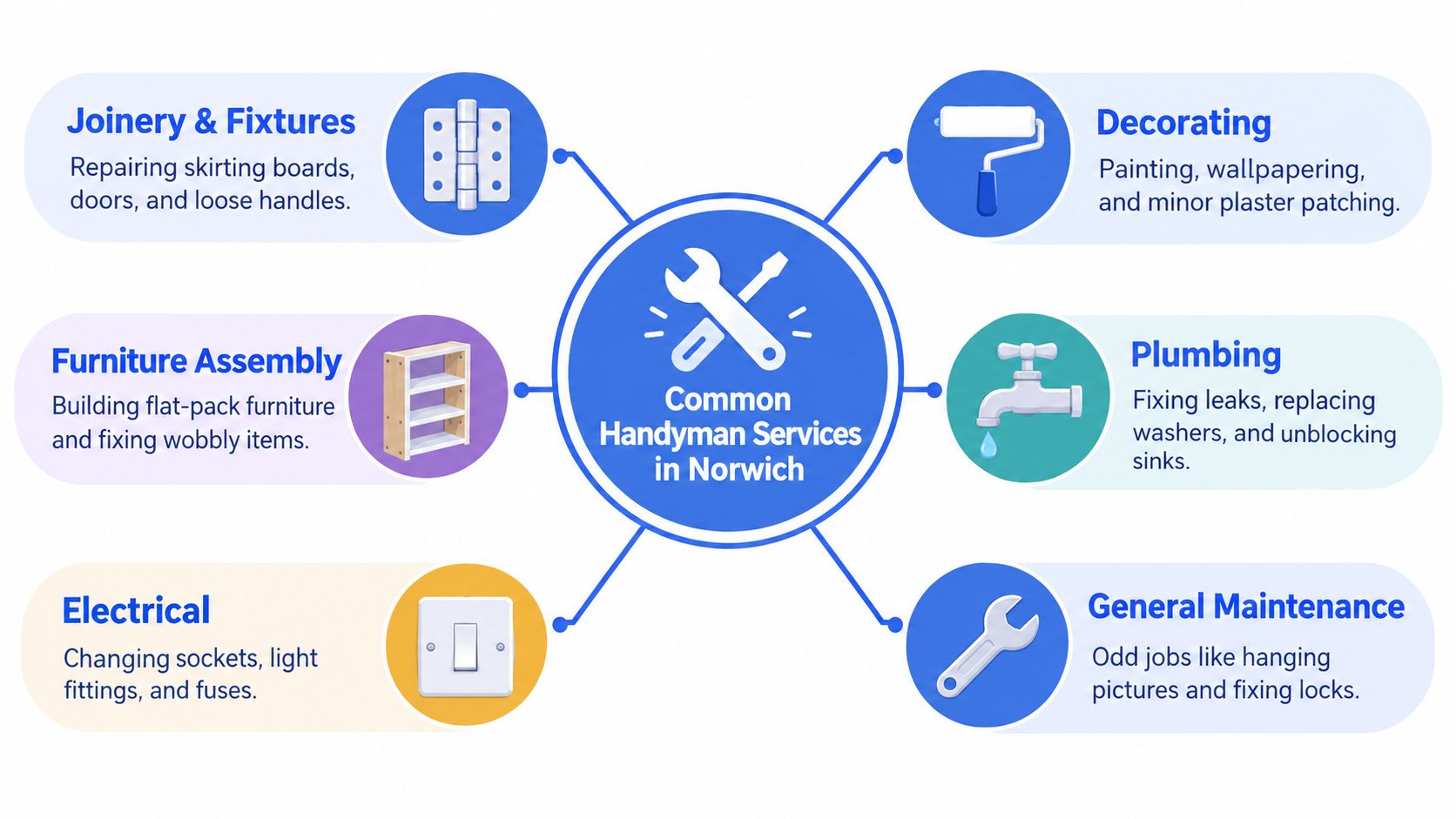
Jobs worth asking about
Describe the item and what it's doing, rather than booking a broad category such as “plumbing”.
Joinery and fixtures: Adjusting an internal door, securing a loose handle, repairing skirting, or refitting a cupboard hinge.
Furniture assembly: Building flat-pack furniture, checking fixings, and investigating a wobbly chair or shelving unit.
Decorating: Filling minor surface damage, preparing sound surfaces, and touching up paint. For a larger finish-focused job, consult the guide to painters and decorators in Norwich.
Minor plumbing: Investigating an accessible dripping tap or waste connection, provided the person is competent and can isolate the supply safely.
General maintenance: Hanging approved fittings, replacing suitable sealant, and carrying out small patch repairs after the cause has been addressed.
An older fitting may need careful identification rather than a forceful adjustment. Ask whether the quote allows for finding a compatible replacement instead of assuming any modern part will fit.
Where the handyman's role stops
The diagram groups tasks by trade, but an electrical label isn't permission for an unqualified person to change sockets or fixed wiring. Ask an appropriately competent electrician to assess fixed electrical faults and any certification requirements.
Gas defects, structural movement, suspected asbestos, and hazardous roof access belong outside a general handyman booking. Specialist status should be checked against the actual task, not inferred from a van full of tools.
Practical rule: A reliable handyman should be able to explain both what they can repair and what would make them stop.
Understanding Repair Priorities and Costs
Judge a repair by what could happen if it's left alone, not how small the damaged part looks. A loose decorative handle and a loose stair handrail might both involve screws, but they don't present the same risk.
Norwich City Council's housing service standards classify repairs as emergency, attended within 24 hours; urgent, within 5 working days; and routine, within 60 working days. Its housing-condition guidance also identifies concerns including damp, unsafe electrics, gas defects, leaks, and structural damage. These are council service standards, not guaranteed response times for private handymen or serviced accommodation.
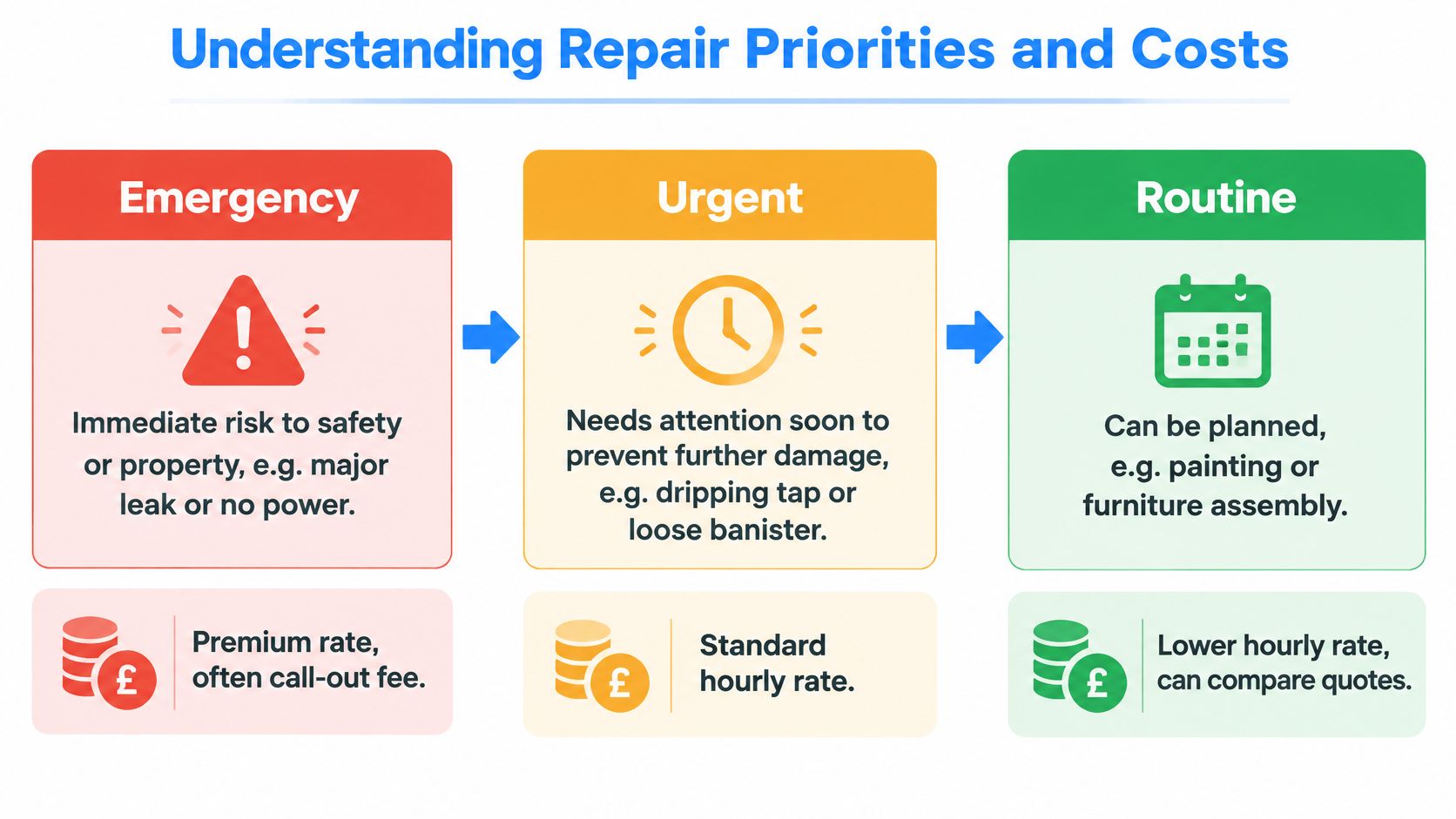
Use risk to decide what happens next
Situation | Sensible next action |
|---|---|
Immediate danger to people or substantial active damage | Move away from danger and seek emergency help appropriate to the hazard. |
A worsening defect without immediate danger | Ask the host to arrange prompt assessment and explain any safe temporary controls. |
A stable cosmetic or convenience issue | Agree a planned appointment that suits access and occupancy. |
These categories aren't a queue you must move through. A loose banister may demand immediate restriction of access, while a dripping tap needs a different response if water is reaching electrical equipment.
Likewise, the graphic's price labels are illustrative, not Norwich tariffs. Routine work isn't automatically charged at a lower hourly rate, and a call-out fee doesn't establish competence.
Compare the whole job
Ask the trader to separate labour, materials, travel or parking, call-out charges, waste removal, and any applicable tax. Clarify whether diagnosis is included and whether the proposed amount is a fixed quote or an estimate that could change.
For example, replacing sealant without investigating persistent moisture might leave you paying for the visible repair while the underlying issue remains. A more useful proposal explains the suspected cause, what will be checked, and what happens if the inspection reveals something outside scope.
Agree spending authority: State who can approve additional work.
Check exclusions: Ask whether replacement parts, making good, and return visits are included.
Match the trade to the defect: For water-related problems needing specialist attention, the guide to plumbers in Norwich and Norfolk is a starting point, not a substitute for checking suitability.
A safe temporary measure should reduce exposure to the hazard. It shouldn't disguise a defect or turn an unsafe room back into an apparently usable one.
How to Vet a Tradesperson in Norwich
When you're booking from another city, a friendly phone manner can feel like enough reassurance. Treat it as the beginning of the conversation, not the end of your checks.
Citizens Advice recorded 36,903 home maintenance and improvement complaints in 2025, and found that 28% of people who arranged repairs did the work themselves because they didn't think they could find a trustworthy trader, according to its home-repair findings. Those national figures aren't a judgement on Norwich tradespeople, but they explain why verification matters.
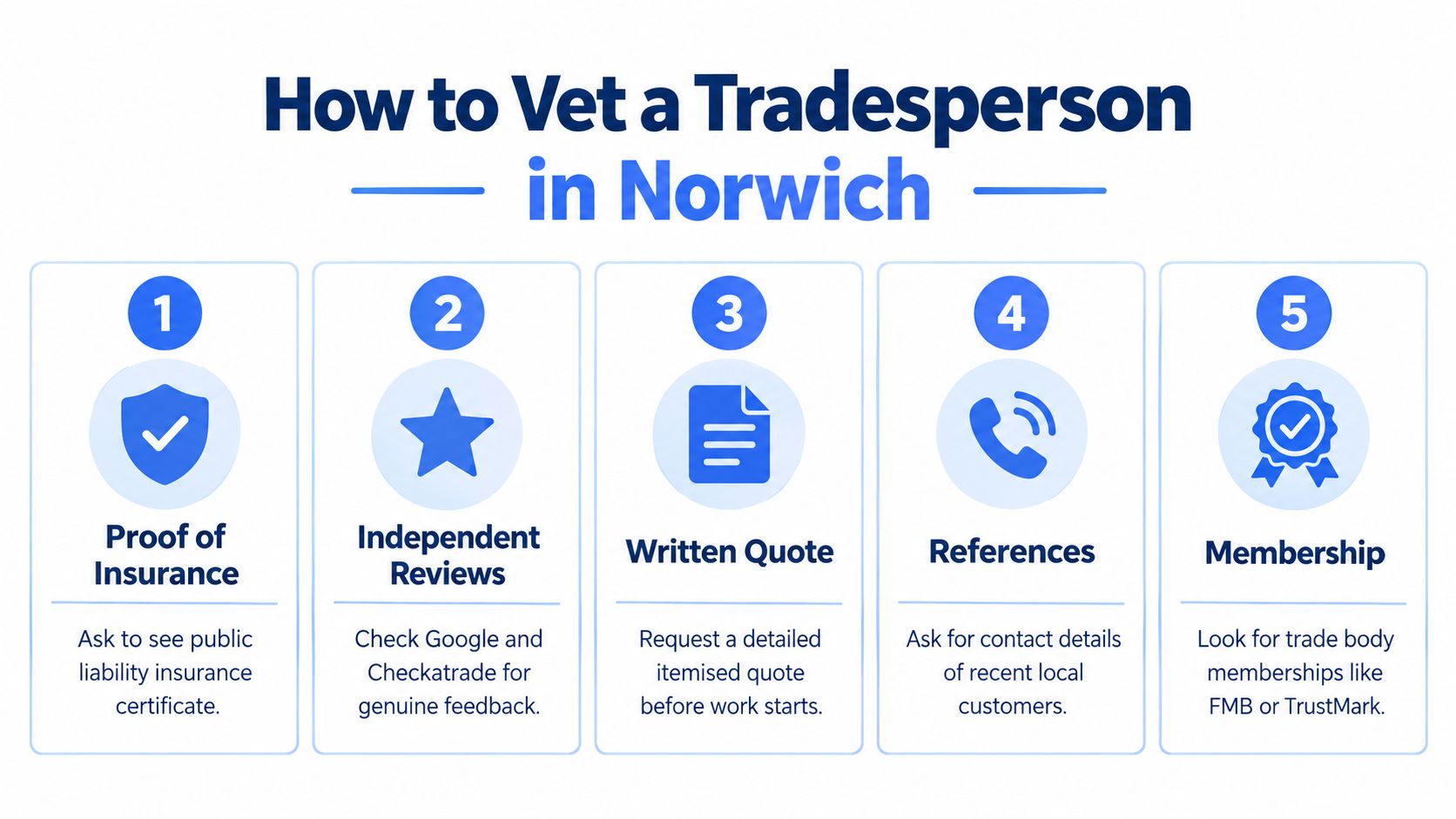
Check evidence before availability
Start with identity and task-specific competence. Ask for the trading name, contact details, relevant experience, and proof of public liability insurance covering the proposed work.
Insurance: Check the insured name, validity, and relevant activities. A certificate isn't evidence that every possible task is covered.
Independent feedback: Read reviews on platforms such as Google or Checkatrade for details about comparable jobs, communication, and follow-up.
References: Ask whether a recent customer with similar work would be willing to provide a reference, with their permission.
Specialist credentials: For gas work, verify the engineer's Gas Safe registration and relevant work categories. For other specialist work, ask what qualifications, approval, or certification the job requires.
Membership claims: If someone advertises FMB membership or TrustMark registration, verify the claim rather than relying on a logo.
The local guide to trusted traders in Norfolk can help you organise a shortlist. A listing should prompt your checks, not replace them.
Make the written agreement useful
A written quote should identify the property, defect, agreed work, materials, exclusions, payment arrangements, and who will authorise changes. Ask who will confirm whether building-regulations approval or other consent is needed, where applicable.
For remote bookings, add access permission and a completion process. Name the person who can approve decisions while you're unavailable, and ask the trader not to expand the job without that approval.
A clear refusal to tackle an unsuitable job is more reassuring than a promise to fix everything.
Ask what would cause the trader to refer the work elsewhere. Someone who explains that a damaged hinge is within scope but a distorted structural opening isn't has given you useful information.
Avoid sending door codes before you've confirmed the appointment and identity. Arrange access through the host wherever possible, particularly when belongings will remain inside.
Real-Life Repair Scenarios in Serviced Apartments
The following are illustrative situations, not customer case studies. They show how an ordinary defect can lead to different decisions depending on its cause and surroundings.
A kitchen tap keeps dripping
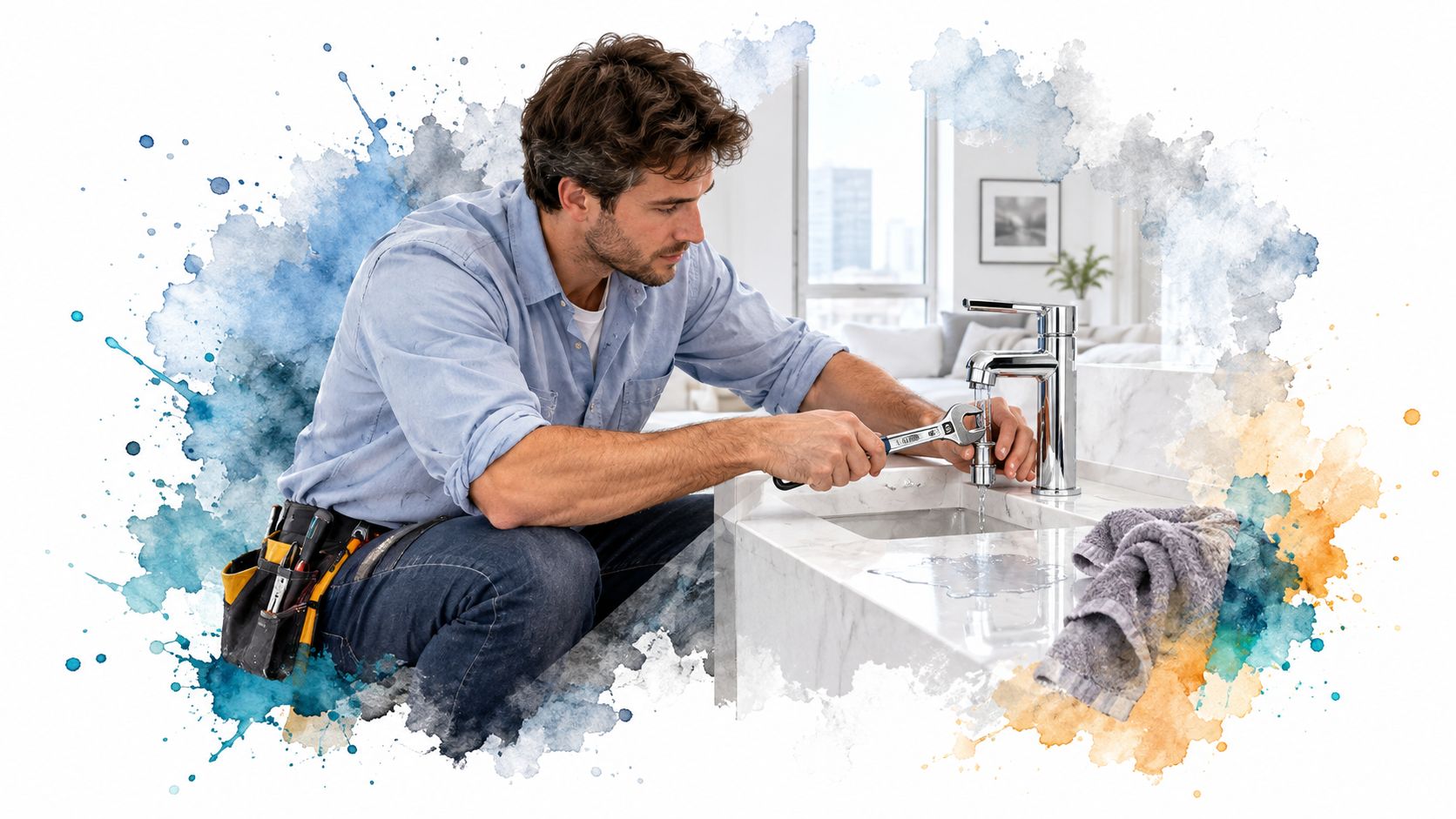
You notice a drip after turning the handle firmly closed. Send the host a photograph and describe whether water is staying inside the sink or appearing below the worktop.
A competent repairer might inspect the tap mechanism and accessible connections before proposing a suitable component replacement. Don't keep tightening the handle or dismantle unfamiliar fittings yourself.
A wardrobe door hangs unevenly
A repairer may find an adjustment problem, a failed hinge, or damaged material around the fixing. Those possibilities call for different remedies, so a photograph of the whole door and a close-up of the hinge are more useful than reporting “broken wardrobe”.
Keep people away if the door appears liable to fall. Don't support it with improvised furniture and carry on using it.
Other everyday examples need equally specific reporting:
A faulty light switch: Stop using it if it behaves abnormally. Report flickering, heat, buzzing, or visible damage without removing the cover, and ask the host to arrange an electrician.
A window won't close: Don't force the handle. Describe whether the problem appears to involve the handle, hinges, frame, or obstruction, and tell the host if weather exposure or security is affected.
Safe access matters even for small repairs. The HSE estimates 79,000 construction workers experienced work-related ill health across 2022/23–2024/25, while falls from height accounted for 53% of construction deaths over the referenced five-year period, in its construction safety statistics.
Don't offer a dining chair as a stepladder. Leave equipment selection and the assessment of hidden cables, pipes, dust, and suspect materials to a competent person.
Ask for a completion note describing what was repaired and any remaining limitation. If damage makes accommodation unusable, discuss relocation with the host and insurer where relevant; this guide to alternative accommodation insurance offers a starting point for those conversations.
Why Norwich Needs Reliable Maintenance Support
For someone working away from home, accommodation is more than a bed. It's where you prepare food, wash work clothes, answer emails, and recover before another shift. A defect affecting those routines can matter more than an untidy paint finish, even if the repair itself looks modest.
Norwich recorded 12,938,800 tourism trips in 2023, including 419,800 staying trips and 483,000 staying nights, with a reported total tourism value of £769,350,590, according to the council's Economic Impact of Tourism report. The combined trip figure includes day visitors, so it shouldn't be mistaken for accommodation bookings.
Maintenance supports different kinds of stay
The practical requirements vary with the guest. A contractor may be absent while repairs take place, a relocating professional may have possessions stored in the apartment, and a university visitor may need a quiet workspace during the day.
For accommodation managers, that means matching the repair arrangement to the occupant rather than treating every vacant appointment slot as suitable.
Working guests: Agree access around shifts and protect equipment left inside.
People between homes: Keep essential living areas usable where safe, and explain any restrictions.
University visitors: Consider study commitments and the effect of drilling or decoration.
Remote bookers: Provide clear confirmation without expecting them to travel back to inspect a minor repair.
For property managers: Completion should mean the item has been checked, the space is usable, and the guest knows what happened.
Small repairs need clear ownership
The older housing context described earlier doesn't mean every property is defective. It means repairers may encounter different materials, previous alterations, and fittings that need investigation before replacement.
My view is that dependable maintenance relies as much on coordination as practical skill. Someone must receive the report, approve the work, organise access, and tell the guest when normal use can resume.
Without that coordination, even a straightforward repair can become a chain of missed calls. With it, visitors can concentrate on their work or stay instead of managing somebody else's building.
Emergency Contacts and Booking Tips for Guests
Immediate danger takes priority over booking a handyman. If there's a fire, suspected gas escape, serious electrical danger, or another threat to life, move to safety and contact the appropriate emergency service from a safe place. Don't remain inside to photograph the problem or attempt unfamiliar isolation procedures.
For a suspected gas escape, avoid flames and electrical switches. For water near electrical equipment, keep clear rather than touching plugs or controls in the affected area.
Use the right contact route
Keep the host's maintenance contact, out-of-hours instructions, and property address accessible on your phone. Use emergency-service contact details from official information rather than a sponsored search listing.
Active property problem: Notify the accommodation provider as soon as it's safe, describing what is happening and whether anyone is at risk.
Lockout or damaged lock: Contact the host before authorising entry or replacement. The guide to a locksmith in Norwich and Norfolk can help frame the booking questions.
No answer: Follow the booking's escalation procedure. A voicemail isn't confirmation that someone is attending.
Some maintenance businesses use answering services to capture out-of-hours reports. Mercateer's information on overnight call handling for trades is useful context for understanding that arrangement, but taking a message isn't the same as dispatching emergency help.
Make a non-emergency booking easier
Before arrival, tell the provider about accessibility needs or facilities essential to your work. When reporting a defect, include the apartment identifier, affected item, visible symptoms, available photographs, and access restrictions.
Confirm the attending person's identity, relevant insurance, arrival arrangements, and who is paying. Keep communications together so the host, guest, and repairer aren't working from different versions of the problem.
Frequently Asked Questions About Handyman Services
Who is responsible for repairs in a serviced apartment?
Report the problem to the accommodation provider and check your booking terms before commissioning work. Who arranges a repair and who ultimately pays aren't necessarily the same question, especially where accidental damage is alleged.
Ask for the reason and supporting evidence if you're charged. Don't assume reporting a defect means accepting responsibility for causing it.
Can a handyman decide whether a specialist is needed?
A competent handyman should recognise the limits of their work, but you can also request a specialist assessment directly. Describe the symptoms rather than asking someone to perform a predetermined fix.
Use the task boundaries and verification checks above when deciding whether the proposed person is suitable.
What evidence should I retain after completion?
Keep the original report, approval, quote, invoice, before-and-after photographs, and completion note. Include any certificates or instructions relevant to the work.
For remote arrangements: Ask who checked the result and whether the affected item was tested.
For an unresolved defect: Record what remains wrong and send it to the trader and property decision-maker in writing.
What is a reasonable snagging period?
Agree a reporting and correction process before work starts rather than assuming a universal period. Ask how visible defects, replacement-part problems, and issues found during normal use will be handled.
Can I leave a minor-looking issue until checkout?
Report it when you notice it, even if you don't need an immediate visit. A 2026 survey reported that 47% of UK homeowners were postponing vital maintenance, including 29% leaving broken boilers unrepaired, 18% ignoring mould, and 11% overlooking potentially unsafe electrics, as reported by Our Fair Future's maintenance survey.
Those are homeowner findings, not guest statistics. The practical lesson is to let the responsible person assess the defect rather than deciding from appearances that it can wait.
Stay Norwich Apartments offers furnished, self-catering accommodation in Norwich, Norfolk, for contractor stays, business visits, relocation periods, and time between homes. Visit Stay Norwich Apartments to explore available properties and ask about maintenance reporting and access arrangements before you book.


Comments