


Short Term Accommodation Cost Norwich: 2026 Guide

Your start date is fixed, the house move has slipped, or the relocation is live before the permanent place is signed. The useful figure for short term accommodation cost Norwich is a 20-night envelope: which nights you pay for, what the invoice includes, and whether the total stays under the £120 ceiling many employers and procurement teams recognise. Compare it with a monthly private rent before you commit; for a short project, deposit, bills and minimum terms can make a tenancy look cheaper on paper and costlier in practice.
A single nightly average will not defend a budget.
Disclosure: Stay Norwich Apartments, a Norwich provider of furnished short-stay apartments, publishes this guide. Use the figures with any provider, and check live dates through search available Norwich properties.
Table of Contents
Setting a Realistic Norwich Cost Range for 2026 - Why a Single Average Misleads You - The Five Decisions That Set Your Final Price
Comparing Apartments, Holiday Lets, Hotels and Private Rentals - What Each Option Really Includes - Which One Should You Choose
How Seasonality and Lead Time Move the Final Price - How to Use the Calendar - Flexibility Is Insurance, Not a Luxury
Using the £120 Benchmark and Building a Real All-In Total - Build the Total From the Bottom Up - Test It Against Rent, Properly
Reading the Listing and Asking the Host the Right Questions - Questions to Send Before You Pay - Warning Signs to Take Seriously
The 20-Night Stayer's Real Cost in Practice - Where the Apartment Saves Money - Asking for a Better Weekly Rate
Booking With Confidence and What to Do Next - The Four Rules to Keep
Setting a Realistic Norwich Cost Range for 2026
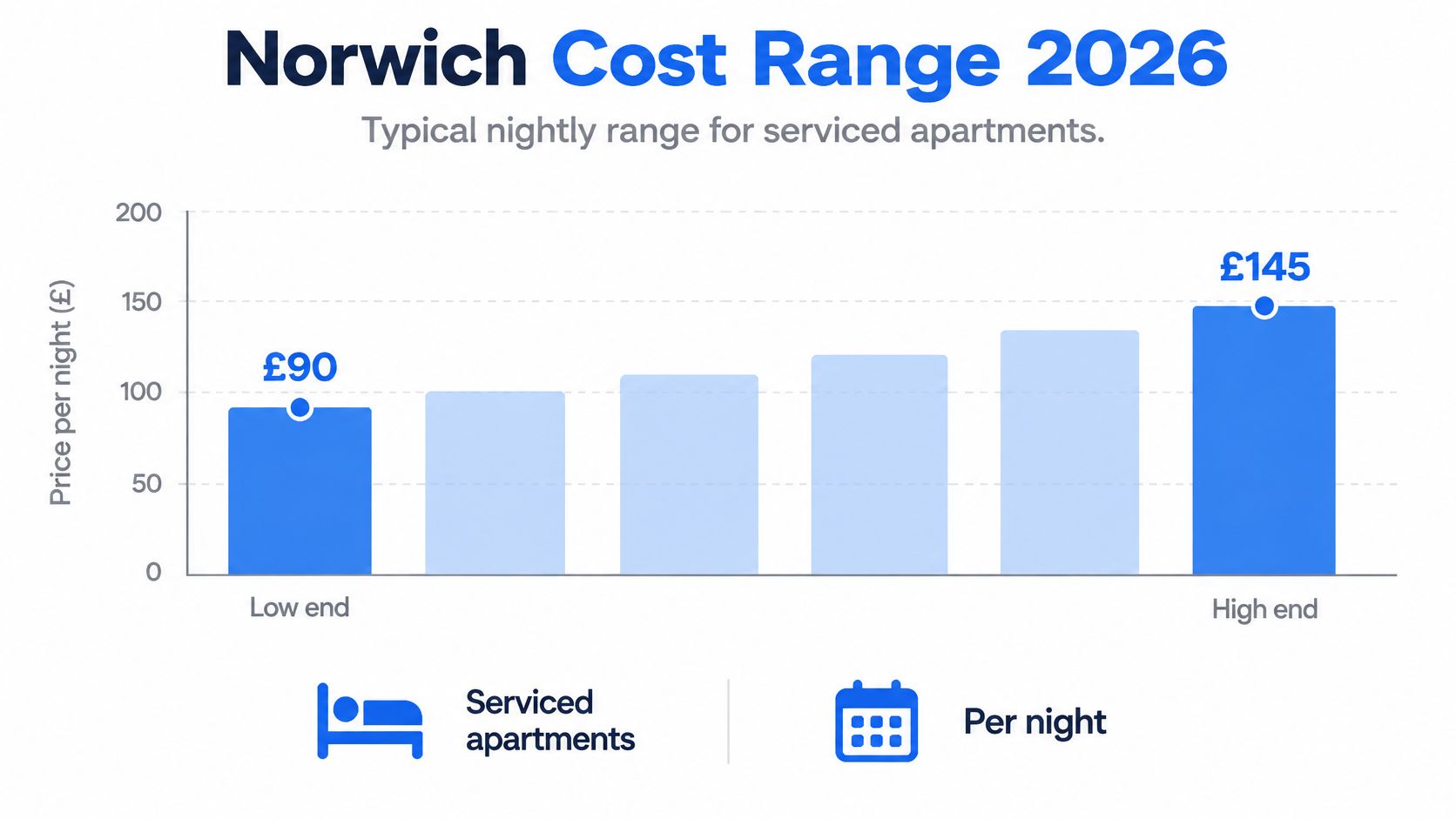
Start with the range, not an average. For planning short term accommodation cost Norwich in 2026, work on £90 to £145 per night for a serviced apartment. Multiply that by your nights before you look at any listing, then adjust for the five factors below. A 20-night stay at those rates is £1,800 to £2,900 before any length-of-stay discount, which is the envelope most contractors and relocating professionals should budget inside.
The spread isn't guesswork. Observed Norwich hotel pricing shows the same pattern, with Momondo reporting a £110 average over the preceding week, £99 on Sunday and £145 on Saturday. That £46 Saturday-to-Sunday difference tells you day of week alone can move a quote more than a negotiation will. If your project lets you check in on a Sunday or Monday and avoid paying peak weekend rates for nights you don't need, do it.
Why a Single Average Misleads You
An average hides the calendar. January pricing and May pricing in the same city aren't the same product in cost terms, even if the apartment is identical. You're not buying a night in abstract. You're buying specific nights, with specific demand behind them.
Norwich also has a large visitor market behind those prices. Norwich City Council recorded 419,800 staying trips and 1,334,000 staying nights in 2023, producing £101.834 million in staying-trip expenditure. You're competing for beds with business visitors, leisure visitors and people visiting friends and relatives, not only with other contractors.
The Five Decisions That Set Your Final Price
Work through these in order before you request quotes. Each one changes the total in a different way.
Stay length: Longer stays give you room to ask for a weekly or monthly rate. Short stays pay close to the nightly headline.
Exact dates: Month and day of week matter more than small differences between similar apartments.
Location and parking: A cheaper rate that adds daily parking or a long commute isn't cheaper. Price the whole routine.
Cancellation terms: Flexibility has value if your project end date isn't fixed. A non-refundable saving that you lose to one change isn't a saving.
What's included: Utilities, Wi-Fi, cleaning, linen and kitchen access change what you'll spend elsewhere. Compare all-in totals only.
If you're between homes, add storage to that list. Many people price the apartment and forget the furniture sitting elsewhere. Checking what storage costs in 2026 before you commit helps you compare a furnished apartment against renting unfurnished and storing part of your household. That's a separate monthly bill, but it belongs in the same decision.
Set your budget as a range for your actual dates, then reject any quote you can't itemise.
My recommendation is simple. Budget at the middle of the range for weekday-heavy stays outside peak months, and at the top end if your stay includes several Saturdays or lands in a busy period. Get a dated quote early. Don't annualise a January rate and expect it to hold in summer.
Comparing Apartments, Holiday Lets, Hotels and Private Rentals
Compare weekly and 20-night totals, not headline nightly rates. A hotel room, a holiday let, a serviced apartment and a private tenancy bundle costs differently. The cheapest headline often becomes the most expensive stay once food, parking, laundry and work space are counted.
A serviced apartment gives you a kitchen, separate living space and usually a proper place to work. That matters on a 20-night stay because you can cook, wash clothes and take calls without sitting on a bed. For guidance on how that fits wider stays across the county, see Norfolk accommodation options for short and longer visits.
What Each Option Really Includes
Hotels suit one or two nights. Beyond that, you pay for breakfast, evening meals, laundry and parking on top of the room, and you still have limited space to work or relax. The rate looks clean because so much sits outside it.
Holiday lets can work for families or groups sharing several bedrooms because the cost spreads across more people. For a solo contractor, cleaning fees and platform charges spread over a short stay can erode the saving, and terms for extending or changing dates vary widely between owners.
Private rentals look cheapest on a monthly figure, but they aren't a like-for-like alternative for a few weeks. The ONS reported average monthly private rent in Norwich at £1,142 in August 2026. That figure doesn't include furnishing a property, setting up utilities, council tax arrangements, a deposit, or committing to a longer tenancy than your project needs. For a short project, those setup costs and commitments are the true barrier.
Option | Headline rate | Inclusions | 20-night total |
|---|---|---|---|
Serviced apartment | £90 to £145 per night | Furnished space, kitchen, Wi-Fi and utilities typically in the quote. Confirm cleaning and parking. | £1,800 to £2,900 before discounts |
Hotel | Varies sharply by day and month | Room only unless breakfast is stated. Food, laundry and parking usually extra. | Headline multiplied by 20, plus daily living costs |
Holiday let | Nightly rate plus fees | Furnished and self-catering, with cleaning and platform fees often added. | Headline multiplied by 20, plus all fees |
Private rental | Monthly rent | Usually unfurnished, with deposit, bills and setup separate. | Rent plus deposit, furnishings, utilities and commitment risk |
Which One Should You Choose
Use stay length as your first filter.
Under 14 nights: Choose a serviced apartment if you need to work and cook. Choose a hotel only for very short, simple stopovers.
One to three months: A serviced apartment is almost always the cleaner comparison against a hotel because kitchen and laundry access cut daily spending, and you avoid tenancy setup.
Beyond six months: Revisit a private rental. At that length, furnishing and utility setup can be spread over enough months to make sense.
Don't compare a monthly unfurnished rent with a nightly furnished rate and call the difference profit or waste. You're buying flexibility, furnishings, bills management and a defined end date in one price. If you don't need those things, rent privately. If you do, price them properly instead of pretending they're free elsewhere.
How Seasonality and Lead Time Move the Final Price
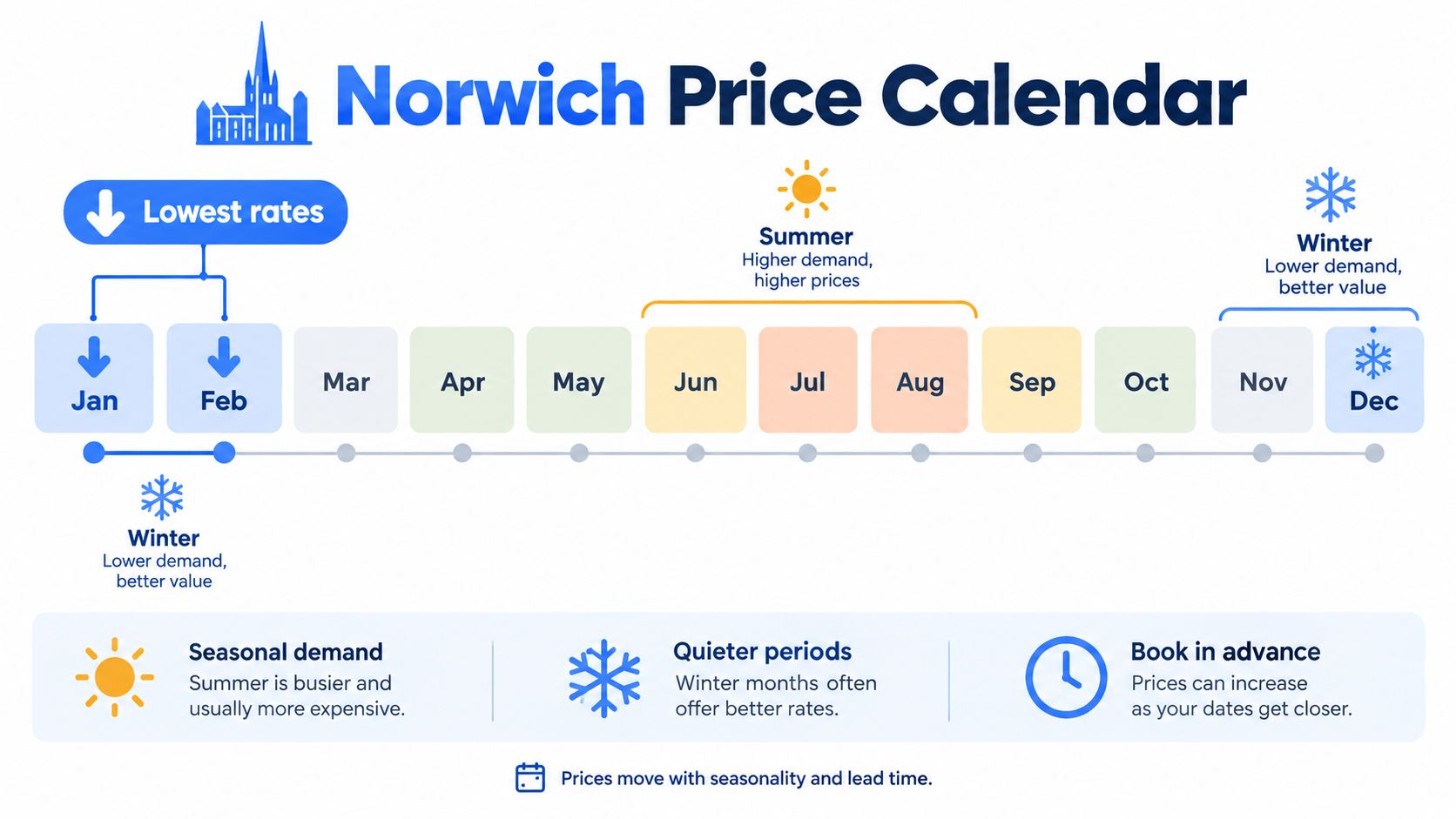
Your dates will do more to set the price than haggling will. Norwich demand rises and falls through the year, and the same apartment can be sensibly priced in winter and expensive in late spring or during busy event periods. Plan around that instead of treating it as bad luck.
The verified hotel observations show how wide the swing can be. January averaged £90, while May averaged £139 in the Momondo data cited earlier. Another seasonal view in the regional material puts September at about £117. Those datasets don't agree on a single peak month, and that's the point. You need a quote for your dates, not comfort from an annual average.
Regional demand explains why availability can tighten. North Norfolk recorded approximately 0.6 million staying trips and 2.4 million staying nights in 2025. Norwich sits inside that wider visitor economy, alongside university activity, business travel and events, so project stays compete with leisure demand in busier months.
How to Use the Calendar
Book project stays at least four weeks ahead where you can. That gives you choice on location, parking and apartment size before the better-value options go. Leave it late in a busy month and you're choosing from what's left, which is rarely the cheapest sensible option.
Check what's on during your stay. A run of Norwich festivals and major events can lift demand for particular weekends even when the surrounding weeks look calm. If your work is Monday to Friday, ask whether arriving Sunday evening or Monday morning changes the weekly total compared with a Saturday check-in.
Avoid Saturday check-ins unless you need that Saturday night. It's the most expensive night in the observed data, so paying it as a convenience night is poor value.
Flexibility Is Insurance, Not a Luxury
If your end date might move, price certainty matters more than the lowest headline. Ask for two figures where available, a flexible rate and a restricted rate, then decide based on how likely your dates are to change. Contractors whose work can overrun, and relocators waiting on completion dates, should usually protect the option to extend or shorten.
Booking rule: Lock the flexible option when the project end date is uncertain, even if the nightly figure looks higher today.
Don't confuse a cancellable weekly rate with overpaying. You're buying the ability to react without rebooking in a tighter market. For a fixed short visit with confirmed travel, the restricted rate may be fine. For project work, flexibility usually earns its keep.
Finally, get the quote in writing with dates on it. Dynamic pricing means a rate you saw last week isn't evidence of today's price. Your budget should rest on a dated, itemised total for the nights you need.
Using the £120 Benchmark and Building a Real All-In Total
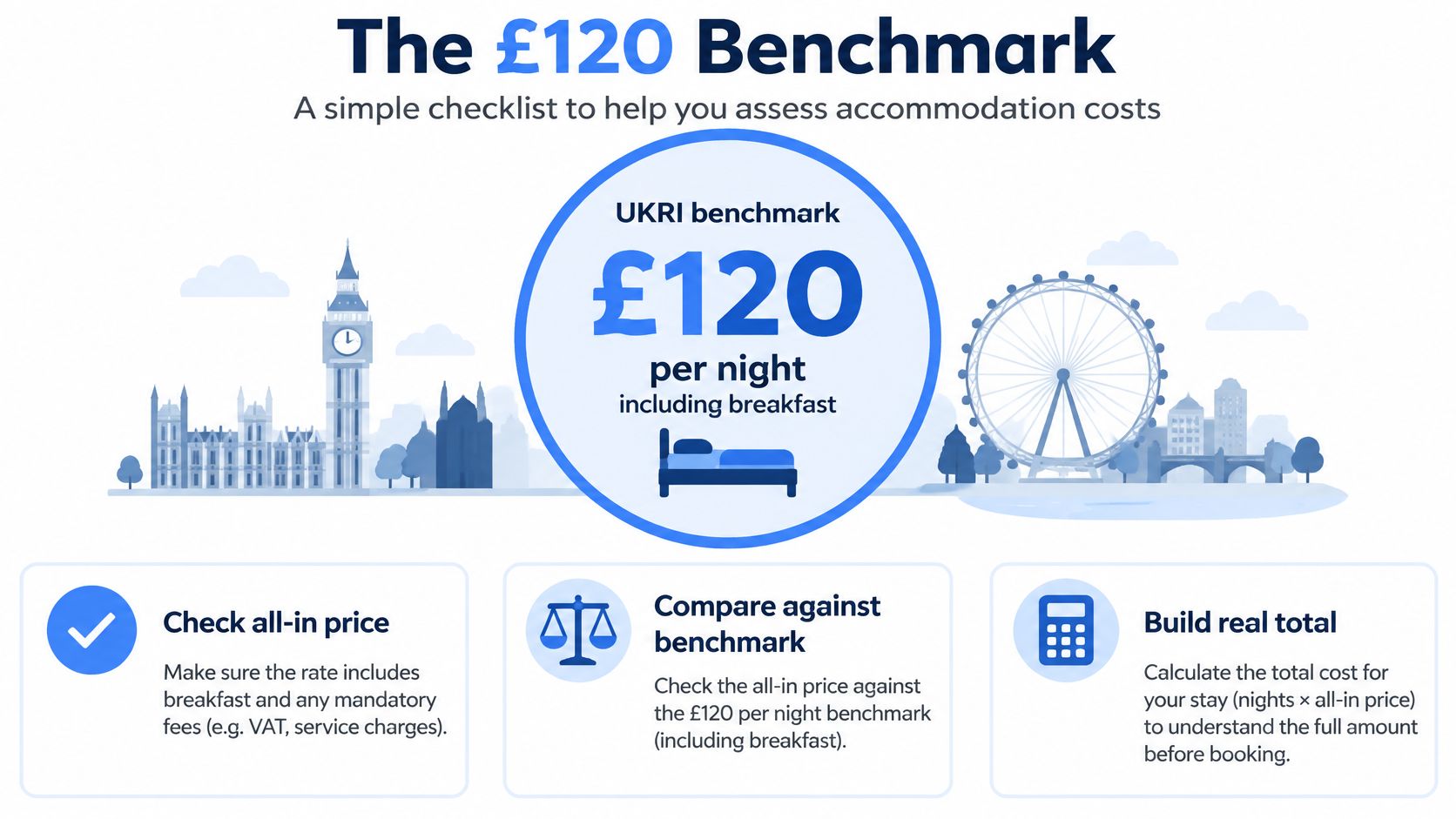
Use £120 per night including breakfast as your sanity check outside London and Edinburgh. That's the ceiling used by UK Research and Innovation for employee accommodation in places like Norwich, and it's a procurement benchmark rather than a market average. UKRI's £120 benchmark and £170 London and Edinburgh ceiling are set out in contractor accommodation guidance.
That distinction matters. A Norwich apartment above £120 isn't automatically overpriced, but it may need extra approval or a documented justification if your employer follows a similar policy. An all-in rate below it is easier to expense and easier to defend. If you're comparing Norwich with the capital for a wider relocation budget, check what it costs to rent in London separately rather than applying London ceilings to a Norwich stay.
Build the Total From the Bottom Up
Never compare headline rates alone. Ask whether the figure includes each of these, then add anything missing.
VAT and booking fees: Confirm the total payable amount, not a pre-tax or platform-only figure.
Cleaning and linen: Ask if end-of-stay cleaning and weekly linen changes are included or charged separately.
Utilities and Wi-Fi: These should be explicit in a serviced apartment quote. Don't assume.
Parking: Price it per night or per week if it's separate. Over 20 nights it changes the ranking of two apartments.
Breakfast and food: The benchmark includes breakfast. A self-catering apartment replaces that with kitchen access, so compare grocery spending with your own expenses.
Take a contractor quoted at the benchmark for 20 nights. The arithmetic is 20 multiplied by £120, which is £2,400. If the quote is completely all-in and sits inside the £1,800 to £2,900 planning range, it's defensible. If cleaning, parking and fees sit outside it, the actual total is higher and may breach the policy ceiling you thought you'd met.
Test It Against Rent, Properly
A relocating family should run the same check against private rent, but with setup costs included. Norwich City Council's reporting placed average monthly private rent at £1,149 in April 2026, below the East of England average of £1,278 and the UK average of £1,381, in Norwich's May 2026 Economic Barometer. That makes Norwich relatively affordable for a tenancy, but it doesn't make a tenancy right for 45 nights.
For more detail on that comparison, read rent in Norwich and how local rents compare before you decide. A longer furnished stay spreads any one-off cleaning charge across more nights, which lowers its effect per night. A tenancy spreads deposit and furnishing costs too, but only if you're staying long enough and want that commitment.
Use the benchmark as a question, not a target. If a quote is above £120 per night, ask what justifies it. Size, parking, location, flexibility and peak dates can all be valid reasons. If nobody can explain the difference in writing, keep looking.
Reading the Listing and Asking the Host the Right Questions
Read the inclusions list before you read the photos. Photos sell the stay. The terms decide what it costs and what happens when plans change. A clear listing should let you find the all-in price, cancellation policy, check-in arrangements and what's included without sending three follow-up messages.
Look for the total for your dates first. If you can only see a nightly figure, ask for a dated itemised total. Check whether cleaning is added later, whether parking is guaranteed or subject to availability, and whether the price changes for stays over a week. For broader selection criteria, use these accommodation tips for finding the right stay alongside the listing itself.

Questions to Send Before You Pay
Copy these into one message. A well run provider should answer them in writing.
All-in total: What's the total payable for my exact dates, including VAT, cleaning and any booking fees?
Utilities and Wi-Fi: Are heating, electricity, water and fast Wi-Fi included, and is there a fair-use limit I should know about?
Cleaning and linen: Is there a weekly clean or linen change, and what's charged at the end of the stay?
Work and parking: Is there a dedicated workspace, and is parking included, reserved or paid separately?
Check-in and support: What's the check-in window, who do I contact if I arrive late, and how is maintenance handled?
Flexibility: Can I extend, shorten or pro-rate a partial week, and what notice do you need?
House details: Is the apartment pet friendly, what's the exact address area, and are there stairs or access limits?
Pay close attention to cancellation language. Non-refundable means exactly that. Flexible should state the deadline and any charge in plain terms. If the policy uses vague wording about manager discretion, ask for the actual rule before you pay a deposit.
Warning Signs to Take Seriously
Walk away if there's no written agreement, no fixed address before payment, or pressure to pay outside a traceable booking process. Be cautious if the host won't confirm inclusions in writing or can't explain how extensions work. You're not being difficult by asking. You're doing basic procurement.
If a cost or cancellation term won't be put in writing, assume it won't work in your favour later.
It's also worth keeping categories straight. Privately booked furnished accommodation for work or relocation is different from emergency housing arranged through a local authority. The English Housing Survey recorded 2 percent of renters in England, approximately 182,000 households, living in temporary or emergency accommodation in 2024 to 2025. That distinction matters when you compare terms, because your booking should come with a clear commercial agreement, a stated price and defined support.
The 20-Night Stayer's Real Cost in Practice
Take a contractor in Norwich for 20 nights in a one-bedroom serviced apartment. At £90 to £145 per night, the accommodation line is £1,800 to £2,900 before discounts. That range, already cited against observed market pricing above, is the starting point. The comparison begins with what that rate lets you avoid spending elsewhere.
Here's the practical picture. You arrive Sunday evening, work weekdays, cook most evenings, wash work clothes in the apartment, and take project calls from a table that isn't a bed. You don't need a restaurant meal because there's nowhere to heat food. You don't need a launderette run after a long shift. You don't pay hotel breakfast prices for something you'd rather make yourself.
For project-specific considerations around location, parking and team stays, see accommodation for contractors in Norwich. Those details affect cost indirectly through travel time, vehicle security and whether a team can share sensibly.
Where the Apartment Saves Money
The savings aren't magic. They come from substituting included facilities for paid services.
Kitchen access: Cooking several dinners each week replaces takeaway and restaurant spending with grocery spending. You still pay for food, but you control the cost.
Laundry access: Washing in the apartment removes repeated external laundry charges and saves time.
Workspace: A proper table and Wi-Fi remove the need to pay for separate work space or work uncomfortably from a hotel room.
Parking clarity: If parking is included or fixed in the quote, you avoid uncertain daily charges. If it isn't, add it before comparing.
Space to stay in: Separate living space makes evenings in realistic, which reduces incidental spending driven by escaping a small room.
Now compare that with a hotel at a similar nightly headline. The hotel total grows through meals, laundry and parking, while the apartment total stays closer to the quote if inclusions are clear. That's why a furnished rate that states utilities, Wi-Fi, kitchen access, workspace and furnishings is easier to judge. Government statistics recorded 134,760 households in temporary accommodation in England on 30 September 2025, and the government publication on statutory homelessness in England for July to September 2025 is the source for that figure. The wider lesson for private bookers is that nightly-paid arrangements without clear inclusions can become expensive and hard to compare.
Asking for a Better Weekly Rate
At 20 nights, ask directly whether a weekly rate applies. Don't assume the nightly figure is the final offer for a longer stay. Phrase it plainly. State your dates, say the stay is for work, and ask for the best all-in total for 20 nights with the option to extend.
If your stay may pass 28 nights, say so at the start. Providers price certainty and length differently from short breaks, and it's easier to agree extension terms before you check in than during a busy week. Get the extension rate basis in writing, even if the exact end date is provisional.
Use this worksheet for your own dates. Write the nightly rate multiplied by nights, add cleaning, parking and any fees not included, then subtract the hotel costs you'd realistically avoid through cooking and laundry. If you can't fill a line because the quote is unclear, that's not a minor gap. That's the reason to ask again before booking.
Booking With Confidence and What to Do Next
Book in the order that protects your budget. Search by exact dates and party size first, then filter for the things that affect total cost, such as parking, workspace, kitchen and laundry. Don't start with the lowest nightly figure and discover the missing items later.
For stays of seven nights or more, request a quote instead of relying only on a headline rate. Give your dates, number of guests, work requirements, parking needs and whether the end date might move. That lets the provider price the actual stay, including any longer-stay rate, rather than a generic night.
The Four Rules to Keep
Book ahead: Aim for at least four weeks for project stays, earlier in busier months.
Protect uncertain dates: Choose flexible terms when work may extend or a property move may slip.
Compare all-in totals: Confirm VAT, cleaning, Wi-Fi, utilities, linen and parking in one dated figure.
Use £120 as a check: Treat the benchmark as a procurement sanity test, not a promise that every good apartment sits below it.
Before you pay, review the rental agreement and cancellation policy together. Check the address area, check-in process, extension process and who to contact for maintenance. Confirm support hours and response arrangements in writing. Good local information also has practical value, including walking-distance recommendations and a map of Norfolk, because poor location choices turn into transport spending.
Direct booking is worth checking where it's offered, since it can avoid third-party platform service fees and make date changes simpler to discuss. Stay Norwich Apartments is one Norwich provider offering furnished serviced apartments with kitchens, workspaces, Wi-Fi and a guest guidebook, with support available seven days a week from 9 am to 9 pm. Judge it the same way as any other provider. Ask for the dated all-in quote and written terms.
Your next step is not more browsing. Pick your dates, set your budget range, request itemised quotes for the apartments that fit your work pattern, and book the one whose total and terms you can defend. If the quote is clear, the location works and the cancellation terms match your risk, you've solved the cost question properly.
Stay Norwich Apartments offers furnished, self-catering serviced apartments in the heart of Norwich with equipped kitchens, dedicated workspaces, fast Wi-Fi and clear quote-based pricing for contractor, relocation and longer project stays. If you need a dated all-in total for your Norwich dates, search availability and request your quote through Stay Norwich Apartments.


Comments