


Medieval Norwich Guide: Sites, Walks and Visiting Tips

Updated: 4 days ago
You've found Norwich Castle and the cathedral on your map, but the spaces between them are harder to judge. Is that medieval church open? Can you enter the priory ruins? Will a picturesque lane work for someone who needs a step-free route?
The most useful way to explore medieval Norwich is by access, not just by fame. Build your visit around places you can enter, add streets and buildings you can appreciate from public space, and treat appointment-only or seasonal openings as opportunities rather than guarantees.
Medieval Norwich Guide: Sites, Walks and Visiting Tips: Table of Contents
Medieval Norwich at a Glance - Medieval Norwich timeline and where to see it
Medieval Sites and Museums to Visit - The major interiors and their wider setting - Medieval sites and how to visit them
Walking Routes Through the Medieval Lanes - Castle to cathedral and river - Market lanes and Elm Hill - Walls and riverside - Why the lanes look this way
Daily Life, Trade and Faith in Medieval Norwich - Trade under supervision - Faith alongside exclusion
Accessibility Across the Medieval Sites - Formal access and practical use - Access notes for medieval sites
Seasonal Events, Family and Business Visits - Choose openings before filling the diary - Fit heritage around the purpose of your stay
Plan Your Medieval Norwich Visit and Base - Make the itinerary resilient - Set the dates and choose your route
Medieval Norwich at a Glance
Start with the castle mound and the cathedral. They help you understand how Norman rulers reorganised an existing town around military and religious power, rather than creating Norwich from nothing.
In 1067, William I ordered more than 98 Saxon homes demolished for the castle enclosure; the mound was subsequently enlarged to support the masonry keep, according to the Norfolk Historic Environment Record's castle account. When you approach the mound, think about the displaced streets and households beneath the monumental building.
Medieval Norwich timeline and where to see it
The population figures below are estimates, not a continuous census. The population study published by Cambridge University Press places Norwich at approximately 5,000–10,000 people around 1086, rising to about 25,000 in 1333, then falling to roughly 7,500–8,000 by 1377.
Date | Event | Where to see it today |
|---|---|---|
1067 | Saxon homes demolished for the castle enclosure | Norwich Castle mound |
c.1086 | Domesday survey; population about 5,000–10,000 | Castle surroundings, as a starting point for understanding the earlier settlement |
c.1094–1110 | Stone keep construction, begun under William II | Norwich Castle |
1096 | Cathedral building begun | Norwich Cathedral |
c.1294 | Flint city wall begun, completed by the mid-fourteenth century | Surviving wall sections and former gateway locations |
1311 | Population about 15,000–17,000 | Historic central streets, rather than a single population monument |
1333 | Population about 25,000, among England's largest towns | Medieval street pattern around the centre |
1349–50, 1369, 1375 | Successive plague outbreaks | No specific plague site established for this itinerary |
1377 | Adjusted poll-tax evidence suggests about 7,500–8,000 residents | Historic parish areas, interpreted through documentary evidence |
1424 | Guildhall completed; around 130 trades recorded | Norwich Guildhall |
1525 | Revised population estimate of approximately 11,000–12,000 | Historic centre, with no single surviving population marker |
The sharp population changes matter when you look at Norwich's buildings. A large medieval church doesn't mean that its surrounding parish remained equally populous throughout the Middle Ages. Migration helped replenish the city after plague, but recovery wasn't immediate.
For a closer introduction to the Norman stronghold, use our Norwich Castle history guide before visiting.
Reading the city: The castle and cathedral are the easiest anchors. The walls, churches and lanes reward a second look because they reveal how people worked, worshipped and moved between those centres of power.
Medieval Sites and Museums to Visit
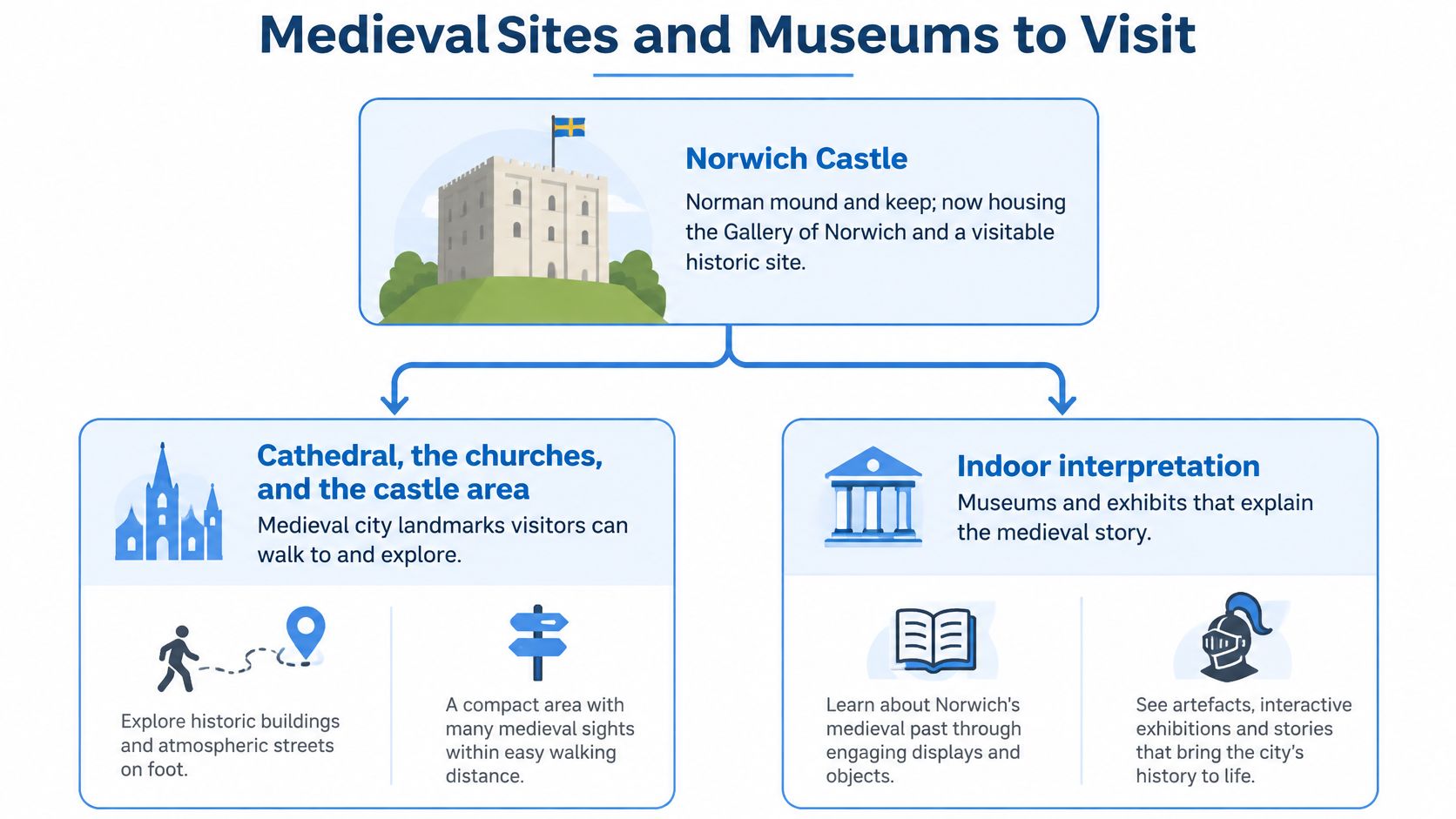
The useful filter for medieval Norwich is access. A museum interior, a working cathedral, an appointment-only church and a ruin behind a development boundary ask for different levels of planning. Start with what you can enter, then treat the rest as streetscape and archaeology.
The major interiors and their wider setting
At Norwich Castle, begin with the daily-life displays before concentrating on the keep. Objects associated with ordinary activities make the building easier to understand as more than an impressive stone shell. The Gallery of Medieval Life gives that context, while the keep itself shows how power sat above the streets.
At Norwich Cathedral, look at the Norman nave, then allow time for the cloisters and Cathedral Close. The Norfolk Historic Environment Record's Norwich overview records the cathedral's construction beginning in 1096 and completion by the 1140s, with facing stone imported from Normandy and Northamptonshire, a defensive circuit of approximately 40 towers and 11 fortified gateways enclosing more than 2.5 miles of wall, and the Guildhall's completion in 1424, when approximately 130 trades were listed. Those figures widen the visit beyond two monuments.
Use our Norwich Cathedral visitor guide to prepare for the cathedral setting, but confirm current arrangements with the venue.
Carrow Priory is the counterexample. Its twelfth-century ruins lie within the Carrow Works redevelopment area, so the site illustrates the difference between interpreted heritage you can enter and archaeological remains where access is not guaranteed. Plan to see what is publicly visible, and treat any closer view as a bonus.
Medieval sites and how to visit them
Site | What to see | Visit status today |
|---|---|---|
Norwich Castle | Norman mound, keep and Gallery of Medieval Life | Open attraction; check opening times and available displays |
Norwich Cathedral | Norman nave, cloisters and Cathedral Close | Welcomes visitors; check services and visiting hours |
City walls and gateways | Surviving parts of the defensive circuit, originally about 40 towers and 11 gateways | Sections can be viewed from public space; do not expect an intact circuit |
Norwich Guildhall | Civic building completed in 1424 | Plan an exterior stop; confirm any interior opening separately |
Strangers' Hall | Merchant's house and furnished rooms | Check published opening sessions before travelling |
Carrow Priory ruins | Twelfth-century priory remains | Inside a redevelopment area; access is not guaranteed |
Parish churches | Medieval churches across the city | Some open daily, others by appointment; check individual Heritage Open Days listings |
Strangers' Hall gives a domestic counterpoint to institutional buildings. Read its rooms as evidence of a wealthy household, while remembering that furnished historic interiors can represent different periods rather than one untouched medieval moment.
Parish churches need the same care. Seasonal openings through Heritage Open Days can let you enter buildings that are usually closed, but not every church takes part, and opening hours can change with services and building work.
A separate examination of named bricks in Nanjing's city wall looks at how makers' marks survive in fortifications. The Norwich version of that evidence sits in the surviving wall and gate sites, where repairs and later alterations show in the fabric.
Ask the castle or cathedral welcome desk whether printed routes, interpretation panels or guided options include smaller churches and lanes. Check opening times and the availability of displays before travelling, since services, events and building works can change the visit.
Walking Routes Through the Medieval Lanes
A good medieval Norwich walk links different kinds of evidence: an imposing institution, a working street, a household frontage and the river. Don't measure success by the number of interiors you enter. Some of the strongest stretches are viewed from the pavement, and knowing which stops work that way before you set out saves wasted detours.
Treat the following as flexible routes rather than timed tours. Budget for pauses and at least one booked interior rather than racing between stops.
Castle to cathedral and river
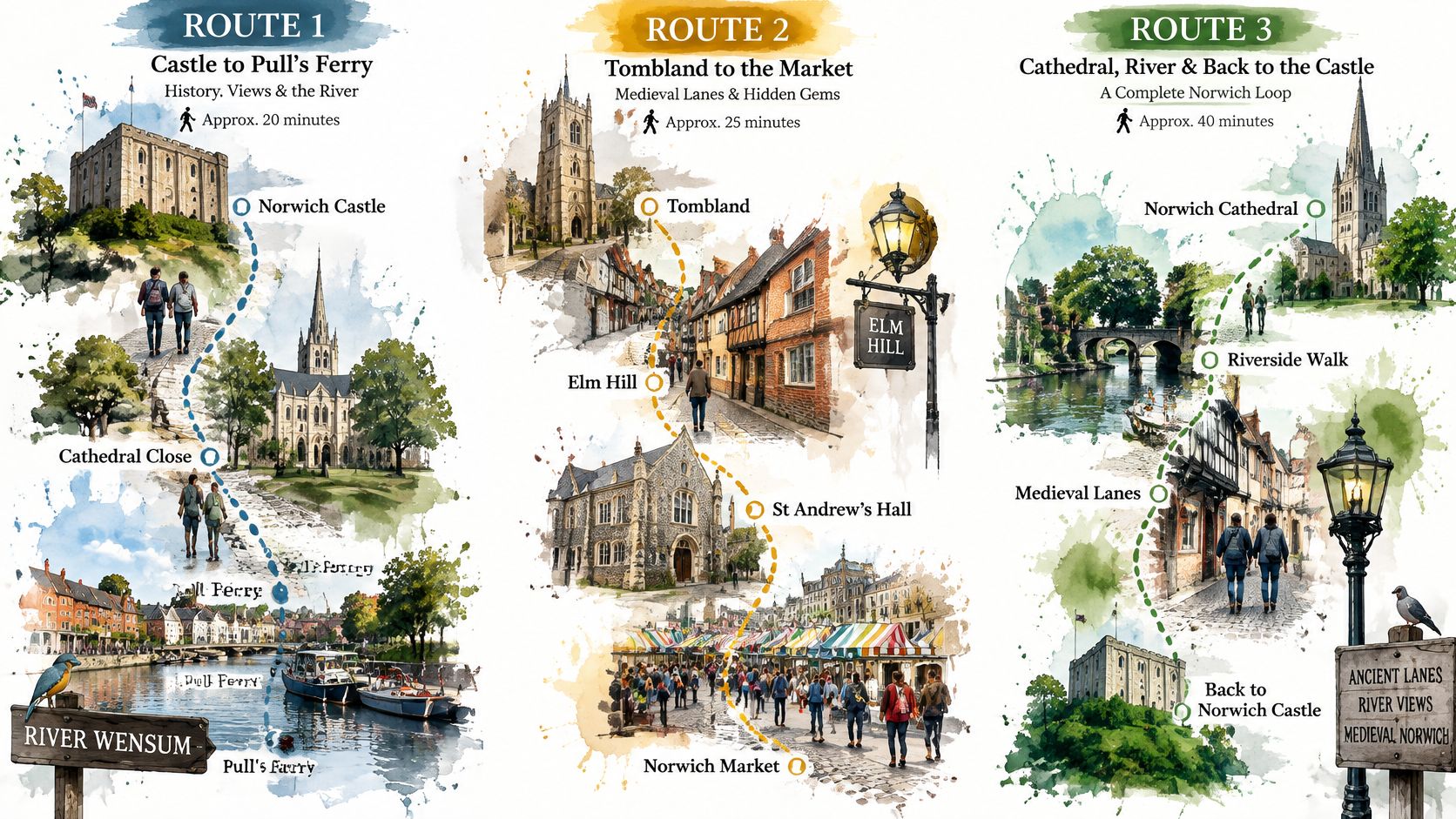
Start at Norwich Castle, continue towards Cathedral Close, and finish at Pull's Ferry on the river. This is a point-to-point walk, not a loop, unless you add a return leg along the same streets.
The castle interior needs a booked ticket, so take that slot first if you have one. Cathedral Close then works as a change of pace, an open precinct you can walk through without committing to an attraction. At the river, ask why a city's commercial and religious buildings needed connections beyond their immediate streets. Goods, deliveries and people moved by water, and that traffic explains a great deal about where the route runs.
Market lanes and Elm Hill
Begin at Norwich Market, pass the Guildhall, continue towards Tombland, then climb Elm Hill. Finish on Elm Hill or return towards the centre if you need somewhere convenient for lunch or onward travel.
Look at building lines, narrow plots and the relationship between doors and the street. Timber-framed buildings make the area visually memorable, but a street following a medieval alignment can still be lined with later façades. Elm Hill is largely an outside-looking route, so treat the jetties and shopfronts as the exhibit rather than hunting for a door that opens.
Walls and riverside
Choose a publicly accessible surviving wall section as your starting point, using a current local map to locate it. Continue towards Cow Tower and the riverside, then return through the centre, shortening the river leg if needed.
This is a route between fragments, not a continuous wall-top walk. Former gateway locations don't come with standing gatehouses, so don't build a day around finding one.
Why the lanes look this way
Medieval Norwich grew along the roads leading out of the city, with buildings concentrated on street frontages. That arrangement gave traders access to passing customers, while rear plots could hold yards, storage and workshops. The pattern still shapes what you walk past. A narrow frontage with a long yard behind it is a surviving piece of that same logic.
Look beyond the shopfront where public access allows. Plot widths, boundary walls and changes in ground level can be more revealing than decorative details, though a modern frontage alone can't establish what survives behind it.
Start early: Quieter lanes make it easier to pause without obstructing other pedestrians.
Check entrances first: Arrange booked interiors before deciding the order of your walk.
Carry only what you need: Business visitors combining sightseeing with work may find Grainmark Leather's guide to leather backpacks for business travel useful when choosing a practical day bag.
Our Norwich walking tours guide offers further planning ideas. Carrow Priory isn't freely accessible: restrict yourself to lawful public viewpoints outside the site, and don't assume the ruins themselves will be visible.
Daily Life, Trade and Faith in Medieval Norwich
Medieval Norwich wasn't merely a place of castles and churches. People bought food, moved goods, made textiles, negotiated debts and maintained households within the same streets visitors now photograph.
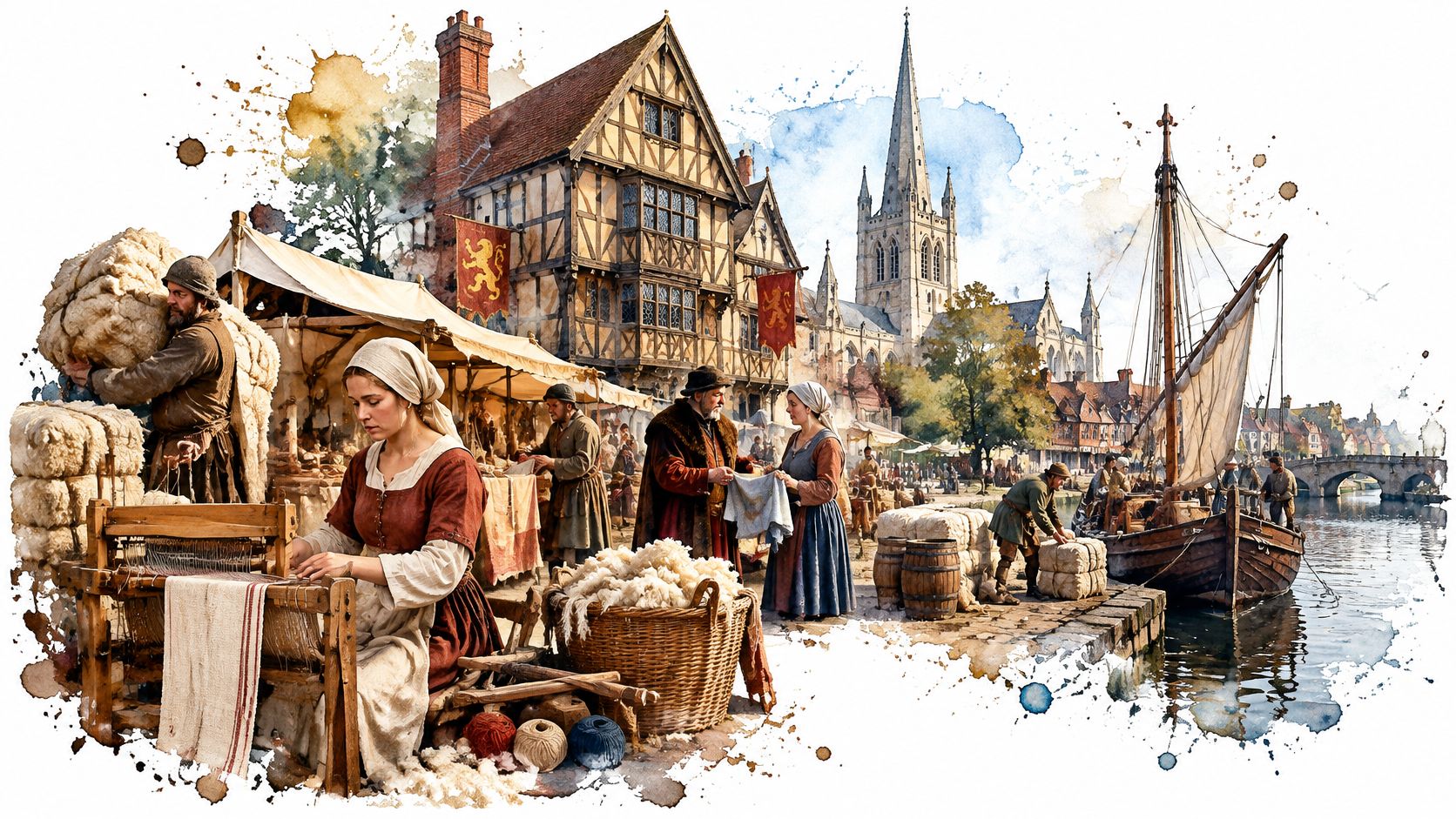
Its role as a regional market, port and manufacturing centre helps explain why merchants could build substantial houses. Wool and textile wealth supported impressive domestic buildings, but a merchant's house represents the prosperous end of urban life, not everyone's circumstances.
Trade under supervision
The range of recorded occupations is a reminder to look beyond a wool-only explanation of Norwich's economy. A trading city also needed people who supplied food, repaired equipment, transported materials and provided services.
The gates connected those activities to civic control. The Norwich City Council account of the city walls explains that murage taxes financed the defences, gateways closed at night, and officials could monitor and tax goods passing through them.
A city gate was both an entrance and a checkpoint. Protection, taxation and the movement of goods belonged to the same urban system.
Standing near a former gateway, consider the difference between arriving before closure and finding the entrance shut. For background on the city's commercial centre, our Norwich Market history provides a useful companion.
Faith alongside exclusion
Religious buildings shouldn't be interpreted only through architecture. Their communities also participated in a society where belonging and protection were unequal.
The Norwich Castle account of coexistence, prosperity and persecution places Jewish settlement probably in the late eleventh century, while allowing for an earlier presence. It describes cathedral monk Thomas of Monmouth's writings during the 1150s, 1160s and 1170s about the alleged murder of the Christian boy William in 1144, and records the nationwide expulsion of Jews ordered in 1290.
The accusation must be understood as an anti-Jewish persecution narrative, not treated as established evidence that Jewish people committed the alleged crime. The text is valuable for understanding hostility and its expression, rather than validating its claims.
Read the castle gallery and Strangers' Hall with that balance in mind. Material prosperity, skilled work and impressive buildings belong alongside questions about who could participate safely in city life.
Accessibility Across the Medieval Sites
An accessible attraction does not automatically create an accessible day out. The route between venues, the entrance in use and the availability of a toilet can matter as much as a lift inside a building.
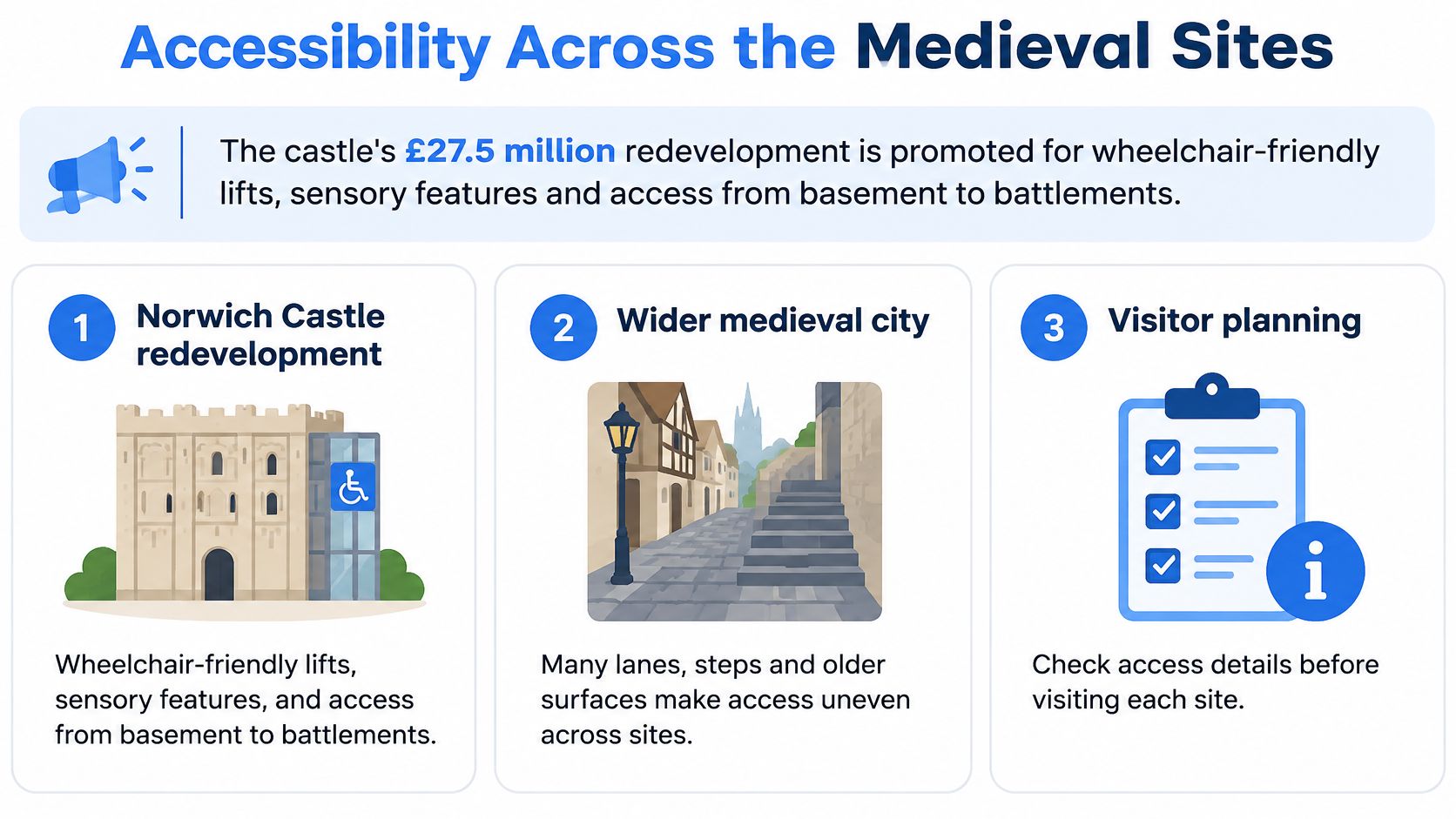
Art Fund's Norwich visitor feature highlights the castle's £27.5 million redevelopment, including wheelchair-friendly lifts, sensory features and access from basement to battlements. Those improvements apply to the castle. They do not describe the cathedral, parish churches or surrounding lanes.
Formal access and practical use
An entrance described as accessible may still require a different approach from the main visitor route. Ask whether a ramp is permanent, whether staff assistance is needed, and whether the accessible entrance is open throughout your planned visit. A lift that exists is not the same as a lift that runs on the day.
Historic surfaces need equally specific questions. Cobbles, flint, thresholds and gradients can make an apparently short connection tiring or unusable, particularly with a manual wheelchair, walking aid or pushchair. A short map walk can become a longer route once rest stops are included.
Access notes for medieval sites
Site | What is known about step-free access | What to check before you go |
|---|---|---|
Norwich Castle | Wheelchair-friendly lifts, sensory features and basement-to-battlements access reported after the redevelopment | Which lift is running, whether the full route is open, and how staff assistance works |
Norwich Cathedral | Thresholds and nave floor surfaces need checking | The entrance in use on your visit, the internal route, and any closures for services |
City walls and gateways | Public access is limited to particular approaches, and some structures are viewed from outside | Whether your chosen approach is step-free and whether any section is open to enter |
Parish churches | Narrow entrances and appointment arrangements may affect use | Which door will be opened for you and whether staff assistance is needed |
Carrow Priory ruins | Restricted setting, and nearby development may alter arrangements | Whether any public viewing point is open during your stay |
Norwich station to city centre | The shortest map route may not suit every mobility need | A street route for your first destination, plus toilet provision and opening hours there |
Toilets are not uniform across these sites. Ask each venue when you book or arrive, and check opening hours as well as accessibility.
For hearing, visual or sensory access, explain what would make the visit workable. Ask about written interpretation, seating, lighting, quiet spaces, audio options and whether any guided activity relies entirely on spoken commentary.
A useful question is more precise than “Are you accessible?” Try: “Can I reach the gallery from the entrance without steps, and can I use that route independently?”
Before leaving your accommodation: Save the venue's access information and contact details. Mobile reception, a closed door or a changed entrance shouldn't leave you without an alternative.
Check the station route: Find a step-free approach to your first destination.
Phone churches ahead: Ask which entrance will be opened.
Plan rest points: Break up climbs rather than waiting until you're exhausted.
Check toilets on the day: Ask about both accessibility and opening hours.
Seasonal Events, Family and Business Visits
Timing can determine whether you see a church interior or only its exterior. Heritage Open Days is worth checking for special access, but participation, booking arrangements and opening sessions must be confirmed building by building.
Use the official event calendar for the next edition rather than assuming a fixed annual date. Match individual listings to your travel dates, and don't interpret an old event page as a current invitation.
Choose openings before filling the diary
List the events taking place during your stay, then check whether they affect your intended route. A cathedral service might change visitor access; a city-centre event could alter pedestrian movement or make a quiet pause harder to find.
Keep a weatherproof alternative, such as an available museum interior, without assuming you can arrive without booking. Timed entry, where offered, is useful only if the rest of your itinerary leaves enough room to reach it comfortably.
For families: Combine an interior with a shorter outdoor leg, rather than attempting every landmark.
For children's activities: Confirm the activity, suitable ages and booking requirements with the venue.
For personal care: Check baby-changing provision and any required Changing Places facility separately. They aren't interchangeable.
For business visitors: Consider a weekday morning for the castle or cathedral, while checking opening times rather than assuming early admission.
Fit heritage around the purpose of your stay
If you're attending meetings, choose a route with an obvious stopping point near the centre. A walk from the market towards Tombland is easier to shorten than an itinerary that depends on reaching a distant appointment-only building.
Contractors and people staying during a relocation can spread visits across their stay. That approach makes it easier to use an unexpected church opening without sacrificing a booked attraction.
Leave one optional stop in your plan. A closed church then becomes a reason to enjoy the surrounding streets, not a failed day.
For families, the equivalent is permission to stop early. A well-paced visit with somewhere to sit is more useful than completing a route while everyone is tired.
Plan Your Medieval Norwich Visit and Base
Set your dates around confirmed access, then choose your base. Check the next Heritage Open Days calendar and the events scheduled during your stay before committing to an itinerary built around occasional openings.
For a leisurely example, you could give the castle and cathedral separate days, fit a walk around one of those visits, and reserve another morning for churches with confirmed access. This is a suggested pace, not a minimum stay or a promise that every site will be open.
Make the itinerary resilient
Book timed admission where it's offered, but avoid placing another fixed commitment immediately afterwards. Allow space for lunch, rest and the journey between entrances, especially if you're following a step-free route.
Keep your priorities simple:
Choose an anchor: Decide which major interior matters most to you.
Pick one walk: Select lanes, cathedral and river, or defensive remains.
Add conditional stops: Include churches only when their arrangements are confirmed.
Keep an alternative: Have a public-space route ready if an interior closes.
A central base can make it easier to return between sightseeing and work. Our properties are close to the train station, Norwich Cathedral, the market and the main employment sites in and around the city, with city-centre locations in NR1, NR2, NR3 and NR5.
Our Norwich city-centre accommodation guide can help you think through location alongside your route and daily commitments. Choose the setting that suits the whole stay, not just the first attraction.
Set the dates and choose your route
This post is sponsored by Stay Norwich Apartments, your furnished rental accommodation provider in Norwich, Norfolk, offering temporary or short-term furnished accommodation. You never know when you might need it. Rest assured that Stay Norwich Apartments will have you covered. staynorwichapartments.com
Medieval Norwich Guide: Sites, Walks and Visiting Tips: Check the opening times for your priority sites, pick the walk you most want to take, then use the property search for dates that match your plan. Keep restricted sites optional and make confirmed access the foundation of your visit.
Stay Norwich Apartments offers furnished short-term accommodation in Norwich for visitors balancing medieval sightseeing with work, relocation or a temporary stay. Visit Stay Norwich Apartments to choose a central base for your dates and build your visit around the places you can explore.
Comments