


Norwich City Centre Accommodation: A Practical Guide

You've just stepped off the train at Norwich Thorpe Road with a suitcase, a laptop, and a project that starts early tomorrow. The hotel beside Riverside is easy to find, but the room offers little beyond a bed, a bathroom, and somewhere to balance your laptop. A serviced apartment near the Forum costs more at first glance, yet gives you a kitchen, a proper desk, and space to work without eating every meal in a restaurant.
That choice matters more than the hotel star rating when you're staying for a project, a relocation, a house renovation, or a university visit. Good Norwich city centre accommodation should answer four practical questions before you book: how close is it, can you cook, can you work, and what will the complete bill be?
Table of Contents
Accommodation Types in Norwich City Centre Compared - Branded hotels - Independent boutique hotels - Serviced apartments - Short-term rentals and B&Bs
Amenities That Matter by Traveller Type - Business travellers - Contractors - Families
Booking Direct and What a Smooth Stay Looks Like - What should happen before arrival
Choosing the Right Norwich City Centre Accommodation for You
Arriving in Norwich and Choosing Where to Stay
A contractor arriving for a short Norfolk assignment usually has two immediate options. They can take a taxi from the station towards a Riverside hotel, or walk or drive towards a furnished apartment closer to the Forum and central shops. The hotel is straightforward, particularly if the stay is only for one night. The apartment becomes more useful once the booking stretches beyond a few nights.
A compact hotel room gives you a predictable routine, reception cover, and often breakfast. It can also leave you working from the bed or a narrow ledge, with no fridge suitable for proper food and nowhere to separate work from sleep. A one-bedroom flat with a kitchen and dedicated workspace gives you more control. If linen is changed weekly and the bills are explained clearly, it also makes longer stays easier to budget.
For station arrivals, read the practical advice in this guide to Norwich train station accommodation before choosing a postcode. The most central address isn't automatically the best fit if you're carrying equipment, arriving late, or travelling to a site outside the centre each morning.
Practical rule: For a short stay, prioritise arrival convenience. For a longer stay, prioritise the total cost and how comfortably you can live between check-in and departure.
Norwich has substantial overnight visitor demand. In 2024, the city recorded 12.5 million trips, including 0.4 million staying trips, which generated 1.4 million nights and £631 million in tourist spending, according to Norwich City Council's tourism economy report. That scale supports hotels, serviced apartments, and short-stay lettings, but it also means you need to book around your actual reason for travel rather than choosing the first available room.
Before paying, ask:
Proximity: Can you reach the station, meeting site, hospital, or city-centre venue without an awkward daily journey?
Kitchen: Is it fully equipped for self-catering, or does it only contain a kettle and microwave?
Workspace: Is there a desk, a suitable chair, and Wi-Fi that can handle a working day?
Total bill: Are utilities, cleaning, linen, parking, and deposits already included?
Norwich City Centre Neighbourhoods at a Glance
Norwich's central areas suit very different guests. The Riverside and Station district works well for rail users, business travellers, and anyone who wants chain-hotel convenience. Tombland and the Cathedral Quarter are better for atmosphere, cafés, historic streets, and weekend wandering, but parking is tighter and some roads feel less practical with heavy luggage.
Prince of Wales Road is handy for late arrivals and nightlife, although noise can become the deciding issue. The Golden Triangle and Unthank Road edge feel more residential and calmer, with local cafés and larger homes, but you'll trade some immediacy for a longer walk into the market and central attractions.
Neighbourhood | Walk to Station | Parking | Best For | Watch Out For |
|---|---|---|---|---|
Riverside and Station | Short and convenient | Usually paid car parks or limited private spaces | Rail users, business trips, quick stays | Chain-hotel feel and busy roads |
Tombland and Cathedral Quarter | Walkable, but less direct | Tight streets and limited spaces | Couples, culture-focused breaks, café visits | Parking, event noise, uneven pavements |
Prince of Wales Road | Convenient for the station and centre | Mostly paid or restricted parking | Late arrivals and nightlife | Noise, especially around busy evenings |
Golden Triangle and Unthank Road edge | Further from the station | More residential options, but check restrictions | Longer stays, families, quieter work trips | Less convenient for repeated central errands |
The Cathedral Quarter deserves a closer look if you want to stay among historic buildings, restaurants, and independent businesses. This guide to Norwich Cathedral Quarter accommodation is useful when the character of the neighbourhood matters as much as the room itself.
Contractors should also look beyond the obvious central hotel belt. If your work is linked to Norfolk and Norwich University Hospital or the Norwich Research Park, a quiet apartment with dependable parking may beat a more central room with an awkward commute. The right choice depends on whether you'll spend your day walking around Norwich, travelling to a work site, or returning late with tools and equipment.
Central housing supply is changing too. Norwich delivered 2,136 homes between 2016 and 2021, averaging over 400 homes per year, and the Great Norwich Local Plan broadly aligns that delivery with a target of about 425 homes per year through 2038 for the city centre and East Norwich, as set out in the city-centre housing delivery note. More apartments mean more choice, but also more competition for well-designed central accommodation.
Accommodation Types in Norwich City Centre Compared
Norwich gives you four main accommodation choices, and each works for a different kind of stay. Branded hotels provide consistency and reception support. Independent hotels offer character. Serviced apartments give you a more functional base. Short-term rentals and B&Bs can be good value, but quality varies sharply.
The city has a long-established hotel base. The Maids Head Hotel is described as dating back to the 1100s and has 84 rooms and suites in the city centre, while independent listing data records 303 hotels in Norwich. The same listing data places peak-season average prices at around $171, compared with $131 in low season, showing why the headline rate can change substantially with timing. See the Maids Head Hotel listing and Norwich hotel overview for context.
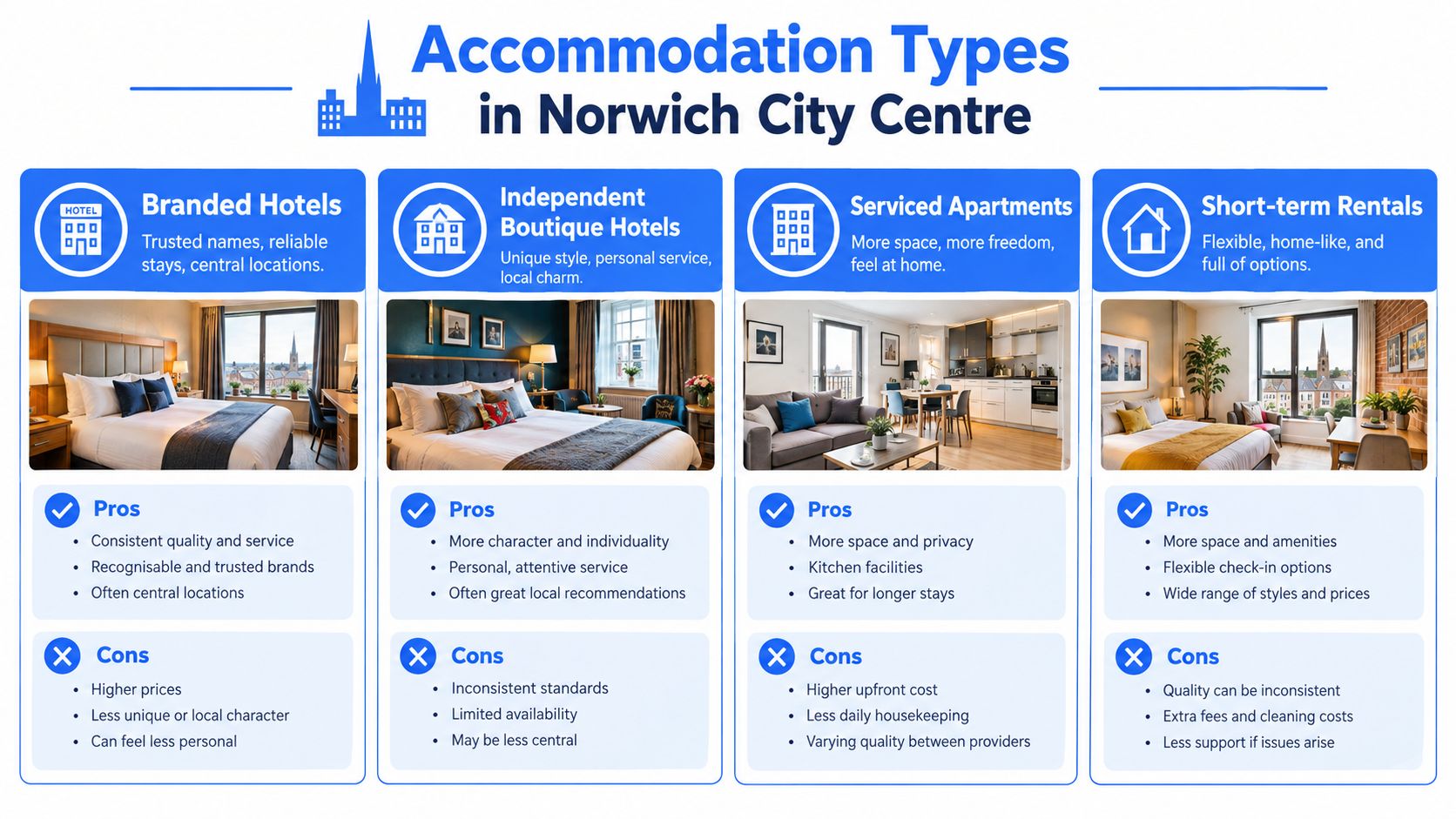
Branded hotels
Hotels are the easy answer for one or two nights. You'll usually get a staffed reception, breakfast options, loyalty points, and a familiar service model. The drawbacks appear during longer bookings. A hotel room rarely gives you a full kitchen, and dining out repeatedly pushes up the actual cost of the stay.
Independent boutique hotels
Boutique hotels suit couples and visitors who care about design, history, and a memorable setting. Norwich has plenty of attractive central streets where an independent property can make a weekend feel more connected to the city. Space, parking, kitchen access, and late check-in can be less consistent, so ask direct questions before booking.
Serviced apartments
Serviced apartments cost more upfront than a basic room because you're paying for usable living space, furnishings, a kitchen, and often a dedicated work area. For contractors, relocating professionals, and university visitors, that extra space can reduce restaurant spending and make the stay feel manageable rather than improvised.
A useful comparison is self-catering cottages versus serviced apartments. The key difference isn't just style. It's whether the property supports your daily routine, including cooking, laundry, work, and an extension if the project runs on.
Short-term rentals and B&Bs
Short-term rentals can offer houses, spare rooms, or apartments, but you need to check who manages the property, whether the listing is current, and what support exists after arrival. B&Bs are often welcoming and personal, but they're rarely the strongest option for stays beyond a week because kitchens and separate living space are uncommon.
Amenities That Matter by Traveller Type
Generic descriptions hide the details that determine whether a stay works. A “comfortable room” tells a project manager almost nothing about video calls, a family nothing about laundry, and a tradesperson nothing about storing equipment.
Business travellers
A project manager working near Aviva needs a reliable desk, a proper chair, and Wi-Fi that supports video calls. A breakfast tray beside the bed isn't a workspace. Blackout curtains matter if early meetings follow a late arrival, while flexible check-in helps when a train or flight runs behind schedule.
Contractors
A fibre engineer working across Norfolk needs different priorities. A full kitchen supports self-catering, a separate living area gives the evening some breathing room, and laundry access prevents the suitcase becoming a daily problem. Secure parking or storage can matter more than a stylish lobby, particularly when tools or work clothing travel with the guest.
Weekly billing should be simple. Ask whether the quoted amount includes utilities, Wi-Fi, linen, cleaning, and any parking charge. If the operator can't explain the bill before arrival, the property isn't ready for a professional booking.
Families
A family visiting Norwich Castle Museum may need two bedrooms, interconnecting space, or at least a living room where children can sleep without taking over the adult bedroom. A washing machine, child-safe kitchen equipment, nearby supermarkets, and access without difficult stairs will make a bigger difference than a decorative feature wall.
Amenity | Business | Contractor | Family |
|---|---|---|---|
Reliable Wi-Fi | Essential for calls and cloud work | Essential for planning and communication | Useful for entertainment and travel planning |
Proper desk | High priority | Helpful for paperwork | Useful if adults need to work |
Full kitchen | Convenient | Essential for longer projects | Important for meals and routines |
Laundry | Helpful | Often essential | Essential for longer stays |
Parking or storage | Depends on travel | High priority | Helpful with luggage and children |
Flexible check-in | Important for late arrivals | Important around changing shifts | Useful when travelling with children |
Separate living space | Helpful | Strong preference | Important in a multi-night stay |
Before booking, ask for specific answers rather than relying on amenity icons. “Wi-Fi available” isn't the same as a suitable work connection, and “kitchen” may not mean an oven, cookware, or enough fridge space for a proper shop.
Reading Norwich Prices, Seasons, and All-Inclusive Bills
Norwich prices respond to demand, so the cheapest room is rarely the best-value booking. University terms, football fixtures at Carrow Road, and summer tourist weeks can tighten central availability. January and February often feel quieter, while late summer can bring different options from the busiest holiday periods.
Independent market data records 303 hotels in Norwich. Peak-season average prices sit around $171, compared with $131 in low season. Airbnb-style supply fell 9.8% over the measured year, while average nightly rates reached $148, occupancy stood at 41.2%, and median lead time was 44 days, according to Norwich short-term rental market data. Use these figures as market context, not as a promised rate for a specific property.

For stays longer than a week, compare the complete weekly total. A cheaper apartment can cost more once electricity, parking, cleaning, or linen changes are added. A serviced apartment such as Stay Norwich Apartments can suit guests who need a kitchen, workspace, and furnished move-in readiness, provided the quote clearly states which bills are included. Ask for the terms in writing before transferring money.
Use these checks:
Compare like with like: Put hotel, apartment, and rental prices into a weekly total using the same guest and night count.
Request an itemised quote: Confirm utilities, Wi-Fi, linen, cleaning, deposits, council tax where relevant, and parking.
Ask about direct booking: A local operator may explain the property and terms more clearly than a platform listing. Compare the final total rather than assuming a direct rate is lower.
For furnished lets, legal responsibilities matter. Read the Norwich guide to renting and furnished lets, then check Norwich City Council's guidance for private landlords on housing standards, licences, written information, accurate rents, lawful letting practices, and possession grounds. Furniture supplied with a let should meet the Furniture and Furnishings Fire Safety Regulations guidance.
Booking Direct and What a Smooth Stay Looks Like
A good direct booking starts with a useful enquiry, not a vague “is it available?”. Send the dates, guest numbers, reason for the stay, parking needs, and whether you need a workspace or longer-term rate. A responsive host should return a clear answer promptly, with the apartment offered, the total cost, deposit terms, check-in window, and any restrictions that could affect the booking.
The difference becomes obvious before payment. A helpful local operator will explain whether bills are included, where you'll park, how you collect the keys, and what happens if your project extends. They won't hide the important conditions in a long platform thread.
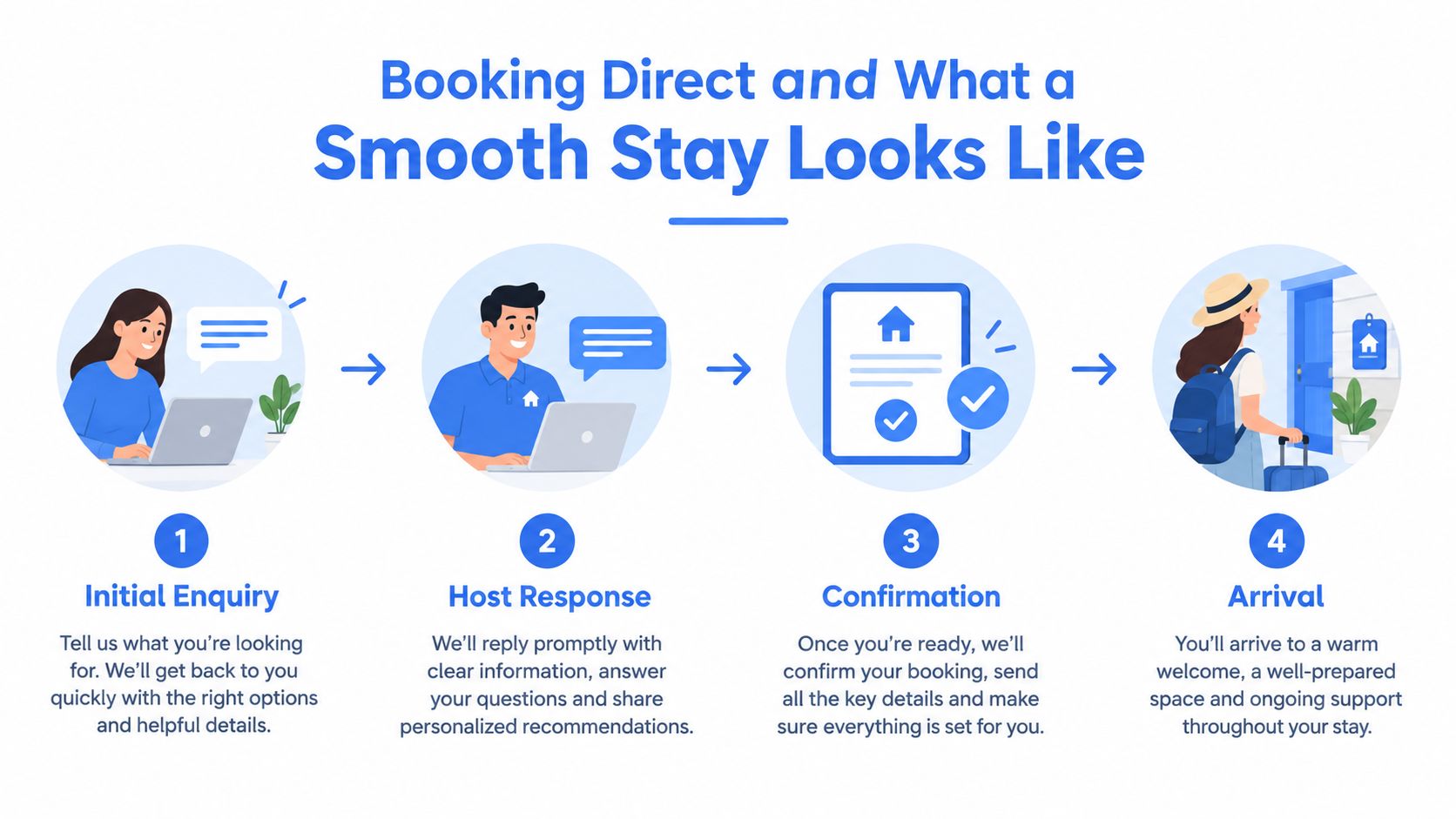
What should happen before arrival
You should receive written confirmation of:
The full amount: Include rent, bills, cleaning, parking, deposits, and applicable charges.
The arrival plan: State key collection, access instructions, check-in times, and late-arrival arrangements.
The property rules: Cover noise, smoking, visitors, pets, rubbish, and parking.
The contact route: Give a direct number or clear emergency process for problems.
At check-in, a smooth handover is practical rather than theatrical. You collect the keys, walk through the apartment, test the Wi-Fi, locate the bins and heating controls, and receive local recommendations that match your plans. A guest guide with Norwich restaurants, shops, transport, and day trips saves time when you've arrived after a long journey.
You can use top hotel and rental websites to compare broad availability, but a platform's support team may not know the apartment, parking arrangement, or quickest solution to a local problem. Direct communication is particularly valuable when you're booking several units, extending a project, or arranging temporary accommodation during a move.
Departure should be just as clear. Confirm the check-out process, damage assessment, deposit return timeline, and how an extension is agreed. A local host who handles those points in writing gives you far less uncertainty than a listing that only looks polished on the booking page.
Getting Around Norwich and Exploring Norfolk
Norwich is compact enough for many central journeys on foot, but your transport plan should match your work and arrival pattern. Norwich Station links the city to the wider rail network, while buses from St Stephens and Castle Meadow serve central and outer neighbourhoods. Taxi apps and local taxi services are useful when you're carrying equipment, arriving late, or heading to a site where a bus connection would be inconvenient.
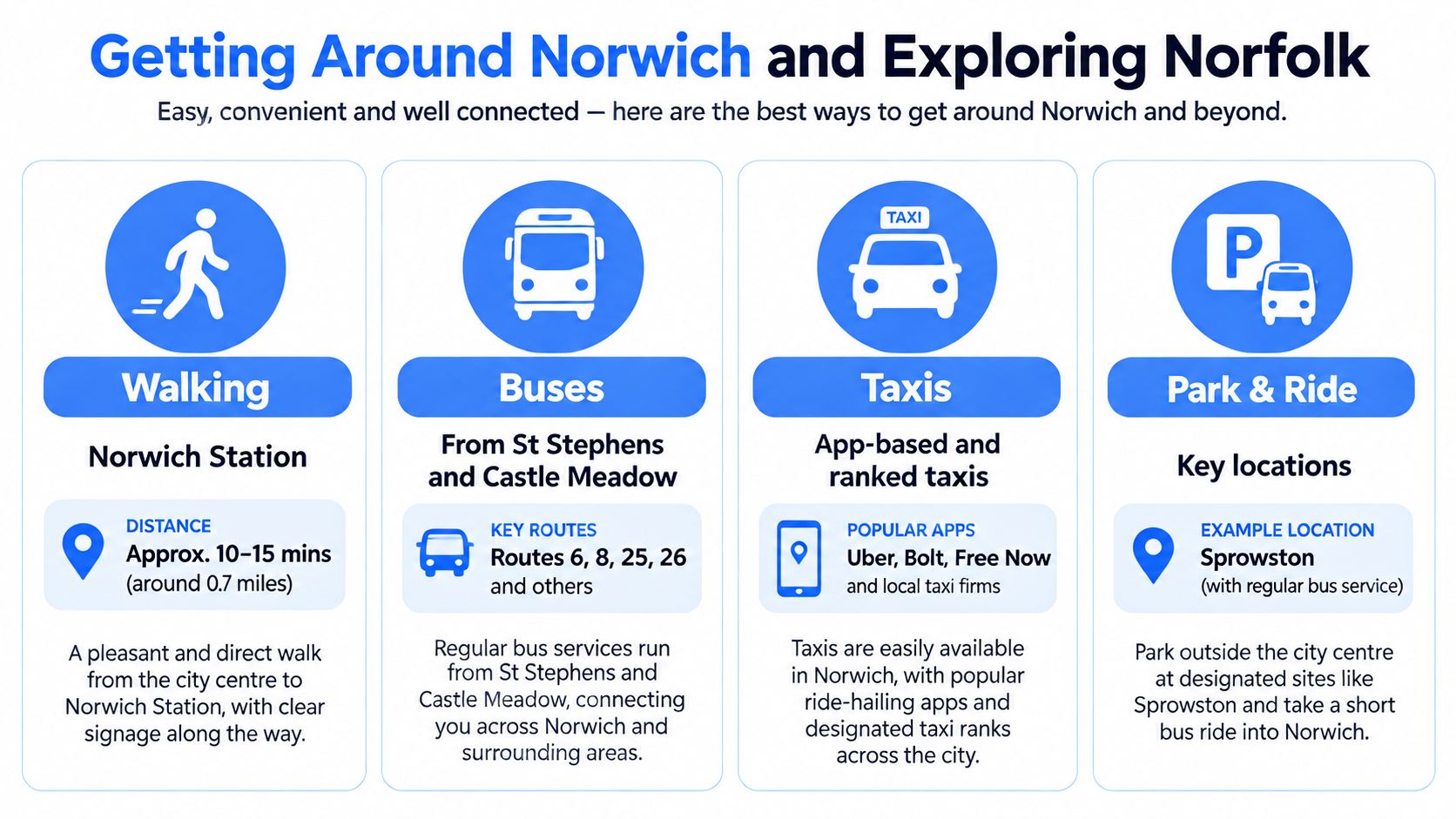
Central parking needs a realistic conversation. Many properties don't have a private bay, so guests rely on paid car parks such as NCP or Chantry Place. Ask whether a space is reserved, whether overnight parking is permitted, and how far you'll carry luggage. Park and Ride sites at Sprowston and Costessey can suit visitors who would rather leave the car outside the centre.
If your work takes you to the Norwich Research Park, Norfolk and Norwich University Hospital, or the EPIC innovation cluster, check the morning route before booking. A central apartment can be excellent for evenings but less efficient if you need to drive across the city daily.
For leisure, pair nearby activities rather than trying to cover everything at once. Walk from the centre to Norwich Castle Museum and Norwich Cathedral, browse Norwich Market, and book dinner in the Lanes. On another day, travel north towards Wroxham and the Broads, or take the Bittern Line from Norwich Station towards the North Norfolk coast and places such as Cromer and Sheringham.
The Norfolk day trips from Norwich guide can help you plan around meetings instead of guessing how much time a coastal or Broads outing will take. If you're hiring a vehicle for wider travel, this 2026 car rental abroad guide offers broader preparation advice, although central Norwich guests should still check local parking first.
Choosing the Right Norwich City Centre Accommodation for You
Choose by the shape of your stay, not by the most attractive photograph.
A solo consultant on a short project should look for a serviced apartment within easy walking distance of Norwich Station, with a proper desk, fast Wi-Fi, and a kitchen. A family staying for a week or more should prioritise a two-bedroom apartment with a full kitchen, washing machine, and practical access near Chapelfield or Riverside. A couple on a weekend break may prefer an independent boutique hotel in the Lanes, where atmosphere and dining matter more than a weekly food shop.
Corporate teams need a different arrangement. Several units under one agreement can simplify arrivals, invoices, and communication, particularly when staff rotate through a project. Direct operators such as Stay Norwich Apartments provide furnished, self-catering city-centre accommodation for short stays and longer visits, with kitchens, workspaces, Wi-Fi, and clear booking information.
Student and relocation demand makes early planning sensible. UniHomes describes Norwich as the 12th most in-demand UK city for student housing in the 2026–27 letting season, with 20,000 students arriving each year, as reported in its Norwich student housing guide. The Norwich Nelson redevelopment was approved in July 2026 and includes a 248-bedroom Premier Inn, 492 purpose-built student beds, a public park, and a river walkway, according to the same source. New supply may improve some availability, but it won't remove the need to match location and terms to your stay.
Use three final filters:
Weekly predictability: Can you understand the cost without calculating separate bills?
Genuine inclusivity: Are utilities, Wi-Fi, linen, cleaning, and parking clearly covered?
Host responsiveness: Did the operator answer practical questions before you booked?
Comfort also includes navigation, arrival information, and local accessibility. Guidance on enhancing hotel guest experiences is useful because a well-managed stay depends on more than the room itself. Prioritise fit over novelty, and book early for high-demand weeks around graduation and Christmas.
Landlords direct with Stay Norwich Apartments, Norfolk, furnished accommodation when you need it, for as long as you need it. No hassle, no drama, pay and stay. Visit Stay Norwich Apartments to check practical city-centre apartments, review clear rates, and arrange a short or extended stay around your work, move, or visit.
Comments