


Norwich Postcode Areas and Neighbourhood Guide

Updated: Oct 8
Contact us for more information or WhatsApp
A contractor arrives in Norfolk with a week of site visits, a car full of equipment and a booking confirmation showing an NR postcode. The address looks promising until they realise that NR might mean a city-centre apartment, a coastal town or a rural village far from the next morning's appointment. A relocating professional can face the same problem when a listing says “Norwich area” but gives little practical context beyond the postcode.
That's why understanding Norwich postcode areas matters. The NR prefix is more than a mailing label. Used properly, it helps you judge location, commuting demands, access to Norwich, and whether a furnished base suits your project or household. This guide translates the postal geography into useful accommodation advice for contractors, business travellers, families, students and people between homes.
Norwich Postcode Areas and Neighbourhood Guide: Table of Contents
Understanding the NR Postcode Area Structure - How the districts are arranged - Why Norwich has the NR prefix
Exploring the Urban Norwich Districts NR1 to NR8 - Choose the district around your daily destination - Apply a simple location test
Discovering Rural and Coastal Postcode Districts - Compare the main types of outer location
Matching Postcode Areas to Your Accommodation Needs - Ask the right accommodation questions
Legal and Practical Rules for Furnished Temporary Lets - Understand the occupancy arrangement - Prepare for right-to-rent checks
Why Stay Norwich Apartments is the Ideal Base - Use local knowledge to choose the right base
Frequently Asked Questions About Norwich Postcodes - Does an NR postcode guarantee a Norwich city-centre location? - Can I travel from an outer NR district into Norwich? - Is a central Norwich apartment suitable for a contractor? - What should I check before booking temporary housing?
Navigating Norwich and Norfolk Postcodes
Start with the exact district, not just the NR prefix. NR1 and NR2 suggest a very different daily routine from NR9, NR17 or NR35. A central address may let a professional walk to meetings and use city amenities, while a rural or coastal address could offer more peace, parking and space, but require dependable road transport.
For a contractor, the right decision depends on the worksite rather than the postcode's prestige. Someone attending meetings near the station may value a central apartment and a short walk after a long day. Someone carrying tools to projects across Norfolk may prefer straightforward road access and on-site parking, even if the property sits outside the urban core.
Practical rule: Treat the postcode as the starting point for checking a location, not as proof that the property is in Norwich city centre.
Transport is another deciding factor. Check the journey from the accommodation to the station, bus routes, trunk roads and the actual worksite. If rail travel is part of your routine, read this practical guide to Norwich train station before choosing a base. A property that looks close on a map may still be inconvenient if equipment, luggage or children make walking difficult.
Families need a different assessment. Quiet streets, kitchen facilities, storage, parking and access to everyday shops can matter more than being close to nightlife or historic attractions. A household staying during a move or renovation should also ask whether the accommodation has enough living space for normal routines, rather than treating a temporary let as a hotel room.
The useful question is simple: where will you spend your working and personal time? Once you answer that, the NR district becomes a practical filter. It can narrow a broad Norfolk search into a realistic shortlist, but you still need to inspect the exact address, transport options and booking terms.
Understanding the NR Postcode Area Structure
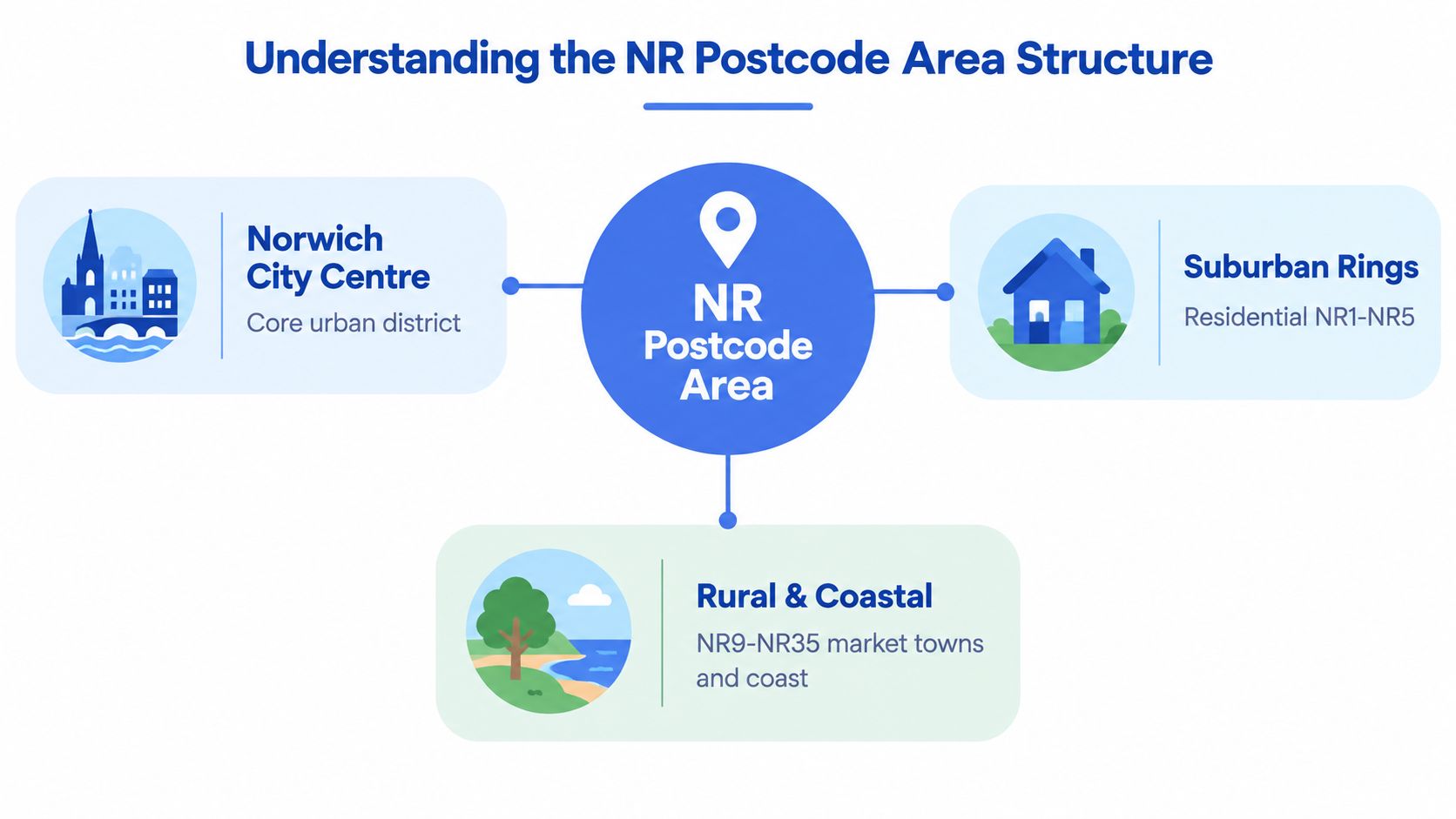
A contractor booking a temporary flat in Norwich can easily choose the wrong base if they treat “NR” as a city label. The NR postcode area covers a substantial part of eastern England, with 35 postcode districts, 114 postcode sectors and 16 post towns, extending across central, northern and eastern Norfolk and into north-east Suffolk, as recorded in the NR postcode area overview. It includes Norwich, Great Yarmouth, Attleborough, Wymondham, Dereham, Fakenham, Walsingham, Wells-next-the-Sea, Holt, Sheringham, Cromer and North Walsham, alongside Lowestoft, Beccles and Bungay.
That range makes the postcode a useful first filter for accommodation, not a final location decision. An NR address does not automatically mean Norwich city. It may identify the urban centre, a suburban edge, a coastal settlement, a rural community or a Suffolk town. A listing grouped under NR can therefore represent a very different commute, parking situation and choice of local amenities.
How the districts are arranged
Norwich Postcode Areas and Neighbourhood Guide: The numbering follows a broadly concentric pattern. NR1 to NR8 cover the Norwich built-up area, while NR9 to NR16 cover rural places associated with the Norwich post town. NR17 to NR35 serve other post towns across the wider postal region.
Use that structure to narrow a property search, then verify the complete address. A lower NR district often points towards the urban area, but district boundaries and neighbourhood character still vary. Higher districts can place a property closer to another town, a village or the coast, so check road connections, nearby shops and the distance to the actual worksite before booking.
Published postcode statistics list 23,457 live postcodes and 28,198 postcodes in total, including discontinued or inactive entries, as at May 2020. Those figures show why the area is too broad to treat as a single city market. The postcode system describes postal delivery geography, not one housing market or one local authority.
Why Norwich has the NR prefix
Norwich helped shape the modern UK postcode system. In 1959, it was selected for a major postcode experiment because the city already had eight automatic mail-sorting machines. The initial scheme was intended to cover approximately 150,000 private and business addresses, with codes issued by October of that year, according to the history of UK postcodes.
The original codes used “NOR”, a space, a two-digit number and a final letter. That format preceded the familiar structure used today, such as NR1 3AA. The national system was introduced in stages between 1959 and 1974, and Norwich was completely recoded by 1974 as the national design was finalised.
For temporary or flexible accommodation, combine the NR district with the town, street and travel route. That check turns a broad postal area into a practical shortlist.
Exploring the Urban Norwich Districts NR1 to NR8
NR1 to NR8 cover the Norwich built-up area, but they aren't interchangeable. Your best choice depends on whether you prioritise walkability, a quieter residential setting, access to the university, proximity to the hospital or convenient routes out of the city.
Choose the district around your daily destination
NR1 is the natural choice for people who want the city centre, station access and a wide range of shops, restaurants and cultural venues close by. It suits business travellers with meetings in central Norwich and visitors who don't want to rely on a car for every trip.
NR2 combines established residential streets with student and mixed housing areas. It's useful for people who want a more lived-in setting while remaining close to the centre, and it can work well for university visitors or professionals who prefer local cafés and everyday amenities over a purely central location.
NR3 sits north of the centre and offers a practical balance between urban access and routes towards the wider region. It can appeal to contractors who need to leave Norwich regularly, particularly when parking and road access matter more than being beside the main shopping streets.
NR4 covers southern parts of the built-up area and is a sensible area to investigate for access towards the university, hospital and southern suburbs. Check the specific address carefully, because the difference between a convenient route and an awkward cross-city journey can be significant during peak travel times.
NR5 is associated with the west and south-west of the urban area. It can suit university-related stays and people looking for a residential base outside the busiest central streets. Review bus routes and parking arrangements before committing.
NR6 reaches northwards through residential areas and can be useful for people needing access to northern Norwich or onward road connections. It's a better fit for a vehicle-based worker than for someone whose week depends entirely on walking between central appointments.
NR7 covers north-eastern parts of the built-up area. It can provide a quieter base while retaining access to Norwich, although the exact commute will depend on the property and destination.
NR8 sits on the northern edge of the city and is often worth considering when road access, space and a suburban feel are priorities. It isn't the automatic choice for a visitor with daily city-centre meetings, but it may suit a family or contractor working across the northern side of Norfolk.
Apply a simple location test
First, write down your primary destination. Then identify whether you'll travel by foot, public transport or car. Finally, check whether the accommodation provides the practical features that support that choice, such as a workspace, reliable Wi-Fi, kitchen facilities or parking.
For a central visitor, the Norwich Cathedral Quarter guide can help you understand the character of the historic centre. For a contractor, the more important question may be how quickly you can reach the next site each morning.
The best urban postcode is the one that reduces friction in your actual week, not the one that sounds most central in a listing.
Discovering Rural and Coastal Postcode Districts
NR9 to NR35 extend the search beyond the Norwich built-up area. These districts serve rural locations, market towns and coastal communities, including Wymondham, Dereham, Fakenham, Cromer, Sheringham, North Walsham and other places across Norfolk. The wider NR region also reaches Suffolk towns such as Lowestoft, Beccles and Bungay.

A rural or coastal base makes sense when the worksite is outside Norwich, when a family wants more space and calm, or when the stay is connected to a regional project rather than daily city meetings. Contractors working on infrastructure, agriculture, construction or energy projects may save time by staying near the job instead of commuting into the city every day.
The trade-off is obvious. Outer locations can offer a slower pace and easier parking, but public transport may be less convenient and travel times can vary with the route. A worker with an early start should check the actual drive, not just estimate distance from a map. A family should consider shops, childcare arrangements and whether the property supports self-catering for the full stay.
Compare the main types of outer location
Wymondham offers a well-known market-town setting south-west of Norwich. It may suit people who need access to the city while preferring a smaller community atmosphere.
Dereham is further into central Norfolk and can work well for projects spread across the county. It should be assessed as a regional base, not as a substitute for a city-centre stay.
The north Norfolk coast, including Cromer, Sheringham, Holt and Wells-next-the-Sea, is the right choice when the destination, lifestyle or project is coastal. It's a poor choice for someone who has to attend central Norwich meetings every day.
Great Yarmouth and Lowestoft serve the eastern side of the region. They can be practical for coastal employment and business, while offering a completely different setting from Norwich's urban core.
The Norfolk Broads villages guide is useful for understanding how quickly the character of the region changes beyond the city.
A video can also help you visualise the wider environment before deciding whether a rural or coastal base fits your plans.
For short-term housing, the decision should follow the project map. Choose central Norwich for city convenience, an outer district for a regional commute, or the coast when the coast is where you need to be.
Matching Postcode Areas to Your Accommodation Needs
Postcode selection becomes easier when you begin with the person staying in the property. A professional relocating for work may need a calm workspace and reliable transport. A contractor may care most about parking, early road access and a kitchen that supports long days. A student or university visitor may prefer an urban district with easy access to study, food and public transport.
Visitor Type | Ideal Postcode Zones | Key Benefits |
|---|---|---|
Business traveller | NR1 to NR3 | Walkable central setting, restaurants, city services and access to meetings |
Contractor | NR3, NR6 to NR8, or an outer NR district near the worksite | Practical road access, parking potential and a base for regional travel |
Student or university visitor | NR2, NR4 or NR5 | Residential atmosphere with access to the university and city amenities |
Relocating professional | NR1 to NR5, depending on work location | Furnished convenience, self-catering facilities and a manageable daily commute |
Family between homes | NR4 to NR8 or a suitable market-town district | More residential surroundings, space and access to everyday routines |
Coastal worker or visitor | Relevant NR coastal district | Closer access to coastal employment, activities and local services |
These are starting points, not guarantees. A contractor assigned to a northern site may find NR8 more useful than NR1, even if the latter offers a shorter walk to the centre. A family may prefer a central apartment during a brief move, particularly if it avoids furnishing a house twice.
The same principle applies to property marketing. Owners and operators should describe the exact district, nearby destinations and practical amenities rather than relying on “Norwich” alone. Clear location information supports a more effective non-MLS real estate strategy, because prospective occupants can judge relevance before they enquire.
Ask the right accommodation questions
Before booking, confirm whether the rate includes utilities, internet, bedding, towels and cleaning arrangements. Ask about parking, access instructions, workspace and the kitchen equipment provided. Contractors should also check whether the property can accommodate work clothing, tools or longer stays without creating unnecessary disruption.
People between homes need clarity on availability and flexibility. A property may look suitable online but become impractical if the owner only accepts rigid dates or cannot explain what happens when a move is delayed.
For a focused guide to flexible options, see short-term lets in Norwich. The best accommodation choice is the one that matches the postcode to the reason for staying.
Legal and Practical Rules for Furnished Temporary Lets
A furnished let should be safe, clearly documented and suitable for the length of your stay. In England, supplied furniture and furnishings must comply with the Furniture and Furnishings (Fire) (Safety) Regulations 1988, commonly called the “match test”, according to government guidance for resident landlords. Check that the property appears professionally managed, with furniture provided for use rather than items added without proper care.
The same guidance recognises weekly periodic arrangements and fixed terms of three months. If the agreement does not specify a term, it usually follows the period covered by rent, such as weekly or monthly payments. That flexibility suits contractors, relocating professionals and households waiting for a purchase or sale to complete, but confirm the arrangement before you pay.
Understand the occupancy arrangement
“Temporary” describes the purpose or expected duration of a stay, not the legal agreement. GOV.UK states that an assured periodic tenancy is the common arrangement when the property is the tenant's main accommodation, the landlord does not live there and the tenant has their own room, even where facilities are shared. A person living in the landlord's home and sharing rooms may instead hold an excluded tenancy or licence, generally with less protection from eviction. The differences are explained in the GOV.UK tenancy types guidance.
Ask directly which agreement you will sign, whether the property is treated as your main accommodation and which rooms or facilities are private. Read the notice, cancellation and payment provisions before transferring money. Before signing, read this complete guide to short-term furnished apartment rental so you know which clauses and notice periods to expect. For a longer or more complex arrangement, guidance on how to negotiate lease terms for tenants can help you prepare practical questions. The agreement must still match the actual residential arrangement.
Prepare for right-to-rent checks
In England, landlords must check every tenant aged 18 or over before a new residential tenancy begins. The requirement can also cover people not named in the agreement and arrangements without written terms. If someone has time-limited permission to remain in the UK, the check will normally take place during the 28 days before the tenancy starts, as explained in the right-to-rent document guidance.
Providers must apply these checks consistently. They cannot select people based on assumptions about nationality or appearance. Have the requested documents ready and respond promptly. A responsible provider should explain what information is required, handle personal data carefully and resolve any issue before arrival.
Why Stay Norwich Apartments is the Ideal Base
A central serviced apartment can be the most practical choice when you need a temporary base in Norwich without furnishing a property or managing a full household setup. The operator provides aparthotel-style, fully furnished accommodation with fully equipped kitchens, dedicated workspaces, fast Wi-Fi and TVs, making the format suitable for business trips, contractor stays, leisure visits and people relocating.
The useful distinction is between a room that only supports sleep and an apartment that supports a working week. A proper kitchen gives guests control over meals, while a dedicated workspace makes it easier to handle calls, reports and admin. High-quality bedding and soft towels also make a longer stay feel more manageable than a succession of basic overnight bookings.

Use local knowledge to choose the right base
The accommodation is positioned in the heart of Norwich, with listings and location information that use Norwich postcodes. That makes the exact address important when you're comparing NR1, NR2, NR3 or another urban district. Review the location against your worksite, station plans and parking needs rather than assuming that every central listing suits every visitor.
The booking process includes online viewings, clear rate information and a straightforward route to reserve. The team provides customer service seven days a week from 9 am to 9 pm, which is useful when a contractor's project changes or a relocating household needs an answer outside standard office hours.
A transparent rental agreement and cancellation policy should form part of the decision. Ask what's included, how dates can change and whether bills are covered before committing. For visitors unfamiliar with Norfolk, the complimentary guest guidebook includes a Norfolk map and local recommendations covering Norwich's historic centre, the Norfolk Broads and the nearby coast.
That local context matters because the right temporary home isn't only about the room. It's about understanding whether the postcode supports the purpose of the stay, then booking a clean, peaceful and functional place that reduces the work involved in arriving.
Quick Reference Checklist for Booking Your Stay
Use this checklist before confirming any furnished accommodation in Norwich or wider Norfolk.
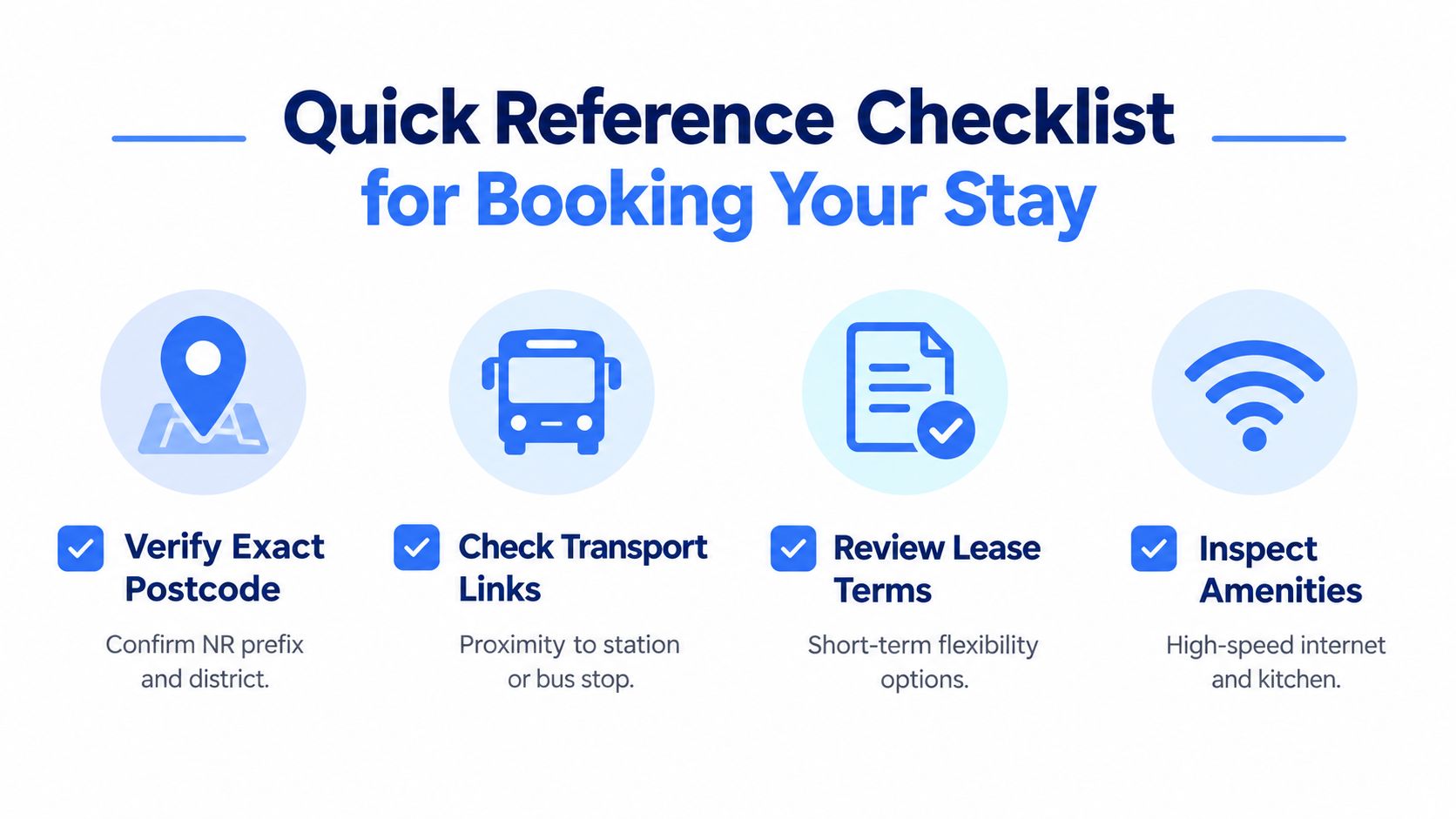
Verify the exact postcode: Confirm the NR district, town and full address. Don't assume that “NR” means central Norwich.
Match the location to the work: Check the route to the project, station, university, hospital or business destination.
Check transport links: Identify nearby bus stops, rail connections and practical road routes. If you're driving, ask about parking before booking.
Confirm the dates: State your arrival and departure dates clearly, especially if a renovation, relocation or contract may change.
Review the agreement: Understand the term, payment schedule, cancellation policy, notice provisions and what happens if plans shift.
Ask what the rate includes: Confirm bills, Wi-Fi, bedding, towels, cleaning and any additional charges.
Inspect the workspace: Business travellers and contractors should confirm that the apartment has a suitable desk or dedicated working area.
Check the kitchen: Ask whether the kitchen is fully equipped for the length of your stay and your normal routine.
Prepare right-to-rent documents: Tenants aged 18 or over should be ready for the required checks before a residential tenancy begins.
Save arrival instructions: Keep access details, contact information and emergency arrangements available before travelling.
Frequently Asked Questions About Norwich Postcodes
A relocating family may see NR on a listing and assume it sits beside the city's main attractions. A contractor may see the same prefix and wonder whether the property is close enough to a rural site. The answer depends on the district and full address.
Does an NR postcode guarantee a Norwich city-centre location?
No. NR1 to NR8 cover the Norwich built-up area, while NR9 to NR35 extend through rural Norfolk, coastal towns and parts of north-east Suffolk. Always check the town and street.
Can I travel from an outer NR district into Norwich?
Often, but the practical route depends on the specific settlement and your destination. Check buses, trains, driving time and parking rather than relying on the postcode alone.
Is a central Norwich apartment suitable for a contractor?
It can be, particularly when the work is in the city and you value walkability. For regional projects, compare the central commute with a property closer to the worksite and confirm parking, workspace and kitchen facilities.
What should I check before booking temporary housing?
Confirm the exact address, agreement, dates, included bills, cancellation terms, right-to-rent process and essential amenities. A clear conversation before booking prevents most avoidable problems.
Landlords direct with Stay Norwich Apartments, Norfolk, furnished accommodation when you need it, for as long as you need it. No hassle, no drama, pay and stay. Visit Stay Norwich Apartments to compare serviced apartments in central Norwich for contractor work, relocation, university visits or time between homes.

Comments