


A Guide to UEA Norwich: Campus Life & Travel Tips
Updated: Oct 12
You may be arriving in Norwich with a suitcase, a conference timetable, and no clear idea whether you should stay beside the university or in the city centre. Perhaps you're starting a course, visiting a colleague, working on a short project, attending an event, or waiting for a permanent home. The practical question is the same: how do you make UEA Norwich work without turning accommodation and travel into another job?
The University of East Anglia is closely tied to Norwich, but it isn't the whole city. Your choice of base affects your commute, meals, workspace, evenings, and how easily you can handle an unexpected change of plans. This guide gives students, visiting academics, contractors, relocating professionals, families, and short-term guests a grounded way to plan the visit.
A Guide to UEA Norwich: Campus Life & Travel Tips: Table of Contents
Arriving at the University of East Anglia - Your first practical decisions
Getting to UEA from Key Locations - From the city centre - From Norwich Railway Station - From Norwich Airport
Understanding UEA's Academic World - Science, writing, and independent study
Exploring Norwich City and Student Life - Build your own local routine - Student life beyond the timetable
Practical Tips for Your Visit - Use a simple preparation checklist
Conclusion - Making the Most of Your Time in Norwich - Choose flexibility when your visit is temporary
Arriving at the University of East Anglia
You get to Norwich with a laptop, a bag, and a fixed start time. The campus itself is usually the easy part. The harder part is making the first few hours work, especially if you are a new student, a visiting academic, a contractor, a parent, or anyone staying only briefly and trying to keep the trip practical.
The University of East Anglia opened in Norwich in 1963, beginning with 87 students in temporary accommodation before growing into the campus people know today, as described in the university's history of UEA. That background still matters. UEA has its own identity and layout, but daily life around a visit often depends on what happens off campus. You will still need somewhere sensible to sleep, somewhere to eat, and a base that does not make the rest of the week harder.
Your first practical decisions
Save the exact building name, room number, entrance, and a working contact before you travel. “UEA” is too vague for a taxi driver, a delivery, or a late arrival when you are tired and carrying bags. If you are meeting a department, ask which entrance you should use. Different visitors need different drop-off points, and getting that wrong wastes time fast.
Handle the first day in a clear order:
Check how you are getting back to your accommodation. Do this while you are alert, not late in the evening when bus stops and campus exits all look unfamiliar.
Pick up what you will need that evening and the next morning. Water, simple food, medication, and charging cables matter more than bringing too much from home.
Check your room properly. Test the Wi-Fi, desk, lighting, heating, and noise level before you commit yourself to a night of poor sleep or a difficult work session.
Here is the rule I give people: choose accommodation for the full rhythm of the visit, not for the relief of the first night.
That matters even more for short-term guests. A student may put up with inconvenience for a week or two. A visiting lecturer, examiner, project worker, or family member usually should not. If you need to work, rest, cook, or keep a stable routine, a furnished place with a kitchen and reliable workspace will often serve you better than changing hotels or taking a student-style room that only looks convenient on a map.
A Guide to UEA Norwich: Campus Life & Travel Tips:
Getting to UEA from Key Locations
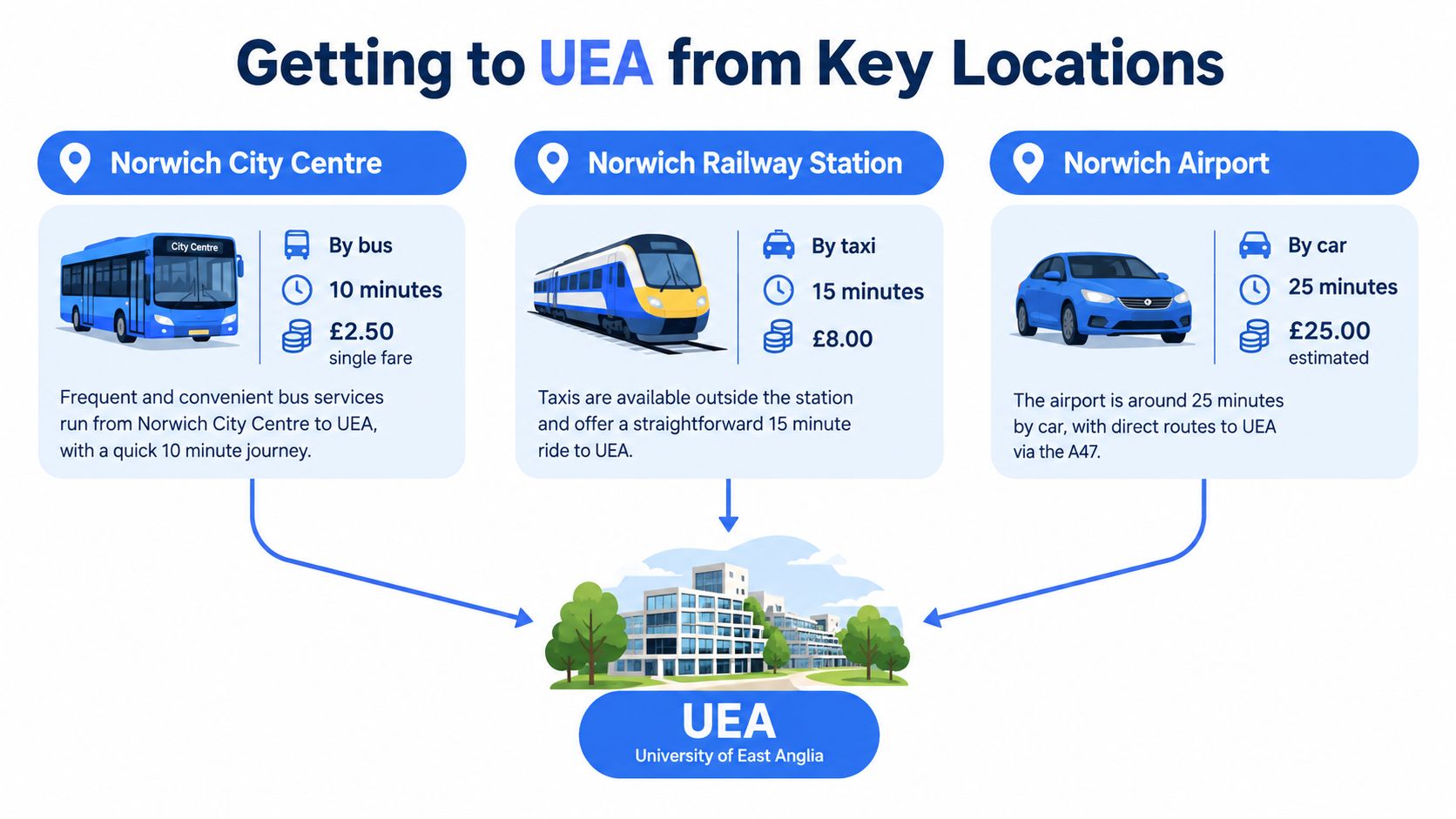
Start by identifying your arrival point, then choose the transport option that matches your luggage, timing, and tolerance for uncertainty. Norwich city centre is usually the simplest starting point for visitors already staying centrally. The railway station works well for rail travellers, while Norwich Airport requires more attention to timing and luggage.
From the city centre
Take a bus serving the university and check the stop location against your building before boarding. The supplied route guide presents 10 minutes by bus and a £2.50 single fare for the city-centre journey. Treat that as a planning reference, not a promise for every departure, since traffic and stop locations can change the experience.
If you're carrying presentation equipment, mobility aids, or several bags, a taxi may be more convenient. Ask the driver to take you to the relevant campus entrance rather than just saying “the university”.
From Norwich Railway Station
Allow time to leave the station, collect luggage, and find the taxi rank. The supplied route information gives 15 minutes by taxi and £8.00 as an estimated fare. For a fuller orientation before you travel, use this guide to Norwich train station.
A bus can be suitable if you're travelling light and have checked the route in advance. Don't choose it automatically because it's cheaper. A modest saving can be poor value if you miss registration, arrive late for a seminar, or have to carry heavy luggage across unfamiliar streets.
From Norwich Airport
For airport arrivals, pre-booking a taxi or arranging a car is sensible when you have a fixed appointment. The supplied route guide lists 25 minutes by car and an estimated £25.00 cost. Confirm the destination building and allow extra time if your arrival overlaps with busy roads.
Understanding UEA's Academic World
UEA's academic identity makes more sense when you compare its beginning with its present scale. The university started with 87 students studying English and Biological Sciences, then reached 3,245 students by 1973, according to its official history. That early combination of science and humanities remains useful shorthand for understanding the institution. It has never been defined by one narrow subject area.
Today, UEA reports 17,707 students, including 12,434 undergraduates and 5,273 postgraduates, with 4,438 staff, as set out in its facts and figures. The university also reports students from outside the UK, a substantial alumni community, and a role in the wider Norwich Research Park. For a visitor, those figures translate into a campus with year-round teaching, research, administration, events, and professional activity.

Science, writing, and independent study
A Guide to UEA Norwich: Campus Life & Travel Tips: Environmental and biological subjects bring a research-led perspective, while humanities and social sciences create a different rhythm of seminars, reading, discussion, and written work. Neither is automatically easier for visitors to manage. A laboratory visit may depend on access, safety, and equipment arrangements. A writing or legal research visit may depend more heavily on library access, quiet working time, and meetings with supervisors.
UEA also created the UK's first degree programme in Creative Writing, founded by Sir Angus Wilson and Professor Malcolm Bradbury. Norwich later became England's first UNESCO City of Literature in 2012, strengthening the relationship between the university, the city, and literary culture.
Postgraduate visitors should treat independent work as a scheduled responsibility, not spare time left over after meetings. A practical resource on how to manage your dissertation schedule can help you protect research blocks, plan supervisor discussions, and avoid allowing travel logistics to consume the day.
For campus orientation and background, this UEA guide for visitors can sit alongside the university's own information. Use official university contacts for access, enrolment, room bookings, and academic requirements.
Exploring Norwich City and Student Life
Norwich rewards visitors who treat it as part of the UEA experience rather than a place to pass through. The city combines medieval landmarks, independent shops, cultural venues, cafés, pubs, and practical services within a compact urban setting. That mix matters to students, but it also suits a contractor who wants a proper evening meal, a relocating professional who needs to understand the area, or a parent visiting for a campus appointment.
Start with the historic core. Norwich Cathedral and Norwich Castle offer two very different ways into the city's past, while the marketplace provides a busier, more everyday centre. The Forum adds a modern civic and cultural counterpoint. Together, these places show why Norwich feels more layered than a typical university town.

Build your own local routine
A short visit becomes easier when you create a repeatable pattern instead of trying to see everything. Walk through the centre on your first free evening, identify a supermarket and a pharmacy, then choose one reliable place for coffee or a meal. Students can add societies and social events, while business travellers may prefer a quieter route and a dependable workspace.
Use Norwich walking tours to understand the city's layout and history without spending hours planning a route. A guided walk can also help you spot the difference between staying in the centre, staying near the station, and staying in a residential district.
Student life beyond the timetable
UEA's literary heritage gives Norwich a strong cultural identity, but visitors shouldn't assume every useful activity is academic. The city works well for ordinary routines: cooking, exercising, meeting friends, browsing shops, or finding somewhere quiet to read. That balance is especially valuable during a placement, dissertation period, relocation, or project where work already occupies much of the day.
For families, check walking distances and evening transport before choosing activities. For professionals, ask whether the accommodation lets you prepare meals and work privately. Norwich feels most welcoming when you have enough structure to explore without turning every evening into another appointment.
Choosing the Best Stays Near UEA
The right accommodation depends on the length and purpose of the visit. University halls may suit a conventional student arrangement, while a hotel can work for a short business trip. Neither is automatically appropriate for someone staying between tenancies, completing a placement, visiting a department, or working on a temporary contract.
UEA accommodation guidance notes that many students move into the private market after first year, where contracts commonly run for 10 to 12 months and smaller one- or two-bedroom homes can be harder to find near campus, as described by UEA Students' Union housing advice. That setup doesn't fit a guest who needs a furnished base for several weeks or a few months.
Compare the whole stay
An HMO room may reduce the headline monthly rent, but shared kitchens, limited privacy, and separate bills can create friction. A private studio offers more control but may cost more. A hotel removes many household tasks but can become awkward when you need to cook, work, wash clothes, or settle into a longer project.
Check these points before booking:
Contract length: Make sure you're not paying for unused weeks.
Bills: Confirm whether gas, electricity, water, and broadband are included in the written agreement. UK government tenancy-fee guidance says included services should be stated as tenancy terms.
Workspace: A proper desk and fast Wi-Fi matter if you're writing, teaching, or handling client work.
Kitchen access: Self-catering reduces dependence on takeaway meals and fixed hotel schedules.
Pet rules: Dog-friendly properties can have limits, fees, lead requirements, and supervision rules. Verify them before arrival using the property's dog-friendly stay information.
Stay Norwich Apartments offers furnished, self-catering holiday lets in Norwich city centre across NR1, NR2, NR3 and NR5, with bills included and several dog-friendly properties. The locations cover central and surrounding residential districts rather than one single neighbourhood, as explained by the NR postcode area reference. For help comparing options, use these tips for choosing a place to stay in Norwich.
Practical Tips for Your Visit
Book around the purpose of the visit, not just the university calendar. A student may need a stable room and study space. A contractor may need parking, cooking facilities, and a quiet evening. Someone between homes needs flexibility and storage more than a communal social atmosphere.
Use a simple preparation checklist
Confirm the dates first. Include arrival and departure days, not only the days you'll be on campus.
Ask what “bills included” means. The government tenant guidance makes clear that bills not included in rent remain the tenant's responsibility, and included services should appear in the tenancy terms.
Pack for the accommodation. Bring work essentials, medication, chargers, and any specialist equipment. Don't assume a temporary stay will provide everything you use at home.
Plan the commute before booking. Check the route from the property to your campus building, not just the distance to UEA generally.
Arrange transport for awkward arrivals. A pre-booked taxi can be sensible with late trains, heavy bags, or equipment. Use this Norwich taxi guide to help structure the decision.
Budget beyond rent. Meals, travel, laundry, deposits, and overlapping housing can change the actual cost of a stay. A lower monthly figure isn't necessarily cheaper if it requires a long contract or leaves you buying every meal.
If you're travelling with a dog, confirm the permitted number, charges, shared-area rules, and whether the animal can be left alone. If you're relocating, ask about storage, cleaning arrangements, cancellation terms, and how quickly the property team responds to problems.
Conclusion - Making the Most of Your Time in Norwich
Arrive in Norwich with a clear plan and the trip usually goes well. Know which UEA building you need, decide in advance how you will get there with your bags or equipment, and choose accommodation early enough that you are not forced into whatever is left.
UEA has grown from a small postwar university into a major part of Norwich life, and that matters because the city does not feel like a place built only for full-time students. If you are here for a course, a conference, contract work, a family visit, or a short academic stay, treat Norwich as your working base, not just the backdrop to the campus.
Choose flexibility when your visit is temporary
Short stays need practical housing. A standard student tenancy suits people settling in for the academic year. It is usually the wrong option for a visiting lecturer, placement student, conference guest, contractor, professional between homes, or relatives attending a university event. Those guests need somewhere they can sleep properly, cook, work, do laundry, and rely on the internet without living out of a suitcase.
A furnished apartment in or near the centre often makes that easier. You get privacy, your own routine, access to shops and services, and a straightforward trip to UEA. Before you book, check the exact postcode, the actual route to campus, what bills are included, whether pets are allowed, and how the agreement handles cancellations or changes.
Norwich rewards that kind of planning. You can get your work done on campus, then still have a city centre with character, useful amenities, and enough going on to make a short stay feel settled rather than stopgap.
Stay Norwich Apartments offers furnished, self-catering apartments and houses in Norwich city centre across NR1, NR2, NR3 and NR5, with bills included and several dog-friendly options for short breaks or longer stays. Visit Stay Norwich Apartments to check availability, compare properties, and book direct for the best rate.