


Nhs Dentist Norfolk

Updated: Oct 6
You've arrived in Norwich for a short contract, settled into temporary accommodation, and a filling has started to hurt. You're staying for weeks rather than years, you don't have a car, and the obvious search, “NHS dentist Norfolk”, produces lists rather than a usable appointment. The practical question is simple: who can see you, how quickly, and what should you do next?
Norfolk's NHS dental system is difficult because registration, urgent care, transport and temporary residency all affect the result. A generic national guide won't tell you whether a practice is accepting patients today, whether you'll only join a waiting list, or whether you can realistically reach the appointment without a car. This guide gives you the local plan, based on the access picture described by Norfolk's oral health profile, NHS guidance and local patient experience.
Table of Contents
Why NHS Dental Access in Norfolk Is Harder Than You Think - What the local picture tells you - Norfolk NHS Dentist Access at a Glance
How to Register with an NHS Dentist Step by Step - Make the first calls count - Temporary stays need a clear record
NHS Dental Charges and Who Gets Free Treatment - Charges and exemptions in plain English
Getting Urgent or Emergency Dental Care in Norfolk - Follow the correct escalation route - Know when it's a medical emergency
Staying in Norwich Without a Car and Still Seeing a Dentist - Choose the appointment and the route together - Reaching NHS Dental Practices from Norwich City Centre Without a Car
NHS Versus Private Dental Care for Short-Term Visitors - NHS vs Private Dental Care Practical Comparison for Norfolk Short-Term Visitors
Your Practical NHS Dentist Checklist for Norfolk - The checklist that works in practice - Match the plan to your situation
Why NHS Dental Access in Norfolk Is Harder Than You Think
You are working at Norwich Research Park for eight weeks, or starting at UEA and suddenly need a filling. You search for an NHS dentist, call nearby practices and find that the online list says little about who can see you. A short stay, temporary address and no car make the usual advice much less useful.
Norfolk and Waveney has a long-standing NHS capacity problem. The number of dentists with NHS activity fell from 457 to 372 between 2014/15 and 2022/23, a reduction of 85 dentists. The local rate was 38 NHS dentists per 100,000 people in May 2022, one of the lowest in England, according to BBC reporting on Norfolk dentistry. The same report identified an £18.3 million dental underspend risk, which shows why available funding has not solved the workforce shortage.
Access results are poor as well. Norfolk ranked 147th out of 150 local authorities in 2020/21 for successfully obtaining a dental appointment, according to the Norfolk Insight report. Great Yarmouth and Waveney performed better than King's Lynn and Thetford in some measures, but neither coastal nor rural access is dependable. Norwich gives you more practices and transport choices, provided the practice is accepting NHS patients and the appointment is reachable.
Local reality: ringing one surgery and waiting for a miracle is a poor strategy. Treat the search as a short campaign, not a single phone call.
What the local picture tells you
Norfolk's geography adds a transport barrier. The county's oral health profile estimates that around 120,000 people without car access cannot reach a dental service by bus, rail or tram within 30 minutes, as noted in the Norfolk Insight report above. For a temporary resident, that turns a distant appointment into a practical refusal. A practice may technically offer NHS care, yet the journey from central Norwich can still make the slot unusable.
Call several practices in one morning. Ask whether the practice is taking patients now or only collecting names for a waiting list. Keep a record of the response, the date and any promised follow-up. If a cancellation becomes available, you need to know which practices can accept you and whether you can reach them by bus.
You may hear different answers from practices serving similar postcodes. One patient gets a cancellation slot, while another is told to try again later. Both may have followed the same official advice. For a short-term resident, live phone confirmation matters more than a directory entry.
Norfolk NHS Dentist Access at a Glance
Area | Approx. Practices Taking New NHS Patients | Typical Wait | Notes |
|---|---|---|---|
Norwich | Availability changes frequently | Routine care may involve a substantial wait | More practices and transport options, but closed lists are common |
Great Yarmouth and Waveney | Limited and variable | Depends on local capacity | Some access measures have performed better than west Norfolk |
King's Lynn and Thetford | Limited and variable | Often difficult for new patients | Access has been weaker in local comparisons |
Rural and coastal Norfolk | Highly variable | Can be longer when travel is required | Car access strongly affects which appointment is usable |
Norwich's population and housing pressures make the wider local growth picture relevant to anyone using temporary accommodation. More people competing for services means you need a deliberate route: check live availability, call several practices, record waiting-list details and keep urgent care separate from routine registration.
How to Register with an NHS Dentist Step by Step
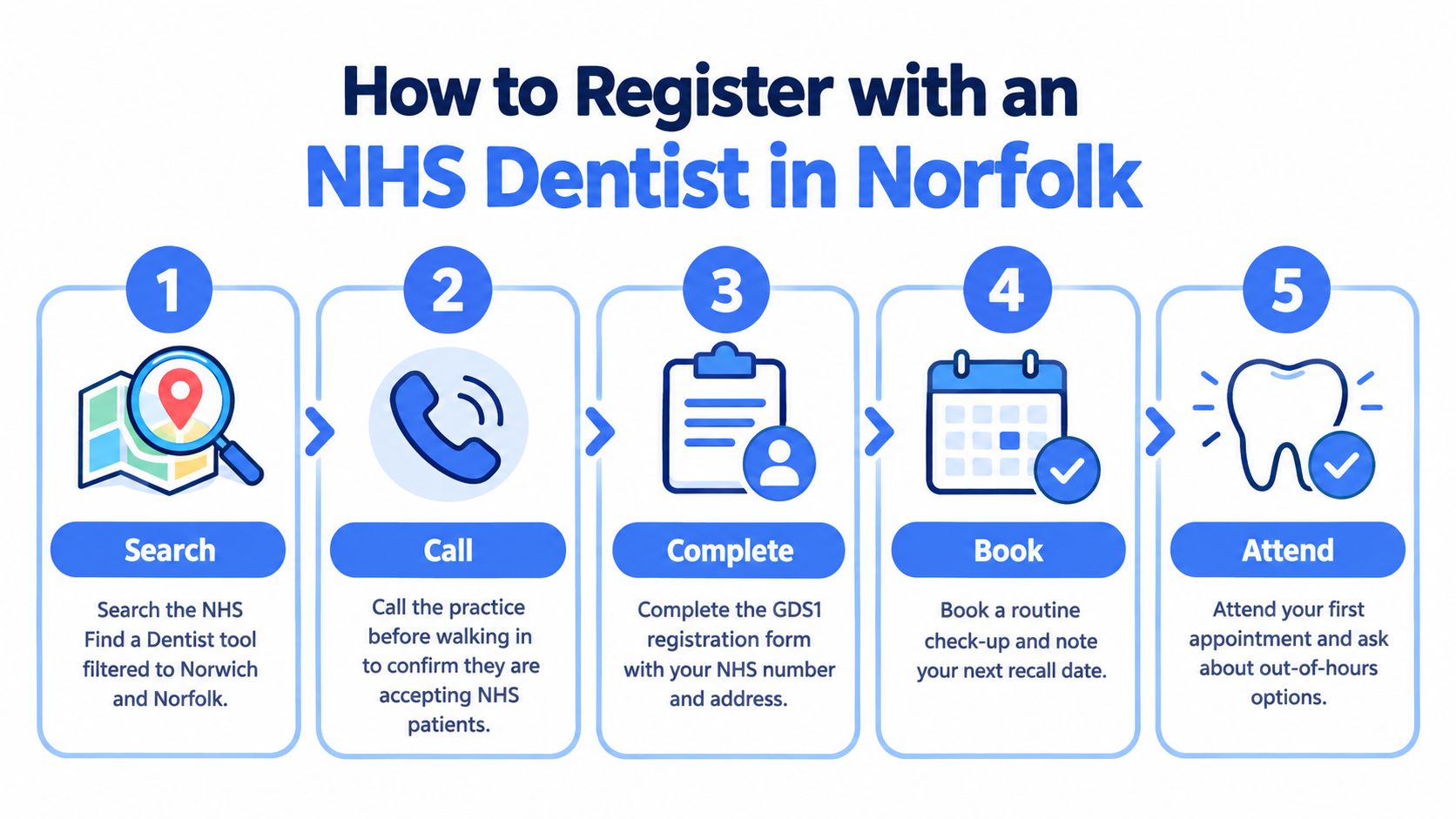
Start with the NHS Find a Dentist tool, filtered to Norwich and Norfolk. Use it to build a call list, not as proof that a practice has a slot. Dental websites and directories can lag behind live capacity, so call before walking anywhere.
Make the first calls count
1. Call several practices in the same morning. Reception teams are dealing with cancellations, urgent requests and registration questions at the same time. Have the next number ready while one practice places you on hold.
2. Use a short, useful script. Say your full name, your address or temporary address, your NHS number if you know it, how long you'll be in Norfolk and whether you need routine or urgent treatment. Don't lead with a long explanation. Reception needs to know which route applies.
3. Ask the question that matters. “Are you accepting new NHS patients, or are you only adding people to a waiting list?” Those are completely different outcomes. If you're added to a list, ask whether the practice can give any indication of the process and record the receptionist's name and the date.
4. Keep calling while you wait. Joining one list shouldn't stop you contacting another practice. Norfolk's access problem makes duplication sensible, particularly if your stay is short and you need care before a list moves.
5. Confirm the first appointment. Registration is only useful when you have a date or a clear route to one. Ask what you should do if pain or another problem develops before the appointment, and save the practice's daytime and out-of-hours instructions.
Temporary stays need a clear record
A short-term resident should keep confirmation emails, appointment details and the practice's contact number. NHS dental registration is generally continuous for 24 months after your last appointment, so your records can matter if you move between temporary addresses or need to prove where you were treated.
Some practices will be cautious about routine registration when you're only visiting. That doesn't remove your right to ask about NHS care, but it does mean you should be precise about your circumstances and realistic about routine availability. If the practice can't register you, ask whether it offers urgent appointments to unregistered patients and whether another local route is recommended.
Use this wording: “I'm staying in Norwich until [date]. Are you accepting new NHS patients, can you add me to your waiting list, and what's the route if I need urgent treatment before then?”
NHS Dental Charges and Who Gets Free Treatment
NHS dental charges are organised into three bands. Band 1 covers an examination, diagnosis, advice, scale and polish where clinically necessary, and urgent treatment. Band 2 covers treatment such as fillings, root canal work and extractions. Band 3 covers crowns, dentures and bridges.
The exact current patient charges should be checked on the official NHS and practice information before treatment, because charges can change. The key point for a short-term visitor is that an urgent-only appointment falls within Band 1, even when it's a one-off visit. Ask the dentist what band applies before agreeing to a course of treatment.
Charges and exemptions in plain English
Band | What It Covers | Patient Charge | Key Exemptions |
|---|---|---|---|
Band 1 | Examination, diagnosis, clinically necessary scale and polish, urgent treatment | Check the current NHS charge | Free for eligible children, qualifying pregnant patients and people with qualifying exemptions |
Band 2 | Fillings, root canal treatment and extractions | Check the current NHS charge | The same exemption rules apply |
Band 3 | Crowns, dentures and bridges | Check the current NHS charge | The same exemption rules apply |
Children under 18, and those under 19 in full-time education, can qualify for free NHS dental treatment. Pregnant women and people who've had a baby in the previous 12 months may also qualify. Adults receiving qualifying benefits may be exempt, including some Universal Credit claimants who meet the relevant take-home-pay threshold, as well as people receiving Pension Credit.
If you don't qualify for free treatment but have a low income, check the NHS Low Income Scheme. An HC2 certificate can provide full help with eligible NHS health costs, while other certificates may offer partial help. Apply before treatment where possible and keep the certificate available, because the practice will need evidence of entitlement.
Temporary residents staying less than 24 weeks can still receive NHS treatment at the relevant charges, but you should expect to pay upfront at each visit. Temporary accommodation doesn't automatically make treatment free. Cosmetic treatment, including whitening, isn't available on the NHS.
Getting Urgent or Emergency Dental Care in Norfolk
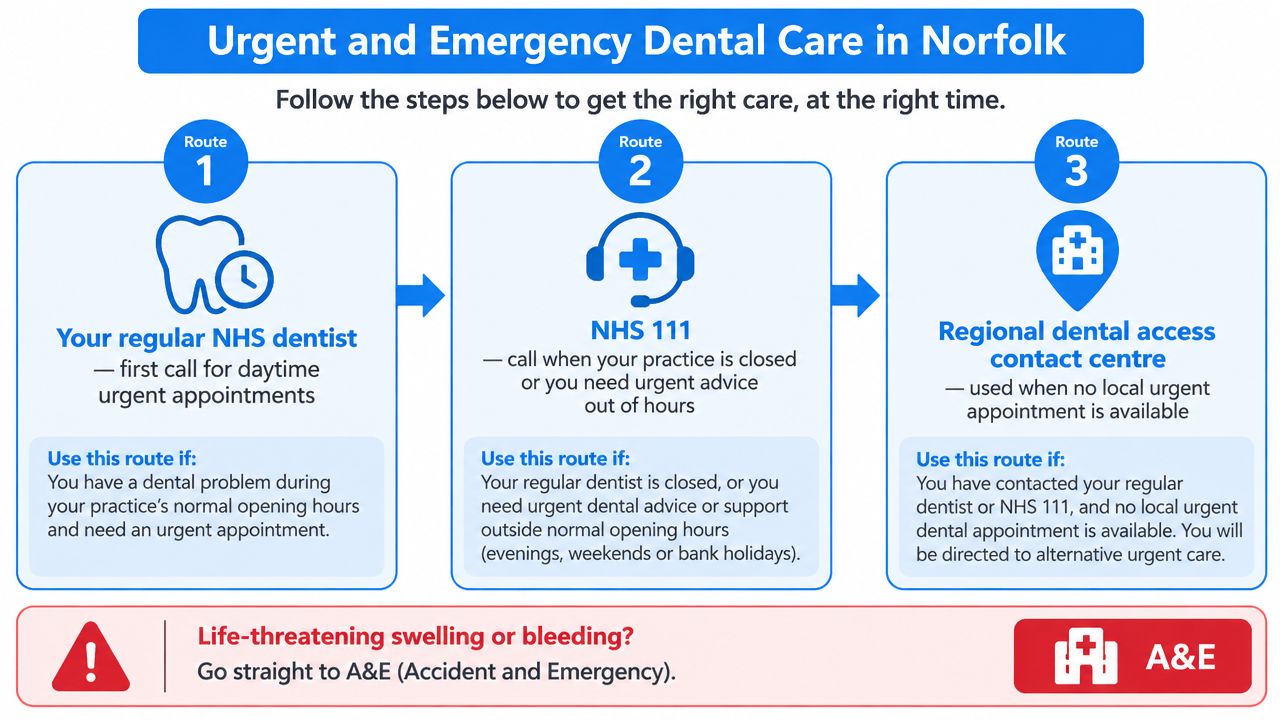
Pain, swelling or a broken tooth needs a different route from routine registration. Don't wait for a waiting list if you need urgent care. NHS guidance for Norfolk and Suffolk says to contact your regular dentist first, use NHS 111 if you don't have a dentist or need out-of-hours help, and use the regional dental access contact centre for entitlement advice.
Follow the correct escalation route
During practice hours, call your regular dentist first. If you're registered, explain that the problem is urgent and ask for the practice's same-day or soonest available route. If you aren't registered, you can still request urgent dental care. Registration and urgent access are separate questions.
When the practice is closed, contact NHS 111. You can use the online service or call by phone. Expect questions about pain, swelling, bleeding, injury, breathing, swallowing, medicines and your location. The triage team decides whether you need advice, a treatment slot or escalation to another service.
Use the regional dental access contact centre when directed. This is particularly relevant when you don't have a regular dentist or a local practice can't offer the urgent appointment you need. You may be directed to an access centre rather than a standard high-street practice. Local arrangements can change, so use the current NHS route rather than relying on an old forum post.
For Norwich visitors, a local hospital reference point may help with general orientation, but it isn't a substitute for dental triage. The practical information around Spire Norwich Hospital can help you understand the city's healthcare geography, while NHS 111 remains the right first contact for urgent dental advice outside your practice's normal route.
Know when it's a medical emergency
Go to A&E or call emergency services for life-threatening symptoms, including swelling that affects breathing or swallowing, uncontrolled bleeding or serious facial trauma. A&E may manage the immediate danger, but it won't replace definitive dental treatment.
The decision tree is straightforward:
Call your dentist first for daytime urgent care.
Contact NHS 111 online or by phone if you have no dentist, the practice is closed or you need urgent triage.
Go to A&E when swelling, bleeding or trauma threatens your airway, circulation or immediate safety.
Staying in Norwich Without a Car and Still Seeing a Dentist
You may find an NHS dentist a short distance from your Norwich accommodation, then discover the appointment requires two buses, a long walk and a return journey outside reliable service hours. Treat transport as part of the booking decision. The county profile shows that people without cars can be cut off from dental services by public transport, so confirm the route before accepting a slot. Check the local NHS service guidance rather than assuming the nearest listed practice is the most practical choice.
Choose the appointment and the route together
If you are staying centrally, search around the city centre, Riverside and the Norfolk and Norwich University Hospital area. For accommodation and transport information around the hospital, see this guide to hotels near Norwich Hospital (NNUH). First Bus routes 25 and 26, along with Park and Ride services, can connect central Norwich with practices farther out. Check the live timetable, stop location and last return service before you agree to an appointment.
Thorpe St Andrew, Cringleford and Bowthorpe can work from central accommodation when the practice sits on a direct or simple bus route. A city-fringe surgery is often a better choice than a rural appointment that looks available but involves an awkward connection. Ask one practical question: “Can I reach the appointment reliably and get back afterwards?”
Reaching NHS Dental Practices from Norwich City Centre Without a Car
Area / Practice Cluster | Bus Routes | Approx. Journey from City Centre |
|---|---|---|
City centre | Local city routes | Shortest option, but availability may be limited |
Riverside | Routes serving Riverside and nearby residential areas | Usually a straightforward city journey |
Norfolk and Norwich University Hospital area | Routes and Park and Ride options serving the hospital area | Allow extra time for the final walk |
Thorpe St Andrew | Local east Norwich routes | Check the exact stop and return service |
Cringleford | South Norwich services and Park and Ride options | Often practical if the practice is near the route |
Bowthorpe | West Norwich services | Check evening and weekend coverage |
Cycling can widen your search if you are comfortable riding. The Marriott's Way and Riverside Walk connect parts of Norwich's residential network, but plan the final section carefully. A pleasant route can become unsuitable in poor weather or after treatment.
What doesn't work: accepting a rural appointment before checking the timetable, relying on one morning call, or assuming a walk-in service exists. Confirm the practice, appointment and complete journey separately.
NHS Versus Private Dental Care for Short-Term Visitors
For a short-term resident, the NHS route is cheaper when you can access it, but availability is the constraint. Routine care may involve waiting, practices may decline new registrations or add you to a list, and a temporary address can make continuity less straightforward.
Private care costs more, but the trade-off is usually clearer scheduling. A private practice may offer a same-week appointment, publish a fee schedule and let you choose a surgery near your temporary accommodation. That can matter more than the headline price when you've got a painful tooth and only a short assignment left.
NHS vs Private Dental Care Practical Comparison for Norfolk Short-Term Visitors
Factor | NHS Route | Private Route |
|---|---|---|
Speed | Urgent care has a defined route, routine access may be delayed | Often easier to request a near-term appointment |
Cost | Free if exempt, otherwise banded NHS charges apply | Fees vary by practice and treatment |
Registration | May involve a closed list or waiting list | Usually arranged directly with the practice |
Location | Choice depends on NHS capacity | More choice near temporary accommodation |
Best fit | Eligible patients who can wait or need urgent NHS care | Visitors prioritising speed and appointment certainty |
Follow-up | Depends on registration and practice capacity | Usually arranged directly with the treating practice |
The verified local guidance doesn't establish the specific private and NHS prices sometimes quoted online, so don't rely on generic figures. Ask for the full cost before treatment, including examination, imaging, temporary work and follow-up. An NHS practice should explain the applicable band, while a private practice should provide its own estimate.
A hybrid approach can be sensible. Use NHS 111 for urgent triage when you need immediate advice, then decide whether private follow-up is practical for a repair or longer treatment plan. Someone staying for several months should ask practices about NHS registration and also check whether a company insurance scheme includes dental cover.
The honest choice is time versus money. If you're staying briefly and need certainty, private care may be the practical option. If cost is the priority and the problem isn't urgent, pursue NHS registration and waiting-list routes without assuming they'll move quickly. The short-term rental guide for Norwich is useful when comparing how long you'll be based in the city, which should shape that decision.
Your Practical NHS Dentist Checklist for Norfolk
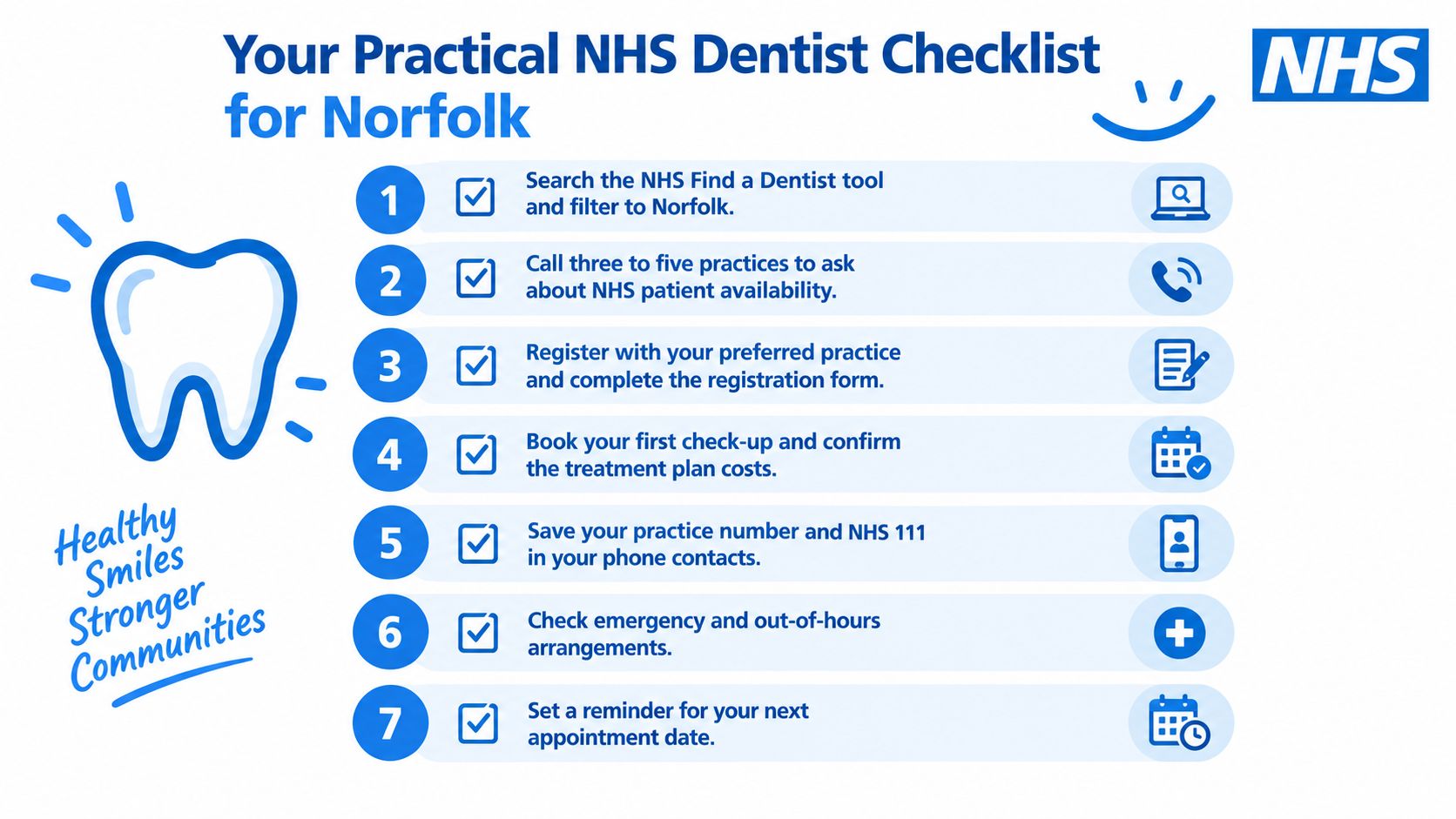
Start today, not when the pain becomes unbearable. Search the NHS Find a Dentist tool, filter for Norfolk and Norwich, then call three to five practices on the same morning. Weekday opening periods are usually your best opportunity to reach reception before the day's urgent demand builds, but practices set their own arrangements, so listen carefully to the recorded message and call at the stated opening time.
The checklist that works in practice
Search first: Use the NHS Find a Dentist tool and filter to Norwich and Norfolk.
Call several practices: Ask whether they're accepting NHS patients, adding names to a waiting list or offering urgent care only.
Record the outcome: Note the practice name, receptionist, date, registration status and any waiting-list instructions.
Ask about cancellations: If you're waiting, request short-notice cancellation information and explain how long you'll be in Norfolk.
Confirm your appointment: Get the date, time, location, charge information and treatment route in writing where possible.
Save urgent contacts: Keep the practice number and NHS 111 in your phone. A nearby pharmacy, such as Boots Chemist Norwich, may help with general local orientation, but pharmacy advice doesn't replace dental treatment.
Plan the journey: Check the bus, Park and Ride or walking route before accepting an appointment, particularly for a practice outside central Norwich.
Match the plan to your situation
A contractor on a six-week assignment should ask about temporary registration, urgent access and a practice reachable by public transport or Park and Ride. A student at UEA should contact relevant university signposting services as well as local practices, but shouldn't assume student status guarantees an NHS appointment.
A holidaymaker should focus on urgent care rather than routine registration. If you're only in Norfolk briefly, call a practice for urgent advice when appropriate, use NHS 111 when you don't have a dentist or need out-of-hours help, and ask about charges before treatment.
Your order of action is simple: first, call several practices; second, secure a waiting-list or registration route; third, save NHS 111 and plan urgent care before you need it. Charges apply unless you qualify for an exemption, so confirm entitlement and payment expectations at the start.
Landlords direct with Stay Norwich Apartments, Norfolk, furnished accommodation when you need it, for as long as you need it. No hassle, no drama, pay and stay.
If you're coming to Norwich for work, study or a temporary move, Stay Norwich Apartments offers furnished serviced accommodation with kitchens, workspaces, fast Wi-Fi and flexible stays that make local appointments easier to manage. Visit Stay Norwich Apartments to find a practical Norwich base for as long as you need it.

Comments