


Apartments to Rent in Norwich: Costs and Areas Compared

More than one in four Norwich households rented privately or lived rent-free, with 17,467 households, or 27.1%, in that combined category at the Census, according to the Office for National Statistics. Renting isn't a niche choice here. But someone settling permanently and a contractor arriving with a suitcase need very different things from the same housing market.
When you're comparing apartments to rent in Norwich, the advertised rent is only the starting point. The useful comparison is what you'll spend over your stay, including household setup, bills, travel and any money tied up in a deposit.
Apartments to Rent in Norwich: Costs and Areas Compared: Table of Contents
Apartment Rents in Norwich by Property Size - How to read a listing against the benchmark
Choosing the Right Area for Your Stay - Availability matters alongside location
Furnished Apartments Versus Standard Lets - Check what furnished actually means
Matching Stay Length to the Right Apartment - Match the booking to your uncertainty
How to Work Out the Real Cost of a Short Stay - A hypothetical contractor calculation
Confirm Terms and Book Your Stay - Read the terms against your work schedule - Check comfort as well as the price
Apartment Rents in Norwich by Property Size
Rent depends on bedroom count and property type, so compare like with like before deciding whether an apartment looks expensive. A city-wide average combines homes that serve very different needs, from compact flats to larger family houses.
The ONS Norwich housing statistics report the following average monthly private rents for September 2026, including an all-property average of £1,148.
Average monthly private rent in Norwich, September 2026
Property Size or Type | Average Monthly Rent |
|---|---|
One bedroom | £781 |
Two bedrooms | £976 |
Three bedrooms | £1,144 |
Four or more bedrooms | £1,586 |
All property sizes (average) | £1,148 |
Flats and maisonettes | £884 |
Terraced | £1,160 |
Detached | £1,588 |
These are private-rental benchmarks, not furnished short-stay quotations. The bedroom figures cover properties of that size, rather than apartments alone, while the property-type rows offer a separate comparison. Don't assume every home represented is unfurnished or that any particular bill is included.
For a solo traveller or couple, the flat-and-maisonette benchmark is a more useful starting point than the detached-house figure. For colleagues sharing accommodation, focus on the bedrooms and sleeping arrangements rather than choosing the cheapest property type automatically.
How to read a listing against the benchmark
Start with the row matching your required bedroom count. Then check whether the listing offers a separate living room, suitable beds and enough usable space for everyone staying.
A spare bedroom can be worthwhile when colleagues need privacy or someone works remotely. But paying for an unused room throughout a stay is different from paying for a feature you'll use daily. If you don't need a separate bedroom, this guide to studio flats to rent in Norwich can help narrow the search.
The broader regional comparison also provides context: Norwich's average private rent was £1,149 in April 2026, against £1,278 in the East of England and £1,381 across the UK, according to the council's Economic Barometer. That's a useful location benchmark, not proof that an individual listing represents good value.
Practical rule: Use the matching rental benchmark to start the comparison, then price everything needed to make the property usable for your stay.
A furnished apartment may sit above the relevant row without being the more expensive practical option. The difference needs to be tested against its inclusions, not dismissed as a premium.
Choosing the Right Area for Your Stay
Choose your area around the journey you'll make most often. A contractor travelling to a site outside the centre has a different priority from a visitor walking between the station, Cathedral and market.
Norwich's compact centre makes walking a realistic option for many central visits. NR1, NR2 and NR3 are useful starting points for a central search, but a postcode isn't a guarantee of an easy commute. Check the actual address, entrance and route rather than relying on the neighbourhood label.
Our properties are close to the train station, Norwich Cathedral, the market and the main employment sites in and around the city. Our city-centre locations include NR1, NR2 and NR3; the Norwich postcode areas guide helps you interpret locations before making a shortlist.
Norwich area choice by traveller situation
Your Situation | Area to Prioritise | Main Trade-off |
|---|---|---|
Contractor on a city site | Central postcodes NR1, NR2, NR3 | Parking and van access can be tighter |
Hospital visitor or carer | Within easy travel of the hospital | Check the route and timings at peak hours |
University guest or visiting academic | Central, close to campus transport | Busier streets and higher demand in term time |
Leisure visitor | Central, near the Cathedral and market | More noise and footfall |
Relocating professional who wants quiet | Outer areas with good transport links | Longer commute into the centre |
Remote worker who needs a desk | Any area with reliable broadband | Confirm broadband speed before booking |
Availability matters alongside location
Norwich and its surrounding authorities recorded a 4.85-year housing land supply as of 1 April 2025, below the five-year benchmark used in local planning monitoring, according to the council's local plan monitoring information. This measures development-land supply, not vacant furnished apartments, but it provides context for local housing constraints.
Don't assume you'll find a suitable central home at short notice, particularly when your requirements include parking, a desk and a flexible departure date. Start early around university arrivals and other dates when you can't easily move your trip.
An outer-area apartment may offer quieter surroundings or easier vehicle access. Balance that against fuel, parking at your destination and the time spent commuting, especially after a long shift.
For hospital visits, check the route to the correct entrance or ward rather than the hospital's general map marker. For site work, confirm where vehicles can enter and unload. The best location is the one that makes your actual day easier, not necessarily the one nearest the city-centre pin.
Furnished Apartments Versus Standard Lets
An unfurnished let gives you a property to organise. A furnished, self-catering apartment gives you a home that's already equipped for daily living, although the precise package still needs checking.
That difference matters most when you're arriving after work, moving between homes or travelling without household possessions. You shouldn't have to discover on arrival that a kitchen has an oven but no saucepan, or that broadband hasn't been connected.
What is included: furnished apartment versus standard let
Item | Furnished Serviced Apartment | Standard Unfurnished Let |
|---|---|---|
Furniture and bedding | Included | Tenant supplies |
Kitchen equipment | Included | Tenant supplies |
Utilities and broadband | Often included; check the apartment's inclusions | Usually tenant pays |
Council tax | Confirm whether included in the quoted price | Usually tenant pays |
Setup before moving in | Usually none beyond personal unpacking | Furniture, connections and cleaning |
Check what furnished actually means
Furniture and bedding should mean more than a bed frame and somewhere to sit. Check for a mattress, linen, towels, storage and a dining surface, particularly if you're travelling with colleagues who need separate sleeping arrangements.
Kitchen equipment deserves the same attention. A useful self-catering kitchen needs cookware, crockery, cutlery and utensils suited to the number of occupants. For a work stay, check whether you can store groceries and prepare meals comfortably rather than relying on takeaway food.
Broadband and utilities require explicit confirmation because furnished doesn't automatically mean bills included. Ask whether internet is active on arrival and whether the quoted price covers normal household energy use. Council tax should also be clearly included or excluded, rather than left for the occupant to infer.
Compare an equipped home with the cost of making an empty home equally usable, not with the empty home's rent alone.
Our guide to finding furnished places to rent in Norwich and Norfolk can help you assess the household essentials without confusing them with decorative extras.
Finally, consider what happens to anything you buy. A bed, desk or kitchen set may retain value, but you'll still need to move, sell or store it when you leave. List everything you'd have to buy, arrange or transport for a standard let, then judge whether the furnished alternative removes enough expense and effort for your particular stay.
Matching Stay Length to the Right Apartment
A brief visit and an open-ended relocation shouldn't be booked in the same way. Stay length determines how much weight to give setup effort, flexibility and the recurring price.
For a short visit, immediate usability usually matters more than furnishing a home yourself. As the stay grows longer, the recurring charge deserves closer scrutiny because you'll pay it repeatedly, while initial setup costs are spread across more time.
Best apartment option by length of stay
Length of Stay | Typical Traveller | Why It Fits |
|---|---|---|
One to two weeks | Short visits, interviews, site surveys | Quick setup and flexible dates |
One to three months | Contractors, renovation or move-out periods | Furnished base without a long tenancy |
Three to six months | Relocating staff, students on placements | A bills-included furnished option provides room to settle |
30 nights or more | Extended projects and transitional housing | Check whether an extended-stay rate applies |
These are planning scenarios, not minimum-stay rules. The overlapping extended-stay category is a prompt to request a quotation for your whole booking rather than assuming a short-break rate applies throughout.
Match the booking to your uncertainty
A contractor with a confirmed start date needs a property that's definitely available when the job begins. Someone relocating may care more about being able to remain in the same apartment while searching for a permanent home.
University-related travel adds another reason to plan carefully. The University of East Anglia reports 17,707 students, including 2,221 international students, supporting a broad audience of students, visiting academics and accompanying families. Those figures don't establish apartment occupancy levels, but they explain why university visitors are an important part of Norwich's temporary-accommodation audience.
Book early if your dates coincide with term starts or graduation. A short arrival stay can help someone settle before taking longer-term housing, while a placement or research visit may require a more stable base.
Fixed start date: Secure confirmed availability rather than relying on a provisional listing.
Possible extension: Establish how additional nights would be requested and whether remaining in the same apartment is possible.
Renovation deadline: Leave room for building delays instead of treating the contractor's target completion date as certain.
Likely longer residence: Compare the full furnished quotation with a standard let rather than renewing automatically.
The guide to short-term lets in Norwich provides further context for choosing a temporary arrangement. If your stay is likely to run beyond six months, treat that as a practical trigger for a fresh cost comparison, not a legal dividing line.
How to Work Out the Real Cost of a Short Stay
Calculate cash required and eventual accommodation cost separately. A refundable deposit affects how much money you need available, but it isn't the same as rent you've permanently spent.
Use this visual as a starting checklist, then add every excluded item to your calculation.
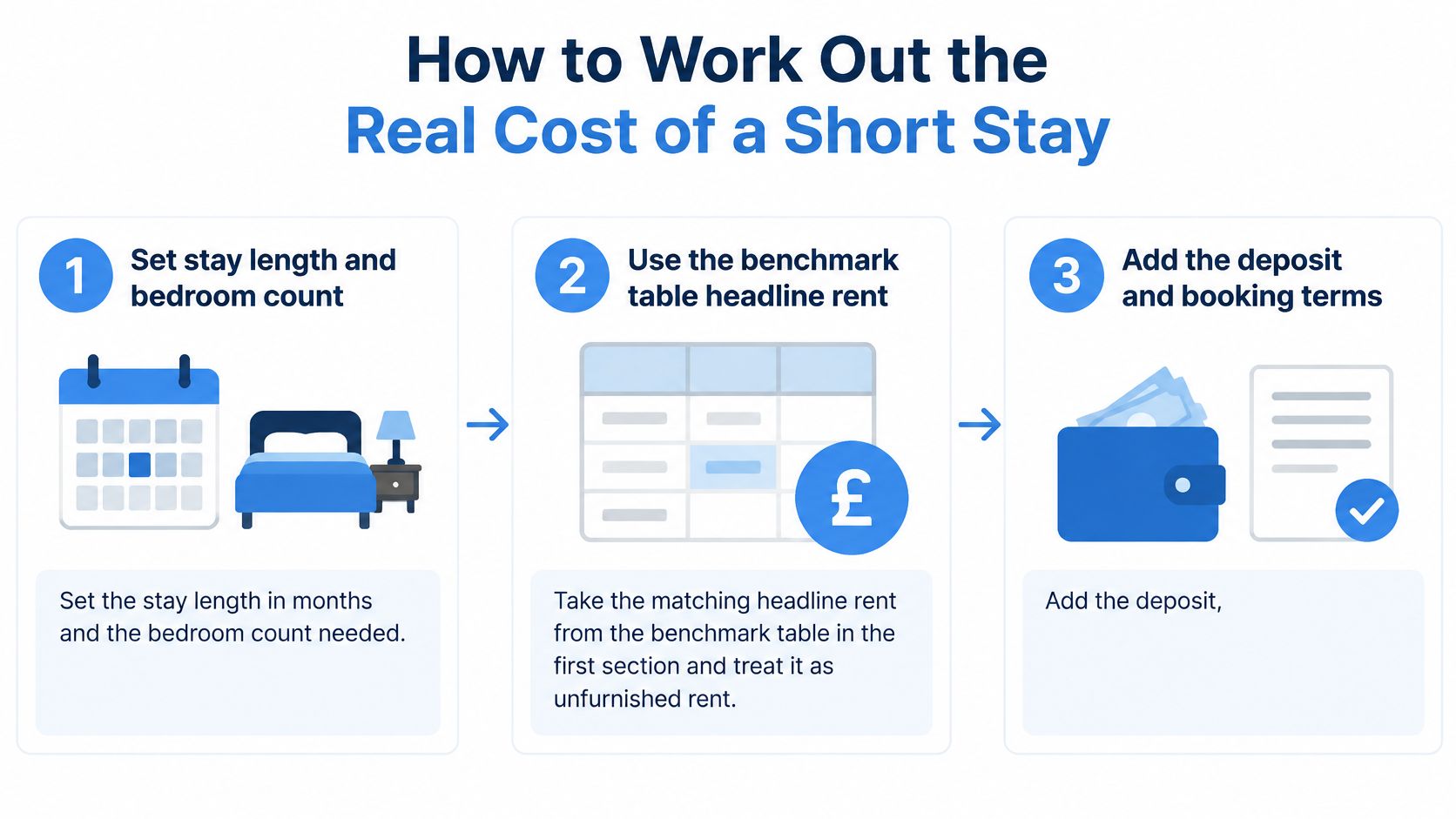
Set the stay length and bedrooms. Use identical dates and occupancy for both options.
Enter the matching headline rent. For this comparison, treat it as the rent-only starting point for an unfurnished alternative.
Record the deposit separately. Note the refund conditions and when you expect to recover it.
Add council tax, utilities and broadband. Use actual quotations where possible.
Include furniture and kitchen equipment. Deduct resale value only if you've realistically allowed for selling and moving.
Allow for cleaning, setup and extra travel. Keep your own time separate from cash expenses unless you assign it a value.
Divide the total by the stay length. Compare both options over exactly the same period.
A hypothetical contractor calculation
Say a contractor needs a two-bedroom base for three months. The following figures are illustrative assumptions, not rental quotations or claims about required deposits.
Illustrative item | Cost over the stay |
|---|---|
Rent at £976 per month | £2,928 |
Assumed refundable deposit | £976 |
Utilities at £120 per month | £360 |
Broadband at £30 per month | £90 |
Furniture hire | £400 |
Setup and cleaning | £150 |
Cash required including deposit | £4,904 |
Under these assumptions, the cash requirement is about £1,635 per month. If the deposit is fully returned, the expenditure falls to £3,928, or about £1,309 per month. Council tax, any separately charged water, extra travel and any contractual overlap still need adding, so this isn't a complete market quotation.
For a separate benchmark, Norwich City Council's tenant annual report gives average private rent for a two-bedroom home as £224.69 per week, roughly £974 per month. That supports checking the rent assumption, not treating the hypothetical household costs as established local prices.
Budget distinction: Compare refundable deposits as cash-flow requirements and non-refundable charges as expenditure.
Visual evidence can also prevent unsuitable bookings. Hosts can use VideoTour.ai's video content tips for Airbnb hosts to present layouts clearly; guests should look for footage showing the workspace, kitchen and bedroom connections rather than decorative close-ups.
This video provides an additional viewing resource.
Apply the same calculation when comparing cheap accommodation in Norfolk. A furnished quotation is cheaper on expenditure only when its complete cost falls below the comparable standard-let total; convenience may still justify a difference, but identify it clearly.
Confirm Terms and Book Your Stay
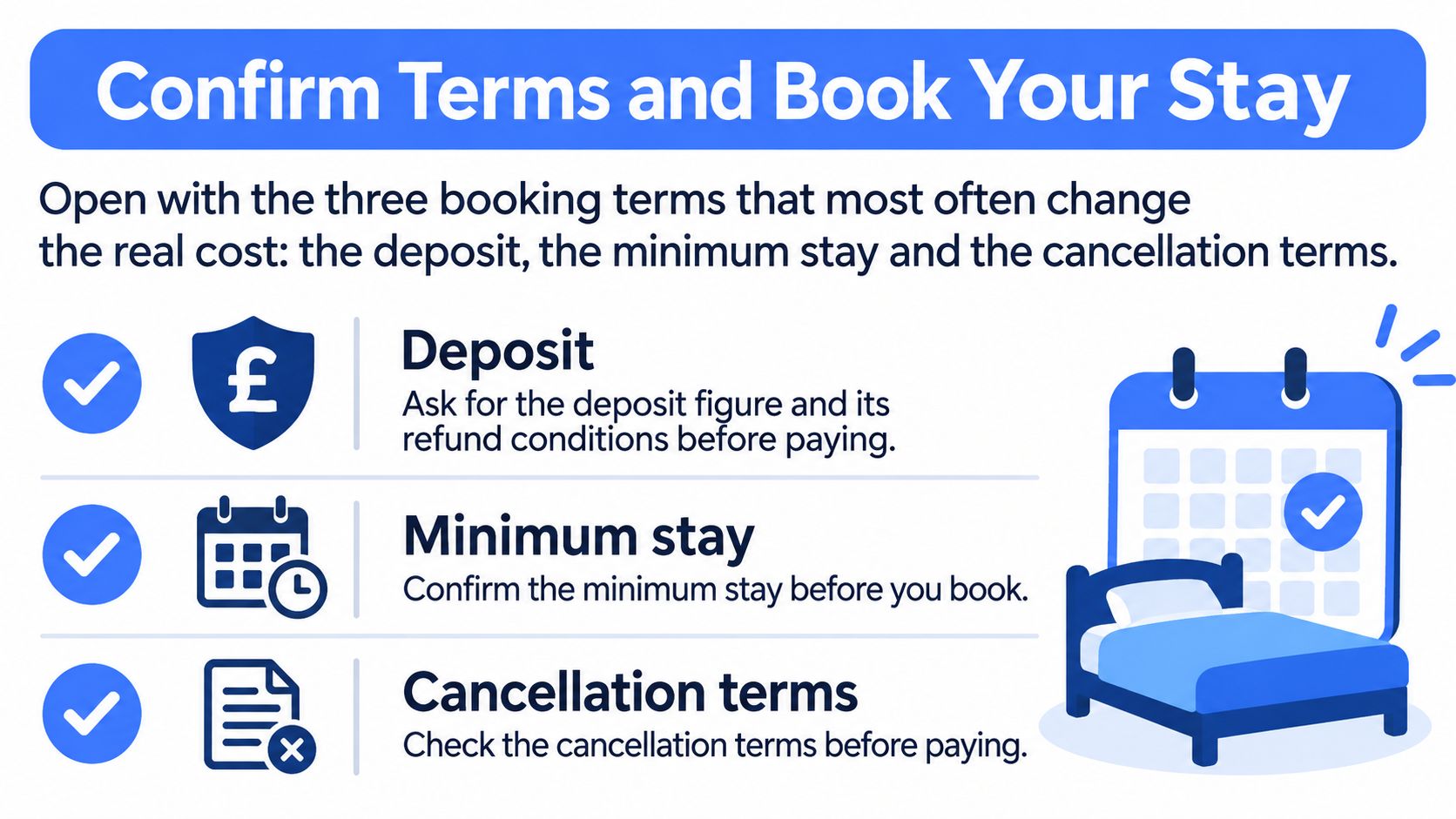
The deposit, minimum stay and cancellation terms can change whether an apparently suitable apartment works for your trip. Resolve them before paying, not after arranging transport or telling your employer the accommodation is secured.
Most of our short-stay bookings require a security or damage deposit, and the amount changes with stay length and apartment type. Ask for the figure and refund conditions in writing so you can distinguish the accommodation charge from money held against possible damage.
Use this booking-terms guide alongside the actual reservation documents.
Read the terms against your work schedule
Our minimum stay differs according to the apartment and is outlined when the reservation is made. A property that looks ideal may still be unsuitable if its required booking period extends beyond the dates you need.
Cancellation and booking changes are separate issues. You might need to cancel entirely, move the arrival date or shorten a stay after a project finishes early, and you shouldn't assume the same conditions apply to each change.
Our Rental Agreement & Cancellation Policy sets out the applicable terms. Keep the reservation confirmation and the relevant policy together, and check that the dates, apartment and named occupants match what you've agreed.
For a work booking, decide who is authorised to request changes. If your employer pays but you arrange the stay, make sure both parties understand who receives the invoice, who supplies the deposit and who can approve an extension. This avoids a practical problem becoming a payment dispute.
Check comfort as well as the price
Energy performance deserves attention even when you're only staying temporarily. The ONS energy performance dataset records 55.77% of assessed Norwich dwellings as EPC band C or above, with higher modelled efficiency generally indicating lower predicted energy demand, although actual consumption depends on occupancy and heating behaviour.
An EPC isn't a promise about your individual bill or how warm a particular room will feel. Ask about the heating controls, glazing and ventilation, especially if you'll work from the apartment during the day or sleep there between night shifts.
An included energy allowance also needs to be understandable. Establish whether the quotation covers heating and electricity without an additional charge under your intended occupancy, and have any limits explained before you commit.
Use this checklist once you've chosen a likely property:
Deposit: Confirm the amount, what it covers, refund conditions and the return process.
Minimum stay: Check the apartment's required booking period against your exact dates.
EPC band: Request the rating and ask how the heating operates.
Included bills: Obtain written confirmation covering heating, electricity, water, broadband and council tax.
Cancellation and changes: Check the consequences of cancelling, shortening, moving or extending the booking.
Wi-Fi and parking: Confirm the internet arrangement and whether the parking suits your vehicle, including van dimensions where relevant.
Contractors should contact us before booking a property that doesn't suit the job. Explain the site location, shift pattern, vehicle and sleeping arrangements so suitability can be addressed before money changes hands.
You can contact us at 01603 477522 or admin@staynorwichapartments.com to clarify the reservation. Keep the final answers in writing alongside the booking confirmation, particularly if a parking arrangement or arrival requirement is important to your work.
Browse the available property search with your dates and occupancy ready. How many bedrooms and how many months does your stay need?
Apartments to Rent in Norwich: Costs and Areas Compared: This post is sponsored by Stay Norwich Apartments, your furnished rental accommodation provider in Norwich, Norfolk, offering temporary or short-term furnished accommodation. You never know when you might need it. Rest assured that Stay Norwich Apartments will have you covered.
Stay Norwich Apartments offers furnished, self-catering accommodation for temporary stays, work assignments and the gap between permanent homes. Visit Stay Norwich Apartments to compare suitable properties, then confirm the complete price and booking terms for your bedrooms, dates and travel needs.
Comments