


Moving to Norwich: A Practical Step-by-Step Guide

You've stepped off the train with two suitcases, a laptop bag, and a list of Norwich property viewings booked for tomorrow morning. The boxes are still in transit, your current address is temporary, and every letting advert seems to demand a decision before you've even walked the street. That's the difficult part of moving to Norwich, not finding a glossy guide to the city.
Norwich is an excellent place to start again, but the move works better when you separate arrival from commitment. Establish a comfortable base, test your commute, walk the neighbourhoods at different times, then choose the home you'll keep. This guide covers that process from planning and budgeting to transport, administration, and your first three months.
Table of Contents
Planning Your Move Before the Boxes Arrive - Build a cashflow plan, not just a rent budget
Choosing the Right Norwich Neighbourhood for You - Match the area to the life you actually lead
Using Aparthotels and Serviced Apartments as Your Arrival Base - Book for how you'll work
Getting Around Norwich and Beyond Without the Stress - Test the last mile before signing
Sorting the Admin Once You Are on the Ground - Make every account easy to find
Your First 90 Days in Norwich - Month one builds the foundation - Month two creates connection - Month three turns arrival into settlement
Why Norwich Works for a Fresh Start
The couple outside Norwich station have already made one good decision: they haven't signed a lease blind. Their viewings are spread across the city, their first accommodation is furnished, and they can compare an early-morning bus journey with an evening walk before choosing where to live.
That flexibility matters in a city with several distinct personalities. The compact centre makes many everyday trips manageable on foot, while the medieval lanes around Tombland and Elm Hill give the city a strong sense of place. Norwich Lanes adds independent shops, cafés, and restaurants, and green space is close by at Mousehold Heath and the Broads. The Theatre Royal, Norwich Castle, and the University of East Anglia provide plenty of reasons to stay connected to the city beyond work.
Norwich has also continued to attract residents. The 2021 Census recorded 143,924 usual residents, compared with 132,512 in 2011, a rise of about 9%, or 11,412 people, according to the Norwich equality information report. The same report estimates 147,182 residents in the 2024 mid-year estimate, placing Norwich 15th out of 39 districts in the East of England by population size.
The honest trade-offs
The city's employment base includes the NHS, UEA, Aviva, and technology businesses, giving movers more variety than a purely tourist or student economy. Rail access also makes London trips practical, although you should test the full door-to-door journey rather than relying on an advertised headline time.
Norwich isn't a smaller version of London. Nightlife is more limited, and bus frequency can become patchy in outer estates or later in the evening. Those drawbacks matter if you work shifts, expect constant entertainment, or want to live without planning your journeys.
Norwich's history makes the arrival of newcomers feel less unusual than it might in a traditional market town. Research from Anglia Ruskin University describes migration waves over roughly 700 years, including Flemish weavers, Jewish children who escaped Nazi Germany through the Kindertransport, and later arrivals from Syria, Zimbabwe, and the Congo. That history is explored in research about Norwich's migration story.
For a broader view of the city's growth and what it means for new arrivals, read this guide to Norwich's population growth. The practical order is simple: prepare carefully, choose an arrival base, inspect neighbourhoods properly, then settle into the version of Norwich that fits your life.
Planning Your Move Before the Boxes Arrive
Start researching several weeks before the removal van arrives. Map your employer, school, regular clients, railway station, preferred supermarket, and any hospital or campus you'll use. Then shortlist two or three neighbourhoods based on the journeys you'll make repeatedly, not on a list of areas that sound attractive online.
Norwich-focused Facebook groups and Nextdoor can reveal useful local detail, including parking pressure, building work, bin arrangements, and which routes feel comfortable after dark. Treat online comments as leads rather than verdicts. Visit the streets yourself before you reject or favour an area.
Build a cashflow plan, not just a rent budget
The first calculation should include more than monthly rent. Allow for removals, transit insurance, deposits, possible rent paid in advance, temporary accommodation, meals, transport, storage, and the household items that always seem to be missing on the first night.
A short-term furnished base can reduce the pressure to move everything into the wrong property. It also gives you time to see whether a low advertised rent is offset by a long commute, expensive parking, poor heating, or awkward access to shops.
For a practical pre-move checklist covering packing and household preparation, use these moving tips from Admiral's Yard Self Storage. Keep your documents together in both paper and digital form:
Identification: Keep photo ID ready for agents, employers, and accommodation providers.
Proof of funds: Prepare bank statements or other evidence requested during an application.
References: Contact previous landlords or agencies before an application becomes urgent.
Digital copies: Store clear scans in one secure folder so you can respond quickly while travelling.
Book removals early enough to secure your preferred date, particularly if your move falls during a busy period. Arrange a short-let or serviced apartment before travelling, so you have a roof on day one rather than hoping a last-minute booking will appear.
September can be especially competitive because student demand changes the availability of suitable accommodation. If your dates are flexible, compare other arrival windows. If they aren't, book earlier and expect to make decisions faster.
Use this Norwich relocation checklist to keep the sequence organised. My strongest recommendation is to delay a long lease until you've walked the streets after arrival. A viewing in daylight won't tell you everything about parking, noise, bus reliability, or the route home after work.
Choosing the Right Norwich Neighbourhood for You
Norwich rewards people who choose by routine rather than reputation. The right area depends on whether you want historic character, a short walk to the centre, access to UEA, family space, a quieter setting, or a lower-cost starting point.
Tombland and Elm Hill suit movers who want architectural character, cafés, and a walkable historic core. The riverside area near Riverside Walk and Norwich Cathedral attracts professionals and culture seekers who prefer a central setting with a more modern feel. These locations reduce dependence on a car, but central living usually means accepting less space, tighter parking, and more activity outside the front door.
The Golden Triangle, around Unthank Road, Newmarket Road, and Earlham Road, is the dependable recommendation for people who want leafy streets, period homes, and access towards UEA. It can command a premium for its location and character. Chapelfield and streets near the city walls are worth inspecting if you want a period terrace without being fully immersed in the oldest part of the centre.
Match the area to the life you actually lead
Costessey and Cringleford make more sense for families who need gardens, larger homes, and convenient access towards the A11. Thorpe St Andrew offers a quieter riverside setting and can suit people who want to remain close to Norwich without living in the centre. Bowthorpe and Larkman are sensible places for first renters who prioritise newer flats or a more accessible starting point over historic streets.
Supermarket access differs by exact address, so test the walk or drive to the shop you'll use rather than assuming an area-wide label tells you enough. School catchment should receive the same treatment. Check current arrangements with the relevant authority and school before making an offer, because a nearby school doesn't guarantee a place.
Neighbourhood | Vibe | Best For | Approx. Commute to Centre | Typical Trade-off |
|---|---|---|---|---|
Tombland and Elm Hill | Historic, lively, walkable | Couples, culture seekers, central renters | Short walk | Less space and tighter parking |
Riverside and Cathedral area | Modern, central, sociable | Professionals and visitors | Walkable or short cycle | Higher central-living costs |
Golden Triangle | Leafy, established, community-minded | Families, UEA staff, professionals | Short cycle or bus journey | Period homes can cost more to maintain |
Chapelfield and city walls | Period terraces and city access | Buyers and character-led renters | Walkable | Older buildings may need careful inspection |
Costessey and Cringleford | Suburban, practical, family-oriented | Families and A11 commuters | Bus, bike, or car-dependent route | Less central and more dependent on route planning |
Thorpe St Andrew | Quieter, riverside, residential | Movers wanting breathing space | Bus, bike, or car-dependent route | Evening transport needs checking |
Bowthorpe and Larkman | Practical, accessible, mixed housing | First renters and budget-conscious movers | Varies by exact route | You may trade character for affordability |
Spend a long weekend in three shortlisted streets before committing. Walk each one in the morning, after work, and at night. Compare the route to the station, supermarket, school, and workplace. This Norfolk neighbourhood guide can help you create the shortlist, but your feet should make the final decision.
Using Aparthotels and Serviced Apartments as Your Arrival Base
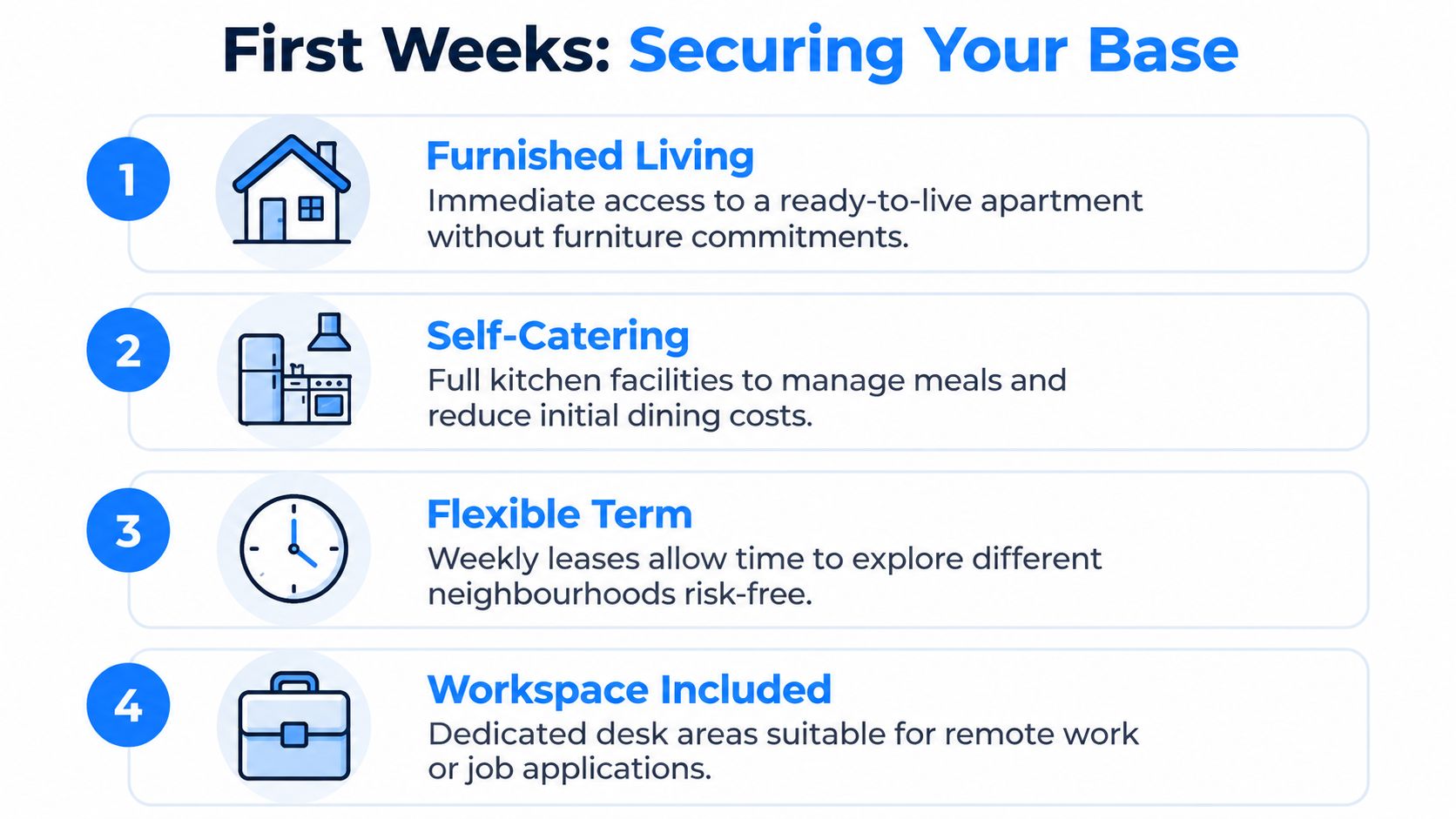
Arriving in Norwich with boxes still in transit is a poor time to choose a permanent home. Book a furnished aparthotel or serviced apartment first, then use it as a scouting phase base while you work, cook, sleep, and keep your belongings secure.
This approach gives you time to attend viewings locally instead of commuting from another county. You can register with agents from a Norwich address, compare streets at different times of day, and avoid paying long-term rent on a property that does not suit you. A kitchen also keeps meal costs and routines under control while removal and travel expenses are competing for your budget.
Book for how you'll work
Central Norwich, Riverside, and the Golden Triangle make practical arrival bases because you can test different parts of the city without committing to one suburb. Before booking, check the details that will shape every day. Our guide to serviced apartments in Norwich walks through what to check before booking an arrival base.
A proper kitchen: Self-catering helps when your hours vary or you are travelling with family.
A workspace: A desk and dependable Wi-Fi matter if you work remotely or are applying for jobs.
Laundry facilities: A washer-dryer reduces luggage and cuts down on errands.
Clear access arrangements: Confirm self-check-in, luggage access, and parking before arrival.
Ask for longer-stay rates if you expect to remain for several weeks. Confirm the cancellation policy, deposit terms, cleaning arrangements, parking, and whether VAT applies to your specific length of stay. Get every answer in writing. Providers set different rules and prices, and assumptions lead to avoidable disputes.
The council's temporary accommodation policy recognises self-contained accommodation as a legitimate interim option. It also covers managed shared or cluster accommodation and states that households may be placed outside the council's administrative area when local accommodation is not reasonably practicable. Read the Norwich temporary accommodation policy for the operational detail. For a private renter, the practical lesson is straightforward: a furnished base gives you time and continuity while you search.
A well-chosen temporary stay improves the decision. You replace rushed guesses with direct comparisons before signing a long-term tenancy.
Getting Around Norwich and Beyond Without the Stress
Norwich is compact enough for walking and cycling to handle many inner-city journeys. The transport decision becomes more complicated once you live beyond the centre, work shifts, commute to an industrial estate, or need reliable early and late connections.
Rail is the backbone for longer trips. Around 87% of rail passenger journeys in Norfolk are to or from Norwich, according to Norfolk's transport information. That dominance tells you something useful: the station is more than a departure point for London. It is a major part of how people connect with the wider county.
Test the last mile before signing
First Bus operates many city routes, but a route on a map isn't the same as a dependable commute. Check the timetable against your actual start and finish times, especially if you work at the hospital, UEA, an outer business park, or a site that requires a second connection.
Cycling can work well for inner-city trips and routes towards UEA and the Broads, although dedicated lanes aren't continuous everywhere. If you're car-free, prioritise a home near a frequent bus corridor or within a realistic cycling distance of work. Keep a taxi app as a backup for late shifts, bad weather, or a missed connection.
Transport Option | Best For | Typical Journey Times | Cost Notes |
|---|---|---|---|
Walking | Inner-city errands and central commutes | Short, route-dependent | No fare, but check weather and luggage practicality |
Cycling | UEA, central areas, and regular local journeys | Route-dependent | Allow for equipment, storage, and maintenance |
Bus | Suburban commutes and hospital or campus access | Varies by route and traffic | Compare fares and employer support |
Train | London, Cambridge, and county connections | Timetable-dependent | Check railcards, season products, and employer discounts |
Car | Outer estates, rural work sites, and irregular shifts | Traffic and parking-dependent | Include fuel, parking, insurance, and maintenance |
Taxi | Late journeys and disrupted connections | On-demand | Keep it as a contingency rather than your daily plan |
Read this guide to Norwich train station before choosing accommodation around your travel pattern. Transport isn't just about reaching the centre. It's about getting home reliably when the standard timetable stops being convenient.
Sorting the Admin Once You Are on the Ground
Use your temporary address to create an administration list, then work through it while the move is still fresh. The first priorities are healthcare, banking, utilities, council tax, insurance, and any school or nursery arrangements.
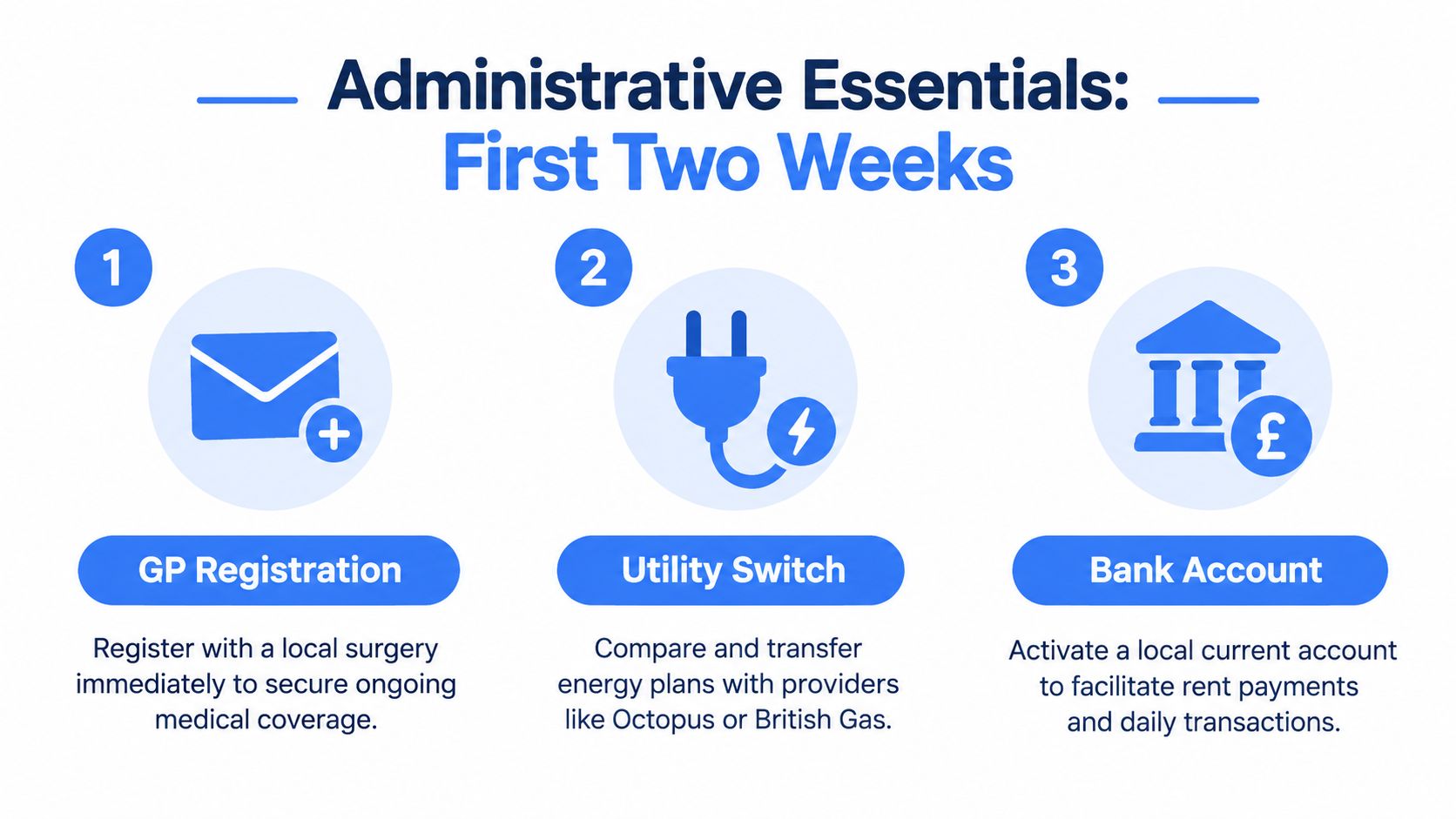
Register with a local GP through the NHS website and check which practice accepts patients in your address area. Norwich options include St Stephen's Gate Medical Practice, Trinity and Bowthorpe Medical Practice, and UEA Medical Centre. Availability and eligibility can change, so confirm directly rather than assuming the nearest surgery is available to you.
Make every account easy to find
Compare energy suppliers such as British Gas, EDF, Octopus, and E.ON, then check whether your building already has a smart meter or a communal arrangement. Water is supplied by Anglian Water across much of Norfolk. Photograph meter readings on arrival and save the date, property address, and account references in one folder.
Council tax depends on the property and your circumstances. Register with Norwich City Council or the relevant district council, then check whether you qualify for a single-person or student discount. Families should contact the relevant school and authority early, because a nearby address doesn't automatically secure a place.
Protect yourself before paying for a furnished tenancy. GOV.UK says a landlord can request a deposit of up to five weeks' rent where annual rent is below £50,000, or up to six weeks' rent where annual rent is £50,000 or more. The Tenant Fees Act guidance also says the deposit must be placed in a government-approved protection scheme within 30 days of receipt.
Shelter explains that a landlord who fails to follow the deposit-protection rules may have to repay the deposit and pay between one and three times the deposit amount. Keep the tenancy deposit guidance from Shelter alongside your agreement, inventory, photographs, and payment records.
For employment searches, especially if immigration status affects your options, you can browse UK jobs with visa while you organise the move. Administration feels tedious, but a complete folder prevents small omissions from becoming expensive delays.
Your First 90 Days in Norwich
A successful relocation has an end point. Use the first month to make the home functional, the second to build local familiarity, and the third to decide whether your temporary choices deserve to become permanent.
Month one builds the foundation
Unpack the essentials first, not every box. Register with a local GP, open or activate a bank account, organise utilities and council tax, and walk your neighbourhood until you know the practical routes to work, shops, green space, and public transport.
Keep a short record of what feels easy and what repeatedly causes friction. If the bus connection is unreliable, the parking is impossible, or the evening walk feels wrong, record that before the details blur.
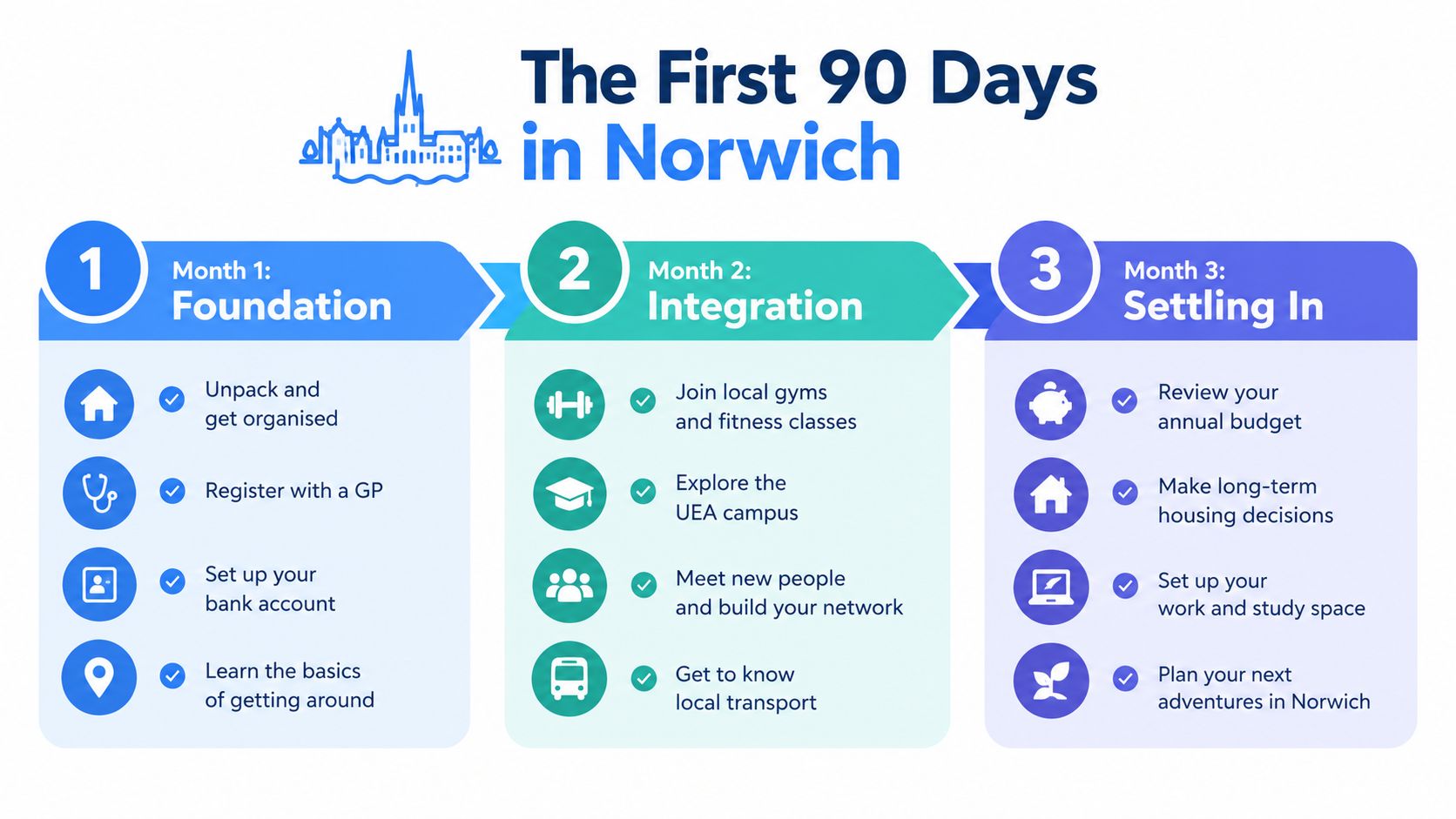
Month two creates connection
Choose activities that put you in the same room as local people. Join a gym such as The Gym Group on Hall Road, take a class at The Halls or Norwich School of Art, and register at Norwich Library on The Forum. A Norwich City FC match at Carrow Road can be an easy way to experience the city's social side without forcing a formal introduction.
Explore UEA even if you don't study or work there. Its campus, events, and surrounding streets help you understand how the west side of Norwich feels at different times of day.
Use this month to revisit any neighbourhood that still interests you. A second viewing after rain or at rush hour often reveals more than another online listing.
Month three turns arrival into settlement
Review your spending against the original budget and identify the costs you underestimated. Then decide whether to sign a longer tenancy, complete a purchase, or extend your furnished base while you continue looking. Don't let an arbitrary deadline push you into a home that fails your daily test.
Renew prescriptions, update insurance and employment records, and plan a seasonal reason to enjoy the region. That could be the Norwich Christmas market or summer boating on the Norfolk Broads. The aim is straightforward: by the end of the third month, your home, routes, paperwork, and social routine should support the life you moved here to build.
Landlords direct with Stay Norwich Apartments, Norfolk, furnished accommodation when you need it, for as long as you need it. No hassle, no drama, pay and stay. Use Stay Norwich Apartments as a furnished base while you view neighbourhoods, attend work commitments, and decide where in Norwich you'll settle for the long term.
Comments