


Norwich Population Growth

Norwich's population grew by 8.7% between 2011 and 2021, faster than England's 6.6% growth over the same period, according to the Office for National Statistics. That difference is more than a headline. It changes how businesses plan workforce accommodations, how relocating households search for a place to live, and how contractors manage temporary assignments in the city.
The important question isn't merely how many people Norwich has. It's what kind of demand this growth creates. Inward migration, employment changes, household transitions, and an aging regional population all produce different accommodation needs. A student, a construction worker on a fixed-term project, a family between homes and a relocating professional may all be counted within the same population figures, but they won't search for the same type of property.
Table of Contents
Understanding Norwich's Growth Story - Why the headline matters - What the figures mean for visitors
Norwich's Recent Growth by the Numbers - City growth and regional absorption
The Key Drivers Behind the Population Surge - Migration changes the timing of demand - Education and employment widen the audience
A Nuanced Look at Norwich's Changing Demographics - Growth and aging can happen together - What does this mean for accommodation decisions?
How Population Growth Impacts Norwich's Accommodation Market - The missing middle in the rental market
Navigating Your Stay in a Growing City - Choose for the whole assignment - Check what is included
Understanding Norwich's Growth Story
Norwich grew from around 132,500 residents in 2011 to about 144,000 in 2021, with an increase of 8.7%, compared with 6.6% across England, according to the ONS Census population change visualization. The figures describe more than a larger resident base. They indicate a city receiving enough newcomers and relocating households to affect how accommodation is used.
That distinction matters for business travelers, contractors, and people moving to Norwich. Growth, driven partly by migration, creates demand at different stages of a move. A new arrival may need immediate accommodation, while a contractor may require a furnished base for a defined assignment. A relocating professional or family may need several weeks to assess a neighborhood, commute, and permanent housing options before signing a longer tenancy.
Why the headline matters
Norwich's faster growth than England's average provides a useful market signal, but it does not predict performance across all property types. The ONS comparison applies to the local authority boundary, so it helps establish city-level direction rather than describing availability at a specific address.
For accommodation providers, the practical implication is a broader range of booking needs. Population growth can increase demand for permanent homes, while migration-led growth also creates demand for transitional, furnished, flexible accommodation. These stays bridge the period between arrival and settlement, particularly when a job, project or household move has a fixed start date but no immediate long-term housing solution.
Practical rule: Treat Norwich's growth as a demand signal, not a guarantee that every type of property will perform equally well.
What the figures mean for visitors
The figures cannot confirm that a particular flat will be available on a particular date. They do suggest that suitable accommodation may face more competition as people relocate, take up work, or move between homes. Business travelers and contractors should compare availability, location, flexibility, and practical facilities, rather than judging options by nightly price alone.
A furnished apartment can provide a workable base while a permanent tenancy is arranged, renovation work is completed or a new role settles into a routine. The choice is especially relevant for visitors with temporary accommodation needs but who require reliable access to the city for work.
The local rental context also affects that decision. This guide to renting in Norwich provides further context for comparing short-term and longer-term options.
Norwich's growth is therefore best read as an increase in people needing accommodation at different points in their relocation or working arrangements. That pattern supports demand for short stays, furnished homes and contractor-focused bookings alongside conventional rental demand.
Norwich's Recent Growth by the Numbers
Greater Norwich grew from 351,000 people in 2001 to 418,000 in 2021, with the increase spread across the city and surrounding settlements. The wider pattern matters for accommodation because demand does not stop at the local-authority boundary. A worker based in Norwich may need regular access to a project elsewhere in the region, while a contractor may prefer the city's services and evening options even when the worksite lies outside the center.
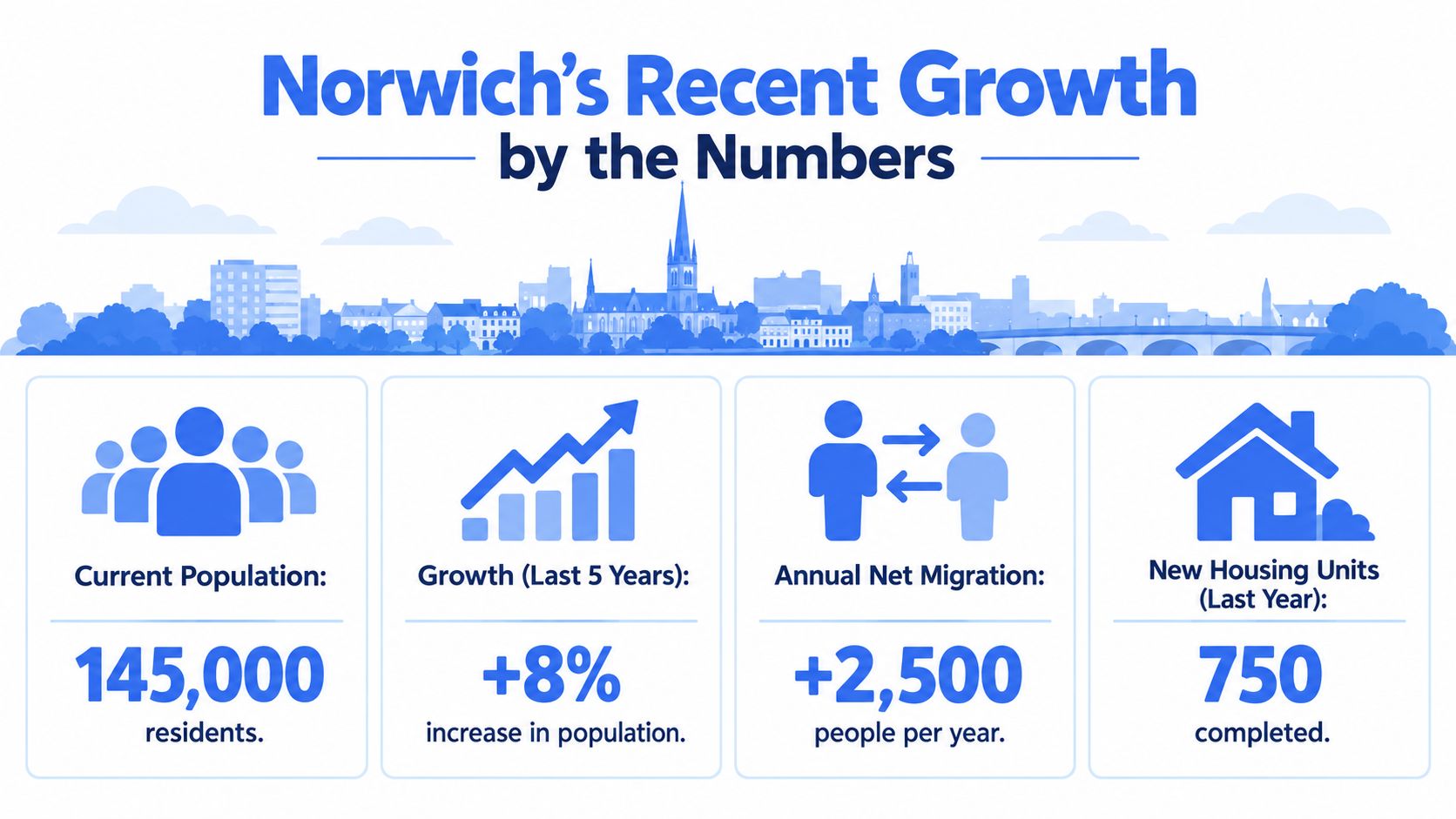
The city-level increase recorded in the previous section should therefore be read as part of a broader regional expansion, rather than as an isolated boundary effect. Greater Norwich profile data also place the area at 381,000 in 2011, rising to 418,000 in 2021, and attribute the increase to natural change and in-migration, largely from elsewhere in the UK.
City growth and regional absorption
The available projection estimates that Greater Norwich will be between 463,000 and 470,000 by 2038. It remains a projection, not a confirmed outcome, but it indicates that housing demand could continue beyond the period measured by the Census.
Area | Population pattern | Practical interpretation |
|---|---|---|
Norwich local authority | Recorded growth during the most recent Census period | Strong city-level expansion |
Greater Norwich | 351,000 in 2001 to 418,000 in 2021 | Wider regional growth |
Greater Norwich projection | Between 463,000 and 470,000 by 2038 | Potential for continuing housing pressure |
The figures do not imply uniform demand across all neighborhoods or property categories. Employment locations, transport links, and the distribution of new homes all affect where people need to stay. The more useful conclusion is that the addressable market for accommodation is expanding across both the city and its surrounding area.
That expansion has a different effect from population growth driven mainly by births. People moving for work, projects, or household changes often need a place before they can secure a long-term home. Their requirements may be furnished, flexible, and time-limited, which support short-term rentals and contractor-focused bookings alongside conventional tenancies.
For someone arriving temporarily, timing and flexibility may matter more than the headline nightly rate. A conventional tenancy can require a longer commitment than the visitor wants, while a hotel may offer less space or privacy during a multi-week assignment. A furnished apartment can provide a practical base while a permanent tenancy, property transaction, or relocation is completed.
Visitors comparing those options can use this guide to renting in Norwich for context on the longer-term rental market. The regional figures do not guarantee availability on a particular date, so checking location, booking flexibility, and facilities remains important.
The Key Drivers Behind the Population Surge
As established earlier, Greater Norwich's expansion is significantly linked to in-migration, much of it from elsewhere in the UK, alongside natural population change. That composition matters because migration-led growth creates housing demand where people arrive. Growth driven mainly by births tends to work through existing households and a slower family cycle.
A household moving into the area may need somewhere to stay before securing a permanent home. A professional may arrive ahead of a partner or family. A contractor may need a furnished base for a project, then leave when the work ends. These movements create churn, thereby supporting flexible accommodation more directly than a gradual increase in local births would.
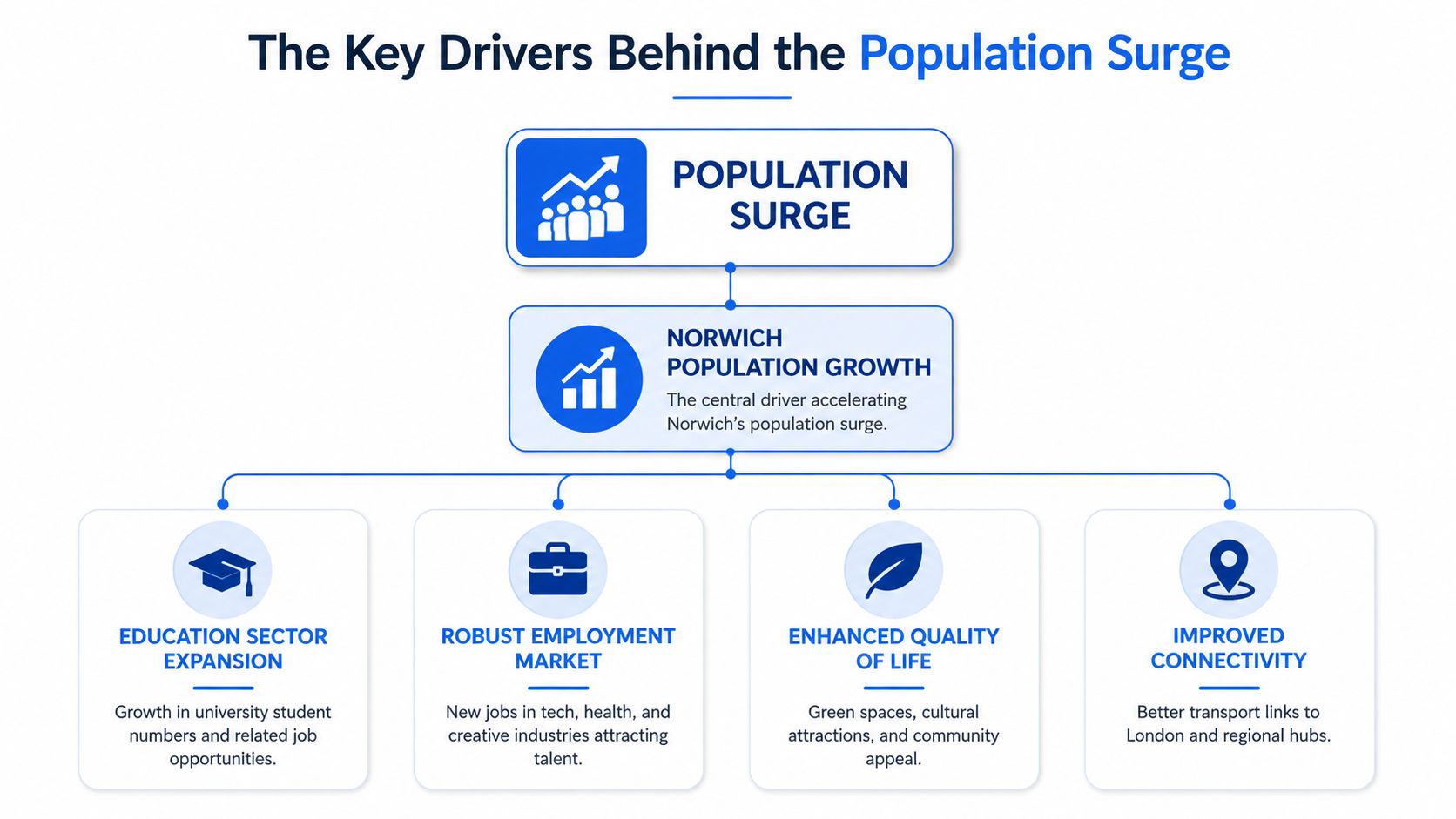
Migration changes the timing of demand
People arriving for work or relocation already need a place to live. Their first requirement may be temporary while they test a new role, wait for a property transaction or work away from their established home. That makes furnished, time-limited accommodation relevant before a conventional tenancy becomes practical.
Birth-rate-driven growth usually develops within existing households. Parents may need more space over time, but the decision often follows a slower household cycle. Migration can create an immediate requirement for a bed, desk, kitchen and reliable internet, particularly for people starting work in the city.
Education and employment widen the audience
Norwich's education sector attracts students, academics, visiting staff, and families attending university-related events. Its employment base also brings professionals and contractors whose requirements vary by assignment. Some need a quiet workspace and strong Wi-Fi. Others prioritize parking, cooking facilities or convenient access to a project location.
The groups overlap but do not have identical needs. A student may seek an academic-year arrangement, a visiting professional may require a shorter stay, and a contractor may want a practical base that avoids the disruption of hotel living. The accommodation market therefore serves several arrival patterns rather than one standard rental customer.
The projected growth already discussed supports planning for continued movement into the area. For property owners and accommodation managers, the opportunity lies in matching the offer to the reason for arrival, rather than treating every new resident as a conventional long-term tenant.
Readers assessing how supply may respond can review these new developments in Norwich. The practical conclusion is clear. Migration creates a bridge-housing problem, and bridge housing needs speed, furniture, and clear terms. That combination supports short-term apartments, furnished stays and contractor-focused bookings alongside the longer-term rental market.
A Nuanced Look at Norwich's Changing Demographics
More residents don't automatically mean a larger working-age rental market. Norfolk's demographic outlook adds an important qualification to the story of Norwich's population growth. The population is projected to grow by around 11% between 2025 and 2045, while the 65+ age group is projected to be the fastest-growing segment, at 36.7%, according to the Norfolk population overview.
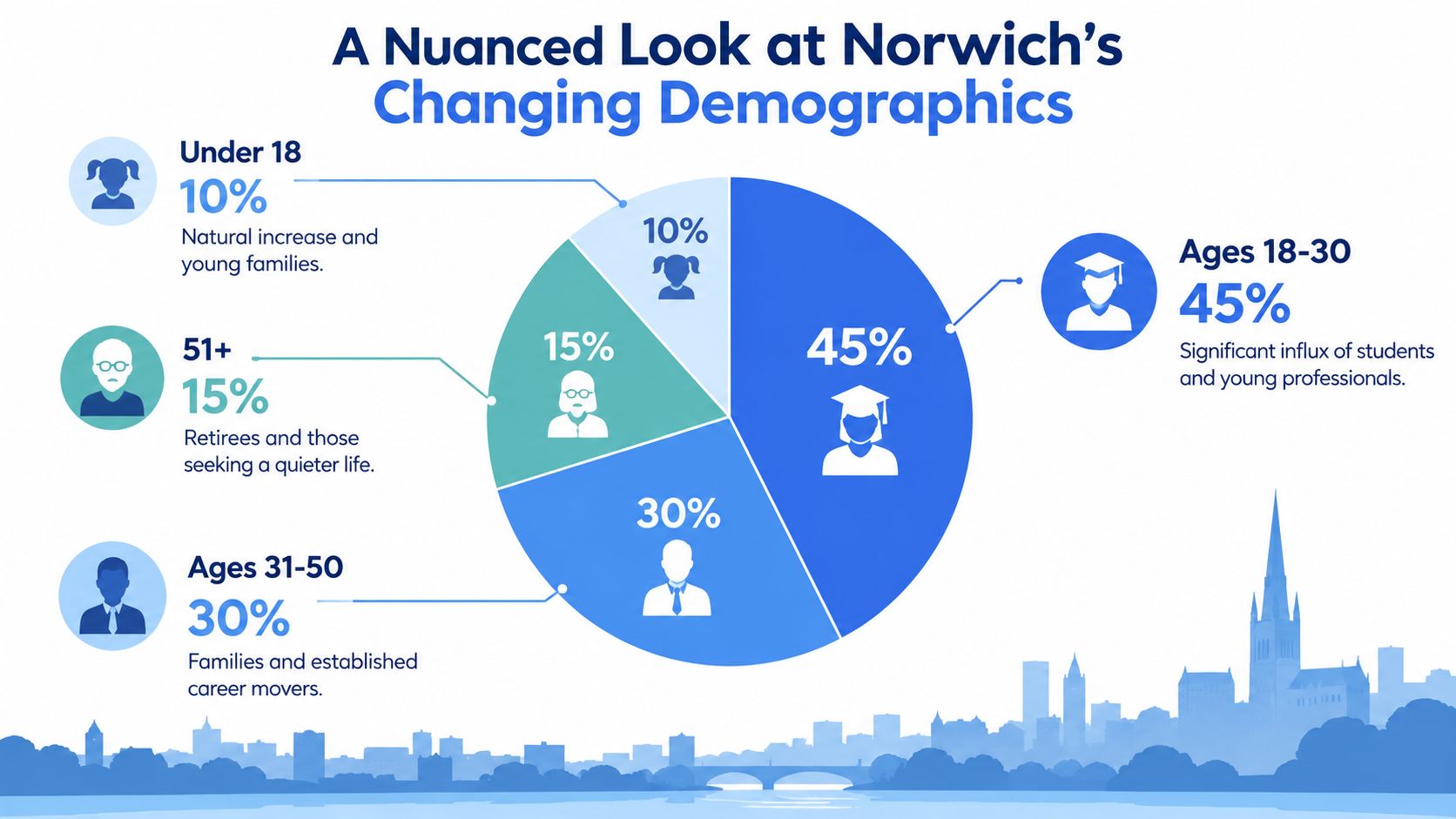
This creates a more complex housing question. A growing population can contain more older residents at the same time as it attracts students, professionals and relocating families. Overall growth, therefore, doesn't indicate which property type will be needed most.
Growth and aging can happen together
An older population may increase demand for smaller homes, accessible layouts, and straightforward living arrangements. That doesn't eliminate demand from working people, but it does weaken the assumption that new housing should focus only on large family properties or student-style accommodation.
Household fragmentation also matters. A person downsizing, a couple living separately during a move or a relative needing a temporary base may all seek a furnished property, even though their circumstances differ from those of a contractor. Flexible accommodation can serve these transitions when a traditional tenancy feels too rigid.
Norwich's population story is not simply “more people, more of the same housing”. The age profile changes the type of accommodation that makes sense.
What does this mean for accommodation decisions?
For business travelers and relocating households, demographic change underscores the importance of evaluating a property's practical design. A furnished apartment with a kitchen, workspace, and a calm environment may suit a professional assignment, while accessible features and a manageable layout may matter more to someone going through a life-stage change.
The University of East Anglia in the United Kingdom remains a relevant reference point for people involved in higher education, but university demand should be considered alongside the broader age structure. A city can attract younger arrivals while the surrounding county ages.
That combination produces segmented demand. Operators need to understand stay length, mobility, household composition, and purpose of travel. Visitors should ask whether a property supports their actual routine, rather than selecting accommodation based only on its label.
How Population Growth Impacts Norwich's Accommodation Market
Norwich's population rose from 36,832 people in 1801 to 74,414 by 1861, according to historical ONS records. That increase shows the city was already a substantial urban center during the industrial and Victorian periods, although the source does not need to be repeated here.
The accommodation implication today is more specific than a simple increase in housing demand. A contractor on a defined assignment, a professional relocating within the UK, or a family between properties may need a furnished base without committing to a standard tenancy. A conventional hotel may provide too little space for a longer or more complex stay.
The missing middle in the rental market
Traditional rentals generally suit people who are ready to make a long-term commitment. Hotels suit brief visits where limited living space and fewer domestic facilities are acceptable. Serviced apartments occupy the middle ground, offering guests a furnished home for stays longer than a weekend but not permanent.
Migration-driven growth affects this market differently from growth caused mainly by births. New arrivals often create immediate demand for short-term, furnished and contractor-focused accommodation while they begin work, complete a property purchase or establish a household. Birth-rate-driven growth changes housing needs more gradually, as households expand over time.
The practical value is reduced disruption. Guests can cook, work, wash clothes, and maintain a routine without furnishing a temporary home. That arrangement can suit builders, engineers, healthcare workers, project teams and families managing a move or renovation.
An accommodation assessment should examine:
Length of assignment: A brief, transitional or open-ended stay may require different terms.
Daily routine: A kitchen and dedicated workspace may matter more than hotel-style extras.
Travel pattern: Connections across Norwich and Norfolk may be more useful than proximity to one attraction.
Household needs: Families and colleagues may need separate sleeping areas and shared living space.
Providers also need clear booking processes when demand is driven by work start dates, property completions, and project schedules. A comprehensive guide for tour operator booking systems can help businesses review how inquiries, availability, and reservations are handled. Better processes reduce delays between an inquiry and a confirmed stay.
This market gap explains why some accommodation providers focus on direct booking, furnished properties, and flexible durations. The practical offer is a “no hassle, no drama, pay and stay” arrangement, but the wider market lesson is more useful: direct, furnished and flexible arrangements answer a specific gap created by population churn.
For the wider housing context, see this guide to housing in Norwich, Norfolk, UK. Population growth does not make every property suitable for every visitor. It increases the importance of matching the property, booking terms and facilities to the purpose and duration of the stay.
Navigating Your Stay in a Growing City
A growing city rewards preparation. Norwich's population has expanded faster than England's national rate, while the wider area is projected to continue growing. For someone arriving for a work assignment, relocation, or university visit, the practical approach is to arrange accommodation based on the purpose of the stay rather than leaving the decision until arrival.
Choose for the whole assignment
Start by defining the period you need, even if the final end date isn't certain. Ask whether the provider can explain extension terms, cancellation conditions, and the process for changing dates. Transparent information is especially useful when a project schedule or property transaction may move.
Location should follow your daily route. A central apartment may suit visitors who want access to Norwich's services and amenities, while someone traveling around Norfolk may value straightforward road or public transport connections. The best choice depends on the work pattern, not on a generic ranking of neighborhoods.
Check what is included
A furnished property should support normal living, not just provide a bed. Before booking, confirm whether the accommodation includes:
Cooking facilities: A properly equipped kitchen can reduce reliance on restaurants during a longer stay.
Work capacity: A dedicated desk and dependable Wi-Fi matter for remote administration and project communication.
Household essentials, bedding, towels, and basic furnishings reduce the need to transport or purchase temporary supplies.
Clear pricing: Confirm what is included in the rate and whether any practical charges apply.
Support: A responsive contact can resolve problems more quickly than an anonymous booking channel.
Relocating households should also plan the move itself. A practical moving house guide from MG Self Storage can help organize possessions, storage, and the transition between addresses. A temporary apartment works best when it is part of a broader relocation plan, rather than an improvised solution after a tenancy falls through.
For contractors and business travellers: Prioritise a usable routine. A kitchen, workspace, laundry access and reliable communication can have more daily value than a superficially cheaper room.
Visitors can use this guide to find temporary accommodation near Norwich and compare options against their actual requirements. Norwich's future growth should create opportunities, but demand will remain varied. Those who book with a clear brief, check the terms, and match the property to their schedule will be better placed to enjoy the city without unnecessary disruption.
Stay Norwich Apartments offers fully furnished, self-catering accommodation in Norwich for business trips, contractor assignments, relocations and temporary stays across Norfolk. Visit Stay Norwich Apartments to compare a practical base with kitchens, workspaces, Wi-Fi and flexible booking support, then arrange the stay that fits your schedule.
Comments