


Norfolk House Prices 2026 Guide

Norfolk's average house price reached £271,947 in May 2026, an annual increase of 3.1%. That county-wide figure shows continued nominal growth, but it doesn't represent every district, property type, or the price a buyer will face in a particular Norwich neighbourhood.
For anyone considering a move, the important question isn't just whether Norfolk house prices are rising. It's whether buying now makes sense for your timing, finances, and plans, or whether renting a furnished home offers a more practical bridge while you wait for a sale, purchase, renovation, or new job to settle.
Norfolk remains a varied housing market. A detached home in a higher-value district belongs to a different financial conversation from a terrace in a market town, while a contractor or relocating professional may have no reason to commit to a purchase immediately. The strongest decisions come from combining official price data with the true cost of flexibility.
Norfolk House Prices 2026 Guide: Table of Contents
Understanding Norfolk House Prices in 2026 - What the county average tells you - Why this matters for temporary living
District-Level Price Differences Across Norfolk - The district picture - Property type changes the answer
Buying Versus Renting in Norfolk, A Cost Comparison - Nominal growth is not the same as improved affordability - Match the tenure to your time horizon
Navigating Temporary Accommodation During Life Transitions - Start with the end date
Real-Life Housing Decisions in Norfolk - A family between properties - Why waiting can be rational
Making Your Housing Choice in Norfolk - Choose according to your situation
Understanding Norfolk House Prices in 2026
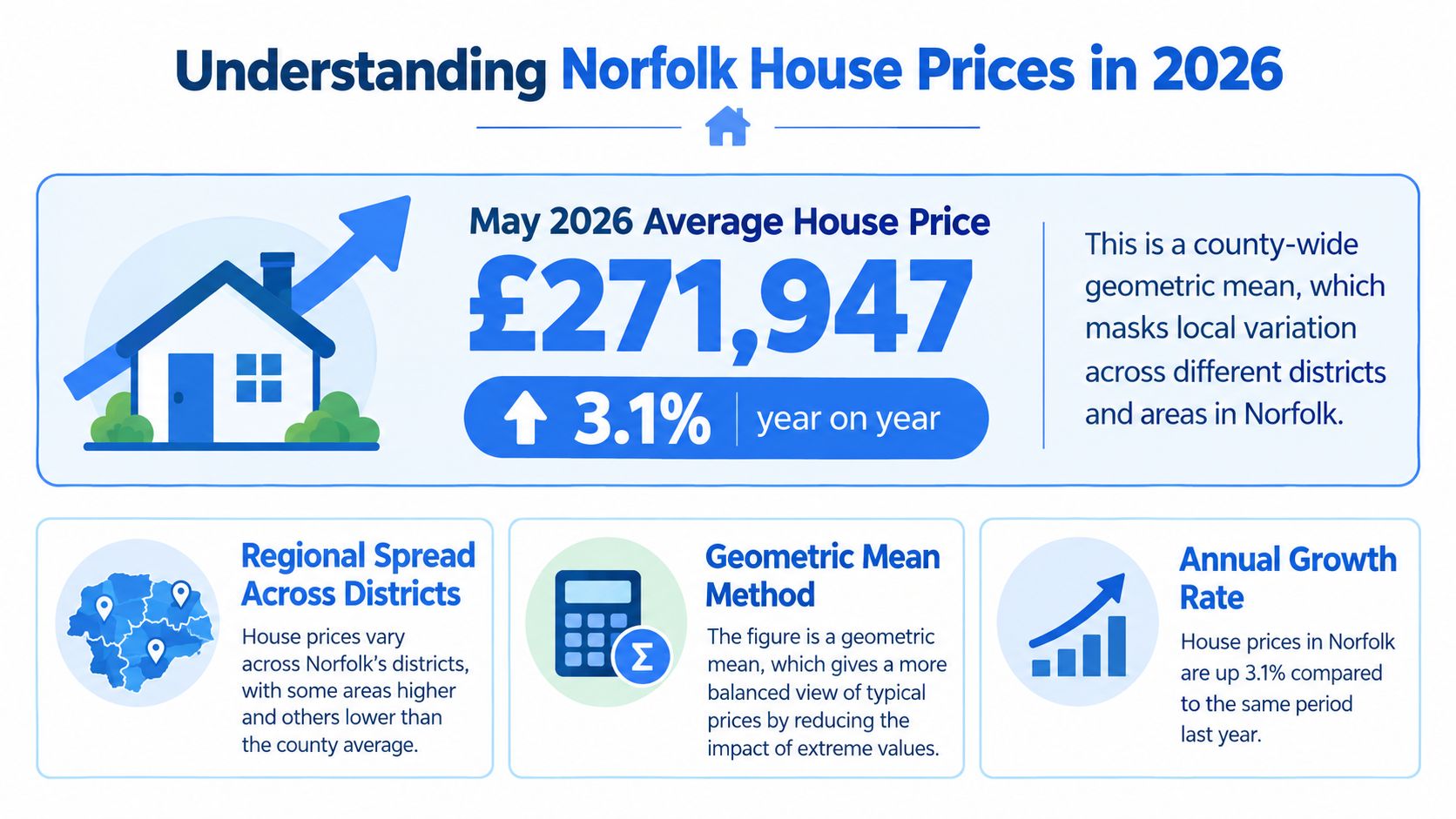
The headline figure is clear. Norfolk's average house price was £271,947 in May 2026, compared with £263,804 a year earlier, producing a 3.1% annual increase, according to the official UK House Price Index for England. That rise amounts to £8,143 over twelve months, or approximately £678 per month when expressed as a simple annualised difference. It isn't a monthly mortgage payment or a typical monthly rise in the value of one home.
The methodology matters. The official series uses completed transactions recorded by HM Land Registry, rather than asking prices set by sellers. It reports a geometric-mean average, so the result is a county-level benchmark, not a promise that a particular Norwich flat, family house, or coastal property is worth anything close to that amount.
What the county average tells you
The figure tells buyers and landlords that Norfolk had returned to positive annual growth in the latest reported period. It also indicates that underlying housing costs remained on an upward path for people relocating, working on temporary assignments, or arranging accommodation during a home move.
It doesn't tell you whether a property is affordable for your household. Your actual decision depends on the home's size and condition, the district, the deposit available, borrowing terms, moving costs, and how long you expect to remain in the property. A county average can establish the market's direction, but it can't replace a local comparison.
Norfolk's official local series runs from January 2005 onwards, giving analysts a long historical record rather than a one-year snapshot. The ONS local statistics for Norfolk allow current conditions to be considered against earlier market periods, while the UK HPI provides comparable monthly information across England.
Practical rule: Use the Norfolk average to understand the wider market. Use district, property-type, transaction, and rental evidence to make a personal housing decision.
Why this matters for temporary living
A moderate rise creates a different pressure from a sudden boom. Buyers may feel they need to act before prices move further, but a modest increase doesn't justify rushing into a home that doesn't suit their work, family, or finances. A purchase also brings commitment, while temporary accommodation can preserve the ability to choose a location after spending time in the area.
That's particularly relevant in Norwich, where the county figure includes urban, rural, coastal, and market-town submarkets. Someone moving for work may need a furnished base before deciding whether to buy in the city, commute from South Norfolk, or search elsewhere in the county. A practical overview of Norwich population growth can add useful context, but the housing decision still needs to be based on the person's own timetable.
District-Level Price Differences Across Norfolk
Norfolk house prices vary enough between districts to make the county average a blunt instrument. Official data recorded an average of £262,525 in King's Lynn and West Norfolk, with annual growth of 2.8%, while ONS-derived figures put North Norfolk at £292,563 and South Norfolk at £311,587. These figures come from the ONS average house price dataset and show why a buyer needs to identify the relevant local market before setting a budget.
The difference isn't just a statistical curiosity. A household choosing between Norwich, a southern commuter location, and a northern or coastal district may face different purchase prices, travel requirements, housing stock, and levels of competition. A lower average can improve the entry point, but it doesn't automatically mean lower total living costs if the location creates longer journeys or offers fewer suitable homes.
The district picture
Norfolk House Prices 2026 Guide: The table below brings the available district figures together. It should be read as a comparison of averages, not as a valuation for an individual property.
District | Average price | Annual change |
|---|---|---|
King's Lynn and West Norfolk | £262,525 | 2.8% |
North Norfolk | £292,563 | Not stated in the cited comparison |
South Norfolk | £311,587 | Not stated in the cited comparison |
The contrast between £262,525 and £311,587 is large enough to affect the amount a buyer needs to borrow and the size of deposit required. It also changes the opportunity cost of waiting. Someone who hasn't decided where to settle may benefit from renting first, particularly if a new role or family arrangement makes the right district uncertain.
King's Lynn and West Norfolk provides a useful reminder that averages can conceal buyer categories. Separate ONS-derived figures put first-time buyers in that district at £221,000, while the overall district average was £266,000 in July 2026, with annual growth of 3.0% and first-time-buyer prices up 3.2%, as reported in the available district-level house-price analysis. Those figures describe different parts of the market and shouldn't be treated as interchangeable.
Property type changes the answer
Property type can matter as much as geography. Rightmove reports an average Norfolk sold price of £309,930 over the latest year, broadly unchanged from the previous year and 3% below the 2022 peak. Its breakdown gives an average of £399,925 for detached homes, £284,506 for semis, and £231,378 for terraces, as shown on the Rightmove Norfolk house prices page.
A buyer searching for a terrace in or near Norwich shouldn't use the detached-home figure as a guide, and a landlord assessing a larger family property shouldn't rely on the terrace average. The same principle applies to temporary accommodation. People between homes usually need a property with the right number of bedrooms, workspace, transport access, and furnishing level, not an abstract county average.
For anyone comparing areas, start with the best places to live in Norfolk, then check actual property types and recent completed sales. Don't let one attractive headline number decide a location that will shape your daily routine.
Buying Versus Renting in Norfolk, A Cost Comparison
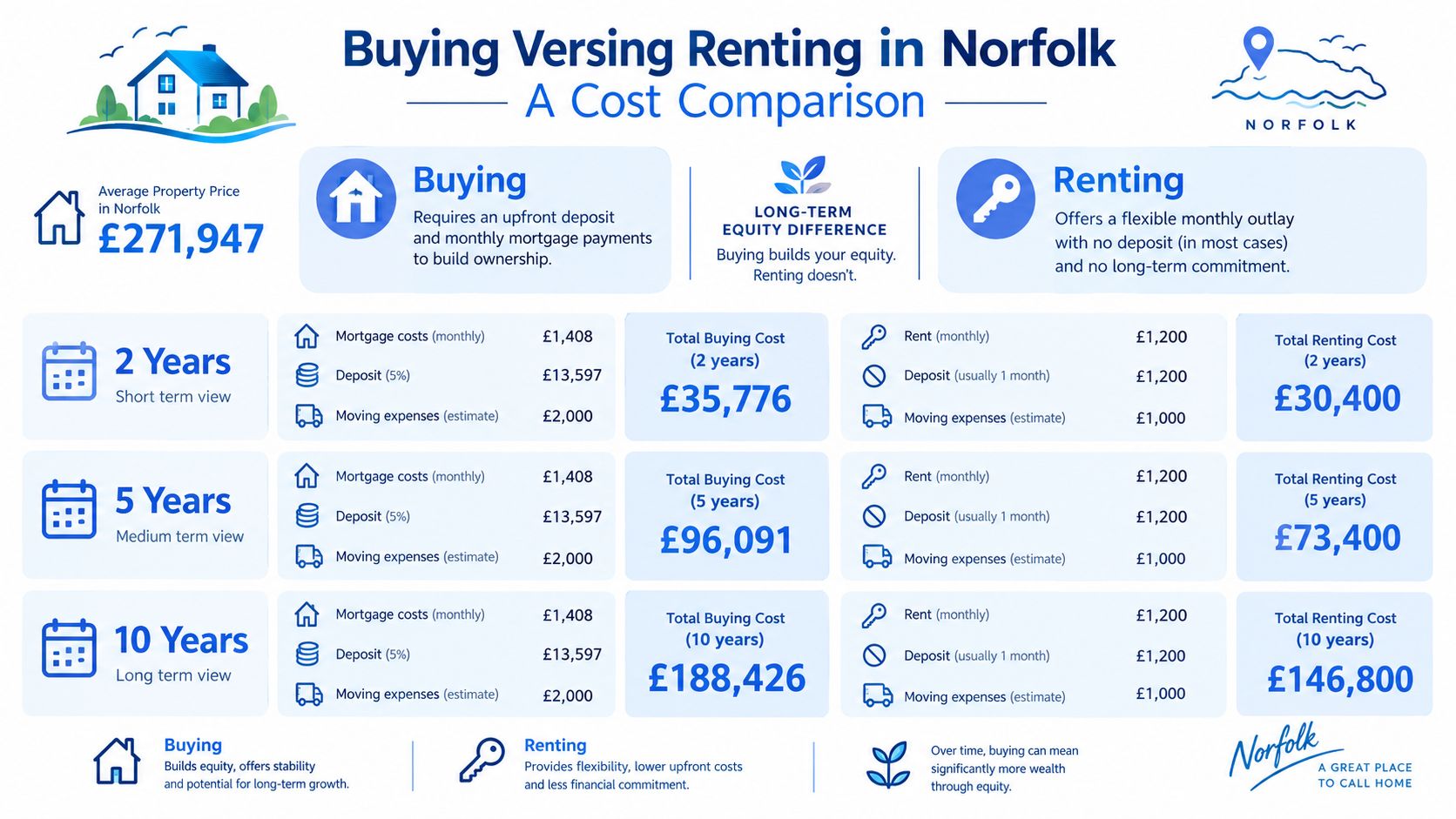
The comparison needs three time horizons: 2, 5, and 10 years. A short stay, a settled medium-term plan, and long-term ownership create very different financial decisions, even when the property and location remain the same.
Buying provides ownership and the possibility of building equity. Renting provides flexibility and keeps a household from being tied to one property while work, family, or relocation plans remain unsettled. Choose based on the length of your stay, the cash you need to preserve, and whether the home will still suit your future.
The purchase price is only the starting point. Buyers must budget for the deposit, mortgage costs, legal work, surveys, moving expenses, maintenance, and the risk of selling earlier than planned. Tenants compare rent, bills, furnishing, and flexibility, while avoiding many purchase-related costs and retaining the ability to move when employment or family circumstances change.
Nominal growth is not the same as improved affordability
A rise or fall in the advertised pound price does not settle the affordability question. Inflation, deposit requirements, mortgage conditions, and transaction costs all affect what a buyer can actually afford. A home can retain or increase its nominal value while becoming cheaper in inflation-adjusted terms, yet still remain out of reach for a household with limited savings.
Use earlier county-level price analysis for context, not as a personal budget. Waiting for a better headline price will not solve a deposit shortfall, an unsuitable mortgage, or the cost of moving again. Compare the full monthly commitment with the flexibility you need.
Match the tenure to your time horizon
Buying is harder to justify for a short stay because there is less time to absorb purchase and resale costs. Longer ownership can make buying more attractive, provided the property works for the household and the payments remain manageable.
Use this test:
Buy when your location is settled: You know where you need to live, expect to remain there for a substantial period, and can fund the deposit and associated costs without exhausting your financial buffer.
Rent when your plans are changing: You are starting a job, waiting for a sale, testing a district, or deciding whether Norwich or another part of Norfolk suits your longer-term needs.
Choose furnished temporary accommodation during a gap: Your previous home has sold, your new home is not ready, or renovation work has made the property uninhabitable. A defined stay can prevent you from committing to the wrong permanent arrangement.
Compare the total housing cost: Include travel, furniture, storage, utilities, maintenance, and the practical cost of changing plans. These costs form part of the cost of the housing shortage, not just the advertised monthly rent.
For local rental options, use this guide to renting in Norwich. Do not buy because you fear missing out. Buy when the property, location, finances, and time horizon align. Rent when flexibility has a clear practical and financial value, especially while a move, renovation, or new job is still in progress.
Navigating Temporary Accommodation During Life Transitions
Norwich City Council recorded an average of 312 people in temporary accommodation in 2022–23, rising to 375 in 2023–24 and 403 in 2024–25. Its review of homelessness and rough-sleeping strategies also reports heavy reliance on pay-nightly placements and a need for more stable, longer-term temporary accommodation.
These figures cover council-supported placements, not every contractor, student, relocating professional, or family arranging a furnished stay privately. They still show why suitable short-term housing affects the wider Norfolk market. Rising house prices can delay a purchase, while a sale, renovation, or job move can create an immediate need for somewhere practical to live.
Temporary accommodation works best as a defined bridge between two settled arrangements. Contractors need a dependable base near a project. Relocating professionals need time to assess Norwich or another Norfolk district before committing to a purchase or longer tenancy. Families may need cooking facilities, privacy, and usable living space while builders complete work or a purchase reaches completion.
Start with the end date
Identify the next likely milestone before booking. It could be a completion date, renovation stage, work contract, or new tenancy. Do not choose an arbitrary departure date if the timing remains uncertain. Ask whether the booking can be extended and what notice the provider requires.
Check these points before paying:
Confirm what is included. Ask whether utilities, Wi-Fi, kitchen equipment, linen, and cleaning arrangements are included in the stated price.
Test the working setup. Contractors and professionals need a proper workspace, dependable internet, and a quiet place to rest after work.
Compare daily travel. A cheaper room can cost more in time and transport if it sits far from the project, workplace, school, or essential services.
Read the agreement carefully. Check payment dates, cancellation terms, deposit requirements, extensions, and the process for changing the booking.
Clarify the extension process. A delayed purchase or building project may run beyond the original date. Get the extension terms in writing.
Check the household fit. Families should confirm storage, cooking capacity, sleeping arrangements, and access to laundry facilities.
For further practical advice, use this guide to finding temporary housing solutions during home renovations or transitions.

A council performance measure records households in temporary accommodation at the end of a reporting period, rather than every household placed during that period. It may also include households housed outside Norwich when Norwich City Council arranged the placement, as explained in its temporary accommodation performance reporting. Treat that figure as an end-period snapshot, not a cumulative annual total. The distinction matters when judging the scale of housing need and choosing between a short-term stay, a tenancy, or a purchase.
Real-Life Housing Decisions in Norfolk
A contractor finishing a six-month project in Norwich should not make the same housing decision as a buyer who has already identified a long-term home. The contractor may know when the work ends without knowing where the next assignment will be. Buying in that position can create legal costs, maintenance responsibilities, and a future sale before the work pattern is clear. A furnished apartment with a kitchen, workspace, reliable internet, and a clearly written agreement can support the assignment without turning a temporary placement into a permanent commitment.
That approach is a practical response to uncertainty, not a rejection of ownership. If the contractor accepts another Norfolk project or chooses to relocate, a flexible base preserves those options. Buying immediately can tie the next move to one property before the contractor understands the local market, commute, or longer-term employment pattern.

A family between properties
A family waiting three months for a new home to become ready faces a different pressure. Their previous property has gone, while the completion date has moved. They need more than somewhere to sleep. Cooking facilities, usable living space, privacy, and a location that protects school, work, and daily routines all affect whether the arrangement remains workable.
A hotel can cover the first night, but its cost and limited facilities often make it unsuitable for a longer transition. A standard tenancy may demand a commitment the family cannot make. Furnished temporary accommodation fills that gap, giving the household a stable base while the permanent home is completed.
Compare the full cost, not only the nightly or monthly rate. Storage, travel, meals bought outside the home, replacement furniture, and moving twice can change the result. A furnished property with a functioning kitchen may reduce those secondary expenses. A poorly located or badly equipped property can add them quickly.
Why waiting can be rational
HouseMetric's inflation-adjusted analysis shows why Norfolk price movement cannot be judged from nominal values alone. A buyer may reasonably delay a purchase while checking affordability, borrowing conditions, and whether a particular district offers suitable value. Prices will not follow a guaranteed path, but waiting can be a sound decision when the household lacks important information.
Give a temporary stay a defined job. Use it to inspect neighbourhoods, attend viewings, complete a work assignment, or allow renovation to finish. The right short-term arrangement can prevent an unsuitable purchase, an overstretched budget, or a rushed tenancy. That makes accommodation choice part of the housing decision, not a separate issue.
Making Your Housing Choice in Norfolk
Norfolk house prices provide a useful starting point, but they don't provide a universal answer. The county average masks district and property-type differences, while inflation-adjusted movement shows why a stable pound price doesn't always make a home easier to afford. Your decision should be based on timing, location, cash available, and flexibility, not on a single market headline.
Choose according to your situation
Contractors should prioritise a furnished base close to the project, with a proper workspace, dependable Wi-Fi, kitchen facilities, and an agreement that can accommodate the work timetable. Buying only makes sense if the contractor has a settled location and a longer-term reason to own.
Relocating professionals should rent or use temporary accommodation before committing to a purchase if they don't yet know which district suits their commute and lifestyle. Time spent in Norwich can reveal whether city-centre convenience, a southern commuter location, or another Norfolk area is the better fit.
Families between homes should focus on space, cooking facilities, practical access, and extension terms. A stable furnished arrangement can protect routines while a sale, purchase, or renovation is completed.
Buyers with a settled plan should compare completed-sale evidence by district and property type, then assess the full cost of ownership. Don't use the county average as a valuation, and don't confuse a modest annual rise with a reason to stretch beyond a comfortable budget.
The housing options available in Norwich make most sense when viewed as a range rather than a competition between buying and renting. Ownership can be right for a settled long-term plan. Renting can be right when flexibility matters. Temporary accommodation can be the most efficient choice when the gap between two homes has a clear beginning but an uncertain end.
Landlords direct with Stay Norwich Apartments, Norfolk, furnished accommodation when you need it, for as long as you need it. No hassle, no drama, pay and stay. Visit Stay Norwich Apartments to find a practical furnished base in Norwich for work, relocation, renovation, or life between homes.

Comments