


Camping in Norfolk: Ultimate 2026 Guide

You can arrive in Norfolk with a van full of kit, a start date on Monday, and nowhere permanent to sleep. That's when the choice stops being “holiday camping” and becomes a housing decision, because you need somewhere legal, workable, and calm enough to keep your job and your head straight.
Norfolk handles that transition better when you treat it as a sequence, not a scramble. A campsite can bridge a short gap, a serviced apartment can carry you through the messy middle, and a permanent lease can wait until you've seen which part of the county fits your routine.
Table of Contents
Understanding Your Norfolk Relocation Timeline - What tends to go wrong - How to sequence the move
Evaluating Camping Options Across Norfolk - What to check before you book - Where the market behaves differently
Serviced Apartments as a Practical Alternative - Where the value shows up - When the premium makes sense
Choosing the Right Norfolk Neighbourhood - Start with your daily pattern - Norwich is the main relocation hub
Planning Your Move and Budgeting for Norfolk Living - Budget for the full transition - Keep the legal side clean
Understanding Your Norfolk Relocation Timeline
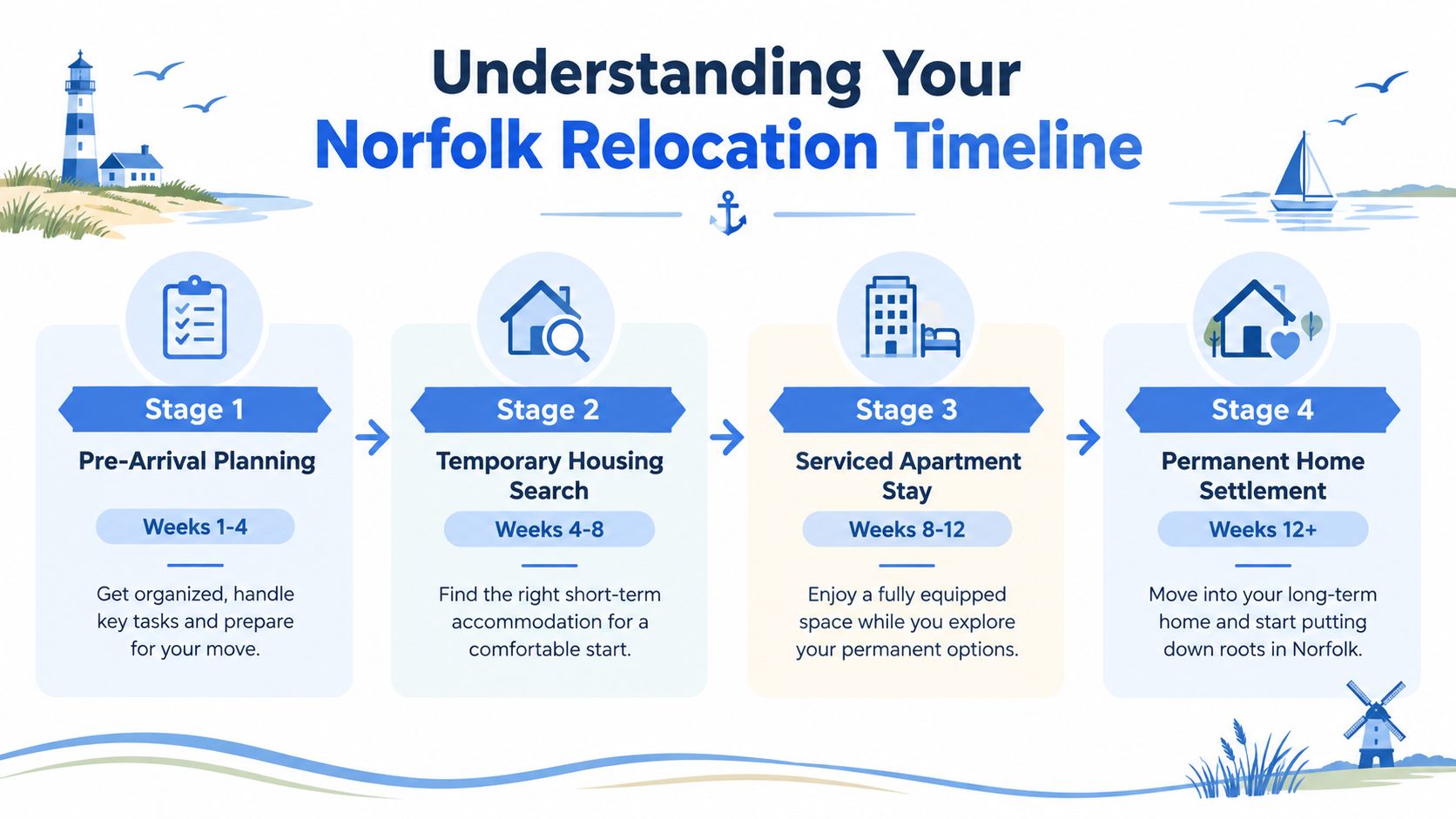
A typical Norfolk relocation starts with optimism and ends with a diary full of moving parts. A contractor might take a short assignment in Norwich, a family might be between houses after a sale completes, or a renovation might run longer than expected. In each case, the first mistake is the same, treating every night's stay as if it needs to solve every problem at once.
The better approach is to split the move into stages. A campsite suits a short, flexible arrival if you already know your next step. A serviced apartment suits the point where you need a proper desk, reliable Wi-Fi, and a place to wash clothes without improvising.
Practical rule: book the first bed for arrival, not for the whole stay. Then keep the next option ready before the current one ends.
The legal and administrative side matters as much as comfort. If you're also trying to understand Norwich itself before signing a lease, moving to Norwich is the kind of practical reading that helps you avoid choosing an area blind.
What tends to go wrong
The first risk is assuming you can extend a campsite stay indefinitely. That rarely works well once work schedules, weather, and local availability start shifting. A second risk is booking an apartment too late and finding yourself in a gap between the campsite and the tenancy start.
For people moving for work, the useful question isn't “where do I want to live?” It's “what is the most stable place I can book right now, and what's my fallback if the move slips?” That mindset keeps the transition controlled.
How to sequence the move
Start with your arrival night, then book the next seven to fourteen days, then keep the longer stay flexible until you've seen the commute and the neighbourhood. If your move depends on completion dates, trade dates, or contractor schedules, keep one option cancellable and one option more settled. That way you're not forced into a bad decision because the calendar shifted.
If you're moving with uncertainty around the end date of a tenancy or renovation, the safest plan is to treat camping as the opening move and serviced accommodation as the stabiliser. That's how you avoid sleeping in a tent while waiting for a lease or handover that drifts by a week.
Evaluating Camping Options Across Norfolk
Camping in Norfolk covers a wider range than many people expect. The county has roots in the UK holiday-camp story, with Caister-on-Sea widely treated as the birthplace of the industry after Fletcher Dodd launched his “Socialist Camp” there in 1906, starting with three bell tents and later expanding into an early large-scale accommodation model. That history matters because Norfolk never became just one thing, it grew into a place where simple seasonal stays and more structured campsite operations sit side by side. Visit Norfolk's account of the holiday-camp origin story makes that clear.
What to check before you book
Surface type should be one of your first filters. The Caravan and Motorhome Club's Norfolk inventory shows a clear split between hardstanding and other pitch types, with Norfolk Broads Club Campsite listing 109 total pitches and 93 hardstanding pitches, while other Norfolk club sites on the same regional page range from 79 to 241 total pitches. That mix is a practical clue, because hardstanding is usually the safer choice when the weather turns and access gets messy. The regional club listing is also useful because it shows opening windows, including Norfolk Broads Club Campsite running only from 27 Mar 2026 to 02 Nov 2026, so late-autumn plans need checking before you commit.
Good booking habit: verify surface, opening dates, and unit type before you look at the photos.
Availability is tight enough that you can't treat every campsite as equal. Hipcamp's Norfolk page shows 1,014 campsites with an overall 96% score, while its The Broads page lists 1,680 campsites at 97%, and individual Norfolk sites often post review scores between 97% and 100%. The practical reading is simple, demand is high, satisfaction is high, and the best-rated coastal or Broads sites can still disappear fast. Hipcamp's Norfolk listings also show how scale varies, with examples such as Whitlingham Broad Campsite at 69 units, North Norfolk Camping & Glamping at 195 units, and Hunstanton Camping & Glamping at 108 units.
Where the market behaves differently
Camping stops behaving like casual budget lodging at this point. Some Norfolk sites operate with seasonal rules, pitch-type differences, and minimum stays that make them feel closer to managed inventory than a roadside stop. A guide to Norfolk camping sites is useful precisely because it forces you to compare site structure instead of just picking the prettiest view.
That structure matters even more if you're arriving without a reservation. North Norfolk Council says overnight sleeping isn't allowed in all council car parks, and it prohibits wild camping at beach access points, woodland and heathland, Broads car parks, and public access sites anywhere in the district. For contractors, late arrivals, and people between homes, that means the difference between an authorised pitch and a casual pull-in spot is not a preference, it's an operational issue. The county needs planning, not improvisation.
If you want a completely different style of camping inspiration, even something like hot tub pods for Irish campsites shows how other markets lean into comfort-led pitching. Norfolk does have some comfort-led options too, but the local deciding factor is still legality, access, and seasonal fit, not novelty.
Serviced Apartments as a Practical Alternative
Camping works when you want simplicity. It stops working when you need a proper workspace, a dry place for paperwork, or somewhere to unpack without living out of a boot. That's where a serviced apartment earns its keep, especially for people relocating on a contract or waiting for a sale to complete.

A serviced apartment usually gives you the things camping doesn't, including a kitchen, a real bed, heating, Wi-Fi, and a stable base for work calls. A campsite can be cheaper and more flexible, but the trade-off shows up fast if you need to keep a laptop charged, store clothes properly, or recover after a long day on site. The gap isn't just comfort, it's how much time you lose dealing with friction.
Where the value shows up
All-inclusive billing is the big advantage. You aren't arranging utility accounts, buying every household item from scratch, or spending your first week turning a temporary bed into something vaguely liveable. That matters more than people admit when they're also juggling removals, GP registration, school searches, or a new commute.
There's a reason operational support matters in short stays, too. A useful read on the virtual assistant role in vacation rentals shows how much back-office coordination goes into keeping temporary accommodation smooth, and that same logic applies to relocation stays. If you're arriving under pressure, the accommodation that has fewer moving parts usually wins.
The admin side is where a place like Stay Norwich Apartments fits naturally, because it provides furnished, self-catering accommodation with practical amenities for short and longer stays. It's one option among several, but it aligns well with moves where you need a clean handover between camping and a more settled base. This guide to serviced apartments in Norwich is worth reading if you want to compare that model properly.
When the premium makes sense
A serviced apartment usually makes sense once your stay stops being optional. If you're working full days, needing privacy, or handling a family move, the extra structure can save more time than it costs. You also avoid the unpredictability of weather, pitch surface, and campsite closures that can disrupt a longer stay.
The practical test is simple. If your week involves laptops, laundry, early starts, and coordination calls, camping becomes a compromise. If your week is mostly leisure, flexible arrival times, and a short stay, camping still has a place.
Choosing the Right Norfolk Neighbourhood
Norfolk isn't one market, and Norwich isn't one neighbourhood. The right area depends on whether you need commuting ease, school access, quieter streets, or proximity to the coast. Temporary accommodation gives you a chance to test that before you sign a longer lease.
Start with your daily pattern
If work pulls you into the city centre, prioritise convenience over image. A location that cuts down your daily travel can be worth more than a slightly cheaper postcode further out. If family life matters most, look for streets that feel settled and practical rather than places that look good only in daylight.
That's why the best places to live in Norfolk should be read as a starting framework, not a verdict. The useful part is comparing how different districts support ordinary routines, school runs, and weekend errands.
A temporary stay lets you check what the map can't show you. You'll find out which roads clog up, which areas feel quiet at night, and which streets are convenient on paper but awkward in practice. That matters more than broad promises about lifestyle.
Norwich is the main relocation hub
Norwich remains the practical base for many relocations because it concentrates work, services, and onward travel better than most places in the county. If you're moving for a professional role, you want a neighbourhood that keeps the commute predictable and gives you easy access to healthcare, broadband, and day-to-day shops.
If you're choosing between two similar districts, spend a night in each. The commute may look the same on a map, but the lived experience often isn't.
Coastal areas suit a different rhythm. They work well if your stay is about leisure, seasonal work, or a temporary break, but they're less forgiving when you need consistent services or a quick route into the city. For many relocators, the compromise is to stay in Norwich first, then widen the search once the pressure lifts.
The strongest move is to use temporary accommodation as a trial period. Stay central if your work is central, stay quieter if family routine matters more, and don't assume a scenic postcode will suit your real life. Norfolk rewards people who choose based on routine, not on brochure language.
Planning Your Move and Budgeting for Norfolk Living
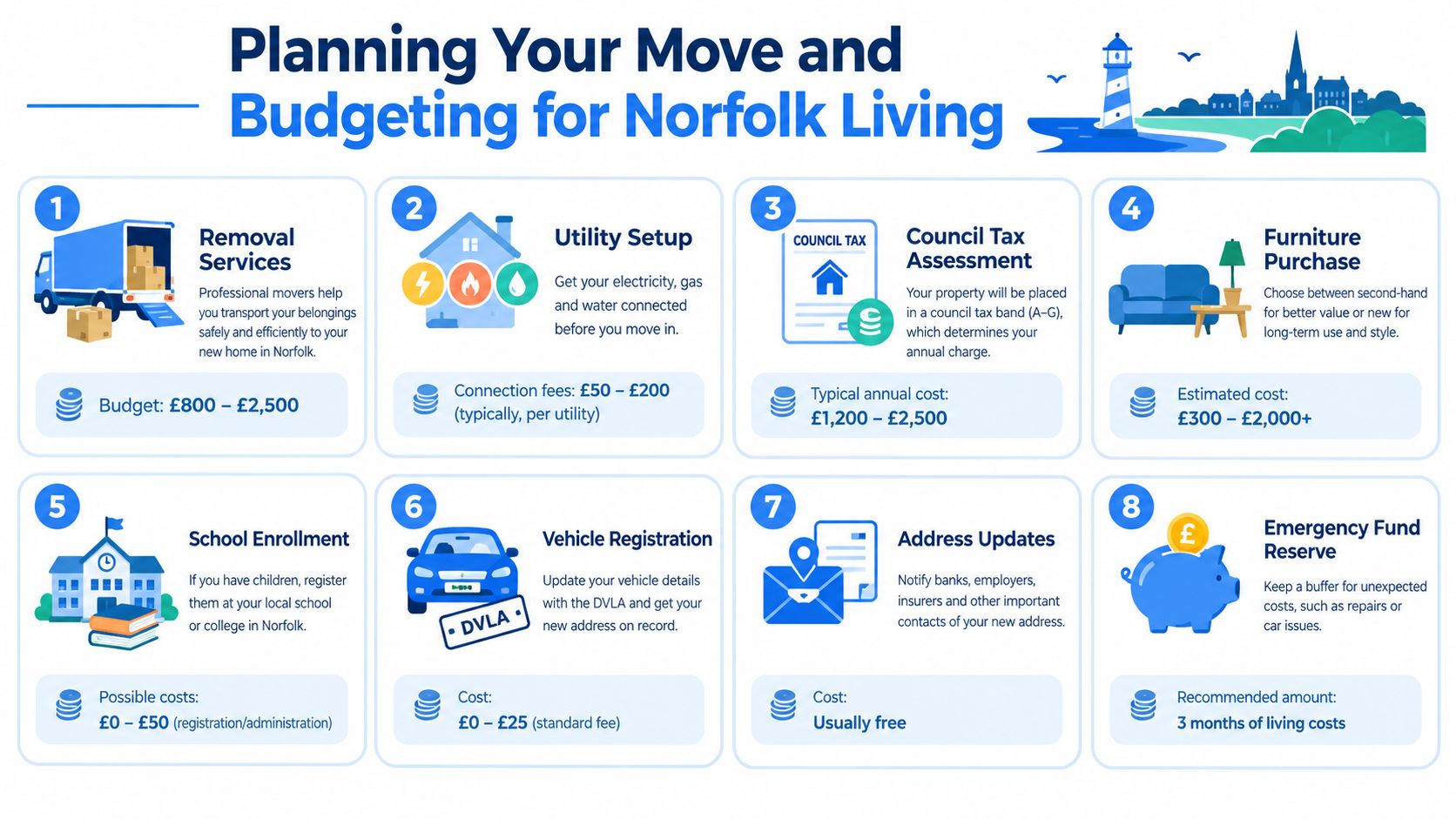
A campsite can keep the first few nights affordable, but the move becomes harder if you treat it as the whole housing plan. Build a bridge from the campsite to a serviced apartment, then use that stable base while you confirm your longer-term rental and move-in date. Removals, utilities, household basics, and admin changes can quickly add pressure if they are left until arrival.
Budget for the full transition
The common mistake is paying for temporary accommodation twice, first at a campsite and then through a rushed permanent arrangement. Set the temporary stay against your expected move and handover dates, while keeping a buffer week in case either date changes. A serviced apartment can cost more per night than a campsite, but it may reduce storage, furniture, and repeated travel costs while you inspect properties.
If you want to sense-check typical costs before committing, this guide to rent in Norwich helps put the rental part of the budget into context.
Use these headings when planning:
Removal timing: align the removal company with the date your settled accommodation begins, so your belongings have somewhere to go and unnecessary storage is avoided.
Utilities and setup: confirm what the short-term accommodation includes before comparing prices.
Furniture and household basics: decide what can be bought second-hand and what must be ready on the first day.
Admin changes: update your address, register the vehicle, and arrange local services promptly.
Reserve cash: allow for accommodation overlap, deposit timing, and an extra trip to a DIY store.
Keep the legal side clean
Furnished rentals require a basic safety check. Where a landlord supplies furniture or furnishings, they should meet the fire-resistance requirements under the Furniture and Furnishings (Fire) (Safety) Regulations 1988. Shelter explains that a furnished property must be fit for human habitation from the first day of letting, and that this is an implied tenancy term. Check the condition of the supplied items and raise concerns before you accept the accommodation.
“Temporary” also describes flexibility, not necessarily a lower total cost. A furnished apartment may charge more for convenience, while avoiding the expense and effort of setting up an unfurnished property. For a short stay between camping and a permanent home, that trade-off can be sensible.
Your Norfolk Relocation Action Checklist
A good move feels boring because the right things happened on time. A bad move feels chaotic because every task started too late. The difference usually comes down to sequence.
Book the first night early. Sort the arrival stay before anything else, then keep the next step flexible.
Check the accommodation terms. Make sure the stay fits your dates, your work pattern, and your need for quiet.
Line up removals last, not first. Book after the temporary base is secure, so the move has somewhere to land.
Set utilities and address changes in motion. Don't leave mail, broadband, and service updates until the week of arrival.
Register with local services. If you're relocating long enough to need a GP or school place, handle it as soon as you're settled.
Test the routine. Drive the commute, shop locally, and check which area feels workable after dark.
If you're relying on connectivity, accessibility, or a stable daily setup, the practical advice in Splash Access's resident connectivity checklist is a useful reminder that small operational details shape the whole stay. The same is true in Norfolk, where a smooth first week depends on planning more than luck.
If you need a short-term base while you decide whether camping, a serviced apartment, or a longer let makes the most sense, Stay Norwich Apartments gives you furnished accommodation in Norwich with a straightforward booking process and practical amenities for work and relocation. Visit Stay Norwich Apartments to find a Norfolk base that bridges the gap between arrival and your permanent home.
Comments