


Temporary Accommodations Near Me: A Practical Guide

Updated: Sep 5
You've got a work contract starting soon, the builders have just confirmed your home won't be ready, or a family move has fallen behind schedule. You search for temporary accommodations near me and get a crowded list of hotels, holiday lets, rooms, and furnished flats, each with different rules, fees, photographs, and promises. The nearest result looks convenient, but it may leave you without a proper desk, usable kitchen, parking, or a clear way out if your plans change.
That's the real challenge. Temporary accommodation isn't simply about finding a bed for tonight. It's about finding a practical base for the period between one home, project, or assignment and the next. England's temporary accommodation system reached a record scale in spring 2026, with 135,580 households living in temporary accommodation on 31 March 2026, up 3.6% from the same point in 2025 and 1.1% from the previous quarter, according to official homelessness statistics for England. That pressure affects emergency placements, but it also highlights the wider need for flexible, self-contained stays.
This guide gives you a clear way to compare accommodation types, expose hidden friction, check the contract, and decide whether a serviced apartment, hotel, or another option will work. The aim is simple: choose somewhere livable, not merely somewhere close.
Table of Contents
Types of Temporary Accommodation Explained - Serviced apartments and aparthotels - Short-term rentals and bed and breakfasts - Extended-stay hotels
Key Decision Factors Most People Overlook - Bills and contract clarity - Workspace quality - Flexibility, parking, and transport
Your Temporary Accommodation Booking Checklist - Start with your actual requirements - Compare the operator, not just the photograph - Verify the paperwork - Secure and save everything
Why Stay Norwich Apartments Is a Strong Option - Booking direct reduces uncertainty - A practical base for different stays
Why Finding Temporary Accommodation Feels Overwhelming
Temporary Accommodations Near Me: A Practical Guide A contractor arriving in Norwich for a project often starts with a simple requirement: somewhere clean, furnished, and available for the length of the assignment. A relocating family may need a kitchen, space for children, and a reliable route to school or work. Someone waiting for a renovation to finish may need a calm place where daily life can continue without unpacking and repacking every few nights.
Search results rarely organise themselves around those realities. They organise around nightly rates, availability, and location pins. A listing may look affordable until cleaning fees, utilities, parking, internet, or a restrictive cancellation rule appear later in the booking process. Another may be close to the city centre but offer a sofa that doubles as a bed and a small table that isn't suitable for a working day.
The phrase “near me” creates a useful starting point, but it can also encourage the wrong decision. The closest property isn't automatically the most convenient if you'll spend your stay commuting to a project site, working from a poor-quality desk, searching for parking, or buying every meal because there's no kitchen.
Practical rule: Choose the accommodation that reduces your daily friction, not the one that wins the map search.
The wider context matters too. The Office for National Statistics data on short-term lets recorded 90.1 million guest nights in UK short-term lets from January to December 2024, including 70.3 million in England, or 78.0% of the UK total. At the same time, English homelessness data reported 177,530 children living in temporary accommodation in 2026, a record level and a 5.2% year-on-year increase, showing that short-term housing serves very different needs, from emergency placements to planned work and relocation stays.
The answer is to assess the whole stay. Look at space, cooking facilities, workspace, bills, transport, contract terms, and flexibility together. Once you do that, the long list of “temporary accommodations near me” becomes a shortlist based on how you live.
Types of Temporary Accommodation Explained
The main categories overlap, but they don't provide the same experience. A serviced apartment usually gives you a furnished flat with self-catering facilities and hotel-style support. An aparthotel follows a similar model, often with a reception or hotel environment. Short-term rentals can offer excellent space, but quality and management vary. Bed and breakfasts suit brief visits, while extended-stay hotels provide convenience at the expense of domestic space.
Accommodation Type | Kitchen Access | Workspace | Housekeeping | Best For | Typical Stay Length |
|---|---|---|---|---|---|
Serviced apartment | Usually a fully equipped kitchen | Often a dedicated desk or work area | Scheduled or arranged service | Contractors, families, relocations, business travellers | Several nights to longer stays |
Aparthotel | Kitchenette or compact kitchen | Usually a table or small desk | Hotel-style service | Business trips and flexible city stays | Short to medium stays |
Short-term rental | Varies from none to full kitchen | Varies considerably | Depends on the host or operator | Leisure stays and independent travellers | Short stays to several weeks |
Bed and breakfast | Usually no guest kitchen | Limited and room-dependent | Daily room service often available | Brief visits and travellers who eat out | Short stays |
Extended-stay hotel | Kitchenette or limited cooking area | Usually a small desk | Regular hotel service | Travellers prioritising convenience | Medium-length stays |
Temporary Accommodations Near Me: A Practical Guide: Serviced apartments and aparthotels
A serviced apartment is the strongest all-round choice when you need to live normally rather than just sleep somewhere. A proper kitchen lets you prepare breakfast, packed lunches, and evening meals. Separate living and sleeping areas make a meaningful difference when one person is working while another is resting, or when children need a more settled routine.
Aparthotels tend to add hotel-style services and a managed front-of-house experience. That can help business travellers who value predictable check-in and support, although compact kitchens and smaller work areas may limit longer stays.
Short-term rentals and bed and breakfasts
Short-term rental platforms such as Airbnb and Vrbo can provide variety, but you'll need to inspect each listing carefully. Photographs may not show the working area, storage, mattress quality, heating controls, or the distance between the property and practical transport links. Read recent reviews for specific comments about cleanliness, noise, check-in, and communication rather than relying on the overall score.
B&Bs offer personal service and local character. They're a reasonable choice for a short visit when you plan to eat out and won't need laundry, cooking, or a sustained workspace. They become less suitable when your stay turns into a temporary home.
Extended-stay hotels
Extended-stay hotels sit between a traditional hotel and an apartment. They can work well when you want regular housekeeping and a simple booking process, but the room may feel restrictive over a longer period. Check whether the cooking facilities are genuinely usable, whether the rate includes the essentials, and whether the desk supports a full working day.
For a more detailed look at the practical differences, use this guide to short-term lets. It's particularly useful when you're comparing a hotel room with a furnished apartment and deciding whether self-catering space will justify the rate.
Key Decision Factors Most People Overlook
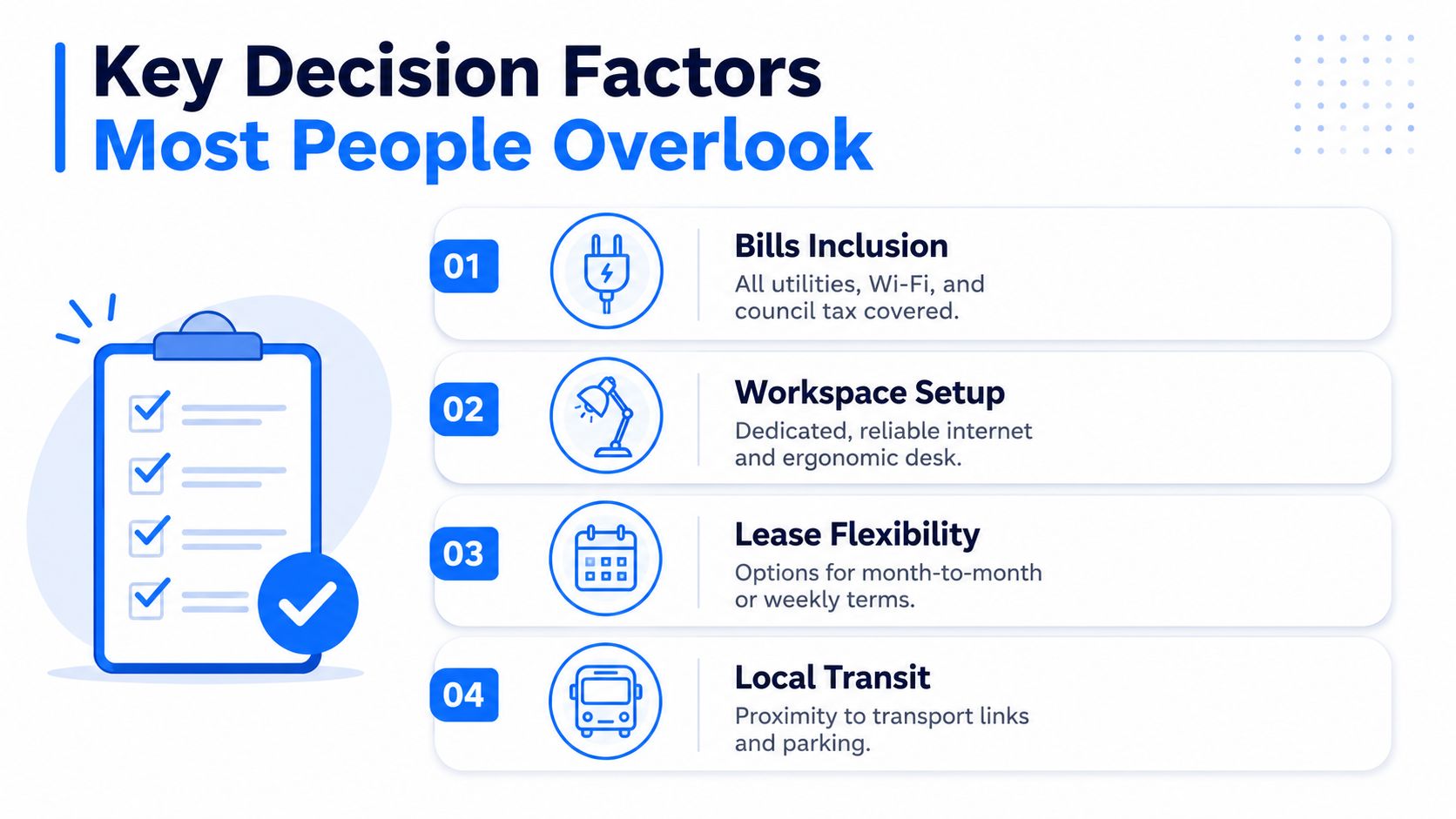
The headline rate is only one part of the cost. A seemingly cheaper room can become poor value when you add utility charges, internet costs, parking, meals, laundry, and time lost travelling to work. Treat the booking like a phone contract. The monthly price matters, but the terms, inclusions, restrictions, and exit conditions determine what you're really buying.
Bills and contract clarity
Ask for a written breakdown before paying. Confirm whether the rate includes:
Utilities: Establish whether electricity, heating, and water are covered.
Connectivity: Confirm that Wi-Fi is included and suitable for video calls or remote systems.
Council tax: Check who handles this during the stay.
Cleaning and linen: Find out what's included at arrival and during the booking.
Deposit terms: Ask when it's due, what deductions are possible, and how the return works.
An all-inclusive arrangement usually makes budgeting easier, especially for students, relocating professionals, and contractors whose employer needs a clear expense record. Don't accept “bills included” as a complete answer. Ask what the phrase covers and whether any usage limits apply.
Workspace quality
A laptop-friendly surface isn't necessarily a workspace. Look for a proper desk, supportive chair, dependable Wi-Fi, enough sockets, and lighting that won't leave you working beside a television or in a dark corner. If you'll take calls, ask about noise from nearby roads, shared corridors, bars, or other apartments.
A dedicated work area can also protect the rest of the stay. You can finish a shift without turning the dining table into an office, and you can leave equipment set up rather than packing it away every evening.
Flexibility, parking, and transport
Cancellation terms deserve the same attention as the room itself. Contractors may finish early, extensions may be approved late, and relocation dates can move. Confirm the cancellation window, notice requirements, extension process, and whether a change of dates triggers a new rate.
Parking needs specific confirmation, particularly if you're travelling with tools or a work vehicle. “Parking nearby” can mean a public car park, a restricted permit area, or an unreliable search for a space. Also compare the property with your actual route to the project site, railway station, hospital, university, or business park.
For practical questions to ask before booking, refer to these accommodation tips for finding the right stay. The strongest booking is the one where the important details are written down before arrival.
Your Temporary Accommodation Booking Checklist
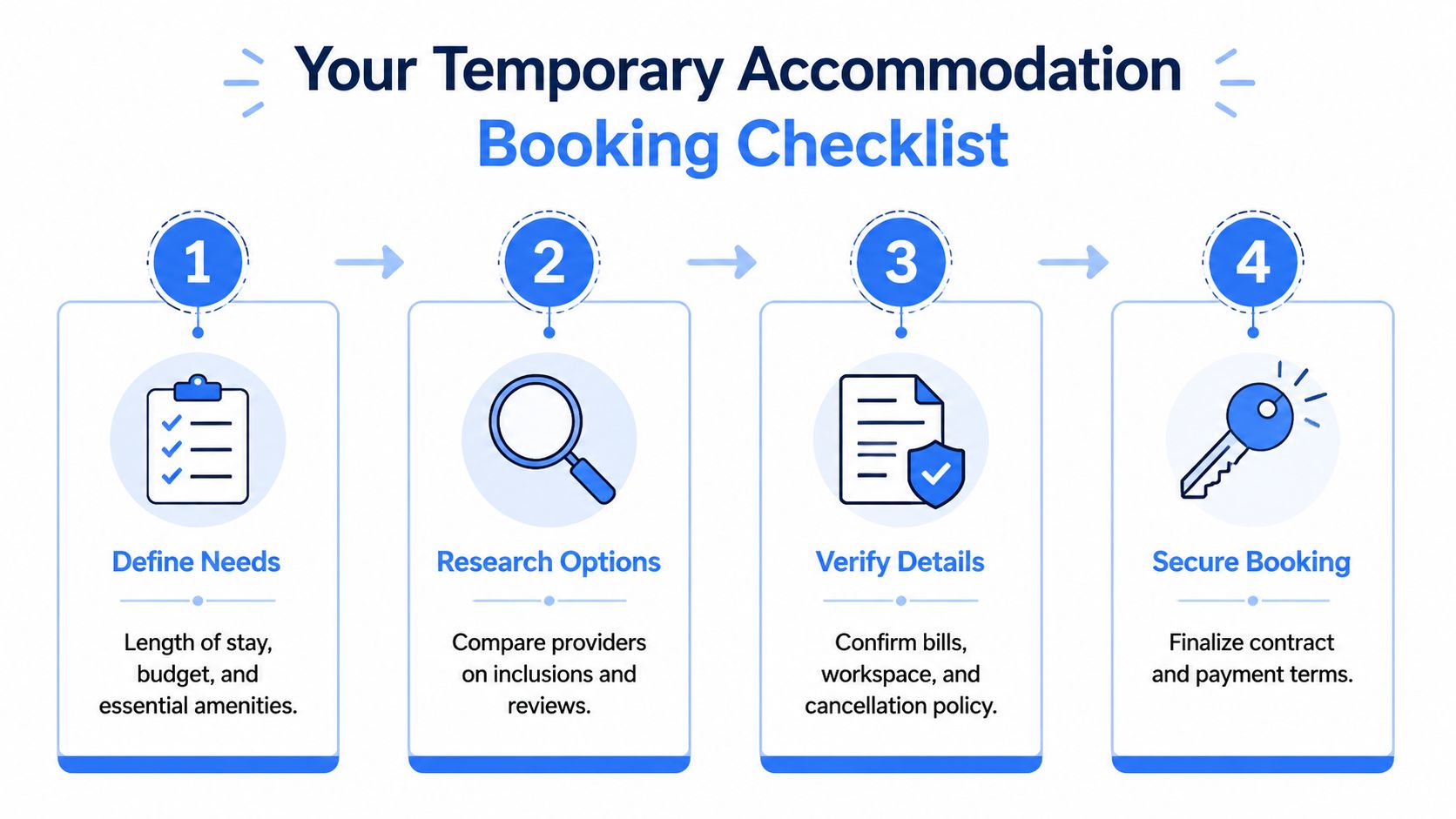
A good booking process prevents most avoidable problems. Follow the sequence below, and don't skip verification because a listing looks attractive.
Start with your actual requirements
Write down the dates, likely extension period, maximum budget, number of occupants, and essential facilities. Separate essential requirements from preferences. A family may need a washing machine and separate sleeping space, while a contractor may prioritise parking, a desk, and a kitchen.
Then calculate the cost of living there, not just the accommodation charge. Include food, transport, parking, laundry, deposits, and any cleaning fees. This gives you a realistic comparison between a self-catering apartment and a hotel rate that initially looks lower.
Compare the operator, not just the photograph
Read recent reviews for details, not general praise. Look for comments about:
Internet reliability: Check whether guests could work and make calls.
Noise: Identify recurring complaints about traffic, nightlife, or neighbouring units.
Check-in: Confirm whether arrival is managed in person, remotely, or through a key safe.
Cleanliness: Look for specific references to kitchens, bathrooms, bedding, and towels.
Communication: Notice whether the operator responds clearly when guests raise problems.
If Wi-Fi matters, ask for the expected setup and whether the property has a dedicated connection. If parking matters, request the exact arrangement in writing. Don't rely on a map pin or a phrase such as “street parking available”.
Verify the paperwork
Before payment, confirm the full price, deposit, bills, check-in instructions, house rules, cancellation window, and process for extending the stay. A professional operator should be willing to confirm those details in writing. A host who refuses to provide clear terms is creating risk before you arrive.
Red flags include a listing with no recent reviews, photographs that don't match the written description, pressure to pay outside the agreed booking process, vague answers about safety arrangements, and unwillingness to explain who manages the property. For a more complete process, use this guide to short-term furnished apartment rental.
Secure and save everything
Once you've agreed the terms, save the confirmation, receipt, address, contact details, check-in instructions, and cancellation policy in one place. Send the arrival time and any practical requirements, such as parking or early access, before travel day. That small amount of organisation prevents a stressful arrival after a long journey.
Why Stay Norwich Apartments Is a Strong Option
For Norwich and Norfolk stays, a serviced apartment makes sense when you need more than a hotel room but less commitment than a conventional tenancy. Stay Norwich Apartments provides furnished, self-catering apartments in Norwich city centre, with dedicated workspaces, fast Wi-Fi, high-quality bedding, soft towels, fully equipped kitchens, and TVs. Those features address the problems that usually make temporary accommodation tiring: limited food preparation, poor work surfaces, and a room that doesn't support ordinary routines.

Booking direct reduces uncertainty
Booking direct with the landlord or operator gives you a clearer conversation about dates, inclusions, extensions, and cancellation. Stay Norwich Apartments presents clear rate information, offers online viewings, and provides a transparent rental agreement and cancellation policy. Direct booking also avoids relying on an intermediary to pass along details about access, parking, workspace, or special requirements.
The team's customer service is available seven days a week from 9 am to 9 pm, which is useful when a contractor's schedule, relocation date, or travel arrangements don't fit a standard office timetable. Before booking, you should still confirm the exact apartment, total rate, deposit, included bills, and cancellation conditions.
A practical base for different stays
The city-centre location suits business travellers who need access to Norwich, while the self-catering layout gives families and longer-stay guests more control over meals and routines. Dedicated workspaces and fast Wi-Fi support remote work, and fully furnished rooms remove the need to transport household basics during a temporary move.
Guests also receive a complimentary guidebook with a Norfolk map and local recommendations, including information for exploring Norwich's historic centre, the Norfolk Broads, and the nearby coast. The provider works in partnership with Hospitality Norfolk, combining local knowledge with flexible short-term letting.
You can review guest feedback through the Stay Norwich Apartments reviews, then ask direct questions about your own dates and requirements. That's the sensible way to assess whether the arrangement fits, rather than assuming every apartment will suit every stay.
Tips for Business Travellers and Contractor Stays
A contractor's accommodation needs to function as a work base. I've seen people choose a property near a project site, then discover that their van won't fit, the desk is decorative, and the kitchen contains little more than a kettle. Those details matter more than a polished photograph once the working week begins.

Ask about early check-in if you're travelling before a shift, and request late check-out when the final working day runs beyond normal departure time. Neither should be assumed. Confirm parking for the exact vehicle, including height restrictions, permits, access hours, and whether tools can remain secure.
For a multi-week project, ask whether the operator can offer a longer-stay rate and what happens if the assignment extends. A flexible arrangement is more useful than a low initial price that forces you to leave or renegotiate under pressure. The guide to flexible business stays in Norwich and Norfolk is a useful starting point for planning those questions.
Self-catering also changes the rhythm of a work trip. A usable kitchen means you can prepare food around shifts, avoid searching for restaurants after a long day, and keep a familiar routine. That matters for tradespeople, engineers, healthcare workers, and corporate visitors who may spend long periods away from home.
For expense planning: Compare the accommodation's full terms with your employer's policy, and use this resource on GSA vs state per diem policies when you need broader guidance on travel allowance rules. Policies differ, so confirm the final position with the relevant employer or client.
The city centre isn't always the right location. If the project sits outside Norwich, compare the actual driving route, parking reliability, and departure-time traffic with the convenience of being close to restaurants and amenities. A slightly less central base may work better if it shortens every morning journey, while a city-centre apartment can be the stronger choice when you're using public transport or moving between sites.
The video below offers another visual perspective on business-stay considerations.
Making Your Final Decision and Booking with Confidence
The right temporary accommodation matches the property to the reason for your stay. Choose a serviced apartment when you need a kitchen, workspace, separate living space, and the ability to settle in. Choose a hotel when you prioritise daily service and a simple short visit. Choose a B&B for a brief stop where you won't need to cook or work extensively.
Then test the practical details. Confirm bills, Wi-Fi, workspace, parking, transport, deposit, cancellation, check-in, and extension terms. Read reviews for evidence about how the property operates, not just whether previous guests liked the décor.
For Norwich and Norfolk, booking direct with a local landlord can make those questions easier to answer and can reduce the uncertainty created by third-party platforms. The accommodation should support your work, family life, or transition, not create another problem to manage.
Landlords direct with Stay Norwich Apartments, Norfolk, furnished accommodation when you need it, for as long as you need it. No hassle, no drama, pay and stay. Visit Stay Norwich Apartments to explore furnished, self-catering apartments in Norwich and ask about availability for your short-term stay.
Comments