


The Old Norwich Hospital History

You've arrived in Norwich with a few hours before a meeting, a temporary work assignment, or the first day of a house move. A search for the old Norwich hospital brings up a historic city-centre building, a hospital that closed years ago, and references to redevelopment that can be difficult to untangle.
The site is no longer a working hospital, but its story remains part of Norwich's urban fabric. It links Georgian charitable healthcare, wartime damage, listed architecture, and the practical question of how a former institutional site can serve a modern city.
This guide takes you from the hospital's origins on St Stephen's Road to its present status. You'll learn what survives, what listed status means, how to approach the area respectfully, and how to plan a useful stop alongside Norwich's cathedral quarter, market, shops, cafés and historic lanes.
It also answers the accommodation question. If you're visiting for leisure, working as a contractor, relocating, or waiting for a home renovation to finish, the right base can make the city much easier to manage. Landlords direct with Stay Norwich Apartments, Norfolk, furnished accommodation when you need it, for as long as you need it. No hassle, no drama, pay and stay.
The Old Norwich Hospital History Table of Contents
History of the Norfolk and Norwich Hospital on St Stephens Road - A hospital that expanded with Norwich - War damage and the later move
Architecture and Heritage Significance Explained - Why the H-shaped plan matters - What does listed status mean
From Closure to Current Status and Redevelopment - What the wider redevelopment means
Visiting Information and How to Get There - Choose your transport sensibly - Expect controlled access
Nearby Attractions, Amenities, and Things to Do - Match the route to your group
Where to Stay Near the Old Norwich Hospital - A practical furnished option
Introduction to the Old Norwich Hospital Today
The name can cause immediate confusion. People searching for the old Norwich hospital often expect to find a functioning medical center, perhaps with public departments, reception desks, and visitor parking. In reality, clinical services left the former city-center site, and visitors should approach it as a historic place within a changing neighborhood, not as a hospital offering appointments.
That distinction matters if you're planning a short break, a work placement or a temporary move. You may want to see the building from the outside, understand why it matters, and combine it with other central Norwich sights. You may also need somewhere practical to stay while working nearby, especially if a hotel room would leave you without a kitchen, workspace or the flexibility of a self-catering apartment.
The easiest way to understand the site is to separate three different questions:
What was it? The Norfolk and Norwich Hospital grew from an eighteenth-century charitable institution into an important hospital in Norwich.
What is it now? The former hospital buildings are part of the city's heritage environment, with protected elements and changing uses.
What does that mean for a visit? Access can be limited, so exterior viewing, respectful photography and sensible route planning are essential.
Practical rule: Treat the former hospital as a private or controlled site unless current information clearly confirms public access.
Its location makes it valuable as part of a wider city walk. From St Stephen's Road, you can shape a route around Norwich Castle, the market area, the Forum, the Lanes, Elm Hill or the cathedral quarter. That gives a history-focused visitor more context than a quick photograph alone. The hospital wasn't an isolated landmark. It was part of the city's working life, and its position still helps explain how Norwich developed around central institutions.
The guide begins with the timeline, then explains the building's design and listed status. From there, it clarifies the hospital's move to Norwich Research Park, discusses planning activity on the wider former hospital site, and concludes with practical advice for visitors and accommodation options.
History of the Norfolk and Norwich Hospital on St Stephens Road
The Old Norwich Hospital History: The hospital's story becomes easier to follow when you place its milestones in order.
The foundation stone was laid on 5 March 1771 at the St Stephen's Road site. The hospital began seeing its first outpatients on 11 July 1772, followed by its first inpatients on 17 November 1772. The original building phase cost £13,323/8/11, a figure recorded in the hospital's historical account at Norfolk and Norwich University Hospitals.
The opening dates show an important distinction. A hospital could begin serving people before every later alteration, extension or rebuilding phase had taken place. Norwich's institution therefore developed through use as well as construction, responding to the needs of the city it served.
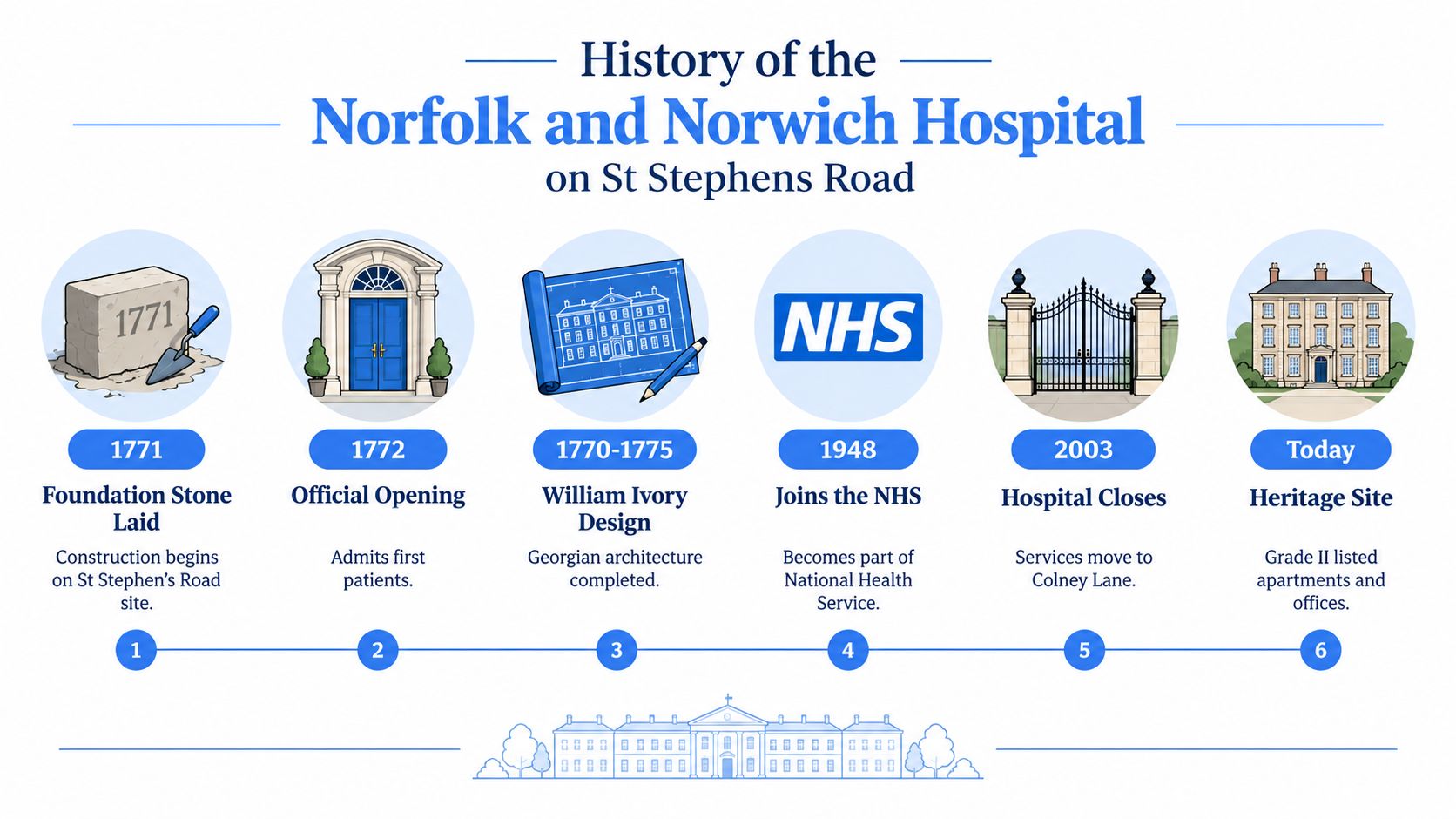
A hospital that expanded with Norwich
The early hospital became Norwich's main charitable hospital before the NHS era. Its clinical reputation was also distinctive. Norwich had the highest incidence of bladder stones in the country at the time, and the hospital became a center of excellence for lithotomy, the surgical treatment of bladder stones. That detail gives the building's history a human and medical dimension. It wasn't only a civic landmark; it was a place where local patterns of illness shaped specialist practice.
The institution continued to change during the nineteenth century. A new wing added in 1802 completed the original H-shaped plan, while a later rebuild of the city-center hospital in 1883 cost £54,494/0/10, as recorded by the hospital's history. Comparing the original and later costs shows the scale of expansion over time, although the figures correspond to different building phases and shouldn't be treated as a simple comparison of modern prices.
You can use this guide to Pigg Lane in Norwich to add another layer to a central walking route, especially if you're interested in how smaller historic streets connect with larger civic buildings.
War damage and the later move
The hospital also carries the marks of twentieth-century conflict. During the Second World War, it was bombed multiple times, and the June 1942 raid destroyed four wards and the main operating theatres, according to the record of the hospital's closure and history. Those losses form part of the site's layered character. What visitors see today reflects construction, adaptation, damage and reuse rather than one untouched historic moment.
The hospital eventually gave way to a new medical campus outside the city centre. Its surviving buildings therefore need to be read as part of a much longer sequence, from eighteenth-century charity to modern healthcare and heritage-led urban change.
Architecture and Heritage Significance Explained
A walk along St Stephen's Road reveals a building shaped by several stages of use, not a single construction project. The original hospital was built between 1770 and 1775 to a design by William Ivory. A wing added in 1802 completed its original H-shaped plan, according to research on Norfolk's medical heritage.
The sequence matters because a phased building works like a house extended by different generations. Later additions can follow the earlier style, while walls, floors, roofs and service routes still meet imperfectly. Hospital buildings make adaptation harder: healthcare requires extensive plumbing, heating, ventilation, electrical systems, and carefully organized circulation.
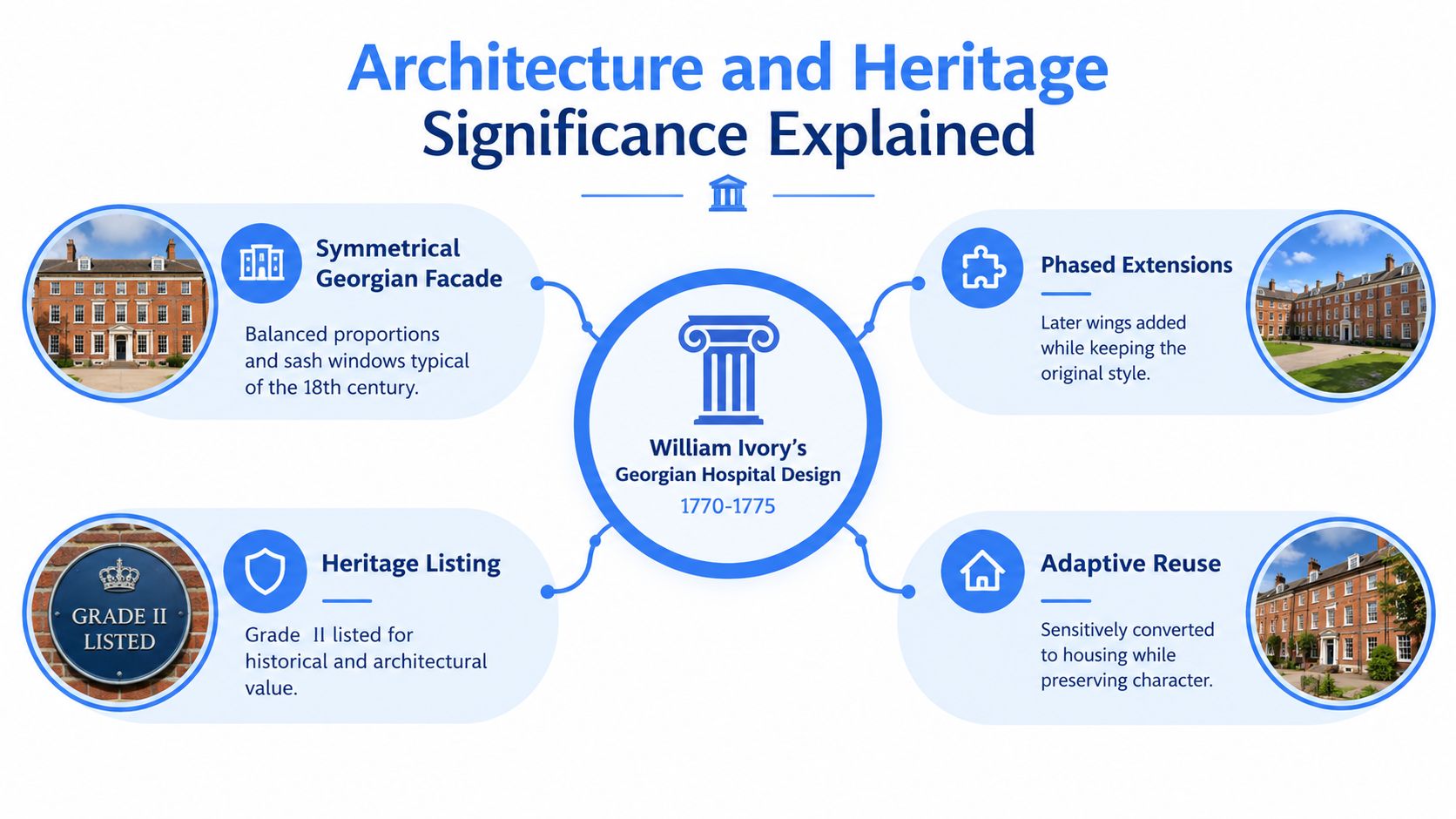
Why the H-shaped plan matters
The H-shaped layout helped organize the institution, with separate wings connected around a central arrangement. It also limits later conversion. Wings may have different structural conditions, floor levels and access routes, so new services must be introduced without making the historic plan difficult to read.
From outside, visitors may notice symmetry, balanced proportions and a formal Georgian character. Inside, conservation work has to account for windows, corridors, staircases and partitions, while allowing a new use to function safely. For a broader look at how Norwich's historic buildings fit together, see this guide to Norwich architecture for visitors.
What does listed status mean
Historic England lists the Administrative Block and Main Hall on the National Heritage List for England. The Historic England's listing record means that alteration, reuse and redevelopment must address statutory heritage controls as well as ordinary planning requirements.
Listed status permits change, provided the building's special architectural and historic interest remains part of the design. That usually supports conservation-led design, carefully matched or complementary materials, and, where possible, reversible interventions. A reversible intervention can be removed later without permanently harming important historic fabric.
A listed building can have a new life, but its character has to remain part of the design conversation.
For visitors, this can mean preserved proportions and historic materials alongside modern uses. A striking façade does not guarantee that every room is open or that the building contains a public museum. Heritage protection influences what can be altered, while access depends on the building's current use and arrangements. That distinction helps set practical expectations when exploring the neighborhood or choosing nearby accommodation for work or leisure.
From Closure to Current Status and Redevelopment
You can still stand on St Stephen's Road and see the old Norfolk and Norwich Hospital, but you will not find a functioning hospital there. Clinical services moved to the Norfolk and Norwich University Hospital on Norwich Research Park. Most departments had left the city-center site by late 2001, and the final departments moved out in January 2003, bringing the old hospital's clinical role to an end, as recorded in the hospital's historical overview.
The replacement hospital opened in late 2001, at a cost of £229 million. It became a teaching trust in September 2002 and a Foundation Trust in May 2008. For visitors, these institutional milestones have a simple, practical meaning: St Stephen's Road is now a heritage site, not a place to find NHS departments or standard hospital visitor facilities.
The site's story also includes wartime loss. Bombing damaged parts of the hospital, and a raid in June 1942 destroyed four wards and the main operating theatres. The surviving buildings therefore represent a layered history, rather than a perfectly preserved eighteenth-century complex.
What the wider redevelopment means
The former hospital land is being considered as part of a broader healthcare and housing area. A formal outline application for the Bowthorpe Road site covered a new hospital, a residential care home, extra-care units, key worker units, some residential conversion, offices, retail space, landscaping and parking. The Greater Norwich Local Plan documentation also allocates the site for hospital development and related activities, supported living, care and key worker accommodation, with at least 80 homes, as set out in the local planning documentation.
For the neighborhood, redevelopment can mean changing routes, construction traffic, noise, and new local services. For a contractor, business traveler, or temporary resident, those changes may affect where you choose to work and stay. An explanation of how older buildings can accommodate new functions while retaining their heritage value is available in this guide to adaptive reuse planning for architecture.
For a broader view of how former institutional sites are shaping Norwich's accommodation and neighborhood patterns, read this overview of new developments in Norwich.

Visiting Information and How to Get There
The former hospital stands on St Stephen's Road in central Norwich, making it straightforward to include in a city walk. From the market and central shopping streets, head towards the St Stephen's Road area and use a current map for the final approach. The route is urban and practical, but the experience on arrival is more about viewing a historic exterior than entering a visitor attraction.

Choose your transport sensibly
Walking is often the easiest option if you're already exploring the center. Norwich's compact historic core makes it possible to combine the hospital with other landmarks rather than planning a separate excursion. Bus routes serve central streets, but check current operator information before traveling because stops, diversions and timetables can change.
Driving may be less convenient in the center. On-street parking can be limited, and a nearby public car park may offer a more predictable arrival. If you need a vehicle for a wider Norfolk itinerary, it's sensible to compare Norwich car rental deals before deciding whether driving is worthwhile.
Train travelers can use the city center as a base and continue on foot or by local transport. This guide to Norwich train station is useful when you're coordinating arrival with luggage, work equipment or a short urban itinerary.
Expect controlled access
Historic England's listing of the Administrative Block and Main Hall means that protected elements need conservation-led treatment, compatible materials and interventions that can be reversed where appropriate, as explained in the official listing. For visitors, that translates into a simple set of expectations: check access before you go, stay out of any private or restricted areas, and don't treat the site as an open museum.
Use the following checklist:
Short stop: View the exterior from a public place, take a respectful photograph, and continue towards the city center.
Heritage walk: Pair the site with Norwich Castle, the Forum, Elm Hill, the Lanes or the cathedral quarter.
Accessibility planning: Historic surfaces, steps, narrow routes and building controls may affect movement, so check the route in advance.
Photography: Photograph public-facing architecture, avoid residents and never enter marked areas for a better angle.
Redevelopment awareness: Allow extra time if works alter pedestrian routes, parking or the immediate streetscape.
Nearby Attractions, Amenities, and Things to Do
The old Norwich hospital works best as one stop in a broader central itinerary. It isn't necessary to build an entire day around the former hospital itself. Instead, choose the nearby experience that matches your reason for visiting.
History lovers can combine the hospital's Georgian and medical story with Norwich Castle and the cathedral quarter. The contrast is useful. The hospital represents charitable healthcare and institutional architecture, while the castle and cathedral help place Norwich's civic and religious history into a much longer context.
First-time visitors may prefer the Forum and market area, where food, city information, and everyday activities are close to the main shopping streets. From there, the Lanes and Elm Hill offer a more intimate view of Norwich, with historic streets, independent shops and places to pause for coffee.
Match the route to your group
Families often need a flexible plan with short walking stages, food options and an easy place to take a break. A brief exterior look at the hospital, followed by the castle, market, or Forum, can work better than trying to inspect every historic building in sequence.
Business travelers and contractors may value convenience over a long sightseeing route. Central cafés, shops, pharmacies and food outlets make the area practical between appointments or after work. A city-center base also reduces the need to travel for every meal or basic purchase.
Visitors with more time can add green space and a longer walk through the center. The key is to keep the former hospital as a context-setting stop, then move towards attractions with established public access. For further trip ideas beyond this immediate route, you can explore curated blog articles and select activities that suit the length and purpose of your visit.
Norwich rewards unhurried wandering, but you don't need to over-plan. Pick one major historic attraction, one food or shopping area and one quieter route, then leave room for the city's smaller details.
Where to Stay Near the Old Norwich Hospital
Accommodation choice depends mainly on how long you're staying and how much independence you need. A hotel can suit a quick leisure visit, while a serviced apartment is often more practical when your Norwich trip includes work equipment, cooking, laundry or an uncertain end date.
Stay Type | Best For | Key Benefits |
|---|---|---|
Hotel | Short leisure breaks | Reception services, simple booking and no need to prepare meals |
Serviced apartment | Business trips and flexible stays | Kitchen, living space, workspace and a more residential routine |
Short let | Relocations and home renovations | Useful interim housing with greater day-to-day independence |
Contractor accommodation | Project-based work | Furnished space, practical facilities and a base between shifts |
The location also matters. Staying centrally can make a heritage visit easier, while keeping you close to cafés, shops, transport links and work appointments. If your project extends beyond the center, check the route to your worksite before booking rather than choosing solely on the building's appearance.
A practical furnished option
Stay Norwich Apartments provides landlord-direct, fully furnished accommodation in the heart of Norwich. The apartments are self-catering and include equipped kitchens, workspaces, fast Wi-Fi, TVs, quality bedding and soft towels. That combination suits business travelers, contractors, students, university visitors, and people who need temporary housing during a move or renovation.
The booking information includes flexible short-term letting, transparent rental agreements and a cancellation policy. Online viewings can help you assess the space before arrival, while customer support is available seven days a week from 9 am to 9 pm. Guests also receive a complimentary guidebook with a Norfolk map and local recommendations covering Norwich, the Norfolk Broads and the nearby coast.
If you're comparing furnished accommodation with hotels, this guide to short-term accommodation in Norwich and Norfolk can help you decide which format fits your dates and routine. The right choice is the one that supports the reason you're in Norwich, whether that means a quiet workspace, a proper kitchen, or a dependable place to stay while redevelopment and local travel plans change around you.
Stay Norwich Apartments offers furnished, self-catering city accommodation with equipped kitchens, workspaces, fast Wi-Fi and flexible short-term letting for visitors exploring the old Norwich hospital or working in Norfolk. Check your dates and practical requirements, then visit Stay Norwich Apartments to view the available apartments and book direct.
Comments