


Norwich Guildhall Visitor and History Guide for 2026

You've finished a shift, a client meeting, or a long journey into Norwich, and you're looking for something meaningful to do before dinner. From Gentleman's Walk, turn towards Guildhall Hill and pause at the foot of the cobbled slope. Above you, the dark flint and stone facade rises against the Market Place, with small upper windows and a timber-framed balcony that make the building feel both imposing and surprisingly intimate.
That first pause gives you the right orientation. Norwich Guildhall is more than an old frontage to photograph. It was the centre of city government for centuries, and it now forms part of the city's visitor and event life. Look at the interpretation boards, identify the entrances, and decide whether you've got time for a quick exterior visit or a deeper tour. Visitors can also find the Tourist Information Centre inside, while nearby cafés make an easy stop for coffee after arrival.
Table of Contents
Stepping onto Guildhall Hill for the First Time - Look for the building's working character
How a 1404 Charter Shaped Medieval Norwich - Two centres of power
Reading the Architecture From Street Level - Why the inside feels more complicated
From Council Chamber to Tourist Information Centre - A building with shared corridors
Planning a Visit Around Hours, Tours, and Access - Match the visit to the time available
Itineraries for Work, Family, and Contractor Stays - Norwich Guildhall Itinerary Comparison - A half-day business plan - A family afternoon - A contractor's evening
Pairing the Guildhall with a Stay Norwich Apartment - Match the base to the day
Stepping onto Guildhall Hill for the First Time
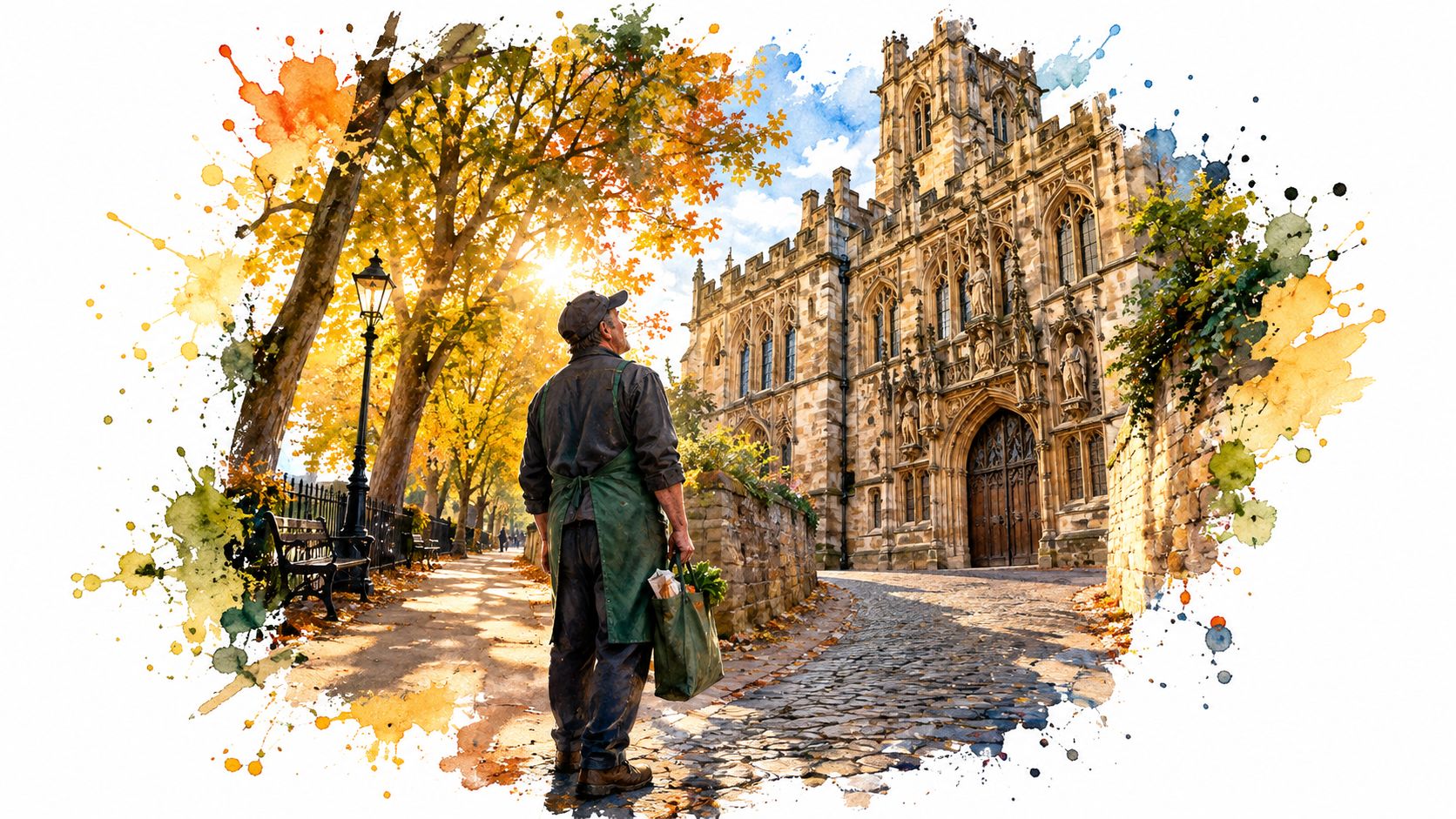
You have a free hour before a meeting, dinner, or check-in. From the foot of Guildhall Hill, look up before walking on. The slope reveals Norwich Guildhall in stages: dark knapped flint catches the light unevenly, pale stone outlines openings and corners, and timber work crowns the facade. The building feels civic rather than domestic, a public marker set above the Market Place.
Stand halfway up the hill and turn around. The road drops towards the busy centre, making the Guildhall's position easy to understand. It was placed within the city's daily movement, where markets, shops, civic business, and public gatherings met. Today, that same setting helps visitors connect the building with the wider centre rather than treating it as an isolated monument.
Look for the heavy flint base first. Local flint gave the walls their dark, durable surface, while the stone details draw attention to entrances and corners. Smaller upper windows and the timber-framed balcony add a lighter rhythm above the solid lower storey. These details work like labels on a map, showing where practical construction meets civic display.
The visit can fit different kinds of stays. Guests on a work trip may have only a short gap before an evening commitment, so an exterior look and a quick orientation can be enough. Someone relocating to Norwich can use the Guildhall as a reliable central landmark, while a short-break visitor might continue downhill to the Market Place or walk towards Norwich Castle. A Norwich heritage walking guide helps link these streets into one practical route.
Look for the building's working character
The Guildhall remains connected to present-day city life. The Tourist Information Centre offers maps, event details, and answers to visitor questions. Historic rooms may follow separate arrangements, with access affected by tours, bookings, or civic activity, so the first visible doorway does not necessarily open into a museum display.
Allow a few minutes to look up as you approach. The contrast between the flint wall, smaller windows, and civic balcony becomes clearer from close range. Then choose your pace: continue into the centre, ask about current access, or save an interior visit for a planned tour.
How a 1404 Charter Shaped Medieval Norwich
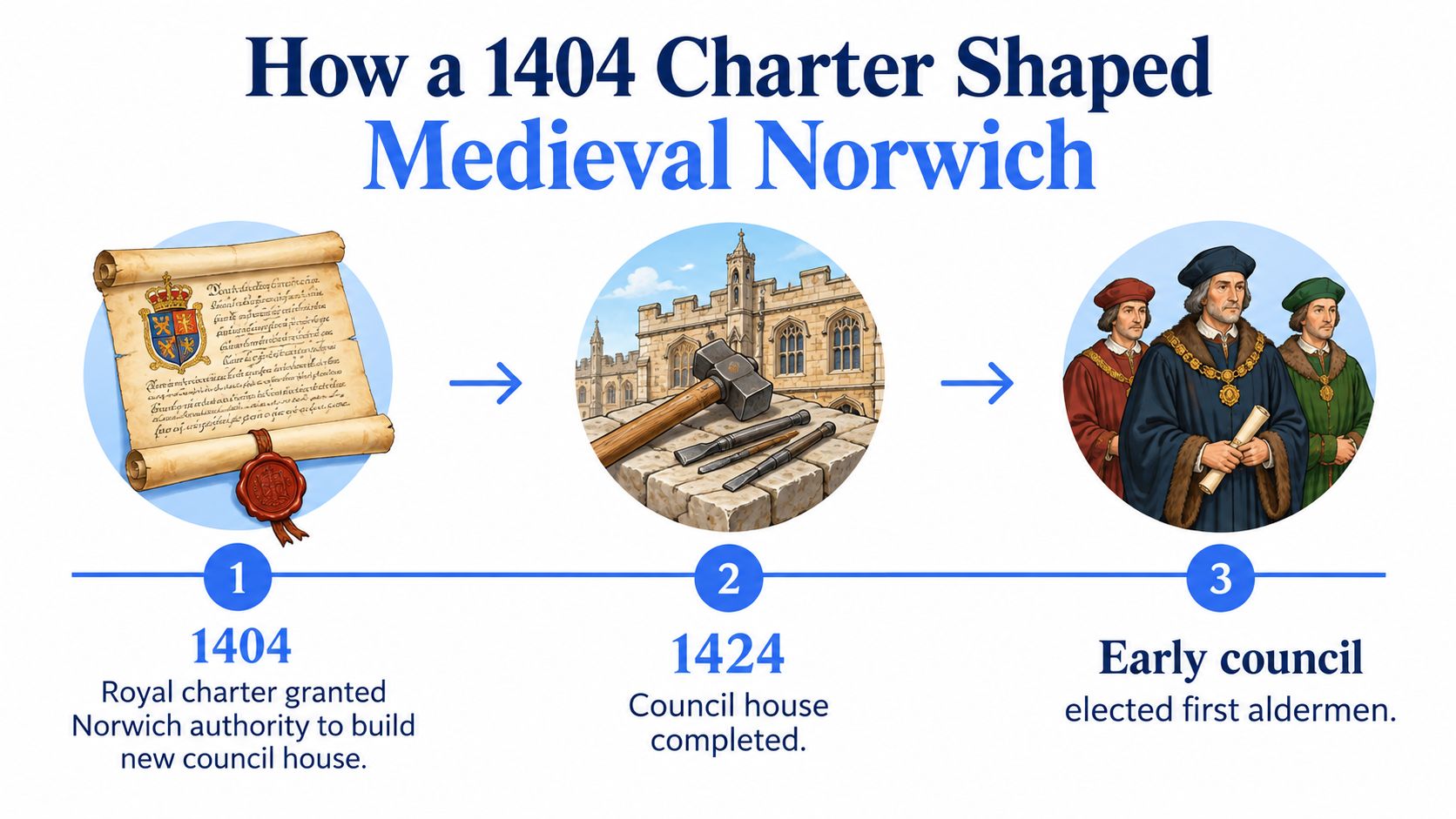
A royal document changed how Norwich governed itself. In 1404, King Henry IV granted Norwich a charter of incorporation, giving the city a stronger civic structure and authority to organise its own government. The charter created a practical need for a permanent council house, rather than relying on an informal meeting place.
Construction followed, and the Guildhall was completed in 1424, according to Discovering Britain's Norwich trail. Its rooms provided a fixed setting for decision-making. Mayoral courts could meet there, burgesses could assemble, taxes could be managed, and civic ceremonies could present Norwich as an independent, commercially important city.
Norwich already had a busy and varied economy. By the time the Guildhall was completed, around 130 recorded trades existed in Norwich. Bakers, smiths, textile workers, merchants, and other trades needed rules, taxation, and ways to settle disputes. The Guildhall worked like the city's shared control room, bringing those responsibilities into one civic institution.
Two centres of power
Norwich Castle represented royal authority, while the Guildhall represented the city's mercantile and municipal power. Together, they show how medieval Norwich balanced outside rule with local administration.
The Guildhall was built for collective government, legal proceedings, and public administration. A chamber used for debate could also carry ceremonial weight. Civic decisions needed a setting that made the city's authority visible to residents and visitors.
Its foundations reach further back. Norwich Guildhall stands on the site of the old tollbooth, and a 14th-century undercroft survives beneath it, as recorded by Norfolk Heritage Explorer. The lower space shows that the medieval building incorporated an established urban site rather than replacing an empty plot.
This history gives a short visit more context. Guests staying in Norwich for work can use the building as a focused stop between appointments. Relocating guests can see how trade and local government shaped the city they are getting to know. Visitors on a short break can pair the Guildhall with broader regional history, including this guide to East Anglia and the Vikings, before continuing through the city centre.
Reading the Architecture From Street Level
A short stop on Guildhall Hill can reveal much of Norwich Guildhall before you enter. Begin at the wall beside the pavement, then trace the openings, corners, roofline and upper sections with your eyes. The building reads like a layered record, with each material showing how local resources and later repairs shaped its appearance.
The main walls use flint, finished with stone and brick dressings. East Anglia offered flint in abundance, but builders had to knap and arrange it carefully to produce a durable surface. Its black and grey texture changes with the weather, so the facade can look sharper in bright light and softer under cloud.
Stone marks selected features rather than covering the whole building. Because good stone was harder to obtain locally, it was reserved for openings, corners and other details that needed emphasis. Against the rougher flint, those pieces provide a formal edge. Later brickwork adds another chapter, showing that the Guildhall continued to change after its medieval construction.
The roof is low-pitched and lead-covered, a specification recorded in Norwich's official architectural guide. From the street, only part of it may be visible. Its shallow slope and weather-resistant covering nevertheless helped protect a large civic building while keeping its outline restrained.
Why the inside feels more complicated
The Guildhall contains 11 different floor levels, according to Norfolk's heritage listing. This describes connected rooms, landings and routes with changes in height, rather than 11 full storeys stacked above one another.
The interior works like a sequence of linked settings:
Lower areas: The undercroft preserves an earlier layer of the site, showing how the building's structure developed over an established urban footprint.
Civic rooms: The council chamber and courtroom occupy important upper areas associated with administration, debate and legal work.
Circulation spaces: Stairs, landings and thresholds join these rooms, while retaining the irregularities of medieval construction.
That arrangement affects the visitor experience. Narrow staircases, uneven floors and low doorways on some landings may make movement difficult, particularly for wheelchair users or visitors with limited mobility. Check the current route before booking a tour, especially if you are fitting the Guildhall between work appointments, planning a relocation stay, or travelling with family.
For a wider comparison, the Norwich architecture visitor guide helps place the Guildhall among the city's other building traditions. Read the exterior for regional resourcefulness, then read the interior for centuries of adjustment. That combination makes even a brief visit from a Stay Norwich Apartments base worthwhile.
From Council Chamber to Tourist Information Centre
Arrive with a work appointment ahead of you, or a suitcase still waiting at your Stay Norwich Apartments base, and the Guildhall can seem like a visitor centre inside an older civic building. That impression is accurate, but incomplete. Norwich Guildhall began as the heart of municipal government, later housed the Magistrates' Court, and now combines visitor services with heritage activities and events.
The change happened through continued civic use rather than a complete replacement. The city council retained ownership, so the building could adapt while remaining part of Norwich's public life. City Hall replaced the Guildhall as the centre of municipal government in 1938. In the same year, the building became the Magistrates' Court, according to Visit Norwich.
Court use gave the upper rooms a different character. Legal proceedings continued in the upper courtroom until 2012, connecting the medieval civic story with a more recent judicial one. Victorian court panelling, ceremonial portraits and modern information signs may appear within the same visit. Read them as clues to changing functions rather than expecting every surface to belong to one period.
A building with shared corridors
Today, the Tourist Information Centre provides a practical public service, while weddings, heritage activities and other events can bring visitors into the wider building. The Guildhall therefore works more like a shared civic address than a closed museum. Tourists, residents, event guests and staff may use related entrances and circulation areas, while particular rooms remain in use or unavailable.
For a guest fitting the building between meetings, that distinction helps set realistic expectations. A closed courtroom door usually indicates restricted access for a guided tour, booked event or civic function. It does not mean the room has vanished. Ask what can be seen on the day, then treat the information centre as both a useful starting point and evidence of the Guildhall's present role.
What to look for: Court panelling suggests legal use, portraits reinforce civic ceremony, and modern information displays show how the building serves visitors today.
Visitors sometimes ask whether the Guildhall is “original”. A better answer is that it contains medieval fabric alongside later repairs, alterations and uses. Historic walls and rooms connect the building to its earlier civic life, while the courtroom and visitor facilities show how Norwich kept the structure useful.
That mixture suits a short city break, relocation stay or work trip. You can spend a brief period understanding the building's changing purpose without needing every room to be open. The Guildhall is valuable because people maintained and repurposed it as Norwich continued to need a civic place.
Planning a Visit Around Hours, Tours, and Access
A workday visitor may have only a short gap before the next meeting, while a family or relocating guest can plan a slower heritage visit. In each case, check the Guildhall's current arrangements before travelling. Opening hours, tour availability and room access can change when events or civic activities use the building.
The visitor information graphic shows the main contact and arrival details:

Match the visit to the time available
Use this sequence to plan the practical side of your visit:
Confirm opening arrangements. Check what is accessible that day, whether guided courtroom tours are running, and whether an event limits movement through the building.
Ask about courtroom access. The upper courtroom is generally visited through a guided tour or event booking, rather than by walking in independently.
Check the undercroft route. On open days, you may be able to view the undercroft from the courtyard. A heritage tour can offer a closer look and may require a ticket.
Discuss access needs in advance. Historic floors, stairs and thresholds can affect the route. Ask whether the side-door approach from Gaol Hill provides a suitable alternative entrance.
Confirm parking arrangements. Blue Badge visitors should check the nearest practical drop-off or parking option before setting out.
Tour dates may be limited to selected weekdays and Saturdays. Free public areas and paid heritage tours can also have different entry conditions, so confirm the current fee, route and booking process with the venue.
Photography may be restricted in particular rooms or during events. Ask before photographing interiors, especially where ceremonies, court-related material or other visitors are present.
If you arrive by train, the Norwich train station guide can help you plan the walk into the centre. Guests staying near the station can use that route information to judge whether a visit fits before work, between appointments or during a short city break.
Allow roughly 20 minutes for a brief look around when planning a gap between meetings. That is a practical estimate, not a fixed tour duration. A guided courtroom visit with time for questions may take around 90 minutes, depending on the available programme.
Accessibility first: Ask about the route before buying a ticket. Historic character includes changes in level, and advance planning keeps access arrangements from disrupting your visit.
Itineraries for Work, Family, and Contractor Stays
The Guildhall works well as an anchor because it sits close to several different types of Norwich activity. A business visitor can combine it with the Market Place, a family can add museums and riverside walking, and a contractor finishing late can keep the plan simple with an exterior visit and a nearby drink.
The table below compares the shape of each option. Walking effort is qualitative, because your route, weather and energy after work will make more difference than a rigid distance estimate.
Norwich Guildhall Itinerary Comparison
Visitor Type | Start Time | Key Stops | Guildhall Focus | Walking Effort |
|---|---|---|---|---|
Business visitor | Between a morning meeting and lunch | Client meeting, guided courtroom tour, Norwich Market, Tourist Information Centre | Booked courtroom visit and quick civic orientation | Moderate, with several central stops |
Family group | Early afternoon | Guildhall courtyard, Museum of Norwich, riverside route past Pulls Ferry, early dinner | Undercroft view and visible architectural details | Moderate, with varied pace |
Contractor or project worker | After the working day | Guildhall Hill, exterior facade, nearby pub | Evening look at the flint facade and a relaxed local stop | Low, compact and flexible |
A half-day business plan
Finish the morning meeting, then use the Guildhall as a structured cultural break rather than trying to fit in a long sightseeing circuit. A courtroom tour can provide the main focus, followed by lunch at Norwich Market and a final stop at the Tourist Information Centre for maps or evening event details.
This format suits visitors who want context without losing the rest of the day. If the tour timetable doesn't fit, replace it with the exterior, undercroft information and a short walk through the Market Place.
A family afternoon
Start at the Guildhall courtyard and look for the surviving lower-level fabric before moving towards the Museum of Norwich. Continue with a riverside walk past Pulls Ferry, then choose an early dinner close to the centre.
Children often respond better to a sequence of visible features than to a long historical explanation. Point out the dark flint, the balcony and the changes in level, then connect them to the idea of a building that served many different civic purposes.
A contractor's evening
After a long workday, keep the route compact. Walk up Guildhall Hill, photograph the facade as the light changes, and settle into a nearby pub rather than planning several formal attractions.
That plan works because it doesn't demand a full tour. You still see the Guildhall in its urban setting, and you can return another day when work finishes earlier.
Pairing the Guildhall with a Stay Norwich Apartment
The Guildhall makes a useful anchor for a low-friction city base. A serviced apartment within a short walk of Guildhall Hill lets you explore without repeatedly moving a car through central streets, and it gives you the option of returning between meetings, tours and evening events.
That flexibility matters to different visitors for different reasons. A contractor can leave a laptop at the apartment before walking into the centre. A family can take a break between Norwich Castle and the Guildhall. Someone relocating during a delayed move-in can keep a normal routine with a kitchen, workspace and room to unpack essentials.
Match the base to the day
Factor | Stay Norwich Apartment, City Centre | Out-of-Town Hotel |
|---|---|---|
Access to Guildhall | Short walk through central Norwich | Requires a longer journey into the centre |
Evening flexibility | Easy to return after a walk or event | Travel planning continues after sightseeing |
Food | Kitchen supports a late meal after work | Usually dependent on restaurants or takeaway |
Working routine | Dedicated space and fast Wi-Fi can support remote work | Room layout and connectivity vary |
Longer stays | Furnished, self-catering setup suits temporary accommodation | Hotel routines may feel restrictive |
Relocation uncertainty | Flexible short-term arrangement can be useful when dates shift | Fixed booking structures may be less adaptable |
The same logic applies when comparing accommodation options more broadly. Travellers who want to understand booking terms and direct reservations can use this hotel direct booking guide as a practical reference before choosing where to stay.
For a city-centre base, review the Norwich city centre accommodation options alongside your work location, transport needs and likely evening plans. The best choice isn't only about being near a landmark. It's about removing small daily obstacles, such as parking, late meals, unreliable work space and long return journeys.
Norwich Guildhall then becomes the readable centre of a wider heritage circuit. You can visit it as a quick landmark after work, return for a deeper tour, or use it as the point that connects the Market Place, Castle, Elm Hill and riverside routes.
Stay Norwich Apartments offers furnished, self-catering accommodation in central Norwich for short stays, contractor projects, business trips and relocation periods, with kitchens, workspaces and fast Wi-Fi to keep daily life straightforward. Choose a practical base near the Guildhall and Stay Norwich Apartments to plan your stay with less travel friction and more time for the city.
Comments