


Norwich Market History

Updated: 14 hours ago
A visitor steps into Norwich Market for a quick look and soon finds themselves following a much older route, from the stalls beneath the modern structures towards the civic buildings and castle quarter. The shopping is immediate, but the ground beneath it carries over 900 years of Norwich market history.
Norwich Market History: Table of Contents
Why Norwich Market Has Thrived for Nine Centuries - A market built into the city
From Domesday Book to Medieval Trading Powerhouse - From royal income to civic resource - Medieval market documentation timeline
How Three Major Redesigns Shaped the Market Square - Three architectural layers - Norwich Market redevelopment milestones
Notable Stall Keepers and Market Traditions Through the Ages - The knowledge behind the counter
Economic and Cultural Significance Across Nine Centuries - A legal foundation that endured - Commerce and identity in the same square
Planning Your Norwich Market Visit from Central Norfolk Accommodation - A simple visitor route - Visitor quick reference
Why Norwich Market Has Thrived for Nine Centuries
Before the first stall is opened, the square has already begun to tell its story. Modern shoppers arrive with coffee, shopping bags and phones, yet the setting still performs the same basic task it performed for medieval Norwich. People gather, compare goods, exchange news and make practical decisions about what to take home.
Norwich City Council describes Norwich Market as one of the oldest continually operating markets in the UK, stating that it has been at the heart of the city for over 900 years. Historical accounts place its establishment in the late 11th century. Evidence indicates that the market was operating by the Domesday Book of 1086, and it was likely founded in the 1070s when the Normans shifted the market towards the Mancroft area.
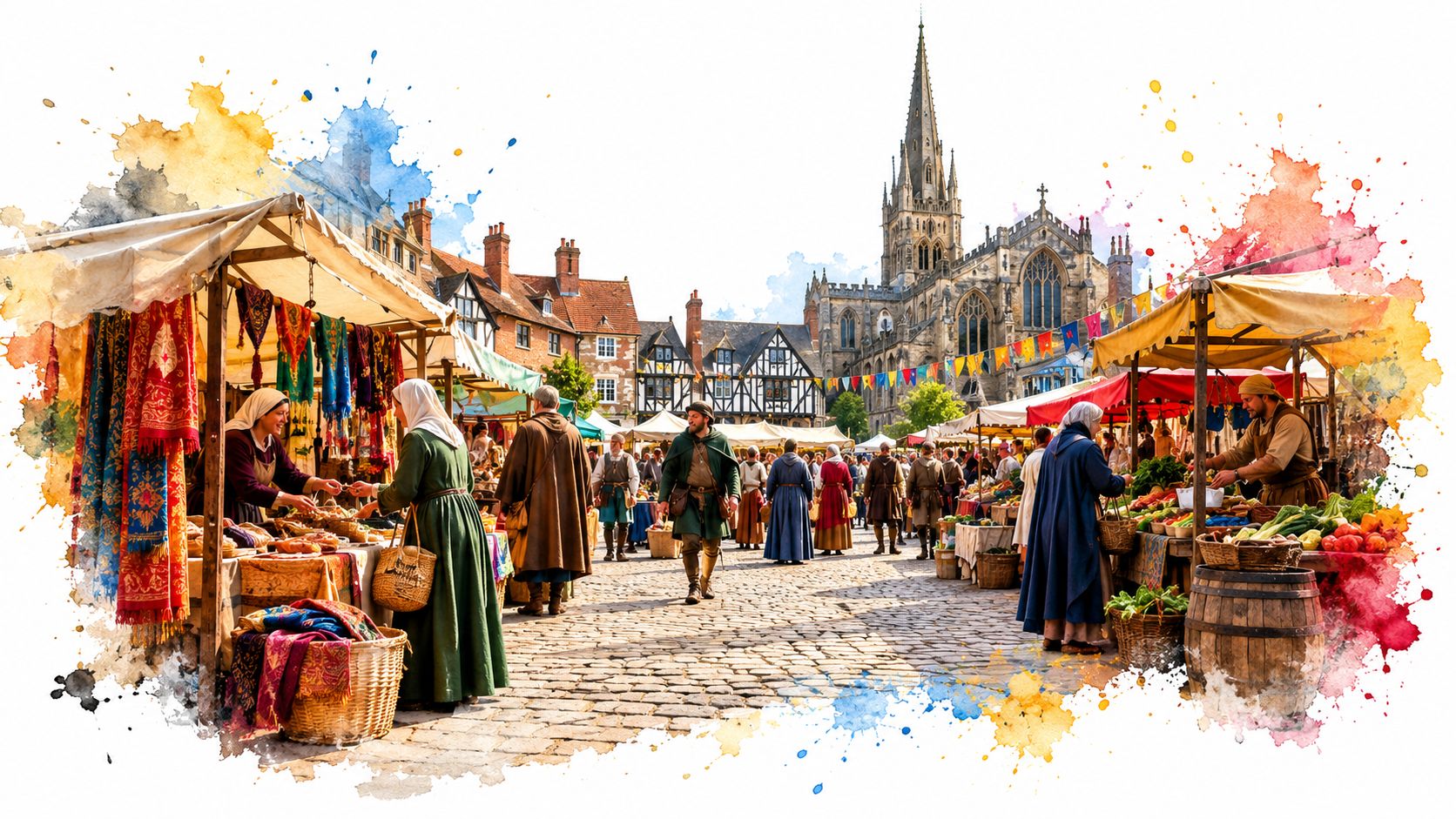
A market built into the city
That Norman decision mattered because it placed commerce close to the castle and civic quarter. The market wasn't an isolated trading patch on the edge of town. It became part of the urban arrangement that helped Norwich grow as a regional centre, connecting civic authority, public movement and everyday buying.
The record becomes especially vivid in 1392, when the market square contained 3 messuages, 18 shops and 42 stalls. Those figures show a structured commercial hub rather than a loose collection of temporary traders. A visitor looking across the square today can still recognise the central idea, a compact place where many independent exchanges happen within a shared civic setting.
In 1341, King Edward III ceded control of the market's income to the city of Norwich. Tolls and rents then became a direct source of municipal revenue, tying the market's success to the city's ability to organise and fund itself.
A useful way to read the square: look beyond the individual goods. The market has survived because Norwich repeatedly adapted its buildings and administration while preserving the habit of public trade.
The market also gives visitors a practical introduction to Norwich itself. Its position makes it easy to combine shopping with a walk through the historic centre, and the story fits naturally alongside the city's wider transformation into a lively urban destination, as described in Norwich's evolving cosmopolitan story.
From Domesday Book to Medieval Trading Powerhouse
The earliest chapter begins with movement. After the Norman Conquest, Norwich's commercial centre was reorganised around the castle and civic quarter, with the market associated with the Mancroft area. By the time the Domesday Book recorded activity in 1086, the market was already part of the city's working life.
The evidence doesn't provide a stall-by-stall diary of medieval Norwich, but it does reveal a place where authority and trade were closely connected. A market needed recognised rights, an agreed location and officials able to collect payments or settle disputes. Every purchase therefore sat within a larger framework of royal power, civic administration and local custom.
From royal income to civic resource
The decisive institutional change came in 1341, when the Crown ceded control and income from the market to the city of Norwich. Market tolls and rents became municipal revenue, converting the market from a royal asset into a locally managed fiscal institution.
That change is easier to understand through the streets around the market. The Guildhall wasn't just an impressive building for visitors to photograph. It represented the city's capacity to govern, record transactions and manage public affairs. The relationship between the Guildhall and the market is explored further in this guide to Norwich Guildhall.
By 1392, the market square was documented as containing 3 messuages, 18 shops and 42 stalls, evidence of a developed trading environment. The numbers suggest different types of occupation and different degrees of permanence. Some traders worked from shops, while others used stalls, all within a defined commercial space.
Medieval market documentation timeline
Year | Event | Significance |
|---|---|---|
1070s | The Normans likely shifted the market towards the Mancroft area | Commerce became part of the reorganised urban centre |
1086 | Market activity was recorded by the Domesday Book | The market was operating within the early Norman city |
1200s | Norwich's market charter dated from this period | Trading rights gained a specific legal foundation |
1341 | Edward III ceded market control and income to Norwich | Tolls and rents became municipal revenue |
1392 | The square contained 3 messuages, 18 shops and 42 stalls | The market had become a structured commercial hub |
The market's importance lay in its ability to serve both ordinary households and the ambitions of a growing city. Goods moved through the square, but so did information, obligations and relationships. A trader met customers, suppliers met traders, and civic officials maintained the rules that allowed the exchange to continue.
For a modern visitor, that history changes the experience of walking across the square. The market isn't old just because some of its surroundings look historic. It's old because the same civic purpose has continued through successive forms, from medieval arrangements to the structures seen today.
How Three Major Redesigns Shaped the Market Square
Norwich Market's architecture is best understood as a sequence of practical decisions. Each generation altered the materials, layout or infrastructure, but none discarded the market's central function. The result is a square where Norman planning, Victorian and civic-era ambition, 20th-century modernisation and contemporary design meet within one visit.
By the Middle Ages, evidence indicates that the market extended from the Guildhall to St Stephen's, making it one of the most important market areas in England. That broad footprint connected civic buildings with the movement of shoppers and traders. It also established a spatial logic that later redevelopment had to respect.
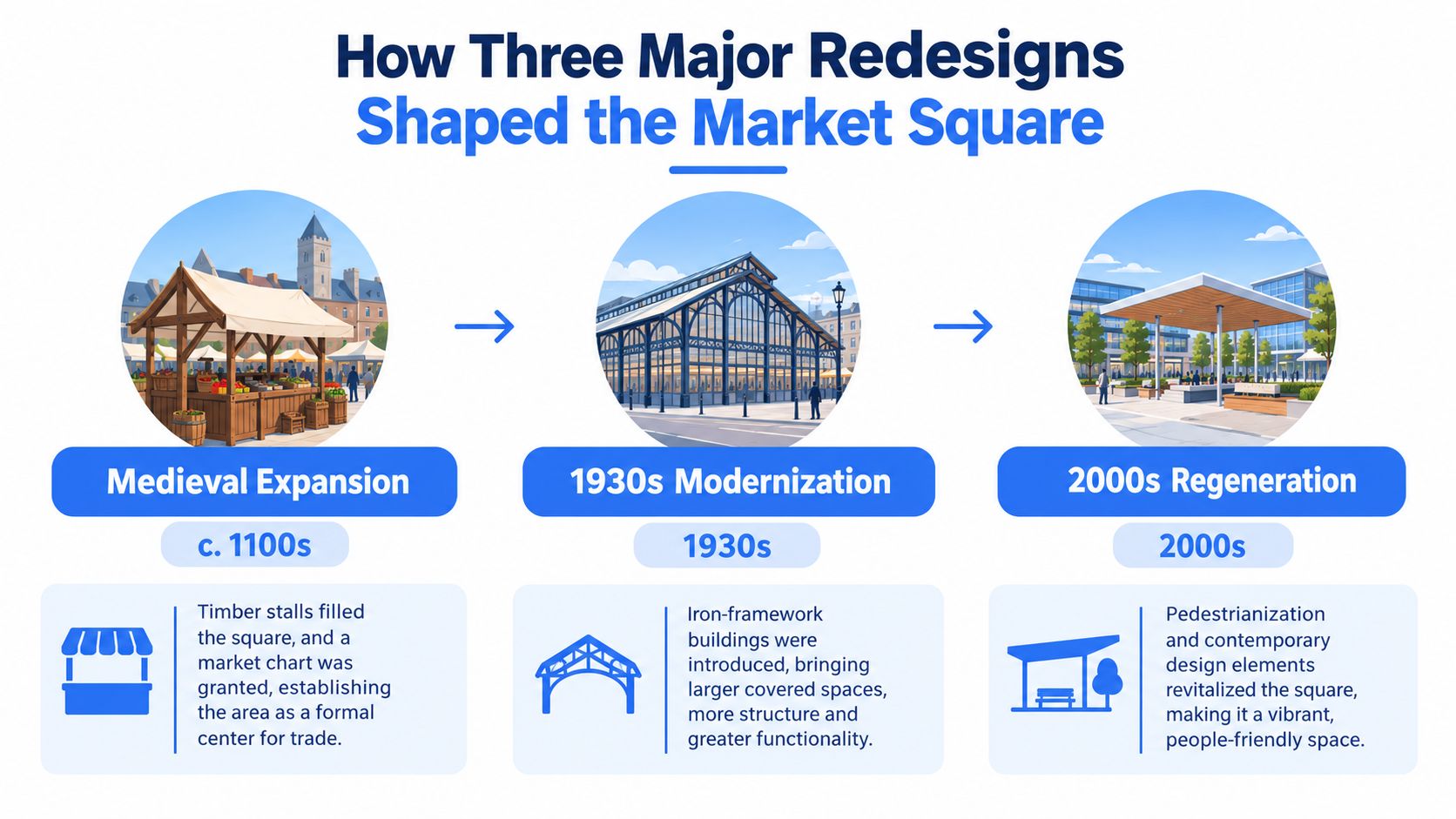
Three architectural layers
The medieval market would have relied heavily on timber stalls and adaptable structures. These were practical rather than monumental, allowing traders to occupy a busy space while the city expanded around them.
The 1938 modernisation introduced the striped canvas stalls that became strongly associated with Norwich Market for decades. The redevelopment was tied to the wider civic reshaping of the area, and the striped coverings gave the market a recognisable visual identity while providing more organised shelter for trading.
The next major transformation arrived in 2005, when a £4.6 million project replaced the canvas-covered stalls with permanent metal structures. The change altered the market's appearance, but it also continued a long pattern of replacing ageing infrastructure without removing the trading function itself.
The Norwich architecture guide for visitors helps place the market within the wider built environment. Visitors who enjoy comparing civic spaces elsewhere may also find useful context in this account of exploring Bruges' historic square.
Norwich Market redevelopment milestones
Period | Investment | Key change | Lasting impact |
|---|---|---|---|
Medieval period | Not specified in the available evidence | Expansion from the Guildhall towards St Stephen's | Established a major commercial area within the city |
1938 | Part of the wider civic redevelopment | Striped canvas stalls became the market's defining visual feature | Created a familiar identity that lasted for decades |
2005 | £4.6 million | Permanent metal structures replaced the canvas-covered stalls | Gave the market its modern physical form |
The easiest way to read these layers is to observe how shelter and structure guide movement. Medieval planning explains why the market sits where it does. The 1938 scheme explains the visual memory of striped canopies. The 2005 project explains the permanent framework visible today.
Norwich City Council and local heritage sources connect the present market to Norman planning from around 1071–1075, when the city's commercial centre was reorganised around the castle and civic quarter. The market therefore acts as a practical map of Norwich's development. Stand beneath the modern metal structures and you're still moving through a plan formed in the aftermath of the Norman Conquest.
Notable Stall Keepers and Market Traditions Through the Ages
A market's history becomes more vivid when it is told through the people who stand behind the counters. Buildings can be repaired and stalls can be replaced, but the daily performance of selling remains recognisable. A trader calls out an offer, a customer asks where something came from, and a brief conversation turns a purchase into a local encounter.
Norwich Market's traditional trades have included fresh produce, fish, meat and cheese, categories that connect the square to the practical needs of households across the region. These goods also explain why markets have mattered beyond their visual charm. A market brought food close to customers, gave producers a public place to sell and created a setting where quality could be judged face to face.

The knowledge behind the counter
A good stall keeper has always offered more than an object. They explain how to use a product, which variety suits a dish, when something is ready and what customers should avoid. That knowledge gives the market a quality that fixed retail spaces often struggle to reproduce, because the transaction includes conversation and judgement.
The market's customs changed as its administration changed. Medieval traders worked within systems of tolls, rents and local controls. Modern traders work within licensing and operational arrangements, but the principle remains familiar. The city sets the conditions, while individual stall holders bring the personality, stock and expertise that make the space worth visiting.
The human story also includes newer businesses. A local wine and beer venture describes its beginnings on the historic market, showing how the square can support a contemporary specialist business as well as traditional food trades. That continuity matters. Norwich Market isn't preserved as a static museum display. It remains useful because new traders can add their own chapter.
A visitor should take time to notice how stall holders arrange their displays. Produce is grouped for quick comparison, specialist goods invite questions, and familiar products can become reasons to return. The market's traditions survive through these small acts of presentation and conversation.
After browsing, visitors can deepen the atmosphere with this short visual introduction:
The most memorable market purchase is often the one that comes with a story about who made it, chose it or knows how to serve it.
Economic and Cultural Significance Across Nine Centuries
A purchase at Norwich Market has always connected private life with public finance. In 1341, the transfer of market income to Norwich gave the city government a direct financial interest in keeping trade productive. Every toll and rent linked ordinary buying and selling with municipal resources, turning the market into both a commercial centre and a civic institution.
That connection still shapes the square visitors see today. The market's trading activity helped support the city's administration, while the city's decisions created the conditions for traders to work. Guests staying in central Norfolk accommodation can explore that relationship through this guide to the market in Norwich, then see how commerce and civic life remain close together around the market.
A legal foundation that endured
Norwich City Council's market strategy states that the city has had a market since it was established as a place where people lived. It dates the market charter to the 1200s, giving Norwich a clear legal foundation for its long-running trading status in the UK. The details appear in the Norwich Market Strategy.
That history gives redevelopment debates their weight. Altering the market changes more than its buildings. It can affect where residents buy food, how independent traders earn a living and how visitors read the centre of Norwich. The visible stalls therefore carry practical and historical meaning at the same time.
The market also maps social connections through the city. Someone may arrive for an errand, stop to browse, meet another person or discover an unfamiliar product, then continue towards the castle, civic buildings or surrounding historic streets. For visitors, the square works as a natural starting point. Its location makes the city's older commercial and civic districts easier to experience on foot.
Commerce and identity in the same square
A market must serve traders and customers, while its buildings and customs give the place a distinct identity. Norwich has repeatedly altered the market's physical form, from medieval expansion to the 1930s scheme and later permanent structures. The materials and appearance changed, yet public trading continued.
That balance explains the market's unusual character. A visitor can enjoy a current shopping trip while standing within a setting shaped by centuries of decisions about law, income, design and public use. The market remains valuable because its history is active in everyday experience, rather than sealed away as a museum display.
The lasting lesson: preservation can keep a place's public purpose alive while allowing its buildings and businesses to change.
Planning Your Norwich Market Visit from Central Norfolk Accommodation
Start with the market, then let the surrounding city unfold around it. From central Norwich accommodation, a visitor can usually plan a straightforward walk towards the market and use the square as a reference point for the rest of the day. Check the market's current opening arrangements before setting out, since trading hours and individual stall availability can vary.
Begin by walking towards the market and approaching from the direction of the Guildhall. This route makes the historical relationship easier to understand. The market's position within the civic quarter reflects the Norman reorganisation of Norwich, while the surrounding buildings help explain why this became such a durable commercial centre.
A simple visitor route
Allow enough time to browse rather than treating the market as a quick shortcut. Look for the permanent metal structures associated with the modern market, then consider the striped canvas stalls that once defined the square. The material has changed, but the shelter still serves the same basic purpose, giving traders and customers a shared place to meet.
Continue towards the civic buildings, then choose a nearby attraction according to your interests. Norwich Castle offers a strong historical counterpoint, Norwich Cathedral brings a different architectural perspective, and the Norfolk Museum Services Forum provides another way to explore the region's collections and stories.
The 1930s redevelopment deserves particular attention. A Norfolk heritage source states that the project was completed in 1938, formed part of the City Hall and Memorial Gardens scheme and belonged to a wider £348,000 city scheme. That figure, recorded by Norfolk heritage research on the market and City Hall, indicates the scale of civic ambition behind the redevelopment.
Visitor quick reference
Detail | Information |
|---|---|
Best starting point | Norwich Market, approached through the central civic quarter |
What to observe | Permanent metal structures and the market's relationship with the Guildhall |
Nearby history | Norwich Castle, Norwich Cathedral and the Norfolk Museum Services Forum |
Before travelling | Check current opening arrangements and individual stall availability |
Useful base | Central accommodation with access to a kitchen, workspace and local information |
If you're comparing places to stay, Norwich city centre accommodation can be useful for planning a visit around the market and other central attractions. A furnished base with a kitchen is practical when you want to bring back local food, while a workspace and reliable Wi-Fi can help business travellers or contractors combine a city visit with their working day.
The market works particularly well as the first stop because it gives you orientation as well as history. Once you've seen how the square connects the Guildhall, civic quarter and surrounding streets, Norwich becomes easier to find your way around on foot.
Landlords direct with Stay Norwich Apartments, Norfolk, furnished accommodation when you need it, for as long as you need it. No hassle, no drama, pay and stay. For a practical base while you explore Norwich Market and the wider city, visit Stay Norwich Apartments.
Comments