


Rent to Rent Serviced Accommodation Explained

The most popular advice about rent to rent serviced accommodation is also the most dangerous: secure a property in a high-demand area, advertise an attractive nightly rate, and let occupancy do the rest. That approach confuses gross booking revenue with usable contribution margin. A property can look busy and still fail to cover rent, utilities, cleaning, platform charges, repairs, voids, compliance and the operator's own time.
The model works when you secure the right property, structure the agreement properly and serve demand that remains dependable beyond weekend peaks. In Norwich and Norfolk, that often means combining leisure bookings with business travel, contractors, relocation stays, students and temporary housing. The strongest deal isn't necessarily the one with the highest advertised rate. It's the one that leaves cash after every operating cost and remains viable when the market is quieter.
Table of Contents
Why National Demand Figures Don't Guarantee a Profitable Rent to Rent Deal
How the Business Model and Cash Flows Work - The money in and money out - What the agreement should settle
Legal Duties and Fire Safety Compliance - Build a property-specific control system
Targeting the Right Guest Segments for Stability - Compare the contribution, not just the booking price - Design the product around the booking
Local Market Dynamics in Norwich and Norfolk - Location needs a use case - Stay flexible without becoming vague
Due Diligence Checklist for Securing a Property - Start with the physical property - Verify the landlord and permissions - Stress-test the commercial terms
Why National Demand Figures Don't Guarantee a Profitable Rent to Rent Deal
National demand can make rent to rent serviced accommodation look safer than it is. England had approximately 257,000 short-term and holiday-letting listings in 2022, according to the UK government's analysis of short-term lets in England. The estimate included online and offline listings, but the government said it was likely understated because it did not cover every platform and partly used older data snapshots.
The analysis also estimated 1.6 to 2.6 million stays and 3.2 to 7.7 million visitors in England. The typical booking lasted 3 to 4 days, while each listing was occupied for approximately 25 to 30 days per year by an average of 2 to 3 guests, based on the assumptions in that analysis. These figures indicate market scale. They do not demonstrate that a particular head lease will produce a surplus.
England recorded 66,114,750 guest nights in platform-based short-term accommodation during the 12 months from July 2023 to June 2024, representing 78% of the UK total, according to official ONS statistics on short-term lets. The dataset recorded 6,750,980 stays in England and 24,015,430 available nights. It also found that 64% of UK guest nights came from domestic visitors, compared with 35% from international visitors, while 1% of records had missing origin information.
Those totals cannot show whether a Norwich flat covers its costs on a quiet winter Tuesday. High-churn weekend tourism brings repeated linen changes, cleaning, guest messages, consumables, damage checks and payment events. Contractors, relocation guests and other longer-stay customers often create fewer turnovers and steadier utilisation. A property with less exciting headline occupancy can therefore produce the stronger contribution margin.
Practical rule: Underwrite the property against dependable utilisation, not the best nightly rate available on a peak weekend.
For operational context, this practical UK guide to short-term lets covers the basic model. The operator's working test is narrower: after guest-related costs, does enough surplus remain to pay the fixed rent and withstand quieter periods? If the answer depends on constant weekend turnover, the deal has little room for operational mistakes.
How the Business Model and Cash Flows Work
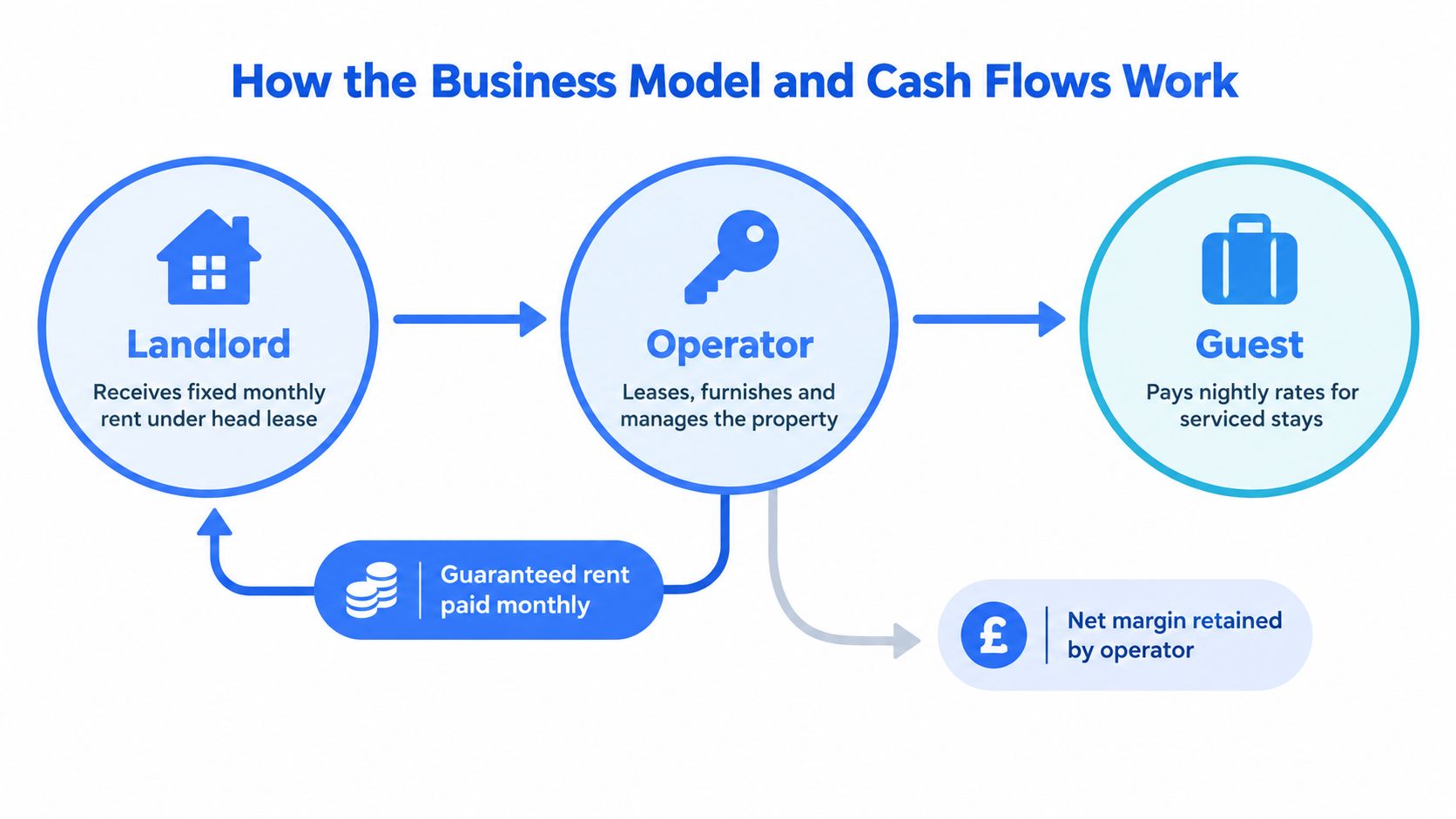
Rent to rent serviced accommodation involves three parties, but only one party carries most of the operating risk.
The landlord owns or controls the property and receives an agreed payment. The operator takes possession under a head lease or management agreement, furnishes and markets the accommodation, handles bookings and manages the guest experience. The guest pays for a short-term or longer serviced stay, usually at a nightly or agreed periodic rate.
The money in and money out
The operator collects booking income from guests, then pays the costs required to keep the property trading. The fixed rent to the landlord usually leaves the account whether the property is full, partly occupied or empty. That fixed commitment makes cash-flow timing more important than a simple revenue forecast.
A typical monthly sequence looks like this:
Booking income arrives. Guests pay nightly rates, cleaning charges where applicable, or agreed rates for longer stays.
Operating bills leave the account. Utilities, broadband, cleaning, linen, consumables, platform charges, repairs and insurance reduce the amount available.
The landlord receives the contracted rent. This payment is normally due regardless of occupancy.
The remaining contribution belongs to the operator. It must cover reserves, administration, tax exposure and profit.
The arrangement isn't the same as a standard residential Assured Shorthold Tenancy. The intended use, guest turnover, furnishing, marketing, access arrangements and maintenance obligations need to be described clearly. A vague agreement creates disputes precisely when the property experiences a leak, appliance failure, complaint or regulatory issue.
What the agreement should settle
Put the commercial boundaries in writing before taking possession. Address who pays for utilities and broadband, who handles repairs, who can enter the property, who communicates with guests, who replaces damaged items and who deals with neighbours or the managing agent.
The agreement should also cover furnishing standards, insurance responsibilities, access for inspections, approval for alterations, deposit treatment, notice provisions and what happens if the building's rules or local requirements change. A landlord's consent to the operating model is not a substitute for checking the lease, mortgage position, building restrictions and relevant permissions.
A guaranteed rent promise protects the landlord's income. It doesn't protect an operator from a poorly negotiated cost base.
The operator should maintain a separate reserve for repairs and interruptions rather than treating every month's surplus as personal income. Cash flow can look healthy after a strong run of bookings, then tighten quickly when a boiler, washing machine or access system fails at the same time as demand softens.
Modelling Break-Even and Contribution Margins
Nightly rate is only useful after you subtract the cost of producing an occupied night. The relevant figure is the contribution per night, not the advertised price.
Build the model in two layers. Fixed monthly costs include guaranteed rent and other costs that continue when the property is empty. Variable costs rise with occupied nights or guest turnover, such as cleaning, linen, consumables and some booking charges. Utilities may behave partly as a fixed cost and partly as a variable cost, so use a conservative allocation rather than pretending they stay static.
Include:
Guaranteed rent: The largest fixed commitment in many head-lease deals.
Utilities and broadband: Model actual service requirements, not a vacant residential baseline.
Cleaning and linen: Separate per-turnover costs from longer-stay servicing.
Repairs and consumables: Include routine replacement, not just major emergencies.
Insurance and payment charges: Check exclusions for paying guests and platform transactions.
Council-tax or business-rates exposure: Confirm the applicable treatment before signing.
Voids and damage reserves: Allow for nights that cannot be sold and costs that aren't recovered.
The operating formula is:
Break-even occupied nights = fixed monthly costs ÷ (average realised nightly rate − variable cost per occupied night)
Consider two scenarios using £2,400 fixed monthly costs and £25 variable cost per occupied night. At a £110 realised nightly rate, the contribution is £85 per night, requiring approximately 29 occupied nights, or 97% occupancy across a 30-day month. At a £125 realised nightly rate, contribution rises to £100 per night, reducing break-even to 24 occupied nights, or 80% occupancy across a 30-day month. These examples are based on the UK government's self-catering accommodation rules and guidance, which also reinforces that safety controls belong in the operating plan.
Realised Nightly Rate | Variable Cost | Contribution per Night | Break-Even Nights | Required Occupancy (30 days) |
|---|---|---|---|---|
£110 | £25 | £85 | Approximately 29 | Approximately 97% |
£125 | £25 | £100 | 24 | 80% |
The table exposes the weakness in many optimistic forecasts. A small change in realised rate can materially alter the number of nights needed, while a peak-season advertised price may have little relevance to the annual average. Test weekday rates, longer bookings, winter demand, cancellation gaps and cleaning frequency separately.
A free rental income calculator can help organise property assumptions, but no calculator replaces local evidence. Compare realistic rates with the property's location, size, parking, workspace, sleeping arrangement and access. The Norfolk house prices guide may add useful local context, but the rent-to-rent decision still depends on the property's operating economics.
Margin beats momentum: A property that books frequently at a weak contribution can be less valuable than one that attracts fewer, longer stays with lower turnover costs.
Legal Duties and Fire Safety Compliance
Paying guests change the operator's responsibilities. In England, the Regulatory Reform (Fire Safety) Order 2005 applies where guests pay to stay, including short-term self-catering flats and houses, as set out in the government's small paying guest accommodation fire-safety guidance.
The operator or another designated Responsible Person must arrange a suitable and sufficient fire-risk assessment, identify people at risk, maintain escape routes and fire-protection equipment, and ensure guests can evacuate safely. Since October 2023, fire-risk assessments within the Order's scope must be recorded. A head lease can allocate duties between landlord and operator, but contractual wording doesn't remove the need for effective on-site compliance.

Build a property-specific control system
A generic policy kept in a folder isn't enough. Each property needs a recorded assessment that reflects its layout, escape routes, occupancy pattern, furnishings and risks. Keep inspection records and make sure someone can respond to an emergency when guests are present.
The government's guidance recommends smoke alarms in bedrooms, corridors, staircases and relevant communal rooms, with interconnected alarms so detection in one area produces simultaneous audible warnings throughout the premises. The practical checklist should include:
Recorded assessment: Keep the current property-specific fire-risk assessment accessible and review it when the layout, furnishing or use changes.
Escape routes: Keep routes clear after every turnover and make sure guests receive understandable fire-action information.
Alarm checks: Test alarms on an organised schedule and record the result.
Emergency coverage: Provide a working emergency contact route and clear instructions for evacuation.
Equipment records: Retain evidence of inspections, maintenance and remedial work.
Fire safety isn't the only compliance question. Check gas, electrical, planning, licensing, insurance and building requirements with the relevant professionals and authorities. A useful overview of landlord fire safety compliance can help operators identify areas that need specialist attention, but it shouldn't replace a property-specific assessment.
The Norfolk Fire Service live incident updates guide may help with local awareness, yet incident monitoring isn't a substitute for prevention. Put compliance costs into the feasibility model before agreeing rent, furnishing the property or accepting bookings.
Targeting the Right Guest Segments for Stability
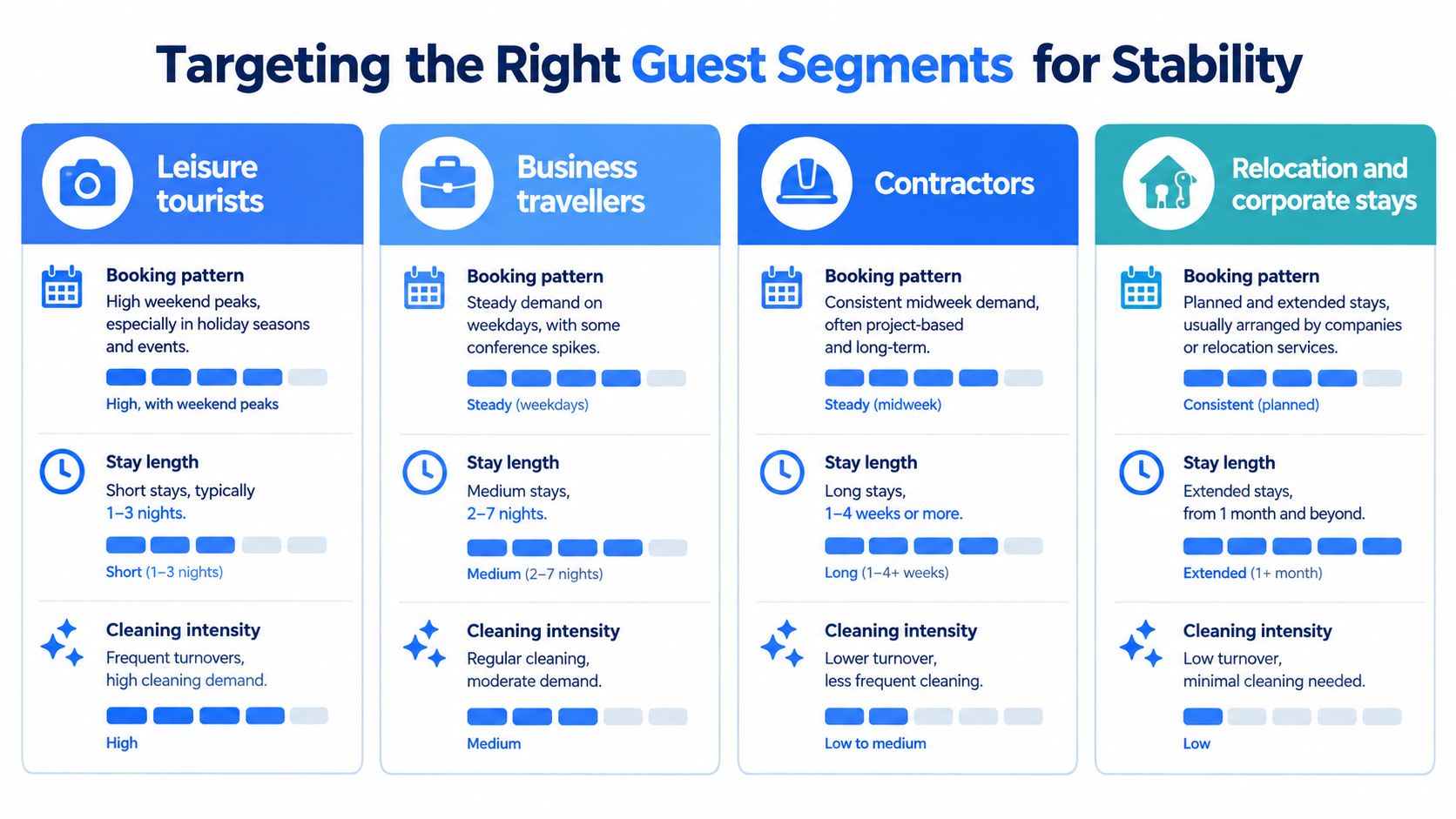
Weekend leisure guests are visible because they fill calendars quickly, but visibility can hide expensive churn. Every short booking may require a cleaner, linen movement, inspection, guest message sequence and restocking visit. A stable rent-to-rent operation needs a deliberate mix of guests whose booking patterns complement one another.
Compare the contribution, not just the booking price
Guest segment | Booking pattern | Operational advantage | Main trade-off |
|---|---|---|---|
Leisure tourists | Often concentrated around weekends and events | Can support stronger peak-period rates | Higher turnover and less dependable weekdays |
Business travellers | Often linked to working schedules | Useful midweek demand and workspace value | Guests expect reliable Wi-Fi, access and invoicing |
Contractors | Frequently need practical accommodation near a project | Longer stays can reduce cleaning and acquisition frequency | Furnishings and maintenance need to withstand regular use |
Relocation and corporate stays | May need temporary housing during a move or renovation | Extended bookings can provide lower-turnover income | Requires clear terms, responsive maintenance and suitable storage |
Contractors usually care about parking, cooking facilities, washing access, dependable broadband and straightforward arrival. Business travellers value a desk, quiet surroundings and a reliable invoice. Relocation guests need a home-like layout, enough storage and the confidence that a longer stay won't be disrupted by avoidable maintenance problems.
Leisure demand still has a place. Local accommodation platforms recognise self-catering and dog-friendly stays as established categories, and Visit Norwich's accommodation listings present properties using characteristics and Norwich postcode districts such as NR2 and city-centre locations. That tells an operator to treat amenities and location as searchable commercial features, not decorative extras.
Design the product around the booking
A mixed strategy requires more than listing the same flat on multiple channels. Set minimum stays where appropriate, publish practical house rules and create rate structures for longer bookings. A contractor may prefer a simple all-inclusive weekly arrangement, while a leisure guest may accept a short break with a different cleaning structure.
The guide to corporate relocation housing offers a useful way to think about the needs of professionals between homes. The commercial lesson is clear: longer stays can outperform high-churn bookings when the saving in cleaning, linen, guest acquisition and administration exceeds any reduction in nightly rate.
Local Market Dynamics in Norwich and Norfolk
Headline national demand can mislead a rent-to-rent operator. Norwich profitability is decided by the property's use case, operating costs and net contribution margin, not by broad growth in short-term letting. Regional concentration still provides context. The South West accounted for 28% of England's short-term-let listings, while London and the South East each represented 17%, according to the government analysis cited earlier. Those figures show why local supply matters, but they cannot identify which Norwich property will produce a workable return.
A property in NR1, NR2, NR3 or NR5 may suit different guests depending on parking, access, noise, nearby services and distance from the city centre. Postcode alone does not determine performance. Two apartments in the same district can produce different margins because one has a usable workspace, easier arrival and better sleeping arrangements, while the other creates problems for guests travelling by car or carrying equipment.
Location needs a use case
Match each property to the guests you intend to attract. Contractors may prioritise vehicle access and proximity to a worksite. University visitors may value transport links and a flexible kitchen. Relocation guests need shops and everyday convenience. Leisure visitors may prioritise walkability, character and access to Norwich attractions.
With roughly two in three guest nights coming from domestic travellers, a Norwich operator's core market is UK-based workers, families, visitors and people needing temporary accommodation, rather than overseas tourism alone. That makes practical positioning more useful than a generic holiday message.
Seasonality affects revenue, but a property does not need to depend on summer weekends. 12% of annual guest nights occurred in August, compared with 5% in January, according to the ONS dataset noted earlier. Lower-turnover bookings from contractors, business travellers and relocation guests can reduce vacancy and cleaning frequency during quieter periods. Their nightly rate may be lower, but the saving in turnovers, linen, guest acquisition and administration can improve net contribution.
Stay flexible without becoming vague
Visit Norwich gives a local example of self-catering accommodation described as open all year round, approximately four miles from Norwich, with facilities suited to different seasons, in its Poolside Lodges listing. The practical lesson is to build a product and message around more than one reason to stay.
Minimum stays can change by calendar period. Poolside Lodges requires two nights during off-peak periods, rising to three or four nights in summer depending on the weekday, and three nights over Christmas and New Year, according to Visit Norwich's group-stays information. Use similar rules only when they match actual demand. A long summer minimum can protect operations, while an inflexible rule may reject a valuable midweek contractor booking.
Due Diligence Checklist for Securing a Property
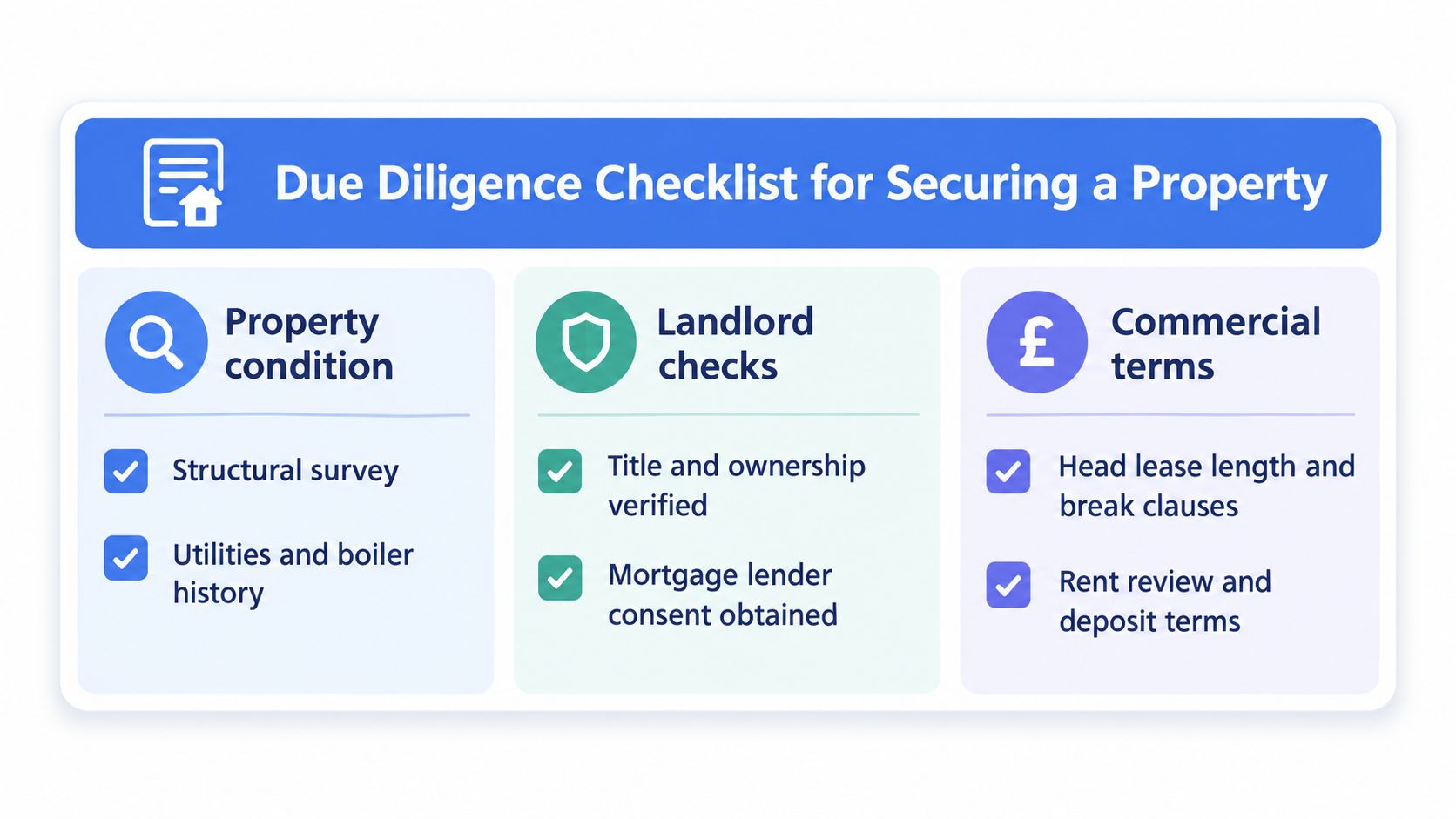
The best time to discover a bad deal is before signing the head lease. Review the property, the landlord, the building and the numbers as separate tests. Passing one doesn't compensate for failing another.
Start with the physical property
Visit at different times if possible. Listen for noise, check mobile reception and broadband options, inspect water pressure, test appliances and look for signs of damp. Confirm how guests will enter, where keys or access devices sit, and whether cleaning teams can work without disturbing neighbours.
Check the fundamentals:
Condition and repairs: Identify defects, photograph them and agree who resolves each item before launch.
Utilities and boiler: Review service history, meter arrangements, heating performance and likely replacement exposure.
Furniture and layout: Confirm that beds, storage, seating, workspace and kitchen equipment fit the intended guest segments.
Access and safety: Trace the escape route, check communal areas and confirm that emergency information can be displayed clearly.
Building rules: Read lease restrictions, management-company policies and any limits on short-term or commercial guest use.
Verify the landlord and permissions
Ask for evidence that the landlord owns the property and can grant the proposed rights. Confirm whether mortgage lender consent, freeholder approval, planning permission, licensing or insurance conditions apply. Don't assume a landlord's confidence means every third party has approved the arrangement.
The guide on what to look for when renting an apartment in Norwich can support a practical viewing mindset, but legal and professional checks should be obtained where the property or agreement creates uncertainty.
Stress-test the commercial terms
Model the deal with conservative realised rates and more than one demand mix. Test a winter period with weaker leisure bookings, delayed contractor work, cancellations, utility inflation, unexpected repairs and a period when the property can't be re-let. Then ask whether the operator can still pay the landlord without relying on personal funds.
Negotiate terms that protect the downside:
Head lease duration and breaks: Align the commitment with the time required to recover furnishing and launch costs.
Rent review mechanics: Avoid vague increases and identify when reviews occur.
Deposit and damage terms: Define evidence, deductions and return timing.
Maintenance allocation: Separate tenant-caused damage, routine repairs and structural responsibility.
Use and access rights: State the permitted serviced-accommodation use and inspection arrangements.
Exit provisions: Set out what happens to bookings, furniture and guest deposits if the agreement ends.
A deal is only attractive if it survives the quiet month you're most tempted to ignore.
Treat the head lease as a commercial risk instrument, not a formality. A property with strong demand can still be a poor rent-to-rent investment if the fixed rent leaves no room for compliance, maintenance, voids and lower-turnover bookings. Secure consent, document responsibilities and sign only after the downside case remains affordable.
Stay Norwich Apartments offers holiday lets in Norwich city centre across NR1, NR2, NR3 and NR5, with self-catering apartments and houses for short breaks and longer stays, bills included and several dog-friendly properties. For a practical Norwich base suited to business travellers, contractors and temporary housing, visit Stay Norwich Apartments and book direct for the best rate.
Comments