


Short Term Rental Properties: A 2026 Traveler's Guide

A six-week job in Norwich looks simple until you try to book the stay. A hotel feels too tight once laptops, work boots, and laundry pile up. A standard lease can feel too heavy if you need flexibility, don't want a long commitment, or can't wait around for paperwork, deposits, and credit checks.
That gap is where short term rental properties make practical sense. They sit between nightly accommodation and a full tenancy, which matters for contractors, project managers, relocating professionals, and people between homes. The right place isn't about holiday polish, it's about being able to work, cook, sleep, and keep moving without adding friction to an already disruptive period.
Table of Contents
The Hidden World of Short-Term Stays
A site manager turns up on a Monday morning and already knows the routine. The crew needs a base for several weeks, the office needs someone available early, and the nearest decent hotel room costs more than it should once you add breakfast, laundry, and the extra dinners that come with no kitchen. A standard lease is no cleaner a solution, because the commitment is too long for a job that may end in a month and a half.
That is the market for short term rental properties. These are not just holiday pads with nicer photos, they're temporary homes for people whose lives are in motion, whether that's a contractor on a project, a professional relocating to Norfolk, or a family stuck between moves. If the stay needs to be liveable rather than luxurious, the property has to work harder than a hotel room.
Practical rule: if you need a kettle, a desk, a washing machine, and the ability to keep the same routine for weeks, you're already thinking like a serviced-stay guest, not a tourist.
The practical value shows up in the details. A proper short stay should reduce admin, cut down the number of separate bills to manage, and let someone settle into work or family life quickly. For owners and guests alike, insurance, house rules, and safe use of the property still matter, which is why alternative accommodation insurance guidance belongs on the shortlist before any booking is confirmed.
For a local context, the pressure on Norwich housing and mobility is easier to understand when you look at population growth in Norwich. More people moving, staying temporarily, or circulating through the city means the middle ground between hotel and lease keeps getting more important.

Understanding the UK Short-Term Rental Market
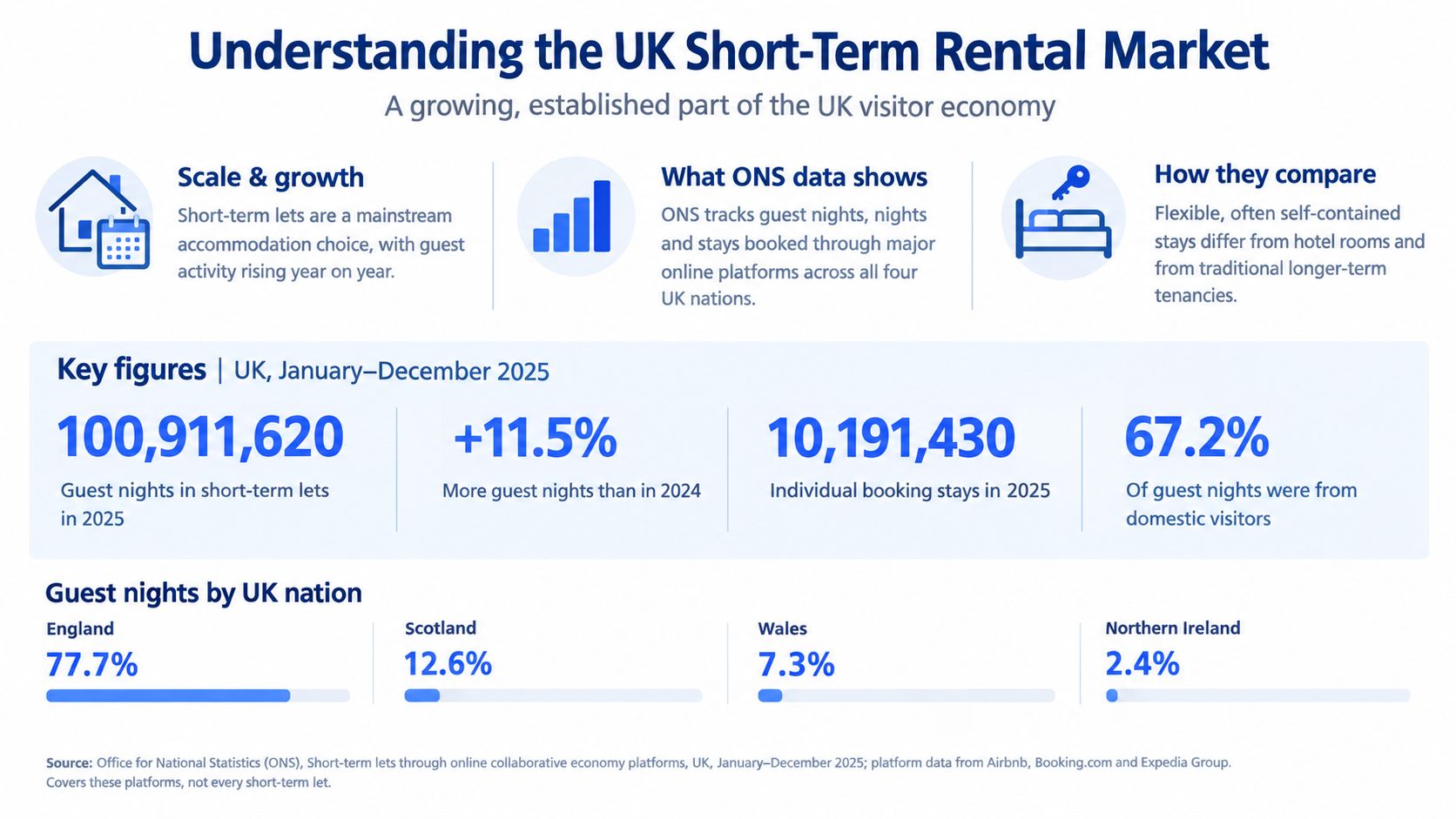
The UK market for platform-booked short stays is no side story. The Office for National Statistics says guests spent 90.1 million nights in short-term lets booked through Airbnb, Booking.com, and Expedia Group during 2024, with England accounting for 70.3 million guest nights, or 78.0% of the UK total, while Scotland, Wales, and Northern Ireland made up the rest in smaller shares ONS. August was the busiest month at 12.8 million guest nights, while January recorded 3.7 million, so summer ran at roughly 3.5 times the January level.
What the concentration tells hosts and guests
The same ONS bulletin shows how uneven the market really is. Around 26% of all UK guest nights happened in just 10 local authorities, with Westminster at 3.9 million, Cornwall at 3.4 million, Edinburgh at 3.0 million, and the Highland council area at 2.6 million. That concentration points to a simple reality, demand follows visitor flows, and location often matters more than listing polish.
For operators, the lesson is to stop treating every month as equal. For guests, it separates properties built for tourists from places that work as a base for work, family, or a temporary relocation. A practical host resource like World Property Investor for hosts is useful because it treats supply, demand, and day-to-day operations as business questions, not branding exercises.
The official data also has limits. The ONS definition covers rentals such as apartments or rooms booked through the three specified online platforms and excludes hotels, campsites, and other accommodation categories, so it is a strong measure of platform-mediated letting rather than a full count of every serviced apartment or holiday home. That distinction matters because short-stay demand is not only a tourism story. It also covers workers, relocators, and people whose housing needs do not fit a normal tenancy cycle.
Cities do not just receive visitors, they absorb moving households, project teams, and temporary residents. That is why a local market like Norwich needs to be read as more than a tourism destination, and why Norwich population growth context is part of the wider picture.
Short-Term Rentals vs Hotels and Long-Term Leases
Hotels, leases, and serviced apartments solve different problems, and too many people compare them only on headline price. That misses the core issue, which is total cost over the actual length of the stay. A hotel can look convenient until laundry, meals, parking, and the lack of a kitchen start adding up. A long-term lease can look cheaper until you factor in the deposit, utility setup, and the fact that you may not need the property long enough to justify the commitment.
VisitBritain's Lighthouse analysis shows why the middle ground matters. In May 2025, it recorded 481,563 available short-term-rental properties, up 7% year on year, while reserved nights fell 5% to 6.1 million. Occupancy dropped to 43%, four percentage points below May 2024, while average daily rate rose 20%, from £258 to £309; average stays lasted 6.6 nights VisitBritain. That mix suggests a market where supply is growing, occupancy can soften, and operators increasingly rely on value-based longer bookings rather than one-off nights.
Bottom line: for stays that run past a few nights and into weeks or months, a serviced apartment often wins on cost control, not just comfort.
Accommodation Comparison: Costs and Flexibility | Hotel | Long-Term Lease | Serviced Apartment |
|---|---|---|---|
Monthly cost shape | High nightly cost adds up fast | Lower base rent, but extra setup costs | Usually easier to align with the length of the stay |
Utility inclusion | Rarely included in a way that helps budgeting | Usually separate bills and account setup | Often bills included, which simplifies planning |
Workspace availability | Variable, often improvised | Depends on the property | More likely to offer a proper table or desk |
Lease flexibility | High nightly flexibility, low value over time | Low flexibility, higher commitment | Flexible enough for project stays and relocations |
The point isn't that hotels are bad or leases are wrong. It's that they're the wrong fit for many intermediate stays. A contractor working in Norfolk for six weeks doesn't want to overpay for breakfast and housekeeping they barely use. Someone between homes doesn't want to sign a year-long contract for a property they'll leave in eight weeks. A serviced apartment sits in the gap, and the gap is exactly where many real-world stays live.
A useful local read is the case for serviced apartments, because the decision is rarely about comfort alone. It's about whether the accommodation matches the duration, the routine, and the budget.
Key Amenities for Contractors and Business Travelers
For work-related stays, the useful details are rarely glamorous. They are the things that keep the stay from turning into a daily nuisance. Reliable Wi-Fi, a proper desk or table, a kitchen equipped for real cooking, and laundry facilities matter far more than decorative extras. If a property looks polished but cannot support remote work or proper meals, it is not fit for purpose.
What to check before you book
A practical checklist helps separate workable accommodation from expensive clutter:
Workspace quality: Look for a genuine table or desk, not just a shelf and a chair.
Wi-Fi reliability: Ask whether the connection supports video calls and file uploads, not just casual browsing.
Kitchen setup: Check for cooking equipment, utensils, and a fridge that can handle several days of groceries.
Laundry access: A washer saves time and cuts the hidden cost of repeated external laundry.
Bills included: Confirm exactly what is covered, especially gas, electricity, water, and broadband.
Parking and access: Important for tradespeople, visiting staff, and anyone arriving with tools or luggage.
Bills included is not a marketing phrase, it is a budgeting tool. Government guidance says any included bills must be set out in the tenancy agreement and charged in line with actual costs UK government guidance. That makes the written terms matter, because a stay only feels cheaper when guests know what is covered and what is not.
England's rules also affect how straightforward a booking feels. The government says England does not have a single national restriction equivalent to London's 90-night rule, while Greater London treats use of residential premises as temporary sleeping accommodation for more than 90 nights in a calendar year as a material change of use requiring planning permission UK government consultation. That difference matters because Norwich operators and guests should not assume London-style limits apply everywhere.
For contractor-focused stays, accommodation guidance for contractors is useful because the core issue is not only where to sleep, but whether the workweek can keep running normally.
Why Norwich is an Underrated Base for Temporary Stays
Norwich works well for temporary stays because it behaves like a real working city, not just a tourist stop. That matters for people who need to get to site, attend meetings, visit the university, or manage a transition without constantly moving across town. The city centre is compact enough to keep daily logistics simple, but large enough to offer decent food, transport, and services.

The strongest short-stay areas are the ones that balance access and practicality. NR1, NR2, NR3, and NR5 are useful because they keep guests close to the centre while still giving them a range of local routines and transport options. For temporary residents, that can matter more than staying in the prettiest postcode. A good base is one where groceries, parking, and the daily route to work don't become a second job.
The other advantage is that Norwich suits mixed-purpose travel. A professional might be in town for a project, but still need somewhere calm enough to rest, cook, and handle admin in the evening. That's where a city-centre self-catering stay beats a hotel, especially when the visit stretches beyond a long weekend. Local context helps here, and Norwich as a growing cosmopolitan hub gives a better sense of why the city keeps drawing temporary residents as well as leisure travellers.
Norwich also rewards guests who want a quieter base without giving up city convenience. That's a strong combination for relocations, family disruption, and work assignments, because it reduces the stress of having to relearn a new area every few days. For short-term living, predictability beats novelty.
How Stay Norwich Apartments Meets These Needs
Stay Norwich Apartments fits the temporary-stay model because it keeps the focus on function. The properties are in Norwich city centre across NR1, NR2, NR3, and NR5, and the apartments and houses are available for short breaks and longer stays with bills included and several dog-friendly options, with booking direct available through Stay Norwich Apartments. That matters because the guest doesn't have to solve every practical problem separately before the stay even starts.
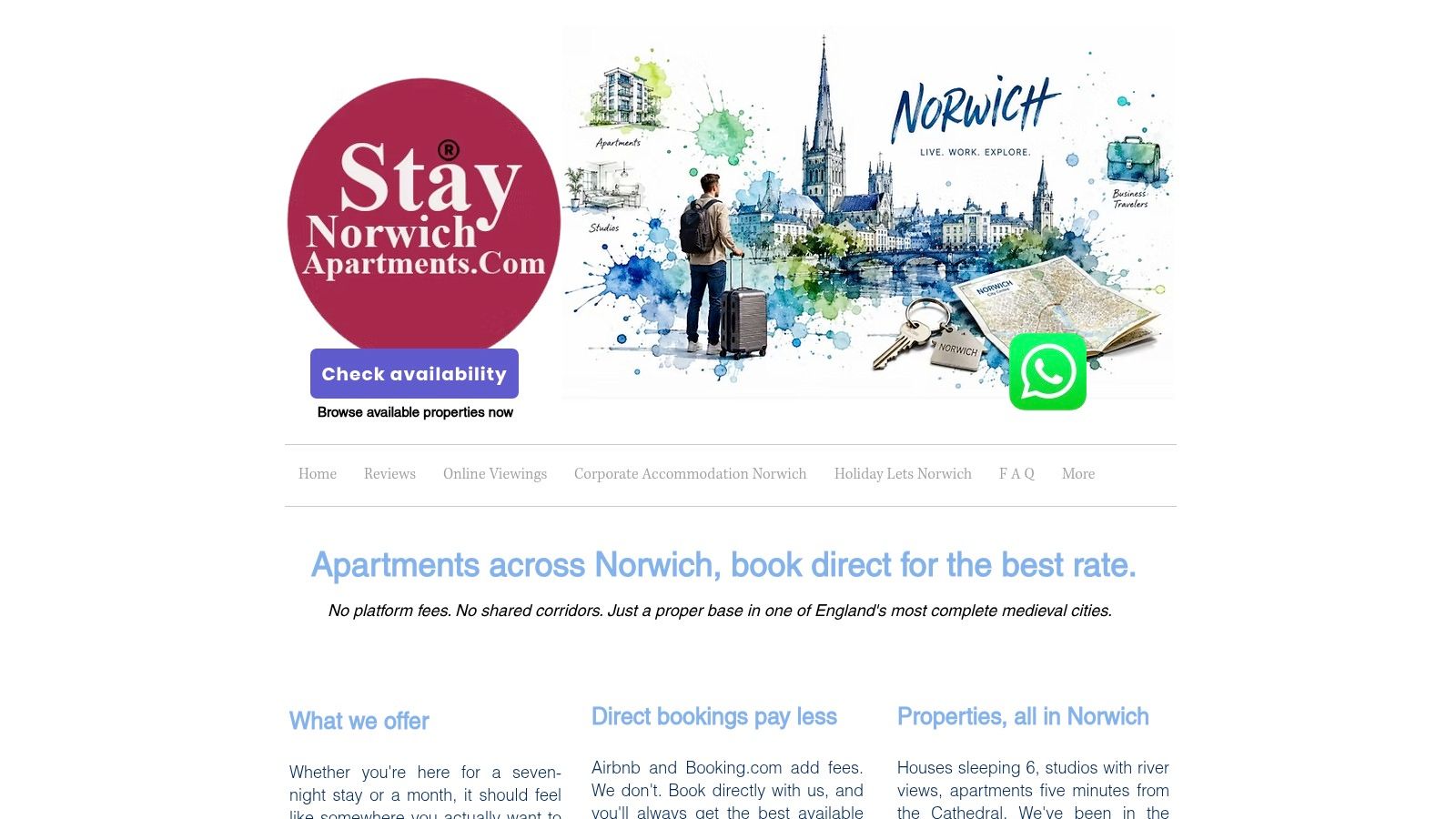
The appeal is straightforward. Self-catering accommodation gives guests a kitchen, which changes the economics of a multi-week stay. Bills included cuts down on separate setup tasks and makes budgeting clearer. For anyone working away from home, that combination is often more valuable than decorative upgrades or a long list of leisure extras.
For teams managing several properties or comparing booking patterns, a dashboard tool like Airbnb reviews in one dashboard can be useful because feedback trends tell you more than a single review ever will. That kind of operational view matters in a market where guest expectations are tied to sleep quality, workspace quality, and responsiveness, not just appearance.
Stay Norwich Apartments also aligns with pet-friendly travel in a practical way. England's tenancy rules allow a structured process for pet requests, which means dog-friendly stays work best when the property policy is clear and the guest knows the rules in advance UK government pet guidance. For longer stays, that clarity is essential. A pet isn't a novelty on a six-week assignment, it's part of the household.
Final Checklist for Choosing Your Short-Term Rental
A useful short stay removes friction instead of creating it. Before you book, check the platform, cancellation terms, whether bills are included, and whether the space supports work as well as sleep. Confirm the property layout, parking, and how keys or access are handled, because the small details are what break a stay.
If you're staying long enough to care about cleaning rhythm and turnover, a room-by-room rental cleaning system can also help you judge whether the property is kept to a standard that suits longer visits. Cleanliness isn't a bonus in temporary housing, it's part of how the accommodation performs day after day.
The best choice is the one that matches your life for the weeks you need it, whether that's project work, relocation, family disruption, or a bridge between homes. Book direct when you can, keep the paperwork simple, and choose a base that lets you get on with the reason you came in the first place.
Stay Norwich Apartments offers self-catering city-centre accommodation for short breaks and longer stays across Norwich's key areas, with bills included and several dog-friendly properties. If you need temporary housing that works like a base rather than a hotel room, visit Stay Norwich Apartments to check availability and book direct.

Comments