


Living in Norwich: A Practical City Guide

You've arrived in Norwich with a suitcase, a work start date, and no appetite for signing the wrong tenancy in a hurry. Perhaps you're a contractor with a six-week project, a professional between homes, or a family waiting for renovations to finish. The immediate questions are practical: where can you sleep tonight, what will the bills add up to, and which side of the city will make your daily journey easier?
Living in Norwich works best when you judge the city through those decisions, not through a list of attractions. Rent, heating, parking, transport, workspace and flexibility can matter more than a property's polished photographs. This guide gives you the local view, including the trade-offs that become obvious only after you've carried shopping uphill, searched for parking after work, or discovered that a cheap room costs more once travel and utilities are added.
Table of Contents
Arriving in Norwich and Getting Your Bearings
A contractor arriving for a short project often makes the same mistake. They book somewhere that looks central on a map, unpack late at night, then realise their work route, parking arrangements and food shop are all awkward. Norwich is compact enough to learn quickly, but its medieval lanes, river crossings and changing gradients reward a slower first look.

Start at the station and orient yourself around the River Wensum, the city centre and the main routes leading west, north and south. The historic core feels intimate, with pedestrianised sections, narrow lanes and a strong medieval street pattern. The outer suburbs feel more residential and practical, with different parking pressures and longer journeys to the centre, the hospital, the University of East Anglia or Norwich Research Park.
The station is a useful arrival point, but it isn't the whole city. Before choosing accommodation, check the actual walking route, the likely bus journey and whether your work requires a car. The guide to Norwich train station and its surrounding area is useful if you're arriving with luggage or planning rail travel during your stay.
Norwich's population rose from just over 132,500 in 2011 to about 143,900 in 2021, an increase of roughly 8.6% to 8.7%, reflecting steady inward demand for housing and accommodation. Office for National Statistics Census data places the 2021 population at 143,922 usual residents. That growth helps explain why short-term accommodation, private renting and relocation housing can feel competitive.
Local rule: Spend your first evening learning the route to work, the nearest food shop and the easiest way back to your accommodation in poor weather. Those three checks tell you more than a glossy neighbourhood description.
Norwich at a Glance
Norwich is a working regional centre, not a dormitory with a few offices attached. The city combines a historic centre, two universities, healthcare and business activity with a larger economy that draws workers from surrounding Norfolk districts. That mix gives the city a different rhythm from a purely residential town.

The latest Nomis labour-market profile records approximately 106,000 jobs in Norwich and a job density of 1.04, compared with 0.83 across the East of England and 0.85 across Great Britain. Nomis labour-market data shows why the city attracts business travellers, contractors, relocating professionals and temporary project workers. Job density is an aggregate measure, though. It doesn't guarantee a suitable role in your sector, and your actual experience depends on the workplace, shift pattern and transport route.
How to read the city
Think of Norwich as a compact urban authority inside a wider Greater Norwich economy. Someone living centrally may work close to the station, hospital or city offices, while someone in the western area may prioritise access to the university, research park or ring road. The best base depends on the journey you'll repeat most often.
The city also has a substantial student and economically mobile population. That creates demand for furnished rooms, flexible apartments, short-term houses and practical accommodation with kitchens and work areas. Students, temporary workers and established professionals may share the same broad districts, but they won't have the same priorities around quiet, parking, storage or lease length.
The Norwich population overview provides useful context for the city's changing scale. My advice is simple: don't judge Norwich by its boundaries alone. Include the surrounding employment geography when you calculate how much time and money a location will save.
Neighbourhoods Across NR1, NR2, NR3 and NR5
A postcode isn't a neighbourhood personality. NR1, NR2, NR3 and NR5 cover noticeably different parts of the urban area, so an advert using the same “Norwich” label can produce very different daily routines.
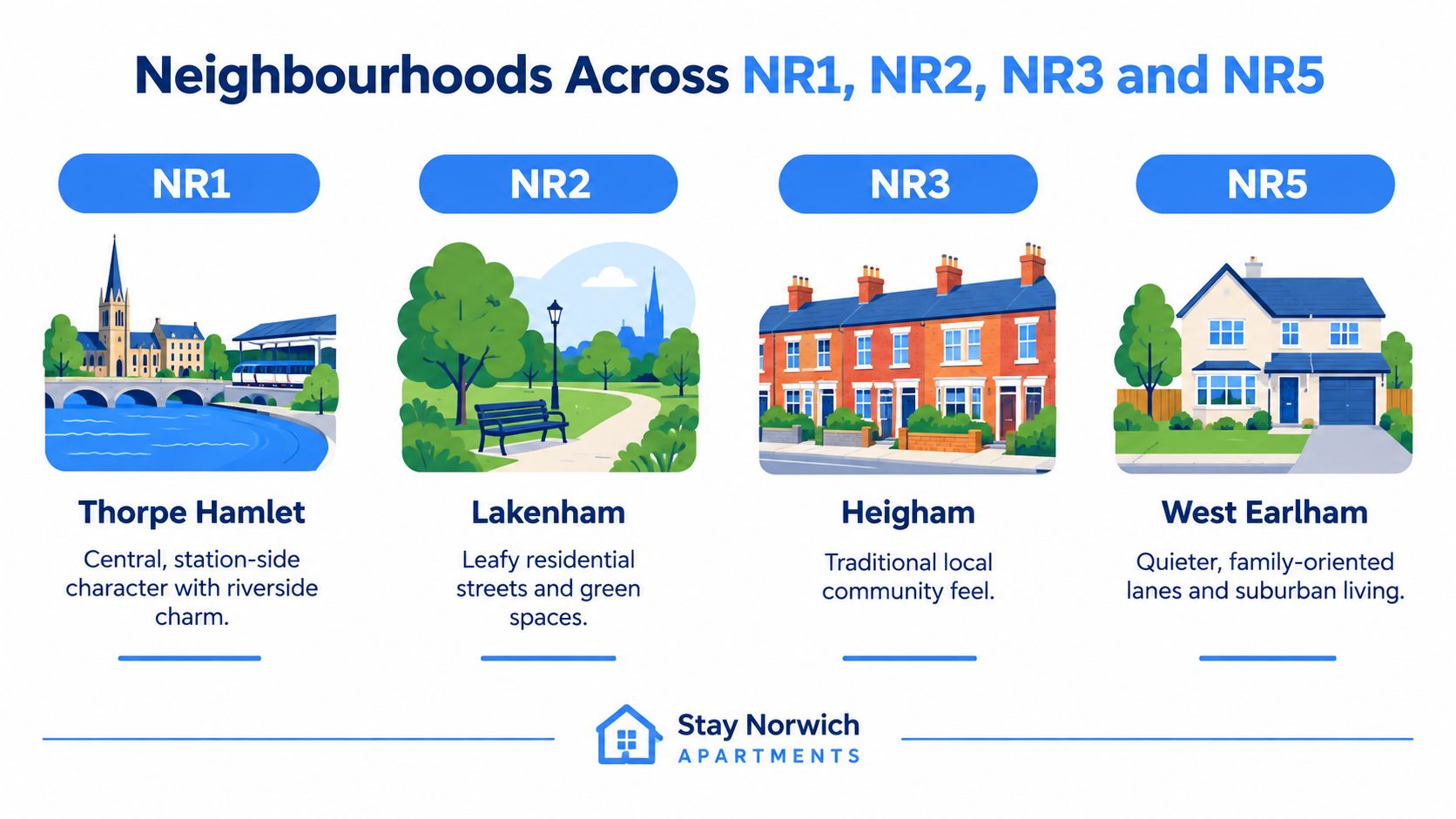
The NR postcode area guide is a useful reference, but these are the practical distinctions I'd use when choosing a base:
NR1, Thorpe Hamlet and Lakenham: This is the obvious choice if you want station access, central amenities and a shorter walk into the historic core. Thorpe Road and nearby streets can suit rail commuters and city-centre workers, while Lakenham gives you a more mixed urban feel. Check parking carefully, especially if you're bringing a work vehicle.
NR2, Eaton, Earlham and western Norwich: NR2 can work well for professionals who want residential streets with access towards the west. It may suit people travelling to the university or research park, but the route and gradients matter more than the postcode label. A property that looks close on a map may feel less convenient if you're carrying equipment or relying on a bicycle.
NR3, Mile Cross and New Catton: Northern NR3 offers traditional terraced housing and a strong local community character. It can be practical for people who want city access without being directly beside the station. Inspect sound levels, parking and the walking route into town rather than assuming every street has the same feel.
NR5, Bowthorpe, Costessey and Earlham: This is the better fit for people who value quieter suburban surroundings, space or access towards the ring road. It can suit families and workers travelling west, but car dependence becomes more likely. If your work is central, calculate the full weekly travel cost before choosing a lower headline rent.
Don't book solely on the district. Ask for the exact address, confirm parking, test the journey at your likely working time and check whether the accommodation has the kitchen, desk and storage you need.
The True Cost of Living in Norwich
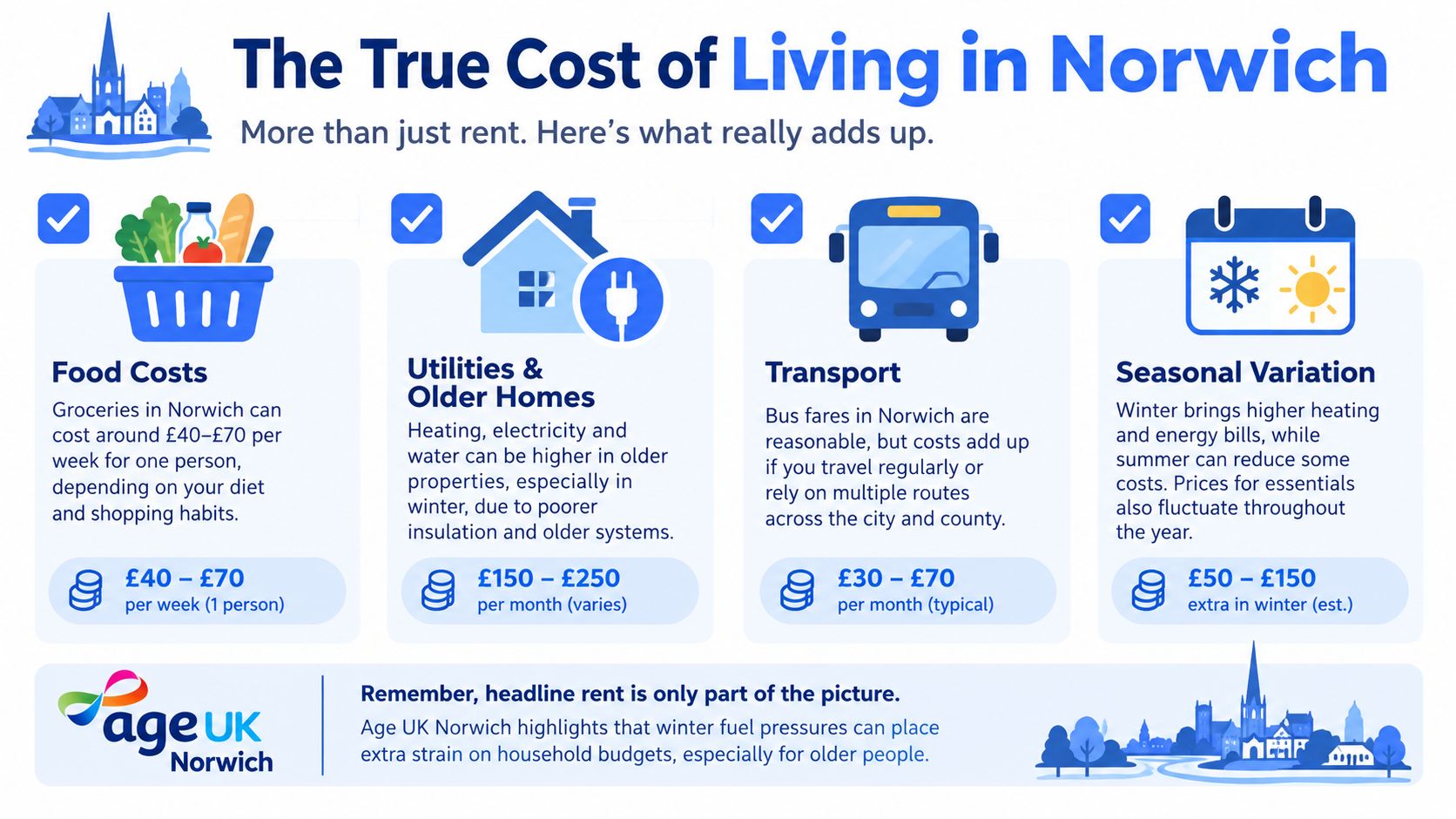
A cheaper room can become the expensive option once you add daily driving, high heating bills, separate internet and laundry costs, or lost working time on a poor commute. Price the whole week before choosing a postcode.
A January 2025 Age UK Norwich report found that 15.5% of Norwich households were experiencing fuel poverty, compared with 11% in 2022. It also found that older residents mainly travelled by car, walking or bus, with difficult bus access to hospitals, dentists and family. The same pressures affect lower-paid workers, contractors and people between homes. A property only works if its energy and transport demands fit your income and routine.
Build an all-in budget
Start with weekly accommodation, then add food, electricity or gas, water, broadband, laundry, parking and travel. For a small household, include school journeys, larger food shops, storage and heating additional rooms. Irregular expenses still count, so keep them in the calculation rather than treating them as surprises.
Norwich City Council's Economic Barometer records average private weekly rents of £177 for a one-bedroom home and £221 for a two-bedroom home. The August 2025 Economic Barometer gives you a useful benchmark, while the actual price depends on condition, location, furnishing and included services. For current price levels, see our guide to rent in Norwich before you build your budget.
Use this audit before committing:
Bills: Confirm whether utilities, council tax, broadband and TV licensing are included.
Travel: Price the actual route at your working time, not the map distance.
Heating: Ask how the property is heated and whether previous occupants paid separately.
Parking: Check whether a space is included, controlled or unavailable.
Flexibility: Compare early departure costs with the value of a shorter agreement.
Daily access: Find a food shop, pharmacy, GP practice and laundry option.
Practical rule: A central address can cost less overall when it removes repeated car journeys and provides a warmer, better-equipped place to work and sleep.
Housing Pathways from Short Stays to Long-Term Rent
A six-week contractor should not sign the same agreement as a family settling permanently. Choose housing according to how certain your work, household and preferred area are.
The 2021 Census recorded 64,457 households in Norwich. 30.3% lived in social-rented housing and 27.1% were privately rented or lived rent-free. A further 22.2% owned their home outright, while 20.4% owned with a mortgage, loan or shared ownership. Nomis Census housing data shows that renting has a larger role in Norwich than in neighbouring Broadland and South Norfolk, where owner occupation was reported at 79% and 76%.
Choose the pathway that matches your certainty
Serviced accommodation suits a temporary assignment, relocation gap or renovation. You pay for flexibility and convenience, so check the full price, cancellation terms, workspace, parking and included bills. A furnished apartment with a kitchen also avoids buying household basics for a short stay. Compare short-term lets in Norwich with the cost and risk of rushing into a long lease.
A house share can lower the cost of a longer placement, particularly for one worker. The trade-offs are privacy, storage, guests, quiet and shared facilities. Read the agreement carefully, then confirm who pays utilities and handles repairs.
A private tenancy suits you when your job, household and chosen district are stable. It brings more administration and a longer commitment, but gives you greater control over furniture, routine and address. Do not sign just because the headline rent is lower than a flexible stay.
Social housing can cost less for eligible tenants, but access depends on personal circumstances and availability. It will not usually solve the needs of someone arriving for a fixed-term project.
Buying requires confidence in the location, your finances and the length of your stay. Norwich's average house price was £225,109, below the reported Norfolk, East of England and England averages, although the city figure had fallen 2.1% over the preceding year. Lower purchase prices do not automatically make ownership accessible, particularly when private rent makes saving a deposit difficult.
For an uncertain arrival, start with a flexible, fully equipped base. Use the first weeks to test your commute and preferred district before committing to a long-term tenancy or purchase.
Getting Around Norwich by Foot, Bike, Bus and Train
Norwich rewards a sensible base. The medieval centre is compact enough for many daily journeys on foot, but the city becomes less forgiving when your accommodation sits on the wrong side of a busy route or your work lies beyond the centre.
Walking is strongest for central errands, station access, shopping and parts of the historic core. Cycling can extend that practical radius, especially if your accommodation has secure storage. If you're considering an electric bike for a longer or hillier commute, use this guide to choosing the right e-bike before buying or hiring one. Match the bike to distance, weather, storage and the route you'll ride.
Buses remain important for journeys between residential districts, the centre, the hospital and the university. Norwich Bus Station is a useful reference point, but check the specific service from your accommodation rather than relying on a broad area map. Rail works well for regional and national travel, including connections towards Cambridge, London Liverpool Street and the coast.
Let weather change your route
Flood planning isn't just a development issue. Norwich City Council identifies fluvial and tidal risks associated with the Rivers Wensum and Yare, and its Surface Water Management Plan identifies a western and south-western zone between Unthank Road and Earlham Road, plus a north to south corridor from the outer ring road near Catton Grove Road and Oak Lane towards the northern city centre. The council's flood-resilience guidance explains why exact site conditions matter.
After intense rain, check the route on foot and by car, especially if your shift starts early or ends late. The general rule is straightforward: choose NR1 or a similarly central base when walking and rail matter most, NR2 or NR5 when your work is west, and NR3 when you want northern access with a traditional residential setting.
Healthcare, Schools, Shopping and Dog-Friendly Living
A good Norwich base supports an ordinary week. You'll register with a GP, find the quickest route to the Norfolk and Norwich University Hospital, identify a supermarket, manage school or university arrangements and work out where the dog can walk without creating a daily logistical problem.
Families should check school admissions and catchment information directly with the relevant authority and school. The University of East Anglia brings its own timetable, campus access and visitor needs, so a property that works for a city-centre professional may be inconvenient for a student, parent or visiting academic. The same principle applies to healthcare. Test the route to the hospital before choosing a home, particularly if appointments or shift work are involved.
Shopping is easy when you combine the market, supermarkets and local shops rather than relying on one destination. A central base can make small, frequent shops manageable without a car, while a suburban home may make a larger weekly shop easier if parking is available. Mousehold Heath and other green spaces can be valuable for dog owners, but the sensible choice depends on the specific walking route from the property.
Dog-friendly availability isn't automatic. Norwich City Council allows pets in most council homes where the property is suitable and the animal is properly cared for, but tower blocks including Ashbourne, Aylmer, Burleigh, Compass, Markham, Normandie, Seaman and Winchester restrict residents to small caged or tank-kept pets such as budgerigars or goldfish. The council's pet guidance also highlights nuisance, hazards and damage as reasons to take property-specific rules seriously.
For a relocating dog owner, confirm breed, size, outdoor access, flooring and cleaning terms in writing. It's also sensible to find Norwich vet fees before an unexpected appointment turns into another relocation expense.
Making the Right Move for Your Situation
Your housing decision should match the risk you are carrying. A flexible, all-inclusive base suits changing work dates, uncertain household arrangements or a relocation that needs time. A long-term tenancy makes more sense once your job, budget, commute and preferred area are settled.
Tenure or property type | Norwich share or weekly rent |
|---|---|
Social-rented housing | 30.3% of households |
Private rented or rent-free housing | 27.1% of households |
One-bedroom private rent | £177 per week |
Two-bedroom private rent | £221 per week |
Owner occupied outright | 22.2% of households |
Owned with mortgage, loan or shared ownership | 20.4% of households |
The Census tenure shares and Barometer rent benchmarks cited above provide useful Norwich-wide reference points. They are not quotes for a particular address, and the final cost depends on bills, furnishing, transport and contract terms.
Match the base to the situation
Six-week contractor: Choose furnished accommodation with a proper kitchen, desk, reliable Wi-Fi, clear parking information and bills included. Avoid taking a long tenancy merely to reduce the headline rate if the project may finish early.
Professional relocating for several months: Begin with a flexible stay, then assess longer-term areas after experiencing the commute. Living locally will show whether NR1, NR2, NR3 or NR5 fits your working week.
Family between homes: Prioritise bedrooms, storage, laundry, school routes and a written extension policy. Flexible accommodation reduces the risk of signing a tenancy before a renovation or sale has a firm completion date.
Budget-sensitive longer-term renter: Compare social and private options, then audit heating, travel and internet costs. A lower rent can become the more expensive choice if it requires daily driving or has poor energy performance.
A flexible base also gives you time to test the practical details that listings rarely show. Check the morning journey, evening noise, parking pressure and mobile signal before committing to a longer contract.
Gas, electricity, water, broadband, landline, council tax and TV licensing may be included in rent when the agreement identifies them and the charges accurately reflect the landlord's costs. The tenant fees guidance explains the rules for renters. Shelter England also advises checking written terms to confirm which bills are included and which are paid separately.
Before you book or sign, confirm the exact address, total weekly cost, deposit, cancellation terms, included bills, parking, pet rules, workspace, storage and route to work. Norwich continues to attract residents and workers, so securing a practical temporary option early is safer than accepting a poorly matched long-term home under pressure.
You can check Stay Norwich Apartments for self-catering holiday lets and longer stays across NR1, NR2, NR3 and NR5, with bills included and several dog-friendly properties. Book direct to review available apartments and houses, compare your dates and choose a flexible base for work, relocation or temporary housing.

Comments