


Self Catering Apartments Norwich: Areas, Prices and Tips

Norwich City Council's heritage investment strategy counted around 4.7 million visitors a year and, in the same document, named a gap: families and longer-staying visitors were having to stay outside Norwich because the city didn't have enough self-catering accommodation to put them in (Norwich City Council's heritage investment strategy). The visitors were never the problem. The beds were.
That line explains why self catering apartments Norwich has become such a crowded search. Plenty of listings, very little plain information about what any of them will cost for the length of stay you need, or what you're agreeing to when you pay.
Two things decide whether a stay works, and neither is the photograph of the bed. The first is the total running cost for your actual dates, not the headline nightly rate. The second is the written terms, because a three-week booking and a three-month tenancy are different arrangements with different exit routes.
Length of stay is the hinge. Two nights and eleven weeks have almost nothing in common. One is a service purchase, the other is a stand-in for a home, and the same apartment can be a bad deal for one and excellent value for the other.
Self Catering Apartments Norwich: Areas, Prices and Tips: Table of Contents
Choosing an Area for City, Broads and Coast Trips - Three directions worth planning around
Costs Beyond the Nightly Rate - Worked example of a running cost
Deposits, Minimum Stays and Cancellation Terms - Where a stay stops being a tenancy - The five-point pre-booking check
Planning Stays for Students, Contractors and Relocations - Students and university visitors - Contractors on a project - Households relocating or between homes
Frequently Asked Questions About Booking - Can you invoice my company? - What if the apartment doesn't match the listing? - How can I check that a booking is genuine? - Can I change my dates after booking? - Do I need to bring bedding or towels?
Who Self Catering Apartments in Norwich Suit Best
Norwich recorded approximately 12.5 million visitor trips in 2024, including 12.1 million day trips and 0.4 million staying trips, and those staying visitors generated around 1.4 million nights and £121 million in direct expenditure (Norwich City Council's 2024 economic impact assessment). The same assessment puts total visitor spending at £631 million and tourism-supported employment at 14,177 jobs.
The ratio is the useful part. Day visitors dominate the footfall, so most local advice is written for people who go home at six. The overnight market is much smaller, spends far more per head, and splits into two customers who need very different things: the leisure break and the working stay.
A hotel room gives you a bed, daily housekeeping and someone at a desk; a self-catering apartment gives you a kitchen, a living area and a workspace, and asks you to buy your own breakfast. That trade decides everything below.
Guest type | Typical stay length | Must-have features | Why an apartment fits |
|---|---|---|---|
Business traveller | 2 to 14 nights | Desk, fast Wi-Fi, full kitchen | Work and cook without restaurant costs |
Contractor on a project | Several weeks, often extended | Parking, laundry, full kitchen | Extend when a job runs on |
Student or university visitor | 1 to 12 weeks | Quiet study space, kitchen | Covers gaps around term dates |
Relocating household | 4 to 12 weeks | Furnished base, flexible term | Bridges a move without a long tenancy |
Family on a break | 2 to 7 nights | Room for four to six, kitchen | More space and cooking than a hotel room |
Couple on a short break | 2 to 3 nights | Separate living area, kitchen | Cook for two and relax between sightseeing |
Read down the middle column. Stay length shapes a booking more than budget does, because it decides which costs dominate. Over four nights a kitchen pays for itself in breakfasts and packed lunches. Over four weeks, laundry, parking and a reliable broadband line matter more than the decor.
The contractor and relocation rows are the ones the city under-serves. Someone arriving for a plant shutdown or a rail possession doesn't want a room above a bar; they want a door that locks, a van space and an invoice their employer will accept. A household waiting on a house purchase needs an address for post and a base that doesn't commit them to twelve months of rent.
Practical rule: if you want daily cleaning and you're staying one or two nights, book a hotel. From three nights, and certainly past a week, a furnished apartment usually costs less per head and lives a great deal better.
Connectivity is the quiet failure point on longer stays. Guests forgive a small kitchen; they don't forgive a video call that drops mid-meeting. Ask for a download speed in Mbps rather than the word "fast", and if you let flats yourself, managing guest connectivity across apartment properties covers what breaks first when several guests share one connection.
Choosing an Area for City, Broads and Coast Trips
Most Norwich trips get planned the same way: a map on a kitchen table, a list of places, and a decision about which base makes the list walkable. Get that order right and the days organise themselves.

Start with the postcode rather than the pin, because a pin can sit anywhere within a mile of the truth. City-centre addresses fall into NR1, NR2, NR3 and NR5, and the difference between them is often a ten-minute walk versus a twenty-minute bus. Our guide to Norwich postcode areas sets out what each one puts on your doorstep before you commit.
A central base puts the Cathedral, the Castle, the Lanes and the market within walking distance, which suits anyone who wants to leave the car parked all week. Our properties sit close to the train station, Norwich Cathedral, the market and the main employment sites in and around the city, so a car is optional for most guests and a train-based commute is realistic for contractors.
For a sense of how compact the historic core is on foot, this short film is a decent orientation before you pick a street.
Three directions worth planning around
The Norfolk Broads. Wroxham and Hoveton are the gateways, with boat hire and river cruises leaving from the same village. Reach them by bus or car from the centre and treat the day as a slow one, because the point is the water rather than the mileage.
Hickling Broad. Further out again and a longer drive from Wroxham, so it works best as its own car day rather than an add-on to a Wroxham trip.
The North Norfolk coast. Cromer and Sheringham are reachable by train or bus, with seafront walks, pier views and a crab lunch that has become a ritual for visitors. Going by train removes the parking question entirely in high season.
The historic centre. Elm Hill, the Cathedral Close and Norwich Castle sit within walking distance of most central streets, which makes a rainy morning easy to salvage.
Before you choose a base outside the centre, check the last bus or train back. Rural services thin out badly in the evening, and a taxi from the coast costs more than the accommodation saved. Run three questions: how many days out do you have, how will you travel, and does anyone need to be on site before eight in the morning? Those three answers name the area for you.
Amenities Worth Checking Before You Book
A listing photo shows a sofa. The details that decide your week sit in the paragraphs underneath it, and nearly all of them can be confirmed before you pay a penny.
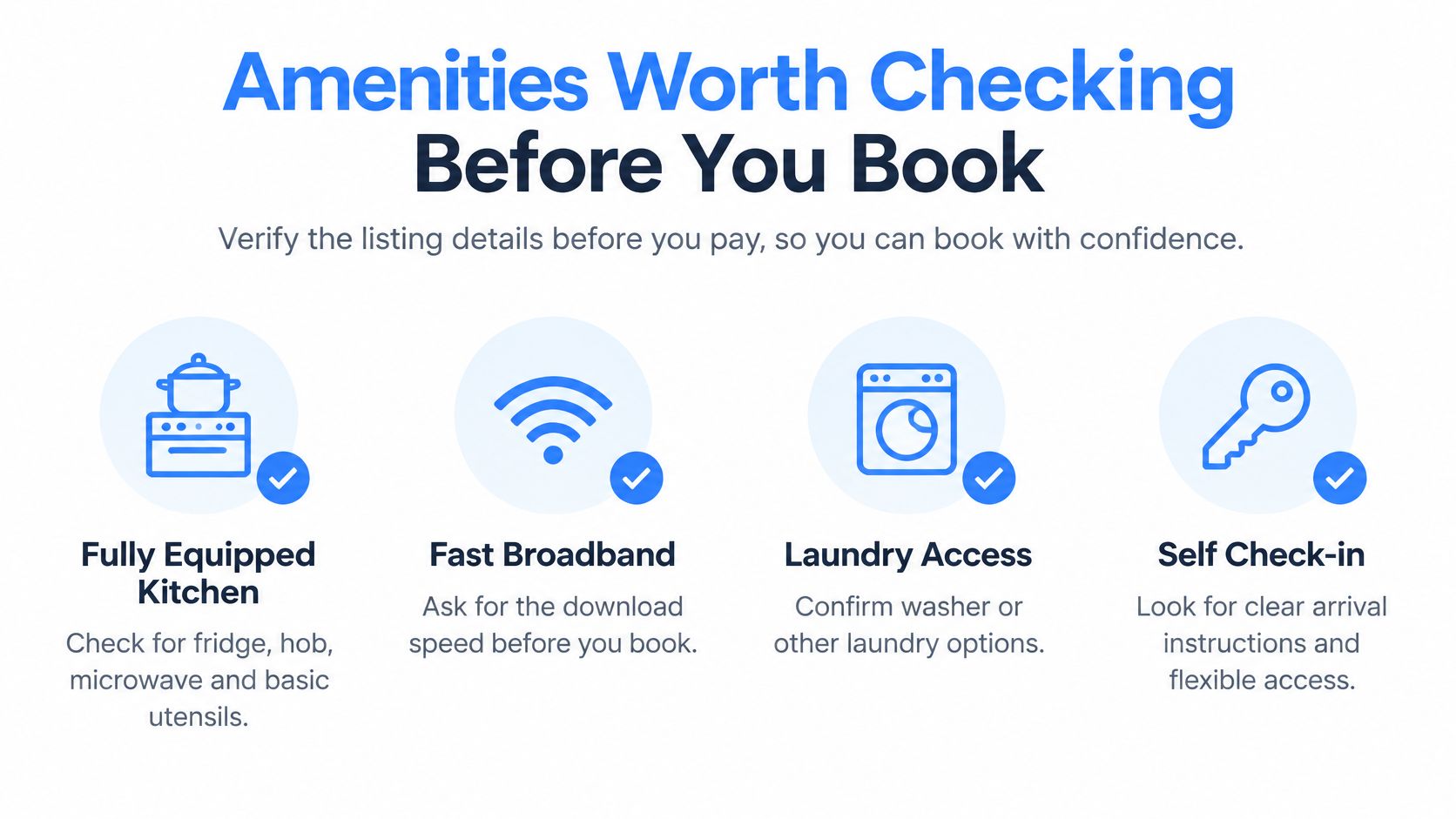
Work through this list against the listing text, not the gallery.
Fully equipped kitchen. Ask whether there's a fridge, hob, microwave, kettle and basic utensils, plus pans that will fit the hob. A kitchenette with a kettle isn't a kitchen.
Fast broadband. Ask for the download speed in Mbps and whether the router is in the flat or shared with the building. Below about 10 Mbps, video calls will struggle.
A desk and chair. Ask whether the desk is in a bedroom or the living room, because a desk beside the bed is a poor place to take a call.
A bed for each adult. Ask how many separate bedrooms the price covers, not just how many guests are allowed.
Linen and towels for the party. Ask whether they're provided and whether extras arrive mid-stay on longer bookings.
Secure entry and a safe. Ask how you get in and where valuables go. We fit every apartment with secure locks and, where applicable, a safe for valuables.
Longer stays need a second pass. Laundry is either in the flat or a walk away, and that distinction matters at week three. Parking should be confirmed by number of vehicles, not just "parking available". Housekeeping frequency is worth pinning down in writing, and step-free access needs confirming at the door, not on the floor plan.
If cooking is part of the plan, the farm shops near Norwich are worth mapping before you shop, and anyone kitting out a shared kitchen or a site compound rather than a flat may find the case for catering pods as a compact cooking space useful background.
Score each property out of these items and reject anything that fails the kitchen or broadband line if you'll be working remotely. Two good amenities beat ten vague ones.
Costs Beyond the Nightly Rate
The nightly rate is a quotation, not a bill. Almost every cost surprise on a self-catering stay comes from adding up the extras after the decision has been made, so do the adding up first.
Cost item | When it applies | Question to ask before booking |
|---|---|---|
Nightly or weekly rate | Every stay | Is the rate per night or per week, and how does it change over 30 nights? |
Bills (heating, electricity, water, broadband) | Stays where bills are not included | Are bills included in the quoted price? |
Security or damage deposit | Most short stays | How much is it, and when is it refunded? |
Cleaning and linen changes | Stays under 30 nights | Is cleaning included, and how often does it happen? |
Parking | Drivers and van users | Is a space included, and how many vehicles fit? |
Booking or platform fees | Bookings made through third-party sites | Are any service fees added at checkout? |
Meals you cook yourself | Stays of several nights or more | Is there a full kitchen, and what would the same meals cost out? |
Worked example of a running cost
These figures are illustrative, not a Norwich price list. Say a property quotes £1,260 for 14 nights, adds £60 for a cleaning and linen change, and £40 for bills that aren't included. The running cost is £1,360, or about £97 per night. A £150 damage deposit sits outside that total and comes back after the check-out inspection if nothing is damaged.
Do that sum for every shortlisted property and compare only the running cost per night. A flat at a higher headline rate with bills and cleaning included frequently beats a cheaper one with three additions stacked on top.
The cheapest nightly rate is rarely the lowest project cost. A kitchen, included utilities and the ability to avoid restaurant dinners for a fortnight can outweigh a £15 difference on the room.
That meal line is doing real work. Two adults eating out every evening for two weeks is a large number, and one of the reasons a self-catering stay wins on total spend even when the room looks pricier. If you'd rather see the whole comparison laid out again with local context, this guide to short-term accommodation costs in Norwich is a useful cross-check.
Prices shift with property, season and length of stay, so ask for a written quote covering your own dates. A quote you can read twice beats a rate you half-remember.
Deposits, Minimum Stays and Cancellation Terms
Three terms decide whether a stay works, and none of them is usually in the headline price.
The minimum stay. This differs by apartment and is set by the property rather than the platform, and we tell you the length when the reservation is made. A studio built for midweek business stays won't always take a single Saturday, while a house set up for teams has more room to be flexible.
The deposit. Most short-stay bookings carry a security or damage deposit, and the amount varies by stay length and apartment type. Ours is fully refundable after a satisfactory inspection of the apartment at check-out, which is why the check-out photos you take on arrival are worth keeping.
The cancellation rules. These decide whether a shifting project timeline costs you the whole booking or just a date change. Ask for the deadline in writing, and ask separately whether an extension in weekly steps is possible.
Where a stay stops being a tenancy
This is the distinction readers get wrong most often. A self-catering booking is short-term accommodation, not a tenancy, and that changes your rights and your exit route. Government guidance for resident landlords states that a tenancy must be for an agreed term, giving examples of a weekly periodic tenancy or a fixed term of three months, and that the term, payment obligations and other conditions should be agreed between the parties (GOV.UK guidance on letting rooms in your home).
That guidance is general UK guidance and doesn't set the terms of any particular Norwich property. Individual agreements vary, so ask directly whether a booking creates tenant rights or only a short-term licence.
The five-point pre-booking check
Minimum stay. Confirm the shortest accepted booking for your dates in that specific apartment.
Deposit. Confirm the amount, what triggers a deduction, and how many days the refund takes.
Cancellation deadline. Confirm the last date you can cancel or move without charge.
Bills. Confirm exactly which utilities are inside the quoted price.
The written agreement. Ask for it before you pay, not after.
Keep the confirmation email, the deposit receipt and your arrival photos in one folder. If a dispute ever arises, those three documents settle it faster than any phone call.
Planning Stays for Students, Contractors and Relocations
Students, contractors and households between homes often need a furnished base for a defined period, but the right booking depends on what that period involves. A desk and reliable Wi-Fi may matter most for study or work; for a move, the key question is how the stay fits around a delayed completion or tenancy start.
Students and university visitors
Norwich attracts students, visiting academics, interview candidates and families coming for graduation. Their stays can range from a few nights to a longer gap before a lease begins. Check that the apartment has a desk and suitable study space, and ask whether an extension is possible if your dates change. Anyone responsible for student buildings can read about segment networks in student housing.
Contractors on a project
For work stays, match the booking to the job's expected length and the possibility that the end date may change. Contractor stays with Stay Norwich Apartments include van parking, proper kitchens, clean invoicing and the option to extend if a job runs on. The guide to accommodation for contractors covers practical questions to settle before booking.
For example, if a job is expected to take three weeks, ask how an extension to five weeks would be handled before you commit. A flexible booking can avoid having to find a new base mid-project. For a stay of only two or three nights, compare the total cost with a hotel, including the facilities you will use.
Households relocating or between homes
A furnished base can bridge a completion date, a tenancy start or a kitchen renovation without requiring a long tenancy. Stay Norwich Apartments offers furnished accommodation for relocating guests with no long tenancy required.
Before booking, ask whether the agreement creates tenant rights or is a short-term licence. Get the dates, early-ending notice requirements, permitted postal address and arrangements if your move is delayed confirmed in writing. Compare the total cost for the actual length of stay, along with the written terms, rather than choosing on the weekly rate alone. A booking that fits your dates can help avoid the cost and disruption of moving twice.
Sample Itineraries for Two and Three Days
Two plans, both built around a central base, that you can copy without rethinking them.
Day | Morning | Afternoon | Evening |
|---|---|---|---|
Day 1, historic centre | Norwich Cathedral and the Cathedral Close | Lunch at Norwich Market, then Norwich Castle | Dinner in the Lanes and Elm Hill area |
Day 2, Norfolk Broads | Wroxham or Hoveton | Boat trip or river cruise, then lunch on the water | Return to base, or walk Hickling Broad at dusk |
Day 3, North Norfolk coast | Cromer or Sheringham seafront | Crab lunch and cliff walk | Return by the last bus or drive back to base |
The two-day version is Day 1 and Day 2. The three-day version adds the coast, and it's the day that rewards an early start because the journey eats into the morning whichever way you travel.
A few timing notes that save real friction. Allow the travel time from Wroxham back into the city before you book an evening table, and check the last bus home before you set off rather than at the stop. Popular boat trips sell out in summer, so reserve ahead for a weekend. Hickling Broad belongs on its own car day rather than tacked onto Wroxham, because the drive between them is longer than it looks on a map.
Pick the itinerary that matches your base and your dates, not the one with the most pins in it. Two days done calmly beats three days spent in a car.
If you want more options to slot in, this collection of day trips from Norwich covers alternatives by direction and travel time.
Frequently Asked Questions About Booking
Can you invoice my company?
Ask for an invoice with the company name and exact stay dates, and confirm the billing details when you book. Stay Norwich Apartments offers corporate accommodation in Norwich, so make sure the invoice information is agreed before the stay begins.
What if the apartment doesn't match the listing?
Photograph any differences on arrival and report them promptly in writing. A clear record helps both sides address concerns about the apartment's condition.
How can I check that a booking is genuine?
Use the provider's official website or published contact details, and keep your booking confirmation and payment receipts. Stay Norwich Apartments manages its properties directly, without letting agents or platform middlemen.
Can I change my dates after booking?
Check the written terms for the booking before paying. Ask whether you can extend your stay and how to request a change, then keep the answer with your reservation details.
Do I need to bring bedding or towels?
Stay Norwich Apartments properties come with bedding and towels. If you are staying longer and want extra linen, check the individual listing to see what is provided.
Confirm Your Dates and Book Direct
Self Catering Apartments Norwich: Areas, Prices and Tips: Turn the reading into a booking. Write down five facts about your own trip first: dates, group size, length of stay, parking needs and a budget ceiling. Then compare two or three apartments on running cost rather than headline rate, and run each shortlist through the five-point pre-booking check.
This article is sponsored by Stay Norwich Apartments. Stay Norwich Apartments, your furnished rental accommodation provider in Norwich, Norfolk, offers temporary or short-term furnished accommodation. You never know when you might need it. Rest assured that Stay Norwich Apartments will have you covered. Booking directly with us gets you the best available rate and a direct line to the business if anything comes up. You can reach the team on 01603 477522 or at admin@staynorwichapartments.com.
Three steps from here.
Search live availability through the Stay Norwich Apartments property search.
Shortlist three apartments that match your guest type and the area you settled on.
Confirm the minimum stay, deposit, cancellation deadline, bills and the agreement in writing before you pay, then keep the confirmation, the deposit receipt and your check-in photos together.
Stay Norwich Apartments provides fully furnished, self-catering apartments and houses across the city, from studios for solo travellers to four-bedroom houses for teams and families, with full kitchens, workspaces and fast Wi-Fi that make a two-night break and a two-month project equally workable. If you're weighing up self catering apartments Norwich for a stay this month or later in the year, compare the total cost for your exact dates rather than the nightly headline. Visit Stay Norwich Apartments to see what's available and confirm your dates directly with the team.
Comments